CH2-Biological Classification
Q1. Who gave two kingdom system?
Answer: Carolus Linnaeus
Q2. Aristotle used simple morphological characters to classify plants into \(A, B\) and \(C\).
Answer: A-trees, B-shrubs, C-herbs
Q3. Two kingdom system did not distinguish between the eukaryotes and prokaryotes, unicellular and multicellular organisms and photosynthetic (Autotrophs) and non-photosynthetic (Heterotrophs) organisms. These are demerits of two kingdom system. (True/False)
Answer: True
Q4. Though \(A\) and \(B\) kingdoms have been a constant under all different systems, the understanding of what group organisms be included under these kingdoms have been changing. The \(C\) and \(D\) of other kingdom have also been understood differently by different scientists over time.
Answer: A-Plantae, B-Animalia, C-Number, D-Nature
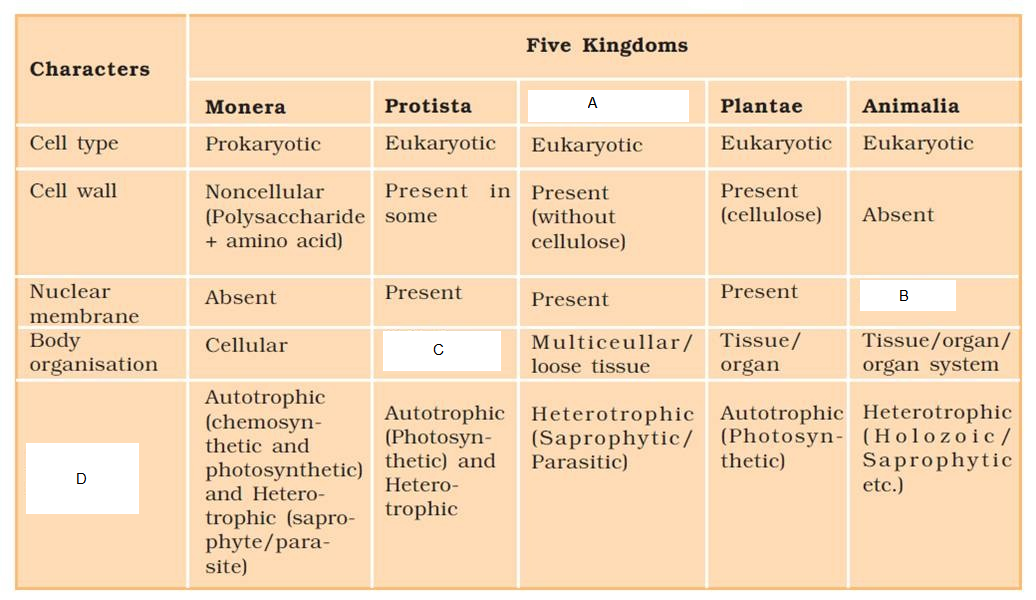
Observe the above Five kingdom table and answer Q5 to Q9.
Q5. Identify the \(A , B , C\) and \(D\).
Answer: A-Fungi, B-Present, C-Cellular, D-Mode of nutrition
Q6. How many kingdoms include producers and name these kingdoms?
Answer: Three; Monera, Protista, Plantae
Q7. In which kingdom unicellular, eukaryotic autotrophic organisms are placed?
Answer: Protista
Q8. In how many kingdom cellulosic cell walled organisms are present?
Answer: Two-Protista, Plantae
Q9. From above table, how many characters are uncommon between fungi and plantae?
Answer: Cell wall, Mode of Nutrition, Body organisation
Q10. On the basis of shape, how many groups of bacteria are formed and what are their names?
Answer: Four Coccus, Bacillus, Vibrium, Spirillum
Q11. The criteria for classification are changing over time. Why?
Answer: Because the improvement in our understanding of characters.
Q12. All \(A\) organisms are grouped under kingdom Monera and unicellular eukaryotes are placed in kingdom \(B\).
Answer: A-Prokaryotic, B-Protista
Q13. Chlamydomonas and Amoeba are classified in kingdom protista according to Whittaker’s classification system but by earlier classification system both these organisms are classified in different kingdoms. (True/False)
Answer: True
Q14. Identify the following figures (A, B, C and D)
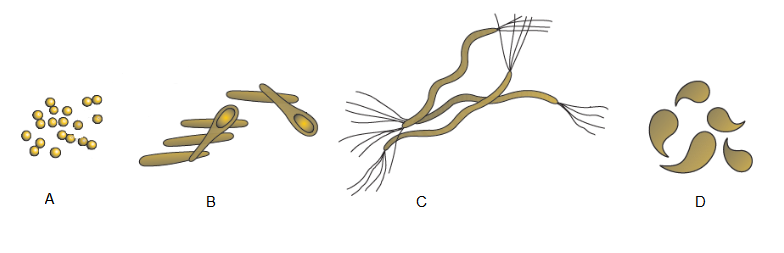
Answer: A-Cocci, B-Bacilli, C-Spirillia, D-Vibrio
Q15. Identify the following figure with structure A and B and write their functions:
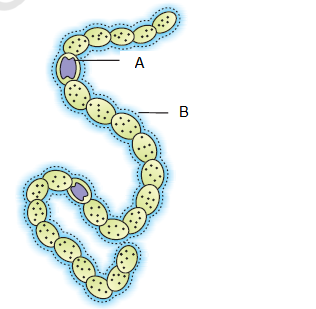
Answer: A-Nostoc, Heterocyst, Function – Nitrogen fixation; B-Mucilagenous sheath, Function-Protection from drying
Q16. The bacterial structure is very \(A\), they are very complex in \(B\).
Answer: A-Simple, B-Behaviour
Q17. The vast majority of bacteria are heterotrophs. (True/False)
Answer: True
Q18. Read the following statements :
(A) Found in the gut of ruminants
(B) Complex cell wall structure
(C) Survive in marshy habitats
Above statements are related to which of the Archaebacteria
Answer: Methanogens
Q19. Compared to many other organisms, which group show the most extensive metabolic diversity?
Answer: Bacteria
Q20. Which organism are the smallest living cells known and can survive without oxygen?
Answer: Mycoplasma
Q21. Cholera, Typhoid, Tetanus, Citrus canker are well known diseases caused by:
Answer: Bacteria
Q22. In which kingdom, Chrysophytes, Dinoflagellates, Euglenoids, Slime moulds and Protozoans are included?
Answer: Protista
Q23. Chrysophytes which are the chief producers in the ocean?
Answer: Diatoms
Q24. Identify the below process in bacteria and identify part \(A , B \& C\):
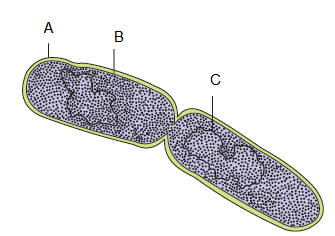
Answer: Process : Binary Fission
A-Cell wall, B-Cell membrane, C-DNA
Q25. Identify the below organism :
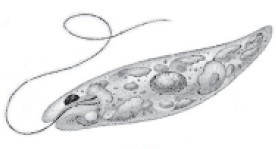
Answer: Euglena
Q26. Which protist possesses two flagella one lies longitudinal and other transversely?
Answer: Dinoflagellates
Q27. Read the following points regarding protista :
(A) Saprophytic nature
(B) Spores with true wall
(C) Wall less vegetative phase
Above organism should be :
Answer: Slime moulds
Q28. Euglenoids have a protein rich layer called _____ which makes their body flexible.
Answer: Pellicle
Q29. ____ are primitive relative of animals.
Answer: Protozoans
Q30. Which organism are used to make bread and beer?
Answer: Yeast
Q31. Some hyphae are continuous tubes filled with multinucleated cytoplasm, these are called:
Answer: Coenocytic hyphae
Q32. The cell walls of fungi are composed of
Answer: Chitin and Polysaccharides
Q33. Fungi prefer to grow :
Answer: Warm & Humid places
Q34. Write the name of three steps of sexual reproduction in fungi :
Answer: 1-Plasmogamy, 2-Karyogamy, 3-Meiosis
Q35. Identify the following figure :
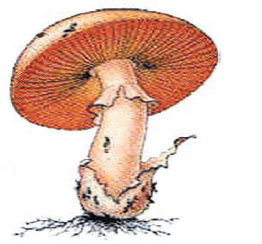
Answer: Agaricus
Q36. By which basis kingdom-Fungi is divided into various classes?
Answer: Morphology of mycelium Mode of spore formation and fruiting bodies
Q37. Identify the \(A , B\) and \(C\) in the given line diagram :
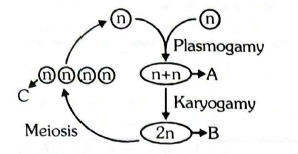
Answer: A-Dikaryon, B-Synkaryon, C-Spores
Q38. Members of which fungal class are found in aquatic habitats and on decaying wood in moist and damp places or as obligate parasites.
Answer: Phycomycetes
Q39. Which fungus is used extensively in bio-chemical & genetic works?
Answer: Neurospora
Q40. The basidiospores are A produced on the B.
Answer: A-exogenously, B-Basidium
Q41. Identify the A, B and C in the following table:
\(
\begin{array}{|c|c|c|}
\hline \text { Class } & \text { Member } & \text { Disease } \\
\hline \text { Ascomycetes } & \text { A } & \text { Ergot } \\
\hline \text { Basidiomycetes } & \text { Puccinia } & B \\
\hline \text { C } & \text { Alternaria } & \text { Blight } \\
\hline
\end{array}
\)
Answer: A-Claviceps, B-Rust, C-Deuteromycetes
Q42. Mushroom, Bracket fungi & smut fungi belong to which fungal class?
Answer: Basidiomycetes
Q43. Most of the members of fungal class _______ are decomposers of litter and help in mineral cycling.
Answer: Deuteromycetes
Q44. Life cycle of plants has two distinct phases – the diploid A and the B gametophyte.
Answer: A-Sporophyte, B-Haploid
Q45. All of us have suffered the ill effects of common cold or ‘flu’. It is caused by
Answer: Viruses
Q46. Which kingdom is characterized by heterotrophic, eukaryotic organisms that are multicellular and their cells lack cell wall?
Answer: Kingdom-Animalia
Q47. Bladderwort and venus fly trap are example of A plant and Cuscuta is a B plant.
Answer: A-Insectivorous, B-Parasitic
Q48. Identify the following figure with \(A , B , C\) and \(D\) :
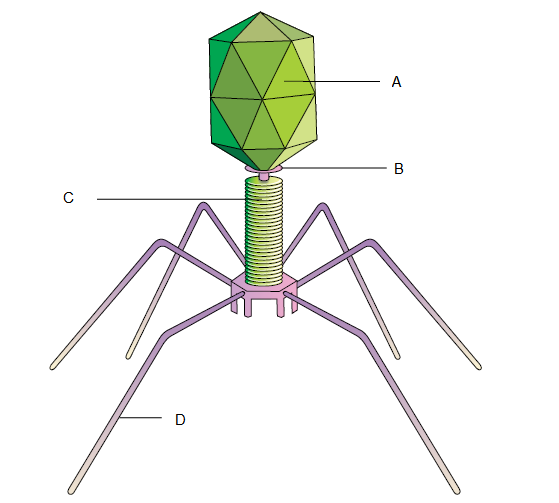
Answer: Bacteriophage, A-Head, B-Collar, C-Sheath, D-Tail fibres
Q49. Who called contagium vivum fluidum and what does it stand for?
Answer: M.W. Beijerinck, Infectious living fluid
Q50. Read the following symptoms :
- Mosaic formation
- Leaf rolling and curling
- Yellowing and vein clearing
- Dwarfing
Above symptoms are due to infection of
Answer: Viruses
Q51. Identify the following figure and \(A \& B\) :
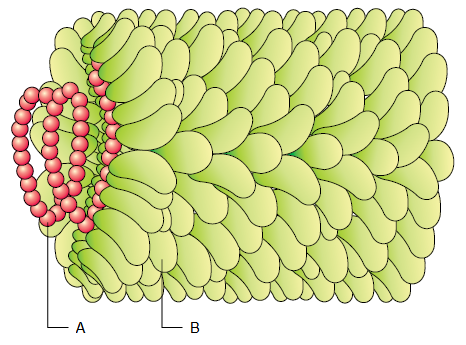
Answer: Tobacco mosaic virus (TMV), A-RNA, B-Capsid
Q52. Who said that viruses are smaller than bacteria?
Answer: D.J. lvanowsky
Q53. In lichens, the algal component is known as A and the fungal component as B.
Answer: A-Phycobiont, B-Mycobiont
Q54. Identify the infectious agent on the basis of given informations :
- Discoverer T.O. Diener
- Smaller than viruses
- Low molecular weight RNA
- Absence of protein coat
Answer: Viroids
Q55. The causative agent of potato spindle tuber disease is composed of
Answer: Only RNA
Q56. Identify the group of organisms, on the basis of given informations :
- Show symbiotic association
- Very.good pollution indicator
- Pioneer to barren rocks
Answer: Lichen
Q57. In lichens, \(A\) prepare food for \(B\) and fungi provide shelter and absorb \(C\) for its partner.
Answer: A-Algae, B-Fungi, C -Water and mineral