2.3 Measurement of length
Measurement of Length
You are already familiar with some direct methods for the measurement of length. For example, a metre scale is used for lengths from \(10^{-3} \mathrm{~m}\) to \(10^{2}\) m. A vernier callipers is used for lengths to an accuracy of \(10^{-4} \mathrm{~m}\). A screw gauge and a spherometer can be used to measure lengths as less as to \(10^{-5} \mathrm{~m}\). To measure lengths beyond these ranges, we make use of some special indirect methods.
Large distances such as the distance of a planet or a star from the earth cannot be measured directly with a metre scale. An important method in such cases is the parallax method.
To measure the distance \(D\) of a faraway planet \(S\) by the parallax method, we observe it from two different positions (observatories) A and \(\mathrm{B}\) on the Earth, separated by distance \(\mathrm{AB}=b\) at the same time as shown in Fig. 2.2. We measure the angle between the two directions along which the planet is viewed at these two points. The \(\angle\) ASB in Fig. 2.2 represented by the symbol \(\theta\) is called the parallax angle or parallactic angle.
As the planet is very far away, \(\frac{b}{D}<<1\), and therefore, \(\theta\) is very small. Then we approximately take \(\mathrm{AB}\) as an arc of length \(b\) of \(\mathrm{a}\) circle with centre at \(\mathrm{S}\) and the distance \(D\) as the radius \(\mathrm{AS}=\mathrm{BS}\) so that \(\mathrm{AB}=b=D \theta\) where \(\theta\) is in radians.
\(D=\frac{b}{\theta}\)
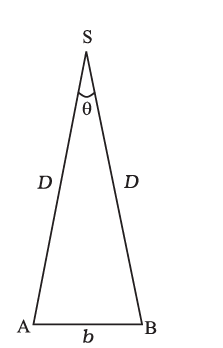
Figure 2.2 Parallax method
Having determined \(D\), we can employ a similar method to determine the size or angular diameter of the planet. If \(d\) is the diameter of the planet and \(\alpha\) the angular size of the planet (the angle subtended by \(d\) at the earth),we have \(\alpha=d / D\)
The angle \(\alpha\) can be measured from the same location on the earth. It is the angle between the two directions when two diametrically opposite points of the planet are viewed through the telescope. Since \(D\) is known, the diameter \(d\) of the planet can be determined using the equation \(\alpha=d / D\).
Example 2.1: A man wishes to estimate the distance of a nearby tower from him. He stands at a point A in front of the tower \(\mathrm{C}\) and spots a very distant object \(\mathrm{O}\) in line with AC. He then walks perpendicular to \(\mathrm{AC}\) up to \(\mathrm{B}\), a distance of \(100 \mathrm{~m}\), and looks at \(\mathrm{O}\) and \(\mathrm{C}\) again. Since \(\mathrm{O}\) is very distant, the direction \(\mathrm{BO}\) is practically the same as AO; but he finds the line of sight of C shifted from the original line of sight by an angle \(\theta\) \(=40^{\circ} \quad(\theta\) is known as ‘parallax’) estimate the distance of the tower \(\mathrm{C}\) from his original position A.
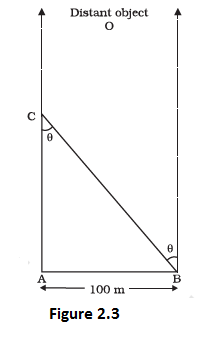
Answer: We have, parallax angle \(\theta=40^{\circ}\); From Fig. 2.3, AB \(=\mathrm{AC} \tan \theta\)
\(\mathrm{AC}=\mathrm{AB} / \tan \theta=100 \mathrm{~m} / \tan 40^{\circ}\)
\(=100 \mathrm{~m} / 0.8391=119 \mathrm{~m}\)
Example 2.2: The moon is observed from two diametrically opposite points A and B on Earth. The angle \(\theta\) subtended at the moon by the two directions of observation is \(1^{\circ} 54^{\prime}\). Given the diameter of the Earth to be about \(1.276 \times 10^{7} \mathrm{~m}\), compute the distance of the moon from the Earth.
Answer: We have \(\theta=1^{\circ} 54^{\prime}=114^{\prime}\)
\(=(114 \times 60)^{\prime \prime} \times\left(4.85 \times 10^{-6}\right)\) rad
\(
=3.32 \times 10^{-2} \text { rad, }
\)
since \(1^{\prime \prime}=4.85 \times 10^{-6}\) rad.
Also \(b=A B=1.276 \times 10^{7} \mathrm{~m}\)
Hence, from the following equation, we can calculate the Earth-Moon
distance, \(\quad D=b / \theta\)
\(
=\frac{1.276 \times 10^{7}}{3.32 \times 10^{-2}}=3.84 \times 10^{8} \mathrm{~m}
\)
Example 2.3:The Sun’s angular diameter is measured to be \(1920^{\prime \prime}\). The distance \(D\) of the Sun from the Earth is \(1.496 \times 10^{11} \mathrm{~m}\). What is the diameter of the Sun?
Answer: Sun’s angular diameter \(\alpha\)
\(
\begin{aligned}
&=1920^{\prime \prime} \\
&=1920 \times 4.85 \times 10^{-6} \mathrm{rad} \\
&=9.31 \times 10^{-3} \mathrm{rad}
\end{aligned}
\)
Sun’s diameter
\(
\begin{aligned}
d &=\alpha D \\
&=\left(9.31 \times 10^{-3}\right) \times\left(1.496 \times 10^{11}\right) \mathrm{m} \\
&=1.39 \times 10^{9} \mathrm{~m}
\end{aligned}
\)
Range of Lengths:
The sizes of the objects we come across in the universe vary over a very wide range. These may vary from the size of the order of \(10^{-14} \mathrm{~m}\) of the tiny nucleus of an atom to the size of the order of \(10^{26} \mathrm{~m}\) of the extent of the observable universe. Table \(2.2\) gives the range and order of lengths and sizes of some of these objects.
Table 2.3: Range and order of lengths
\(\begin{array}{|l|l|}\hline \text { Size of object or distance } & \text { Length (m) } \\
\hline \text { Size of a proton } & 10^{-15} \\
\hline \text { Size of atomic nucleus } & 10^{-14} \\
\hline \text { Size of hydrogen atom } & 10^{-10} \\
\hline \text { Length of typical virus } & 10^{-8} \\
\text { Wavelength of light } & 10^{-7} \\
\text { Size of red blood corpuscle } & 10^{-5} \\
\hline \text { Thickness of a paper } & 10^{-4} \\
\hline \text { Height of the Mount Everest above sea level } & 10^{4} \\
\hline \text { Radius of the Earth } & 10^{7} \\
\hline \text { Distance of moon from the Earth } & 10^{8} \\
\hline \text { Distance of the Sun from the Earth } & 10^{11} \\
\hline \text { Distance of Pluto from the Sun } & 10^{13} \\
\hline \text { Size of our galaxy } & 10^{21} \\
\hline \text { Distance to Andromeda galaxy } & 10^{23} \\
\hline \text { Distance to the boundary of observable universe } & 10^{26} \\
\hline
\end{array}\)
Vernier callipers
A vernier calliper is defined as a measuring device that is used for the measurement of linear dimensions. It is also used for the measurement of diameters of round objects with the help of the measuring jaws.
Actual Reading = Main Scale + Vernier Scale
Vernier Calliper Diagram
Vernier Calliper is a precision measuring instrument used to measure the internal and external dimensions of an object. It consists of two main parts:
- A Fixed Jaw
- A Movable Jaw
The fixed jaw is used to measure the outside of an object, while the movable jaw is used to measure the inside of an object. This is a device that is used to measure very smaller values and it can measure the value in the range of 0.1 mm. The image added below shows a vernier calliper.
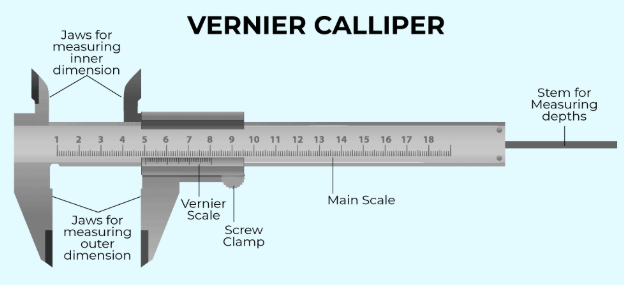
The main parts of a vernier Calliper are:
Main Scale: The main scale is a graduated scale that is used to measure the overall length of an object.
Vernier Scale: The vernier scale is a second scale that is used to measure small increments of length.
Least Count: The least count of vernier Calliper is the smallest measurement that can be made with the instrument. It is calculated by dividing the smallest division on the main scale by the number of divisions on the vernier scale. The mathematical formula for the Least Count of Vernier Calliper is,
Least count \(=1 \mathrm{~MSD}-1 \mathrm{~VSD}\)
(MSD \(\rightarrow\) main scale division
VSD \(\rightarrow\) Vernier scale division)
Least count=VC \(=1 \mathrm{~MSD}-1 \mathrm{~VSD}\)
(MSD \(\rightarrow\) main scale division
VSD \(\rightarrow\) Vernier scale division)
Where,
\(VC\) is Vernier Constant
\(MSD\) is Main Scale Division
\(VSD\) is Vernier Scale Division
\(LC\) is Least Count
If there are \(n\) divisions on the Vernier Scale then if they coincide with ( \(n-1\) ) division on the main scale, now the least count of the Vernier Scale is,
\(
L C=(1-\{n-1\} / n) M S D
\)
For example, A vernier scale has 10 parts, which are equal to 9 parts of the main scale, having each path equal to 1
\(
\begin{aligned}
& \mathrm{mm} \text { then least count }=1 \mathrm{~mm}-\frac{9}{10} \mathrm{~mm}=0.1 \mathrm{~mm} \\
& {[\because 9 \mathrm{~MSD}=10 \mathrm{~VSD}]}
\end{aligned}
\)
Zero Error in Vernier Callipers
Zero error in vernier Callipers is the error that occurs when the jaws of the Calliper are closed and the zero mark on the vernier scale does not coincide with the zero mark on the main scale. Zero error can be either positive or negative. Positive zero error means that the vernier scale is ahead of the main scale, while negative zero error means that the vernier scale is behind the main scale.
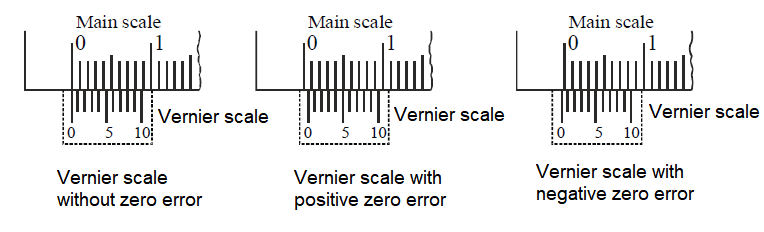
The zero error is always subtracted from the reading to get the corrected value. If the zero error is positive, its value is calculated as we take any normal reading.
Positive zero error =[ vsd coinciding ]\( \times\) L.C.
Negative zero error =-[ Total no. of vsd – vsd coinciding ]\( \times\) L.C.
To get correct measurement with vernier callipers having a zero error, the zero error with its proper sign is always subtracted from the observed reading.
Actual reading = Observed reading – zero error (with sign)
Example 2.4: In the diagram shown below, calculate the zero error.
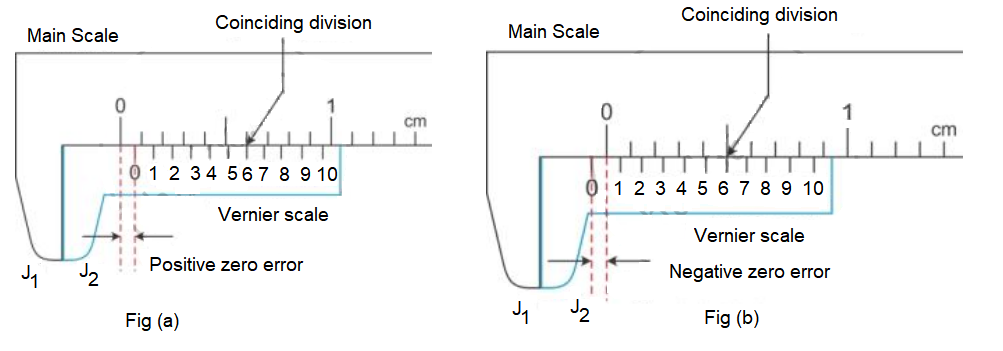
Answer:To find this error, we note the division of the vernier scale, which coincides with any division of the main scale. The number of this vernier division when multiplied by the least count of the vernier callipers, gives the zero error. In Fig. (a), the zero error is positive (on bringing the two jaws together, if the zero mark of the vernier scale is on the right of the zero mark of the main scale, the error is said to be positive).
For example, for the scales shown, the least count is 0.01 cm and the \(6^{\text {th }}\) division of the vernier scale coincides with a main scale division.
Zero error \(=+6 \times\) L.C. \(=+6 \times 0.01 \mathrm{~cm}=+0.06 \mathrm{~cm}\)
In Fig. (b) zero error is negative (on bringing the two jaws together, if the zero mark of the vernier scale is on the left of the zero mark of the main scale, then the error is said to be negative).To find this error, we note the division of the vernier scale coinciding with any division of the main scale. The number of this vernier division is subtracted from the total number of divisions on the vernier scale and then the difference is multiplied by the least count.
For example, for the scales shown, the least count is 0.01 cm and the sixth division of the vernier scale coincides with a certain division of the main scale. The total number of divisions on vernier callipers is 10.
Zero error \(=-(10-6) \times\) L.C.
\(
=-4 \times 0.01 \mathrm{~cm}=-0.04 \mathrm{~cm}
\)
Screw Gauge
For the precise measurement of a spherical or a cylindrical object, a screw gauge is the best instrument.
Screw Gauge Measurement Using the Micrometer
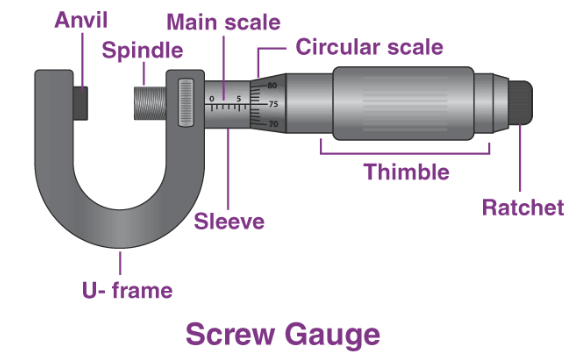
Screw Gauge Formula
There are two parameters used in every screw gauge. They are the pitch and the least count of a screw gauge.
Pitch:
The pitch of the screw gauge is defined as the distance moved by the spindle per revolution which is measured by moving the head scale over the pitch scale in order to complete one full rotation.
Pitch of the screw gauge = (distance moved by a screw) /(no. of rotations given)
Least count:
The least count of the screw is defined as the distance moved by the tip of the screw when turned through one division of the head scale.
\(
\begin{aligned}
& \text { Least count (LC) of the screw gauge }=(\text { pitch }) /(\text { total no.of divisions on the circular } \\
& \text { scale })
\end{aligned}
\)
Least count of micrometer screw gauge \(=(1 \mathrm{~mm}) /(100)=0.01 \mathrm{~mm}\)
Micrometer screw gauge is defined as an instrument that is used for measuring the diameter of thin wires, the thickness of small sheets such as glass or plastics.
Screw Gauge Zero Error
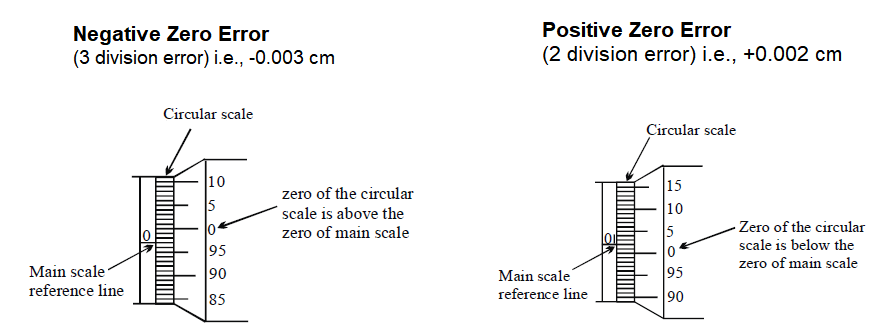
If there is no object between the jaws (i.e., jaws are in contact), the screwgauge should give zero reading. But due to extra material on jaws, even if there is no object, it gives some excess reading. This excess reading is called Zero error. Error cane be postive or negative.
Example 2.5: A Vernier Calliper with no zero error is used to measure the diameter of a cylinder. The zero of the Vernier scale is observed between 4.20 cm and 4.25 cm on the main scale. The Vernier scale consists of 50 divisions, which are equivalent to 2.45 cm. The 11th division on the Vernier scale coincides exactly with one of the divisions on the main scale. What is the diameter of the cylinder?
Answer: Smallest division on the main scale \(=0.05 \mathrm{~cm}(4.25-4.20)\)
Main scale reading \(=4.20 \mathrm{~cm}\),
Vernier coincidence \(=24\)
Least Count \(=0.05-2.45 / 50=0.001 \mathrm{~cm}\).
Diameter \(=\) Main Scale Reading \(+(\) Vernier Coincidence \(\times\) Least Count \()\)
Diameter \(=4.20+11 \times 0.001\)
Diameter \(=4.211 \mathrm{~cm}\)
Thus, the diameter of the cylinder is 4.211 cm.
Example 2.6: A Vernier Calliper is used to measure the diameter of a cylinder. The main scale of the Calliper is calibrated in millimeters, and it is observed that 15 divisions on the main scale are equal in length to 20 divisions on the Vernier scale. When measuring the diameter, the main scale reading is 45 divisions, and the 8th division on the Vernier scale coincides with a division on the main scale. Find the least count of the vernier Calliper and the radius of the cylinder.
Answer: Determine the Least Count:
MSD (Main Scale Division) \(=0.1 \mathrm{~cm}\)
20 VSD (Vernier Scale Division) \(=15\) MSD
Therefore,
VSD \(=(19 / 20)\) MSD \(=(15 / 20) \times 0.1 \mathrm{~cm}=0.075 \mathrm{~cm}\)
Least Count \(=\) MSD – VSD
Least Count \(=0.1 \mathrm{~cm}-0.075 \mathrm{~cm}\)
Least Count \(=0.025 \mathrm{~cm}\)
Thus, the least count of the vernier Calliper is 0.025 cm.
Find the Radius:
Main Scale Reading \(=45 \mathrm{~mm}=4.5 \mathrm{~cm}\)
Diameter \(=\) Main scale reading \(+(\) vernier coincidence \(\times\) least count \()\)
Diameter \(=4.5 \mathrm{~cm}+(8 \times 0.025 \mathrm{~cm})\)
Diameter \(=4.5 \mathrm{~cm}+0.2 \mathrm{~cm}\)
Diameter \(=4.7 \mathrm{~cm}\)
Radius \(=\) Diameter \(/ 2=4.7 / 2=2.35 \mathrm{~cm}\)
Thus, the radius of cylinder is 2.35 cm.