3.9 Electrical Energy, Power
What Is Electrical Energy?
Electrical energy is the energy derived from the electric potential energy or kinetic energy of the charged particles. In general, it is referred to as the energy that has been converted from electric potential energy. We can define electrical energy as the energy generated by the movement of electrons from one point to another.
A cell has two terminals – a negative and a positive terminal. The negative terminal has the excess of electrons whereas the positive terminal has a deficiency of electrons. Let us take the positive terminal as \(A\) and the electrical potential at \(A\) is given by \(V ( A )\). Similarly, the negative terminal is \(B\) and the electrical potential at \(B\) is given by \(V ( B )\). Electric current flows from \(A\) to \(B\) , and thus \(V ( A )> V ( B )\).
The potential difference between \(A\) and \(B\) is given by
\(
V = V ( A )- V ( B )>0
\)
Mathematically, electric current is defined as the rate of flow of charge through the cross-section of a conductor. If the two charges have opposite signs, then the potential energy is negative. This means that the potential energy decreases when the two charges move closer together (the potential energy will get more negative). A negative potential energy means that work must be done against the electric field in moving the charges apart.
In a time interval \(\Delta t\), an amount of charge \(\Delta Q=I \Delta t\) travels from \(A\) to \(B\). The potential energy of the charge at \(A\), by definition, was \(Q V(A)\) and similarly at \(B\), it is \(Q V(B)\). Thus, change in its potential energy \(\Delta U_{\text {pot }}\) is
\(
\begin{aligned}
& =\Delta Q[(V(B)-V(A)]=-\Delta Q V \\
& =-I V \Delta t<0
\end{aligned}
\)
If we take the kinetic energy of the system into account, it would also change if the charges inside the conductor moved without collision. This is to keep the total energy of the system unchanged. Thus, by conservation of total energy, we have:
\(
\Delta K=-\Delta \text { Upot }
\)
Or \(\Delta K=I V \Delta t>0\)
Thus, in case charges were moving freely through the conductor under the action of the electric field, their kinetic energy would increase as they move.
Thus, in case charges were moving freely through the conductor under the action of the electric field, their kinetic energy would increase as they move.
We have, however, seen earlier that on average, charge carriers do not move with acceleration but with a steady drift velocity. This is because of the collisions with ions and atoms during transit. During collisions, the energy gained by the charges thus is shared with the atoms. The atoms vibrate more vigorously, i.e., the conductor heats up. Thus, in an actual conductor, an amount of energy dissipated as heat in the conductor during the time interval \(\Delta t\) is,
\(
\Delta W=I V \Delta t
\)
The energy dissipated per unit time is the power dissipated \(P=\Delta W / \Delta t\) and we have,
\(P=I V\)
Electrical Power
What is Electrical Power?
Every electrical equipment or device that we use has specific power ratings mentioned on it. It means it consumes that specific rated power & converts that electrical power to good use. Such as a cellphone, utilizes the power from the battery, to power its display unit (converting it into light), speakers (for audio generation) & its processors (for logical operations), etc. Same as machines that consume electrical power & generate mechanical power & heaters generate heat energy.
Definition: Generally, the definition of power is the rate of energy transferred or the energy transferred in a unit time. So according to the definition, the electrical power is the rate of flow of electrical energy or the work done on electrical charges in an electrical circuit.
Energy liberated per second in a device is called its power. The electrical power \(P\) delivered or consumed by an electrical device is given by \(P = VI\), where \(V =\) Potential difference across the device and \(I =\text { Current. }\)
If the current enters the higher potential point of the device then electric power is consumed by it (i.e. acts as load). If the current enters the lower potential point then the device supplies power (i.e. acts as a source).

Mathematically, if \(W\) joules is the amount of work done in an electric circuit in a time of \(t\) seconds. Then, the electric power in the circuit is given by,
Power is the rate at which that work is done.
\(
P=\frac{W}{t}
\)
In differential form, instantaneous power
\(
p(t)=\frac{ d w(t)}{ d t}=\vec F \cdot \frac{d \vec s }{d t}= \vec F \cdot \vec v
\)
For electrical energy to move electrons and produce a flow of current around a circuit, work must be done, that is the electrons must move by some distance through a wire or conductor. The work done is stored in the flow of electrons as energy. Thus “Work” is the name we give to the process of energy.
Energy \(=\int p d t\)
Power consumed by a resistor (resistor is a passive circuit element that dissipates energy)
\(
P = VI =I ^2 R =\frac{ V ^2}{ R } \text { using Ohm’s law }
\)
When a current is passed through a resistor energy is wasted in overcoming the resistance of the wire. This energy is converted into heat.
\(
W = VIt = I ^2 Rt =\frac{ V ^2}{ R } t
\)
Electrical Heating
Cause of Heating
The potential difference applied across the two ends of a conductor sets up an electric field. Under the effect of the electric field, electrons accelerate and as they move, they collide against the ions and atoms in the conductor, the energy of electrons transferred to the atoms and ions appears as heat.

Joules’s Law of Heating
When a current \(I\) is made to flow through an ohmic resistance \(R\) for time \(t\), heat \(H\) is produced such that
\(
H = I ^2 R t= P \times t = VIt =\frac{ V ^2}{ R } t \text { Joule }=\frac{I^2 Rt }{4.2} \text { Calorie }
\)
The heat produced in a conductor does not depend upon the direction of the current.
\(
\begin{array}{ll}
\text { SI unit : joule } ; & \text { Practical Units : } 1 \text { kilowatt hour }( kWh ) \\
1 kWh =3.6 \times 10^6 \text { joules }=1 \text { unit }; & 1 \text { BTU (British Thermal Unit })=1055 J
\end{array}
\)
Example 24: If the bulb rating is 100 watt and 220 V then determine
(a) Resistance of filament
(b) Current through filament
(c) If the bulb operates at 110 volt power supply then find the power consumed by the bulb.
Solution: The bulb rating is 100 W and 220 V bulb means when 220 V potential difference is applied between the two ends then the power consumed is 100 W
Here
\(
\begin{aligned}
& V =220 Volt \\
& P =100 W \\
& \frac{V^2}{R}=100
\end{aligned}
\)
So, \(R=484 \Omega\)
Since Resistance depends only on material hence it is constant for bulb
\(
I =\frac{V}{R}=\frac{220}{22 \times 22}=\frac{5}{11} Amp .
\)
power consumed at 110 V
\(
\therefore \text { power consumed }=\frac{110 \times 110}{484}=25 W
\)
Example 25: Estimate the cost of cooking a turkey for 4 h in an oven that operates continuously at 20.0 A and 240 V (estimated price of \(8.00\) cent per kilowatt hour).
Solution: The power used by the oven is
\(
P =I V=(20.0 A)(240 V)=4800 W=4.80 kW
\)
Because the energy consumed equals power \(\times\) time, the amount of energy for which you must pay is
\(
\text { Energy }= P t=(4.80 kW)(4 h)=19.2 kWh
\)
If the energy is purchased at an estimated price of \(8.00\) cents per kilowatt hour, the cost is
\(
\text { Cost }=(19.2 kWh )(0.080 / kWh )=$1.54
\)
Example 26: A light bulb is connected to a battery in a series circuit. Explain the change in brightness of the light bulb if an identical light bulb is added to the circuit in series.
Solution: Adding an identical light bulb in series doubles the total resistance of the circuit. This halves the current flowing through the light bulbs \((V=I R)\). It also causes each light bulb to receive half as much energy from the battery; the voltage across each light bulb is halved.
Since electrical power is given by:
\(
\begin{gathered}
P=V I \\
P_{\text {new }}=\left(\frac{V}{2}\right)\left(\frac{I}{2}\right)=\frac{P}{4}
\end{gathered}
\)
The power dissipated in each light bulb is reduced by a factor of 4. So brightness gets reduced (as you add more series resistor in a series circuit the resistance increases, current decreases, and voltage also decreases across each resistor, so brightness gets reduced).
Power consumption in a combination of bulbs
Series combination of bulbs:
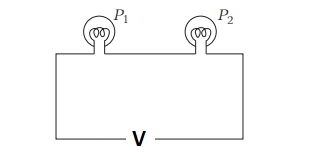
When bulbs with rated powers \(P_1, P_2, \ldots, P_n\) (at the same rated voltage \(V\)) are connected in series across that same voltage \(V\), the equivalent power \(P_{\text {eq }}\) is:
\(
\frac{1}{P_{\mathrm{eq}}}=\frac{1}{P_1}+\frac{1}{P_2}+\cdots+\frac{1}{P_n}
\)
Brightness: The bulb with the lowest power rating (highest resistance) will glow the brightest.
Total Power: \(P_{\text {eq }}\) is always less than the power of the smallest individual bulb.
Proof: A bulb is essentially a resistor. Its “rated power” (\(P\)) is the power it consumes when connected to its “rated voltage” (\(V\)). We use the standard power formula:
\(
P=\frac{V^2}{R} \Longrightarrow R=\frac{V^2}{P}
\)
When we connect bulbs in series, the total resistance (\(R_{\text {eq }}\)) is the sum of individual resistances:
\(
R_{\mathrm{eq}}=R_1+R_2+R_3+\ldots
\)
Express individual resistances:
For each bulb \(i\), the resistance is \(R_i=\frac{V^2}{P_i}\).
Substitute into the series resistance formula:
\(
R_{\mathrm{eq}}=\frac{V^2}{P_1}+\frac{V^2}{P_2}+\frac{V^2}{P_3}+\ldots
\)
Relate total resistance to total power:
If the entire combination is connected to the same voltage \(V\), the total power consumed (\(\left.P_{\text {eq }}\right)\) is defined by \(P_{\text {eq }}=\frac{V^2}{R_{\text {eq }}}\), which means:
\(
R_{\mathrm{eq}}=\frac{V^2}{P_{\mathrm{eq}}}
\)
Equate the expressions:
Substitute the expression from step 3 into the equation from step 2:
\(
\frac{V^2}{P_{\mathrm{eq}}}=\frac{V^2}{P_1}+\frac{V^2}{P_2}+\frac{V^2}{P_3}+\ldots
\)
Simplify:
Divide the entire equation by \(V^2\) :
\(
\frac{1}{P_{\mathrm{eq}}}=\frac{1}{P_1}+\frac{1}{P_2}+\frac{1}{P_3}+\ldots
\)
Why does this matter?
Because the total resistance increases in a series circuit, the total current \(I\) drops. Since \(P= I^2 R\), and the current is shared and squared, the total power output is significantly lower than if the bulbs were used individually.
Parallel combination of bulbs
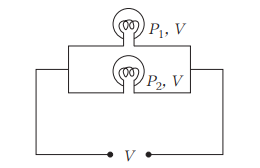
Total power consumed is given by
\(
P_{\text {total }}=P_1+P_2+\ldots .
\)
Proof: In a parallel circuit, the voltage (\(V\)) across each bulb is the same and equal to the supply voltage.
The resistance (\(R\)) of a bulb with a rated power (\(P\)) at voltage (\(V\)) is:
\(
R=\frac{V^2}{P}
\)
For a parallel combination, the equivalent resistance (\(R_{\text {eq }}\)) is given by:
\(
\frac{1}{R_{\mathrm{eq}}}=\frac{1}{R_1}+\frac{1}{R_2}+\frac{1}{R_3}+\ldots
\)
The Derivation Steps
Express the reciprocal of individual resistances:
Using \(R=\frac{V^2}{P}\), the reciprocal is:
\(
\frac{1}{R_i}=\frac{P_i}{V^2}
\)
Substitute into the parallel resistance formula:
Replace each \(\frac{1}{R}\) term with its power equivalent:
\(
\frac{1}{R_{\mathrm{eq}}}=\frac{P_1}{V^2}+\frac{P_2}{V^2}+\frac{P_3}{V^2}+\ldots
\)
Relate total resistance to total power:
The total power consumed by the entire circuit ( \(P_{\text {total }}\) ) is also defined by the voltage and equivalent resistance:
\(
P_{\text {total }}=\frac{V^2}{R_{\text {eq }}} \Longrightarrow \frac{1}{R_{\text {eq }}}=\frac{P_{\text {total }}}{V^2}
\)
Equate the expressions:
\(
\frac{P_{\text {total }}}{V^2}=\frac{P_1}{V^2}+\frac{P_2}{V^2}+\frac{P_3}{V^2}+\ldots
\)
Simplify:
Multiply the entire equation by \(V^2\) :
\(
P_{\text {total }}=P_1+P_2+P_3+\ldots
\)
Summary of Logic
In a parallel circuit, each bulb acts as an independent path for current. Adding more bulbs doesn’t split the voltage; it simply adds more paths for energy to flow. Therefore, the total power is simply the sum of the power consumed by each individual branch. This is why, in your home, turning on a second 60 W bulb results in 120 W of total consumption —the power adds up directly.
Example 27: Two bulbs having rating of \(60 W-220 V\) and \(100 W-220 V\) are joined (i) in series and (ii) in parallel. Which of the two will glow brighter in each case?
Solution: To solve this, remember two things:
Brightness depends on the actual power (\(P_{\text {consumed }}\)) being used, not the number printed on the box.
Resistance (\(R\)) is a constant property of the bulb (assuming it’s ohmic).
Step 1: Find the Resistance of each bulb
Using the rated values (\(V=220 \mathrm{~V}\)):
For the 60 W bulb: \(R_1=\frac{V^2}{P_1}=\frac{220^2}{60} \approx 806.7 \Omega\)
For the 100 W bulb: \(R_2=\frac{V^2}{P_2}=\frac{220^2}{100}=484 \Omega\)
Key takeaway: The bulb with the lower wattage rating actually has higher resistance.
(i) Series Combination
In series, the current (\(I\)) is the same for both bulbs. We use the formula \(P=I^2 R\).
Since \(I\) is constant, \(P \propto R\).
Because \(R_1(60 \mathrm{~W})>R_2(100 \mathrm{~W})\), the 60 W bulb will consume more power.
Result: The 60 W bulb will glow brighter.
(ii) Parallel Combination
In parallel, the voltage \((V)\) is the same \((220 \mathrm{~V})\) for both bulbs. We use the formula \(P=\frac{V^2}{R}\).
Since \(V\) is constant, \(P \propto \frac{1}{R}\).
Because \(R_2(100 \mathrm{~W})\) is lower than \(R_1\), the 100 W bulb will consume more power (exactly its rated 100 W).
Result: The 100 W bulb will glow brighter.
Example 28: Two bulbs having rating of \(40 W-220 V\) and \(100 W-220 V\) are joined in series and alternately, (i) \(300 V\) and (ii) \(440 V\) is applied. Find out which bulb will fuse in each case.
Solution: We first have to find out the maximum current each bulb can bear. This can be calculated from rating of the bulb,
\(
P=V I \Rightarrow 40=220 I \Rightarrow I=\frac{40}{220}=0.18 \mathrm{~A}
\)
This is the maximum current 40 W bulb can bear.
Similarly, 100 W bulb can bear \(\frac{100}{220}=0.45 \mathrm{~A}\).
Now, find out the resistance of each bulb, \(R=\frac{V^2}{P}\)
\(
\text { ⇒ Resistance of } 40 \mathrm{~W} \text { bulb }=\frac{220}{40} \times 220=1210 \Omega
\)
Resistance of 100 W bulb \(=\frac{220 \times 220}{100}=484 \Omega\)
These are joined in series, so total resistance \(=1694 \Omega\)
(i) Current in each bulb when joined with 300 V
i.e. \(I=\frac{300}{1694}=0.177 \mathrm{~A}\)
This current will flow in each, so no bulb will fuse as it is less than their maximum permissible current.
(ii) When they are joined with 440 V in series then current will be \(=\frac{440}{1694}=0.26 \mathrm{~A}\).
This current is less than maximum permissible current of 100 W bulb but more than that of 40 W bulb. Hence, 40 W bulb will be fused and 100 W bulb will remain safe.
Example 29: In above example, if we join the bulbs in parallel and 300 V is applied, which of the two bulbs will fuse?
Solution: When they are joined in parallel and 300 V is applied on them, then both will get 300 V . Since, their rating is 220 V , naturally, current flowing through them will be more than maximum possible value. Hence, both will fuse out.
Example 30: Two coils of power \(60 W\) and \(100 W\) and both operating at \(220 V\) takes time 2 min and 1.5 min separately to boil certain amount of water. If they are joined (i) in series and (ii) in parallel, then find the ratio of time taken by them to boil the same water in the two cases.
Solution: When they are joined in series, then total power,
\(
P=\frac{P_1 P_2}{P_1+P_2}=\frac{60 \times 100}{160}=37.5 \mathrm{~W}
\)
When they are joined in parallel, then total power
\(
=60+100=160 \mathrm{~W}
\)
Time taken to boil the water will be inversely proportional to power, so ratio of time taken in the two cases will be 160 : 37.5.
Example 31: Figure shows three identical bulbs \(A, B\) and \(C\), which are connected to a battery of supply voltage \(V\). When the switch \(S\) is closed, then discuss the change in
(i) the illumination of the three bulbs.
(ii) the power dissipated in the circuit.
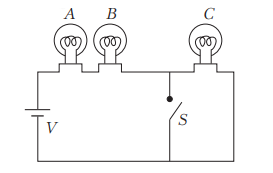
Solution: When the switch \(S\) is open, and
\(
\begin{aligned}
V_A & =V_B=V_C=V / 3 \\
P_A & =P_B=P_C \\
& =\frac{(V / 3)^2}{R}=\frac{V^2}{9 R}=P \text { (say) }
\end{aligned}
\)
(i) When the switch \(S\) is closed, then the bulb \(C\) is short circuited and hence there will be no current through \(C\). So, \(P_C=0\)
\(
V_A=V_B=\frac{V}{2}
\)
So, \(P_A=P_B=\frac{(V / 2)^2}{R}=\frac{V^2}{4 R}=\frac{9}{4} P\)
Therefore, the intensity of illumination of each of the bulb \(A\) and \(B\) become 9/4 times of the initial value but the intensity of the bulb \(C\) becomes zero.
(ii) The power dissipated in the circuit before closing the switch is
\(
P_i=P_A+P_B+P_C=3 P
\)
The power dissipated after closing the switch is
\(
\begin{aligned}
P_f & =P_A+P_B+P_C \\
& =\frac{9}{4} P+\frac{9}{4} P+0 \\
& =\frac{9}{2} P
\end{aligned}
\)