11.1 Introduction
In this Chapter, we shall study about curves, viz., circles, ellipses, parabolas and hyperbolas. The names parabola and hyperbola are given by Apollonius. These curves are in fact, known as conic sections or more commonly conics because they can be obtained as intersections of a plane with a double napped right circular cone. These curves have a very wide range of applications in fields such as planetary motion, design of telescopes and antennas, reflectors in flashlights and automobile headlights, etc.
Conic Section as a Locus of a Point
The locus of a point which moves in a plane such that the ratio of its distance from a fixed point to its perpendicular distance from a fixed straight line not passing through given fixed point is always constant, is known as a conic section or conic.
The fixed point is called the focus of the conic and fixed line is called the directrix of the conic.
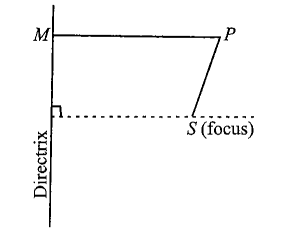
In Figure above \frac{S P}{P M}=[/latex] constant \(=e\) or \(S P=e P M\)
Also this constant ratio is called the eccentricity of the conic and is denoted by \(e\).
If \(e=1\), the conic is called parabola.
If \(e<1\), the conic is called ellipse.
If \(e>1\), the conic is called hyperbola.
If \(e=0\), the conic is called circle.
If \(e=\infty\), the conic is called pair of straight lines.
Equation of Conic Section
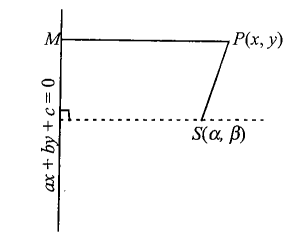
If the focus is \((\alpha, \beta)\) and the directrix is \(a x+b y+c=0\) then the equation of the conic section whose eccentricity \(=e\) is
\(
\begin{aligned}
\sqrt{(x-\alpha)^2+(y-\beta)^2} & =e \frac{|a x+b y+c|}{\sqrt{\left(a^2+b^2\right)}} \\
\text { or } \quad(x-\alpha)^2+(y-\beta)^2 & =e^2 \frac{(a x+b y+c)^2}{\left(a^2+b^2\right)}
\end{aligned}
\)
Important Terms
- Axis: The straight line passing through the focus and perpendicular to the directrix is called the axis of the conic section.
- Vertex: The points of intersection of the conic section and the axis is (are) called vertex (vertices) of the conic section.
- Focal chord: Any chord passing through the focus is called focal chord of the conic section.
- Double ordinate: A straight line that is drawn perpendicular to the axis and terminates at both ends of the curve is a double ordinate of the conic section.
- Latus rectum: The double ordinate passing through the focus is called the latus rectum of the conic section.
- Centre: The point that bisects every chord of the conic passing through it is called the centre of the conic section.
Note: Parabola has no centre, but circle, ellipse, hyperbola have centre.