10.8 JEE Entrance Corner
DIRECTION COSINES AND DIRECTION RATIOS
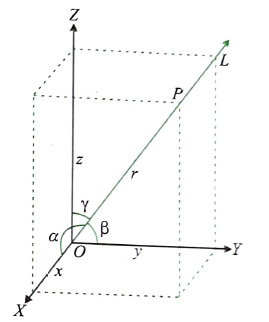
If a directed line \(L\), passing through the origin, makes angles \(\alpha, \beta\) and \(\gamma\) with the \(x\)-, \(y\) – and \(z\)-axes, respectively, called direction angles, then the cosines of these angles, namely, \(\cos \alpha, \cos \beta\) and \(\cos \gamma\), are called the direction cosines of the directed line \(L\).
If we reverse the direction of \(L\), the direction angles are replaced by their supplements, i.e., \(\pi-\alpha, \pi-\beta\) and \(\pi-\gamma\). Thus, the signs of the direction cosines are reversed.
Note that a given line in space can be extended in two opposite directions, and so it has two sets of direction cosines. In order to have a unique set of direction cosines for a given line in space, we must take the given line as a directed line. These unique direction cosines are denoted by \(l, m\) and \(n\).
If the given line in space does not pass through the origin, then in order to find its direction cosines, we draw a line through the origin and parallel to the given line. Now take one of the directed lines from the origin and find its direction cosines as two parallel lines have the same set of direction cosines.
Anythree numbers which are proportional to the direction cosines of a line are called the direction ratios of the line. If \(l, m\) and \(n\) are direction cosines and \(a, b\) and \(c\) are the direction ratios of a line, then \(a=\lambda l\), \(b=\lambda m\) and \(c=\lambda n\) for any non-zero \(\lambda \in R\).
Notes:
- Direction cosines of the \(x\)-axis are \((1,0,0)\).
Direction cosines of the \(y\)-axis are \((0,1,0)\).
Direction cosines of the \(z\)-axis are \((0,0,1)\). - Let \(O P\) be any line passing through the origin \(O\) which has direction cosines \(\cos \alpha \cos \beta\) and \(\cos \gamma\), i.e., \((l, m, n)\) where distance \(O P=r\), i.e., coordinates of \(P\) are ( \(r \cos \alpha, r \cos \beta, r \cos \gamma\) ).
- If \(l, m\) and \(n\) are the direction cosines of a vector, then \(l^2+m^2+n^2=1\).
- \(\vec{r}=|\vec{r}|(l \hat{i}+m \hat{j}+n \hat{k})\) and \(\hat{r}=l \hat{i}+m \hat{j}+n \hat{k}\).
Direction Ratios
Let \(l, m\) and \(n\) be the direction cosines of a vector \(\vec{r}\) and \(a, b\) and \(c\) be three numbers such that \(a, b, c\) are proportional to \(l, m\) and \(n\). Therefore,
\(
\frac{l}{a}=\frac{m}{b}=\frac{n}{c}=k \text { or }(l, m, n)=(k a, k b, k c)
\)
Hence, \(a, b\) and \(c\) are direction ratios.
For example. if \((1 / \sqrt{3},-1 / \sqrt{3}, 1 / \sqrt{3})\) are direction cosines of a vector \(\vec{r}\), then its direction ratios are \((1,-1,1)\) or \((-1,1,-1)\) or \((2,-2,2)\) or \((\lambda,-\lambda, \lambda) \ldots\)
It is evident from the above definition that to obtain the direction ratios of a vector from its direction cosines, we just multiply them by a common number.
“That shows there can be an infinite number of direction ratios for a given vector, but the direction cosines are unique.”
Direction ratios of a line joining two points
For points \(P\left(x_1, y_1, z_1\right)\) and \(Q\left(x_2, y_2, z_2\right)\),
\(
\text { Vector } \overrightarrow{P Q}=\left(x_2-x_1\right) \hat{i}+\left(y_2-y_1\right) \hat{j}+\left(z_2-z_1\right) \hat{k}
\)
Then the direction ratios of \(P Q\) are \(\left\langle\left(x_2-x_1\right),\left(y_2-y_1\right),\left(z_2-z_1\right)\right\rangle\).
To obtain direction cosines from direction ratios
Let \(a, b\) and \(c\) be the direction ratios of a vector \(\vec{r}\) having direction cosines \(l, m\) and \(n\). Then
\(
\begin{array}{ll}
& l=\lambda a, m=\lambda b, n=\lambda c \text { (by definition) }\\
\therefore & l^2+m^2+n^2=1 \\
\Rightarrow & a^2 \lambda^2+b^2 \lambda^2+c^2 \lambda^2=1 \\
\Rightarrow & \lambda= \pm \frac{1}{\sqrt{a^2+b^2+c^2}} \\
\Rightarrow & l= \pm \frac{a}{\sqrt{a^2+b^2+c^2}}, m= \pm \frac{b}{\sqrt{a^2+b^2+c^2}}, n= \pm \frac{c}{\sqrt{a^2+b^2+c^2}}
\end{array}
\)
For Example, Let the direction ratios of a line be 3,1 and -2.
Direction cosines are
\(
\left(\frac{3}{\sqrt{3^2+1^2+(-2)^2}}, \frac{1}{\sqrt{3^2+1^2+(-2)^2}}, \frac{-2}{\sqrt{3^2+1^2+(-2)^2}}\right) \Rightarrow\left(\frac{3}{\sqrt{14}}, \frac{1}{\sqrt{14}}, \frac{-2}{\sqrt{14}}\right)
\)
Remarks
- If \(\vec{r}=a \hat{i}+b \hat{j}+c \hat{k}\) is a vector having direction cosines \(l, m\) and \(n\), then \(l=\frac{a}{|\vec{r}|}, m=\frac{b}{|\vec{r}|}, n=\frac{c}{|\vec{r}|}\).
- Direction cosines of parallel vectors:
Let \(\vec{a}\) and \(\vec{b}\) be two parallel vectors. Then \(\vec{b}=\lambda \vec{a}\) for some \(\lambda\).
If \(\vec{a}=a_1 \hat{i}+a_2 \hat{j}+a_3 \hat{k}\), then \(\vec{b}=\lambda \vec{a} \Rightarrow \vec{b}=\left(\lambda a_1\right) \hat{i}+\left(\lambda a_2\right) \hat{j}+\left(\lambda a_3\right) \hat{k}\)
This shows that \(\vec{b}\) has direction ratios \(\lambda a_1, \lambda a_2\) and \(\lambda a_3\), i.e., \(a_1, a_2\) and \(a_3\) because \(\lambda a_1: \lambda a_2: \lambda a_3 =a_1: a_2: a_3\). Thus, \(\vec{a}\) and \(\vec{b}\) have equal direction ratios and hence equal direction cosines too. - If the direction ratios of \(\vec{r}\) are \(a, b\) and \(c\), then \(\vec{r}=\frac{|\vec{r}|}{\sqrt{a^2+b^2+c^2}}(a \hat{i}+b \hat{j}+c \hat{k})\).
- Projections of \(\vec{r}\) on the coordinate axes are: \(l|\vec{r}|, m|\vec{r}|\) and \(n|\vec{r}|\).
- The projection of a segment joining points \(P\left(x_1, y_1, z_1\right)\) and \(Q\left(x_2, y_2, z_2\right)\) on a line with direction cosines \(l, m\) and \(n\) is \(\left(x_2-x_1\right) l+\left(y_2-y_1\right) m+\left(z_2-z_1\right) n\).
- If \(l_1, m_1, n_1\) and \(l_2, m_2, n_2\) are the direction cosines of two concurrent lines, then the direction cosines of the lines bisecting the angles between them are proportional to \(l_1 \pm l_2, m_1 \pm m_2\) and \(n_1 \pm n_2\).
- Acute angle \(\theta\) between the two lines having direction cosines \(l_1, m_1, n_1\) and \(l_2, m_2, n_2\) is given by
\(
\cos \theta=\left|l_1 l_2+m_1 m_2+n_1 n_2\right|, \sin \theta=\sqrt{\left(l_1 m_2-l_2 m_1\right)^2+\left(m_1 n_2-m_2 n_1\right)^2+\left(n_1 l_2-n_2 l_1\right)^2}
\) - If \(a_1, b_1, c_1\) and \(a_2, b_2, c_2\) are the direction ratios of two lines, then the acute angle \(\theta\) between them is given by \(\cos \theta=\frac{\left|a_1 a_2+b_1 b_2+c_1 c_2\right|}{\sqrt{a_1^2+b_1^2+c_1^2} \sqrt{a_2^2+b_2^2+c_2^2}}\),
\(
\sin \theta=\frac{\sqrt{\left(a_1 b_2-a_2 b_1\right)^2+\left(b_1 c_2-b_2 c_1\right)^2+\left(c_1 a_2-c_2 a_1\right)^2}}{\sqrt{a_1^2+b_1^2+c_1^2} \sqrt{a_2^2+b_2^2+c_2^2}}
\) - Two lines having direction \(\operatorname{cosines} l_1, m_1, n_1\) and \(l_2, m_2, n_2\) are
a. perpendicular if and only if \(l_1 l_2+m_1 m_2+n_1 n_2=0\).
b. parallel if and only if \(\frac{l_1}{l_2}=\frac{m_1}{m_2}=\frac{n_1}{n_2}\) - Two lines having direction ratios \(a_1, b_1, c_1\) and \(a_2, b_2, c_2\) are
a. perpendicular if and only if \(a_1 a_2+b_1 b_2+c_1 c_2=0\)
b. parallel if and only if \(\frac{a_1}{a_2}=\frac{b_1}{b_2}=\frac{c_1}{c_2}\)
Direction ratio of line along the bisector of two given lines
If \(l_1, m_1\) and \(n_1\) and \(l_2, m_2\) and \(n_2\) are the direction cosines of the two lines inclined to each other at an angle \(\theta\), then the direction cosines of the
a. internal bisector of the angle between these lines are \(\frac{l_1+l_2}{2 \cos (\theta / 2)}, \frac{m_1+m_2}{2 \cos (\theta / 2)}\) and \(\frac{n_1+n_2}{2 \cos (\theta / 2)}\), and
b. external bisector of the angle between these lines are \(\frac{l_1-l_2}{2 \sin (\theta / 2)}, \frac{m_1-m_2}{2 \sin (\theta / 2)}\) and \(\frac{n_1-n_2}{2 \sin (\theta / 2)}\).
Proof:
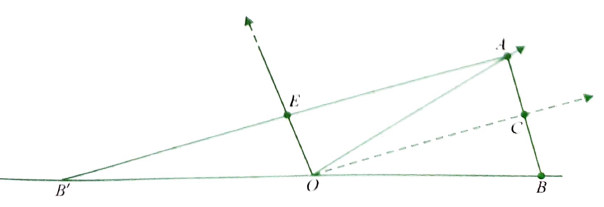
Let \(O A\) and \(O B\) be two lines with direction cosines \(l_1, m_1, n_1\) and \(l_2, m_2, n_2\). Let \(O A=O B=1\). Then the coordinates of \(A\) and \(B\) are ( \(l_1, m_1, n_1\) ) and ( \(l_2, m_2, n_2\) ), respectively. Let \(O C\) be the bisector of \(\angle A O B\). Then \(C\) is the midpoint of \(A B\) and so its coordinates are
\(
\left(\frac{l_1+l_2}{2}, \frac{m_1+m_2}{2}, \frac{n_1+n_2}{2}\right)
\)
Therefore, the direction ratios of \(O C\) are \(\frac{l_1+l_2}{2}, \frac{m_1+m_2}{2}\) and \(\frac{n_1+n_2}{2}\). We have
\(
\begin{aligned}
O C & =\sqrt{\left(\frac{l_1+l_2}{2}\right)^2+\left(\frac{m_1+m_2}{2}\right)^2+\left(\frac{n_1+n_2}{2}\right)^2} \\
& =\frac{1}{2} \sqrt{\left(l_1^2+m_1^2+n_1^2\right)+\left(l_2^2+m_2^2+n_2^2\right)+2\left(l_1 l_2+m_1 m_2+n_1 n_2\right)}
\end{aligned}
\)
\(=\frac{1}{2} \sqrt{2+2 \cos \theta} \quad\left(\because \cos \theta=l_1 l_2+m_1 m_2+n_1 n_2\right)\)
\(
=\frac{1}{2} \sqrt{2(1+\cos \theta)}=\cos \left(\frac{\theta}{2}\right)
\)
Therefore, the direction cosines of \(\overrightarrow{O C}\) are \(\frac{l_1+l_2}{2(O C)}, \frac{m_1+m_2}{2(O C)}, \frac{n_1+n_2}{2(O C)}\)
\(
\frac{l_1+l_2}{2 \cos (\theta / 2)}, \frac{m_1+m_2}{2 \cos (\theta / 2)}, \frac{n_1+n_2}{2 \cos (\theta / 2)}
\)
In the figure, \(O E\) is the external bisector.
The coordinates of \(E\) are \(\frac{l_1-l_2}{2}, \frac{m_1-m_2}{2}\) and \(\frac{n_1-n_2}{2}\).
Therefore, direction ratios of \(O E\) are \(\frac{l_1-l_2}{2}, \frac{m_1-m_2}{2}\) and \(\frac{n_1-n_2}{2}\).
Also,
\(
\begin{aligned}
O E & =\frac{1}{2} \sqrt{2-2 \cos \theta} \\
& =\frac{1}{2} \sqrt{2(1-\cos \theta)} \\
& =\sin (\theta / 2)
\end{aligned}
\)
Therefore, the direction cosines of \(\overrightarrow{O E}\) are \(\frac{l_1-l_2}{2 \sin (\theta / 2)}, \frac{m_1-m_2}{2 \sin (\theta / 2)}\) and \(\frac{n_1-n_2}{2 \sin (\theta / 2)}\).
Illustration 1: \(A B C\) is a triangle and \(A=(2,3,5), B=(-1,3,2)\) and \(C=(\lambda, 5, \mu)\). If the median through \(A\) is equally inclined to the axes, then find the value of \(\lambda\) and \(\mu\).
Solution:
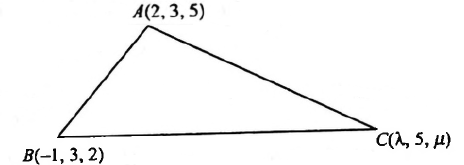
Midpoint of \(B C\) is \(\left(\frac{\lambda-1}{2}, 4, \frac{2+\mu}{2}\right)\)
Direction ratios of the median through \(A\) are
\(
\frac{\lambda-1}{2}-2,4-3 \text { and } \frac{2+\mu}{2}-5, \text { i.e. } \frac{\lambda-5}{2}, 1 \text { and } \frac{\mu-8}{2} .
\)
\(
\begin{aligned}
&\text { The median is equally inclined to the axes; so the direction ratios must be equal. Therefore, }\\
&\frac{\lambda-5}{2}=1=\frac{\mu-8}{2} \Rightarrow \lambda=7, \mu=10
\end{aligned}
\)
Illustration 2: If \(\alpha, \beta\) and \(\gamma\) are the angles which a directed line makes with the positive directions of the co-ordinates axes, then find the value of \(\sin ^2 \alpha+\sin ^2 \beta+\sin ^2 \gamma\).
Solution: The direction cosines of the line are \(l=\cos \alpha, m=\cos \beta\) and \(n=\cos \gamma\).
\(
\begin{array}{ll}
\because & l^2+m^2+n^2=1, \cos ^2 \alpha+\cos ^2 \beta+\cos ^2 \gamma=1 \\
\therefore & 1-\sin ^2 \alpha+1-\sin ^2 \beta+1-\sin ^2 \gamma=1 \\
\text { or } & \sin ^2 \alpha+\sin ^2 \beta+\sin ^2 \gamma=2
\end{array}
\)
Illustration 3: A line \(O P\) through origin \(O\) is inclined at \(30^{\circ}\) and \(45^{\circ}\) to \(O X\) and \(O Y\), respectively. Then find the angle at which it is inclined to \(O Z\).
Solution: Let \(l, m\) and \(n\) be the direction cosines of the given vector. Then \(l^2+m^2+n^2=1\).
If \(l=\cos 30^{\circ}=\sqrt{3} / 2, m=\cos 45^{\circ}=1 / \sqrt{2}\), then \(\frac{3}{4}+\frac{1}{2}+n^2=1\).
\(n^2=-1 / 4\), which is not possible. So, such a line cannot exist.
Illustration 4: A line passes through the points \((6,-7,-1)\) and \((2,-3,1)\). Find the direction cosines of the line if the line makes an acute angle with the positive direction of the \(x\)-axis.
Solution: Let \(l, m\) and \(n\) be the direction cosines of the given line. As it makes an acute angle with the \(x\)-axis, \(l>0\). The line passes through \((6,-7,-1)\) and \((2,-3,1)\); therefore, its direction ratios are \((6-2,-7+3,-1 -1)\) or \((4,-4,-2)\). Hence, the direction cosines of the given line are \(2 / 3,-2 / 3\) and \(-1 / 3\).
Illustration 5: Find the ratio in which the \(y-z\) plane divides the join of the points \((-2,4,7)\) and \((3,-5,8)\) Sol. Let the \(y-z\) plane divide the join of \(P(-2,4,7)\) and \(Q(3,-5,8)\) in the ratio \(\lambda: 1\).
Solution: Let the \(y-z\) plane divide the join of \(P(-2,4,7)\) and \(Q(3,-5,8)\) in the ratio \(\lambda: 1\).
If \(\left(\frac{3 \lambda-2}{\lambda+1}, \frac{-5 \lambda+4}{\lambda+1}, \frac{8 \lambda+7}{\lambda+1}\right)\) is in the \(y-z\) plane, then its \(x\)-coordinate is zero. Therefore,
\(
\frac{3 \lambda-2}{\lambda+1}=0 \text { or } 3 \lambda-2=0
\)
\(
\lambda=2 / 3
\)
Illustration 6: If \(A(3,2,-4), B(5,4,-6)\) and \(C(9,8,-10)\) are three collinear points, then find the ratio in which point \(C\) divides \(A B\).
Solution: Let \(C\) divide \(A B\) in the ratio \(\lambda: 1\). Then
\(
C \equiv\left(\frac{5 \lambda+3}{\lambda+1}, \frac{4 \lambda+2}{\lambda+1}, \frac{-6 \lambda-4}{\lambda+1}\right)=(9,8-10)
\)
Comparing, we get
\(
5 \lambda+3=9 \lambda+9 \text { or } 4 \lambda=-6 \text { or } \lambda=-3 / 2
\)
Also, from \(4 \lambda+2=8 \lambda+8\) and \(-6 \lambda-4=-10 \lambda-10\), we get the same value of \(\lambda\)
Illustration 7: If the sum of the squares of the distance of a point from the three coordinate axes is 36 , then find its distance from the origin.
Solution: Let \(P(x, y, z)\) be the point. Now under the given condition,
\(
\begin{aligned}
& {\left[\sqrt{x^2+y^2}\right]^2+\left[\sqrt{y^2+z^2}\right]^2+\left[\sqrt{z^2+x^2}\right]^2=36} \\
& x^2+y^2+z^2=18
\end{aligned}
\)
Then distance from the origin to point ( \(x, y, z\) ) is
\(
\sqrt{x^2+y^2+z^2}=\sqrt{18}=3 \sqrt{2}
\)
Illustration 8: A line makes angles \(\alpha, \beta, \gamma\) and \(\delta\) with the diagonals of a cube. Show that \(\cos ^2 \alpha+\cos ^2 \beta+\cos ^2 \gamma+\cos ^2 \delta=4 / 3\).
Solution: The four diagonals of a cube are \(A L, B M, C N\) and \(O P\).
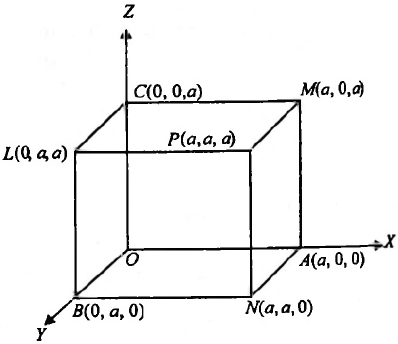
Direction cosines of \(O P\) are \(\frac{1}{\sqrt{3}}, \frac{1}{\sqrt{3}}\) and \(\frac{1}{\sqrt{3}}\).
Direction cosines of \(A L\) are \(\frac{-1}{\sqrt{3}}, \frac{1}{\sqrt{3}}\) and \(\frac{1}{\sqrt{3}}\).
Direction cosines of \(B M\) are \(\frac{1}{\sqrt{3}}, \frac{-1}{\sqrt{3}}\) and \(\frac{1}{\sqrt{3}}\).
Direction cosines of \(C N\) are \(\frac{1}{\sqrt{3}}, \frac{1}{\sqrt{3}}\) and \(\frac{-1}{\sqrt{3}}\).
Let \(l, m\) and \(n\) be the direction cosines of a line which is inclined at angles \(\alpha, \beta, \gamma\) and \(\delta\), respectively, to the four diagonals; then
\(
\begin{aligned}
\cos \alpha & =l \cdot \frac{1}{\sqrt{3}}+m \cdot \frac{1}{\sqrt{3}}+n \cdot \frac{1}{\sqrt{3}} \\
& =\frac{l+m+n}{\sqrt{3}}
\end{aligned}
\)
\(
\text { Similarly, } \quad \cos \beta=\frac{-l+m+n}{\sqrt{3}}
\)
\(
\begin{aligned}
& \cos \gamma=\frac{l-m+n}{\sqrt{3}} \\
& \begin{aligned}
\cos \delta=\frac{l+m-n}{\sqrt{3}} & \\
\cos ^2 \alpha+\cos ^2 \beta+\cos ^2 \gamma+\cos ^2 \delta & =\frac{1}{3}\left[(l+m+n)^2+(-l+m+n)^2+(l-m+n)^2+(l+m-n)^2\right] \\
& =\frac{1}{3} \cdot 4\left(l^2+m^2+n^2\right)=\frac{4}{3}
\end{aligned}
\end{aligned}
\)
Illustration 9: Find the angle between the lines whose direction cosines are given by \(l+m+n=0\) and \(2 l^2+2 m^2-n^2=0\).
Solution: \(l^2+m^2+n^2=1 \dots(i)\)
\(
\begin{aligned}
& l+m+n=0 \dots(ii) \\
& 2 l^2+2 m^2-n^2=0 \dots(iii) \\
& 2\left(1-n^2\right)=n^2 \text { or } 3 n^2=2 \text { or } n= \pm \sqrt{2 / 3} \dots(iv) \\
& 2\left(l^2+m^2\right)=n^2=(-(l+m))^2 \text { or } l=m \dots(v) \\
& l+m= \pm \sqrt{2 / 3} \text { or } 2 l= \pm \sqrt{2 / 3} \\
& l= \pm 1 / \sqrt{6}, m= \pm 1 / \sqrt{6}
\end{aligned}
\)
Direction cosines are
\(
\left(\frac{1}{\sqrt{6}}, \frac{1}{\sqrt{6}}, \sqrt{\frac{2}{3}}\right) \text { and }\left(\frac{1}{\sqrt{6}}, \frac{1}{\sqrt{6}},-\sqrt{\frac{2}{3}}\right)
\)
\(
\left(-\frac{1}{\sqrt{6}},-\frac{1}{\sqrt{6}}, \sqrt{\frac{2}{3}}\right) \text { and }\left(-\frac{1}{\sqrt{6}},-\frac{1}{\sqrt{6}},-\sqrt{\frac{2}{3}}\right)
\)
The angle between these lines in both the cases is \(\cos ^{-1}\left(-\frac{1}{3}\right)\).
Illustration 10: A mirror and a source of light are situated at the origin \(O\) and at a point on \(O X\), respectively. A ray of light from the source strikes the mirror and is reflected. If the direction ratios of the normal to the plane are \(1,-1,1\), then find the DCs of the reflected ray.
Solution: Let the source of light be situated at \(A(a, 0,0)\), where \(a \neq 0\).
Let \(O A\) be the incident ray and \(O B\) the reflected ray.
\(O N\) is the normal to the mirror at \(O\). Therefore,
\(
\angle A O N=\angle N O B=\theta / 2 \quad \text { (say) }
\)
Direction ratios of \(O A\) are \(a, 0\) and 0 and so its direction cosines are 1,0 and 0.
Direction ratios of \(O N\) are \(1 / \sqrt{3},-1 / \sqrt{3}\) and \(1 / \sqrt{3}\). Therefore,
\(
\begin{aligned}
& \angle A O N=\angle N O B=(\theta / 2) \quad(\text { say }) \\
& \cos (\theta / 2)=1 / \sqrt{3}
\end{aligned}
\)
Let \(l, m\) and \(n\) be the direction cosines of the reflected ray \(O B\). Then
\(
\begin{array}{ll}
& \frac{l+1}{2 \cos (\theta / 2)}=\frac{1}{\sqrt{3}}, \frac{m+0}{2 \cos (\theta / 2)}=-\frac{1}{\sqrt{3}} \text { and } \frac{n+0}{2 \cos (\theta / 2)}=\frac{1}{\sqrt{3}} \\
\Rightarrow & l=\frac{2}{3}-1, m=\frac{-2}{3}, n=\frac{2}{3} \\
\text { or } & l=-\frac{1}{3}, m=-\frac{2}{3}, n=\frac{2}{3}
\end{array}
\)
LINE IN SPACE
Equation of Straight Line Passing through a Given Point and Parallel to a Given Vector
Vector Form
Line Passing through Point \(\mathrm{A}(\vec{a})\) and Parallel to Vector \(\vec{b}\)
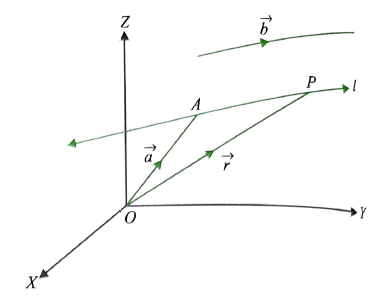
Let \(A\) be the given point and let \(A P\) be the given line through \(A\). Let \(\vec{b}\) be any vector parallel to the given line.
Position vector of point \(A\) is \(\vec{a}\).
Let \(P\) be any point on line \(A P\), and let its position vector be \(\vec{r}\).
Then, we have \(\vec{r}=\overrightarrow{O P}=\overrightarrow{O A}+\overrightarrow{A P}=\vec{a}+\lambda \vec{b} \quad\) (where \(\overrightarrow{A P}=\lambda \vec{b}\) ) and \(\lambda\) is some scalar.
Hence, the vector equation of straight line, \(\vec{r}=\vec{a}+\lambda \vec{b} \dots(1)\).
Here, \(\vec{r}\) is the position vector of any point \(P(x, y, z)\) on the line. So \(\vec{r}=x \hat{i}+y \hat{j}+z \hat{k}\).
In particular, the equation of straight line through origin and parallel to \(\vec{b}\) is \(\vec{r}=\lambda \vec{b}\).
Cartesian Form
Let the coordinates of the given point \(A\) be \(\left(x_1, y_1, z_1\right)\) and the direction ratios of the line be \(a, b\) and \(c\). Consider the coordinates of any point \(P\) be \((x, y, z)\). Then
\(
\vec{r}=x \hat{i}+y \hat{j}+z \hat{k}, \vec{a}=x_1 \hat{i}+y_1 \hat{j}+z_1 \hat{k} \text { and } \vec{b}=a \hat{i}+b \hat{j}+c \hat{k}
\)
Substituting these values in (i) and equating the coefficients of \(\hat{i}, \hat{j}\) and \(\hat{k}\), we get
\(
x=x_1+\lambda a ; y=y_1+\lambda b ; z=z_1+\lambda c
\)
These are parametric equations of the line.
Eliminating the parameter \(\lambda\), we get \(\frac{x-x_1}{a}=\frac{y-y_1}{b}=\frac{z-z_1}{c}\).
Remarks
- Here any point on the line is \((x, y, z) \equiv\left(x_1+\lambda a, y_1+\lambda b, z_1+\lambda c\right)\) ( \(\lambda\) being a parameter).
Example 1: Find the equation of the line in vector form passing through the point \((4,-2,5)\) and parallel to the vector \(3 \hat{i}-\hat{j}+2 \hat{k}\). Hence, find the equation in Cartesian form.
Solution: Given that the line pass through the point \(A(4,-2,5)\) and parallel to the vector \(\vec{b}=3 \hat{\imath}-\hat{\jmath}+2 \hat{k}\).
Let \(\vec{a}\) be the position vector of the point A
\(
\therefore \vec{a}=4 \hat{\imath}-2 \hat{\jmath}+5 \hat{k}
\)
\(\therefore\) The vector equation of line passing through the point. \(\mathrm{A}(\vec{a})\) and parallel to vector \(\vec{b}\) is \(\vec{r}=\vec{a}+\lambda \vec{b}\) where \(\lambda\) is scalar
\(
\vec{r}=(4 \hat{\imath}-2 \hat{\jmath}+5 \hat{k})+\lambda(3 \hat{\imath}-\hat{\jmath}+2 \hat{k} .)
\)
If \(\vec{r}=x \hat{\imath}+y \hat{\jmath}+z \hat{k}\) then
\(
\begin{aligned}
& x \hat{\imath}+y \hat{\jmath}+z \hat{k}=(4 \hat{\imath}-2 \hat{\jmath}+5 \hat{k})+\lambda(3 \hat{\imath}-\hat{\jmath}+2 \hat{k}) \\
& \quad(x-4) \hat{\imath}+(y+2) \hat{\jmath}+(z-5) \hat{k}=3 \lambda \hat{\imath}-\lambda \hat{\jmath}+2 \lambda \hat{k}
\end{aligned}
\)
Comparing the coefficients of \(\hat{\imath}, \hat{\jmath}, \hat{k}\) on both sides.
\(
x-4=3 \lambda, y+2=-\lambda, z-5=2 \lambda
\)
\(
\begin{aligned}
&\frac{x-4}{3}=\frac{y+2}{-1}=\frac{z-5}{2}=\lambda\\
&\therefore \text { Cartesian form of the equation of line is } \frac{x-4}{3}=\frac{y+2}{-1}=\frac{z-5}{2}
\end{aligned}
\)
EQUATION OF LINE PASSING THROUGH TWO GIVEN POINTS
Vector Form
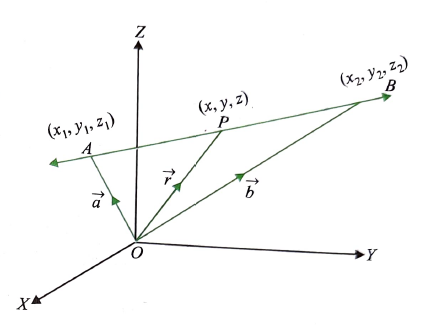
From the figure, \(\overrightarrow{O P}=\vec{r}, \overrightarrow{O A}=\vec{a}\) and \(\overrightarrow{O B}=\vec{b}\). Since \(\overrightarrow{A P}\) is collinear with \(\overrightarrow{A B}, \overrightarrow{A P}=\lambda \overrightarrow{A B}\) for some scalar \(\lambda\), we have
\(
\overrightarrow{O P}-\overrightarrow{O A}=\lambda(\overrightarrow{O B}-\overrightarrow{O A})
\)
\(
\begin{aligned}
& \vec{r}-\vec{a}=\lambda(\vec{b}-\vec{a}) \\
& \vec{r}=\vec{a}+\lambda(\vec{b}-\vec{a}) \dots(i)
\end{aligned}
\)
Therefore, the equation of a straight line passing through \(\vec{a}\) and \(\vec{b}\) is \(\vec{r}=\vec{a}+\lambda(\vec{b}-\vec{a})\).
Cartesian Form
We have \(\vec{r}=x \hat{i}+y \hat{j}+z \hat{k}, \vec{a}=x_1 \hat{i}+y_1 \hat{j}+z_1 \hat{k}\) and \(\vec{b}=x_2 \hat{i}+y_2 \hat{j}+z_2 \hat{k}\).
Substituting these values in (i), we get
\(
x \hat{i}+y \hat{j}+z \hat{k}=x_1 \hat{i}+y_1 \hat{j}+z_1 \hat{k}+\lambda\left[\left(x_2-x_1\right) \hat{i}+\left(y_2-y_1\right) \hat{j}+\left(z_2-z_1\right) \hat{k}\right]
\)
Equating the coefficients of \(\hat{i}, \hat{j}\) and \(\hat{k}\), we get
\(
x=x_1+\lambda\left(x_2-x_1\right) ; y=y_1+\lambda\left(y_2-y_1\right) ; z=z_1+\lambda\left(z_2-z_1\right)
\)
On eliminating \(\lambda\), we obtain \(\frac{x-x_1}{x_2-x_1}=\frac{y-y_1}{y_2-y_1}=\frac{z-z_1}{z_2-z_1}=\lambda\) which is the equation of the line in Cartesian form.
Example 2: The Cartesian equation of a line is \(\frac{x-3}{2}=\frac{y+1}{-2}=\frac{z-3}{5}\). Find the vector equation of the line.
Solution: The given line is \(\frac{x-3}{2}=\frac{y+1}{-2}=\frac{z-3}{5}\).
Note that it passes through \((3,-1,3)\) and is parallel to the line whose direction ratios are \(2,-2\) and 5. Therefore, its vector equation is \(\vec{r}=3 \hat{i}-\hat{j}+3 \hat{k}+\lambda(2 \hat{i}-2 \hat{j}+5 \hat{k})\), where \(\lambda\) is a parameter.
Example 3: The Cartesian equations of a line are \(6 x-2=3 y+1=2 z-2\). Find its direction ratios and also find a vector equation of the line.
Solution: The given line is \(6 x-2=3 y+1=2 z-2 \dots(i)\)
To put it in the symmetrical form, we must make the coefficients of \(x, y\) and \(z\) as 1. To do this, we divide each of the expressions in (i) by 6 and obtain \(\frac{x-(1 / 3)}{1}=\frac{y+(1 / 3)}{2}=\frac{z-1}{3}\).
This shows that the given line passes through \((1 / 3,-1 / 3,1)\) and is parallel to the line whose direction ratios are 1,2 and 3. Therefore, its vector equation is
\(
\vec{r}=\frac{1}{3} \hat{i}-\frac{1}{3} \hat{j}+\hat{k}+\lambda(\hat{i}+2 \hat{j}+3 \hat{k})
\)
Example 4: A line passes through the point with position vector \(2 \hat{i}-3 \hat{j}+4 \hat{k}\) and is in the direction of \(3 \hat{i}+4 \hat{j}-5 \hat{k}\). Find the equations of the line in vector and Cartesian forms.
Solution: Since the line passes through \(2 \hat{i}-3 \hat{j}+4 \hat{k}\) and has direction of \(3 \hat{i}+4 \hat{j}-5 \hat{k}\), its vector equation is
\(
\vec{r}=\hat{a}+\lambda \hat{b} \Rightarrow \vec{r}=2 \hat{i}-3 \hat{j}+4 \hat{k}+\lambda(3 \hat{i}+4 \hat{j}-5 \hat{k}), \text { where } \lambda \text { is a scalar parameter. } \dots(i)
\)
Cartesian equivalent of (i) is \(\frac{x-2}{3}=\frac{y+3}{4}=\frac{z-4}{-5}\)
Example 5: Find the vector equation of line passing through \(A(3,4,-7)\) and \(B(1,-1,6)\). Also find its cartesian equations.
Solution: Since the line passes through \(A(3 \hat{i}+4 \hat{j}-7 \hat{k})\) and \(B(\hat{i}-\hat{j}+6 \hat{k})\), its vector equation is
\(
\begin{aligned}
\vec{r} & =3 \hat{i}+4 \hat{j}-7 \hat{k}+\lambda[(\hat{i}-\hat{j}+6 \hat{k})-(3 \hat{i}+4 \hat{j}-7 \hat{k})] \\
& =3 \hat{i}+4 \hat{j}-7 \hat{k}-\lambda(2 \hat{i}+5 \hat{j}-13 \hat{k}) \dots(i)
\end{aligned}
\)
where \(\lambda\) is a parameter.
The Cartesian equivalent of (i) is \(\frac{x-3}{2}=\frac{y-4}{5}=\frac{z+7}{-13}\).
Example 6: Find the equation of a line which passes through the point \((2,3,4)\) and which has equal intercepts on the axes.
Solution: Since line has equal intercepts on axes, it is equally inclined to axes.
\(
\begin{array}{ll}
\Rightarrow & \text { Line is along the vector } \vec{a}(\hat{i}+\hat{j}+\hat{k}) \\
\Rightarrow & \text { Equation of line }=\frac{x-2}{1}=\frac{y-3}{1}=\frac{z-4}{1}
\end{array}
\)
Example 7: Find the points where line \(\frac{x-1}{2}=\frac{y+2}{-1}=\frac{z}{1}\) intersects \(x y, y z\) and \(z x\) planes.
Solution: Line meets \(x y\)-plane where \(z=0\)
Hence, from the given equation of line, \(\frac{x-1}{2}=\frac{y+2}{-1}=\frac{0}{1}\)
\(
\Rightarrow \quad x=1 \text { and } y=-2 \text {. }
\)
\(\Rightarrow \quad\) Line meets \(x y\)-plane at \((1,-2,0)\).
Line meets \(y z\)-plane where \(x=0\)
Hence, from the given equation of line, \(\frac{0-1}{2}=\frac{y+2}{-1}=\frac{z}{1}\)
\(
\begin{array}{ll}
\Rightarrow & z=\frac{-1}{2} \text { and } y=-\frac{3}{2} \\
\Rightarrow & \text { Line meets } y z \text {-plane at }\left(0,-\frac{3}{2}, \frac{-1}{2}\right)
\end{array}
\)
Line meets \(z x\)-plane where \(y=0\)
Hence, from the given equation of line \(\frac{x-1}{2}=\frac{0+2}{-1}=\frac{z}{1}\)
\(
\begin{array}{ll}
\Rightarrow & z=-2, x=-3 \\
\Rightarrow & \text { Line meets } z x \text {-plane at }(-3,0,-2)
\end{array}
\)
Example 8: Find the equation of line \(x+y-z-3=0=2 x+3 y+z+4\) in symmetric form. Find the direction ratios of the line.
Solution: In the section of planes we will see that equation of the form \(a x+b y+c z+d=0\) is the equation of the plane in the space.
Now equation of line in the form \(x+y-z-3=0=2 x+3 y+z+4\) means set of those points in space which are common to the planes \(x+y-z-3=0\) and \(2 x+3 y+z+4=0\), which lie on the line of intersection of planes.
For example, equation of \(x\)-axis is \(y=z=0\) where \(x y\)-plane ( \(z=0\) ) and \(x z\)-plane ( \(y=0\) ) intersect.
Now to get the equation of line in symmetric form, in above equations, first we eliminate any one of the variables, say \(z\). Then adding \(x+y-z-3=0\) and \(2 x+3 y+z+4=0\), we get
\(
\begin{aligned}
& 3 x+4 y+1=0 \text { or } 3 x=-4 y-1=\lambda(\text { say }) \\
& x=\frac{\lambda}{3}, y=\frac{\lambda+1}{-4}
\end{aligned}
\)
Putting these values in \(x+y-z-3=0\), we have \(\frac{\lambda}{3}+\frac{\lambda+1}{-4}-z-3=0\)
\(
\lambda=39+12 z
\)
Comparing values of \(\lambda\), we have equation of line as
\(
\begin{aligned}
& 3 x=-4 y-1=12 z+39 \\
& \frac{3 x}{12}=\frac{-4 y-1}{12}=\frac{12 z+39}{12} \text { or } \frac{x}{4}=\frac{y+\frac{1}{4}}{-3}=\frac{z+\frac{13}{4}}{1}
\end{aligned}
\)
Hence, the line is passing through point \(\left(0,-\frac{1}{4},-\frac{13}{4}\right)\) and have direction ratios \(4,-3,1\).
If we eliminate \(x\) or \(y\) first we will get equation of line having same direction ratio but with different point on the line.
Example 9: If \(\vec{r}=(\hat{i}+2 \hat{j}+3 \hat{k})+\lambda(\hat{i}-\hat{j}+\hat{k})\) and \(\vec{r}=(\hat{i}+2 \hat{j}+3 \hat{k})+\mu(\hat{i}+\hat{j}-\hat{k})\) are two lines, then find the equation of acute angle bisector of two lines.
Solution: Solution: The direction vectors of the two given lines are identified.
The direction vector of the first line is \(\overrightarrow{b_1}=\hat{i}-\hat{j}+\hat{k}\).
The direction vector of the second line is \(\overrightarrow{b_2}=\hat{i}+\hat{j}-\hat{k}\).
The cosine of the angle between the lines is determined.
\(
\cos \theta=\frac{\overrightarrow{b_1} \cdot \overrightarrow{b_2}}{\left|\overrightarrow{b_1}\right|\left|\overrightarrow{b_2}\right|}=\frac{-1}{\sqrt{3} \cdot \sqrt{3}}=\frac{-1}{3} .
\)
Since \(\cos \theta\) is negative, the angle \(\theta\) is obtuse. The acute angle between the lines is \(\pi-\theta\).
The direction vectors for the angle bisectors are found using the formula
\(
\frac{\overrightarrow{b_1}}{\left|\overrightarrow{b_1}\right|} \pm \frac{\overrightarrow{b_2}}{\left|\overrightarrow{b_2}\right|}
\)
The direction vector for one bisector is
\(
\vec{d}_1=\frac{\hat{i}-\hat{j}+\hat{k}}{\sqrt{3}}+\frac{\hat{i}+\hat{j}-\hat{k}}{\sqrt{3}}=\frac{1}{\sqrt{3}}((\hat{i}-\hat{j}+\hat{k})+(\hat{i}+\hat{j}-\hat{k}))=\frac{1}{\sqrt{3}}(2 \hat{i})
\)
The direction vector for the other bisector is
\(
\vec{d}_2=\frac{\hat{i}-\hat{j}+\hat{k}}{\sqrt{3}}-\frac{\hat{i}+\hat{j}-\hat{k}}{\sqrt{3}}=\frac{1}{\sqrt{3}}((\hat{i}-\hat{j}+\hat{k})-(\hat{i}+\hat{j}-\hat{k}))=\frac{1}{\sqrt{3}}(-2 \hat{j}+2 \hat{k})
\)
Identifying the Acute Angle Bisector:
The dot product of \(\vec{b}_1\) and \(\vec{d}_1\) is calculated to determine if \(\vec{d}_1\) corresponds to the acute or obtuse angle bisector.
\(
\vec{b}_1 \cdot \vec{d}_1=(\hat{i}-\hat{j}+\hat{k}) \cdot\left(\frac{2}{\sqrt{3}} \hat{i}\right)=\frac{2}{\sqrt{3}} .
\)
Since \(\vec{b}_1 \cdot \vec{d}_1>0\), the angle between \(\vec{b}_1\) and \(\vec{d}_1\) is acute. Therefore, \(\vec{d}_1\) is the direction vector of the obtuse angle bisector because the angle between the original lines is obtuse.
The direction vector of the acute angle bisector is \(\vec{d}_2=\frac{1}{\sqrt{3}}(-2 \hat{j}+2 \hat{k})\). This can be simplified to \(\hat{j}-\hat{k}\) by taking out a common factor of \(\frac{-2}{\sqrt{3}}\).
Equation of the Acute Angle Bisector:
The equation of the acute angle bisector is formed using the common point of intersection of the two lines and the direction vector of the acute angle bisector.
The common point of intersection is \((\hat{i}+2 \hat{j}+3 \hat{k})\).
The equation of the acute angle bisector is \(\vec{r}=(\hat{i}+2 \hat{j}+3 \hat{k})+\lambda(\hat{j}-\hat{k})\).
Example 10: Find the equation of the line drawn through point \((1,0,2)\) to meet the line \(\frac{x+1}{3}=\frac{y-2}{-2} =\frac{z+1}{-1}\) at right angles.
Solution: Given line is \(\overrightarrow{A B} \equiv \frac{x+1}{3}=\frac{y-2}{-2}=\frac{z+1}{-1} \dots(i)\)
Let \(P \equiv(1,0,2)\)
Any point on line (i) is \(Q \equiv(3 r-1,-2 r+2,-r-1)\)
Direction ratios of \(P Q\) are \(3 r-2,-2 r+2,-r-3\)
Direction ratios of line \(A B\) are \(3,-2,-1\)
\(
\begin{array}{ll}
\because & P Q \perp A B \\
\therefore & 3(3 r-2)-2(-2 r+2)-1(-r-3)=0 \\
\text { or } & 14 r=7 \text { or } r=\frac{1}{2}
\end{array}
\)
Therefore, direction ratios of \(P Q\) are \(-\frac{1}{2}, 1,-\frac{7}{2}\) or \(1,-2 ; 7\)
Equation of line \(P Q \equiv \frac{x-1}{1}=\frac{y}{-2}=\frac{z-2}{7}\)
Example 11: Line \(L_1\) is parallel to vector \(\bar{\alpha}=-3 \hat{i}+2 \hat{j}+4 \hat{k}\) and passes through a point \(A(7,6,2)\) and line \(L_2\) is parallel to a vector \(\vec{\beta}=2 \hat{i}+\hat{j}+3 \hat{k}\) and passes through a point \(B(5,3,4)\). Now a line \(L_3\) parallel to a vector \(\vec{r}=2 \hat{i}-2 \hat{j}-\hat{k}\) intersects the lines \(L_1\) and \(L_2\) at points \(C\) and \(D\), respectively, then find \(|\overline{C D}|\).
Solution: Line \(L_1\) is parallel to vector \(\vec{\alpha}=-3 \hat{i}+2 \hat{j}+4 \hat{k}\) and passes through a point \(A(7,6,2)\).
Therefore, position vector of any point on the line is \(7 \hat{i}+6 \hat{j}+2 \hat{k}+\lambda(-3 \hat{i}+2 \hat{j}+4 \hat{k})\); line \(L_2\) is parallel to a vector \(\vec{\beta}=2 \hat{i}+\hat{j}+3 \hat{k}\) and passes through a point \(B(5,3,4)\).
Position vector of any point on the line \(5 \hat{i}+3 \hat{j}+4 \hat{k}+\mu(2 \hat{i}+\hat{j}+3 \hat{k})\)
\(
\therefore \quad \overline{C D}=2 \hat{i}+3 \hat{j}-2 \hat{k}+\lambda(-3 \hat{i}+2 \hat{j}+4 \hat{k})-\mu(2 \hat{i}+\hat{j}+3 \hat{k})
\)
Since it is parallel to \(2 \hat{i}-2 \hat{j}-\hat{k}\), we have
\(
\frac{2-3 \lambda-2 \mu}{2}=\frac{3+2 \lambda-\mu}{-2}=\frac{-2+4 \lambda-3 \mu}{-1}
\)
Solving these equations we get \(\lambda=2\) and \(\mu=1\). Therefore, or
\(
\begin{aligned}
& \overrightarrow{C D}=-6 \hat{i}+6 \hat{j}+3 \hat{k} \\
& |\overrightarrow{C D}|=9
\end{aligned}
\)
Example 12: Find the coordinates of a point on the line \(\frac{x-1}{2}=\frac{y+1}{-3}=z\) at a distance \(4 \sqrt{14}\) from the point \((1,-1,0)\).
Solution: The given line equation is \(\frac{x-1}{2}=\frac{y+1}{-3}=z\). This equation can be set equal to a parameter, say \(\lambda\), to express the coordinates of any point on the line in terms of \(\lambda\).
Thus, \(x-1=2 \lambda, y+1=-3 \lambda\), and \(z=\lambda\).
The coordinates of a general point on the line are given by
\(
(x, y, z)=(1+2 \lambda,-1-3 \lambda, \lambda)
\)
The distance between a point \(\left(x_1, y_1, z_1\right)\) and another point \(\left(x_2, y_2, z_2\right)\) is given by the formula \(D=\sqrt{\left(x_2-x_1\right)^2+\left(y_2-y_1\right)^2+\left(z_2-z_1\right)^2}\).
In this case, the point on the line is \((1+2 \lambda,-1-3 \lambda, \lambda)\) and the given point is \((1,-1,0)\). The distance is given as \(4 \sqrt{14}\).
Substituting these values into the distance formula:
\(
4 \sqrt{14}=\sqrt{((1+2 \lambda)-1)^2+((-1-3 \lambda)-(-1))^2+(\lambda-0)^2} .
\)
This simplifies to \(4 \sqrt{14}=\sqrt{(2 \lambda)^2+(-3 \lambda)^2+(\lambda)^2}\).
Squaring both sides of the equation:
\(
\begin{aligned}
& (4 \sqrt{14})^2=(2 \lambda)^2+(-3 \lambda)^2+(\lambda)^2 \\
& 16 \times 14=4 \lambda^2+9 \lambda^2+\lambda^2 \\
& 224=14 \lambda^2
\end{aligned}
\)
Dividing both sides by 14:
\(
\begin{aligned}
& \lambda^2=\frac{224}{14} . \\
& \lambda^2=16 .
\end{aligned}
\)
Taking the square root of both sides:
\(
\begin{aligned}
& \lambda= \pm \sqrt{16} . \\
& \lambda= \pm 4 .
\end{aligned}
\)
Substitute the values of \(\lambda\) back into the parameterized coordinates of the point on the line, \((1+2 \lambda,-1-3 \lambda, \lambda)\).
Case 1: For \(\lambda=4\) :
The coordinates are \((1+2(4),-1-3(4), 4)=(1+8,-1-12,4)=(9,-13,4)\).
Case 2: For \(\lambda=-4\) :
The coordinates are
\(
(1+2(-4),-1-3(-4),-4)=(1-8,-1+12,-4)=(-7,11,-4)
\)
The coordinates of the points on the line at a distance \(4 \sqrt{14}\) from the point \((1,-1,0)\) are \((9,-13,4)\) and \((-7,11,-4)\).
ANGLE BETWEEN TWO LINES
Let the given lines be
\(
\left.\begin{array}{l}
\vec{r}=\vec{a}+\lambda \vec{b} \quad \text { (i) } \\
\vec{r}=\overrightarrow{a^{\prime}}+\lambda \overrightarrow{b^{\prime}} \quad \text { (ii) }
\end{array}\right\} \rightarrow \text { Vector form }
\)
\(
\left.\begin{array}{l}
\frac{x-a_1}{b_1}=\frac{y-a_2}{b_2}=\frac{z-a_3}{b_3} \\
\frac{x-a_1^{\prime}}{b_1^{\prime}}=\frac{y-a_2^{\prime}}{b_2^{\prime}}=\frac{z-a_3^{\prime}}{b_3^{\prime}}
\end{array}\right\} \rightarrow \text { Cartesian form }
\)
Clearly (i) and (ii) are straight lines in the directions of \(\vec{b}\) and \(\overrightarrow{b^{\prime}}\), respectively.
Let \(\theta\) be the angle between the straight lines (i) and (ii).
Then \(\theta\) is the angle between vectors \(\vec{b}\) and \(\overrightarrow{b^{\prime}}\). Therefore,
\(
\begin{aligned}
& \cos \theta=\frac{\vec{b} \cdot \overrightarrow{b^{\prime}}}{|\vec{b}|\left|\overrightarrow{b^{\prime}}\right|} \\
& \vec{b}=b \hat{i}+b_2 \hat{j}+b_3 \hat{k}, \overrightarrow{b^{\prime}}=b_1^{\prime} \hat{i}+b_2^{\prime} \hat{j}+b_3^{\prime} \hat{k} \\
& \vec{b} \cdot \overrightarrow{b^{\prime}}=b_1 b_1^{\prime}+b_2 b_2^{\prime}+b_3 b_3^{\prime}
\end{aligned}
\)
and \(|\vec{b}|=\sqrt{b_1^2+b_2^2+b_3^3},\left|\overrightarrow{b^{\prime}}\right|=\sqrt{b_1^{\prime 2}+b_2^{\prime 2}+b_3^{\prime 2}}\)
\(
\cos \theta=\frac{b_1 b_1^{\prime}+b_2 b_2^{\prime}+b_3 b_3^{\prime}}{\sqrt{b_1^2+b_2^2+b_3^3} \sqrt{b_1^2+b_2^{\prime 2}+b_3^{\prime 2}}}
\)
Notes:
- If the lines are perpendicular, then \(\vec{b} \cdot \overrightarrow{b^{\prime}}=0 \Rightarrow b_1 b_1^{\prime}+b_2 b_2^{\prime}+b_3 b_3^{\prime}=0\).
- If the lines are parallel, then \(\vec{b}=\lambda \overrightarrow{b^{\prime}}\) for some scalar \(\lambda \Rightarrow \frac{b_1}{b_2^{\prime}}=\frac{b_2}{b_2^{\prime}}=\frac{b_3}{b_3^{\prime}}\).
Example 13: Find the angle between the following pair of lines:
i. \(\vec{r}=2 \hat{i}-5 \hat{j}+\hat{k}+\lambda(3 \hat{i}+2 \hat{j}+6 \hat{k})\) and \(\vec{r}=7 \hat{i}-6 \hat{k}+\mu(\hat{i}+2 \hat{j}+2 \hat{k})\)
ii. \(\frac{x}{2}=\frac{y}{2}=\frac{z}{1}\) and \(\frac{x-5}{4}=\frac{y-2}{1}=\frac{z-3}{8}\)
Solution: (i) The given lines are parallel to the vectors \(\vec{b}_1=3 \hat{i}+2 \hat{j}+6 \hat{k}\) and \(\vec{b}_2=\hat{i}+2 \hat{j}+2 \hat{k}\), respectively. If \(\theta\) is the angle between the given pair of lines, then
\(
\begin{aligned}
& \cos \theta=\frac{\vec{b}_1 \cdot \vec{b}_2}{\left|\vec{b}_1\right|\left|\vec{b}_2\right|}=\frac{(3)(1)+(2)(2)+(6)(2)}{\sqrt{3^2+2^2+6^2} \sqrt{1^2+2^2+2^2}}=\frac{19}{7 \times 3} \\
& \theta=\cos ^{-1}\left(\frac{19}{21}\right)
\end{aligned}
\)
(ii) The given lines are parallel to the vectors \(\vec{b}_1=2 \hat{i}+2 \hat{j}+\hat{k}\) and \(\vec{b}_2=4 \hat{i}+\hat{j}+8 \hat{k}\), respectively. If \(\theta\) is the angle between the given pair of lines, then
\(
\begin{aligned}
& \cos \theta=\frac{\vec{b}_1 \cdot \vec{b}_2}{\left|\vec{b}_1\right|\left|\vec{b}_2\right|}=\frac{(2)(4)+(2)(1)+(1)(8)}{\sqrt{2^2+2^2+1^2} \sqrt{4^2+1^2+8^2}}=\frac{18}{3 \times 9}=\frac{2}{3} \\
& \theta=\cos ^{-1}\left(\frac{2}{3}\right)
\end{aligned}
\)
Example 14: Find the values of \(p\) so that line \(\frac{1-x}{3}=\frac{7 y-14}{2 p}=\frac{z-3}{2}\) and \(\frac{7-7 x}{3 p}=\frac{y-5}{1}=\frac{6-z}{5}\) are at right angles.
Solution: The given equations can be written in the standard form as
\(
\frac{x-1}{-3}=\frac{y-2}{2 p / 7}=\frac{z-3}{2} \text { and } \frac{x-1}{-3 p / 7}=\frac{y-5}{1}=\frac{z-6}{-5}
\)
The direction ratios of the lines are \(-3, \frac{2 p}{7} ; 2\) and \(\frac{-3 p}{7}, 1,-5\), respectively. Lines are perpendicular to each other. Therefore,
\(
(-3) \cdot\left(\frac{-3 p}{7}\right)+\left(\frac{2 p}{7}\right) \cdot(1)+2 \cdot(-5)=0
\)
\(
\frac{9 p}{7}+\frac{2 p}{7}=10 \text { or } 11 p=70 \text { or } p=\frac{70}{11}
\)
Example 15: Find the acute angle between the lines \(\frac{x-1}{\ell}=\frac{y+1}{m}=\frac{z}{n}\) and \(\frac{x+1}{m}=\frac{y-3}{n}=\frac{z-1}{\ell}\), where \(\ell>m>n\), and \(\ell, m, n\) are the roots of the cubic equation \(x^3+x^2-4 x=4\).
Solution: Given lines are \(\frac{x-1}{\ell}=\frac{y+1}{m}=\frac{z}{n}\) and \(\frac{x+1}{m}=\frac{y-3}{n}=\frac{z-1}{\ell}\) Angle between lines is given by
\(
\cos \theta=\frac{\ell m+m n+n \ell}{\ell^2+m^2+n^2}
\)
Now \(\ell, m, n\) are the roots of the cubic equation \(x^3+x^2-4 x=4\). Thus,
\(
\begin{aligned}
& \ell+m+n=-1 \text { and } \ell m+m n+n \ell=-4 \\
& (\ell+m+n)^2=\ell^2+m^2+n^2+2(\ell m+m n+n \ell) \\
& (-1)^2=\ell^2+m^2+n^2+2(-4) \\
& \ell^2+m^2+n^2=9 \\
& \cos \theta=-\frac{4}{9}
\end{aligned}
\)
Therefore, acute angle between the lines is \(\cos ^{-1} \frac{4}{9}\).
Example 16: Find the condition if lines \(x=a y+b, z=c y+d\) and \(x=a^{\prime} y+b^{\prime}, z=c^{\prime} y+d\) are perpendicular.
Solution: The equations of straight lines can be rewritten as
\(
\begin{aligned}
& x=a y+b, z=c y+d \Rightarrow \frac{x-b}{a}=\frac{y-0}{1}=\frac{z-d}{c} \\
& x=a^{\prime} y+b^{\prime}, z=c^{\prime} y+d \Rightarrow \frac{x-b^{\prime}}{a^{\prime}}=\frac{y-0}{1}=\frac{z-d^{\prime}}{c^{\prime}}
\end{aligned}
\)
The above lines are perpendicular if \(a a^{\prime}+1 \cdot 1+c \cdot c^{\prime}=0\).
PERPENDICULAR DISTANCE OF A POINT FROM A LINE
Foot of Perpendicular from a Point on the Given Line
Cartesian form
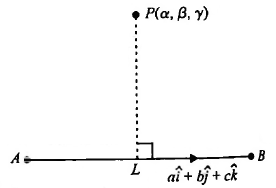
Here, the equation of line \(A B\) is \(\frac{x-x_1}{a}=\frac{y-y_1}{b}=\frac{z-z_1}{c}\).
Let \(L\) be the foot of the perpendicular drawn from \(P(\alpha, \beta, \gamma)\) on the line \(\frac{x-x_1}{a}=\frac{y-y_1}{b}=\frac{z-z_1}{c}\).
Let the coordiantes of \(L\) be \(\left(x_1+a \lambda, y_1+b \lambda, z_1+c \lambda\right)\).
Then the direction ratios of \(P L\) are \(\left(x_1+a \lambda-\alpha, y_1+b \lambda-\beta, z_1+c \lambda-\gamma\right)\).
Direction ratios of \(A B\) are \((a, b, c)\).
Since \(P L\) is perpendicular to \(A B\),
\(
\begin{aligned}
& a\left(x_1+a \lambda-\alpha\right)+b\left(y_1+b \lambda-\beta\right)+c\left(z_1+c \lambda-\gamma\right)=0 \\
& \lambda=\frac{a\left(\alpha-x_1\right)+b\left(\beta-y_1\right)+c\left(\gamma-z_1\right)}{a^2+b^2+c^2}
\end{aligned}
\)
Putting the value of \(\lambda\) in ( \(x_1+a \lambda, y_1+b \lambda, z_1+c \lambda\) ), we get the foot of the perpendicular. Now we can get distance \(P L\) using the distance formula.
Vector form
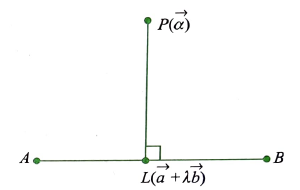
Let \(L\) be the foot of the perpendicular drawn from \(P(\vec{\alpha})\) on the line \(\vec{r}=\vec{a}+\lambda \vec{b}\).
Since \(\vec{r}\) denotes the position vector of any point on the line \(\vec{r}=\vec{a}+\lambda \vec{b}\), the position vector of \(L\) will be \((\vec{a}+\lambda \vec{b})\)
Directions ratios of \(P L=\vec{a}-\vec{\alpha}+\lambda \vec{b}\)
Since \(\overrightarrow{P L}\) is perpendicular to \(\vec{b}\), we have
\(
(\vec{a}-\vec{\alpha}+\lambda \vec{b}) \cdot \vec{b}=0
\)
\(
\begin{aligned}
& (\vec{a}-\vec{\alpha}) \cdot \vec{b}+\lambda \vec{b} \cdot \vec{b}=0 \\
& \lambda=\frac{-(\vec{a}-\vec{\alpha}) \cdot \vec{b}}{|\vec{b}|^2}
\end{aligned}
\)
Thus, position vector of \(L\) is \(\vec{a}-\left(\frac{(\vec{a}-\vec{\alpha}) \cdot \vec{b}}{|\vec{b}|^2}\right) \vec{b}\), which is the foot of the perpendicular.
Image of a Point in the Given Line
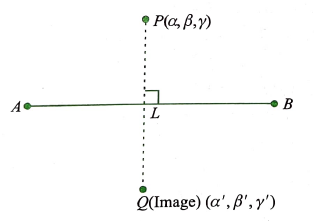
Since \(L\) (foot of perpendicular) is the midpoint of \(P\) and \(Q\) (image of a point \(P\) in the line), we can get \(Q\) if \(L\) is found out.
Example 17: Find the coordinates of the foot of the perpendicular drawn from point \(\lambda(1,0,3)\) to the join of points \(B(4,7,1)\) and \(C(3,5,3)\).
Solution: Let \(D\) be the foot of the perpendicular and let it divide \(B C\) in the ratio \(\lambda: 1\). Then the coordinates of \(D\) are \(\frac{3 \lambda+4}{\lambda+1}, \frac{5 \lambda+7}{\lambda+1}\) and \(\frac{3 \lambda+1}{\lambda+1}\).
Now,
\(
\overrightarrow{A D} \perp \overrightarrow{B C} \Rightarrow \overrightarrow{A D} \cdot \overrightarrow{B C}=0
\)
\(\Rightarrow (2 \lambda+3)+2(5 \lambda+7)+4=0\)
\(
\lambda=-\frac{7}{4}
\)
Thus, coordinates of \(D\) are \(\frac{5}{3}, \frac{7}{3}\) and \(\frac{17}{3}\).
Example 18: Find the length of the perpendicular drawn from point \((2,3,4)\) to line \(\frac{4-x}{2}=\frac{y}{6}=\frac{1-z}{3}\).
Solution: Let \(P\) be the foot of the perpendicular from \(A(2,3,4)\) to the given line \(l\) whose equation is
\(
\frac{4-x}{2}=\frac{y}{6}=\frac{1-z}{3} \quad \text { or } \quad \frac{x-4}{-2}=\frac{y}{6}=\frac{z-1}{-3}=k \text { (say) } \dots(i)
\)
\(
x=4-2 k, y=6 k, z=1-3 k
\)
As \(P\) lies on (i), coordinates of \(P\) are \((4-2 k, 6 k, 1-3 k)\) for some value of \(k\).
The direction ratios of \(A P\) are
\(
(4-2 k-2,6 k-3,1-3 k-4) \text { or }(2-2 k, 6 k-3,-3-3 k)
\)
Also, the direction ratios of \(l\) are \(-2,6\) and -3.
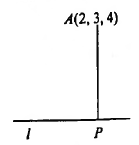
Since \(A P \perp l\), we have
\(
\begin{aligned}
& -2(2-2 k)+6(6 k-3)-3(-3-3 k)=0 \\
& -4+4 k+36 k-18+9+9 k=0 \text { or } 49 k-13=0 \text { or } k=13 / 49
\end{aligned}
\)
We have \(\quad A P^2=(4-2 k-2)^2+(6 k-3)^2+(1-3 k-4)^2\)
\(
\begin{aligned}
& =(2-2 k)^2+(6 k-3)^2+(-3-3 k)^2 \\
& =4-8 k+4 k^2+36 k^2-36 k+9+9+18 k+9 k^2 \\
& =22-26 k+49 k^2 \\
& =22-26\left(\frac{13}{49}\right)+49\left(\frac{13}{49}\right)^2 \\
& =\frac{22 \times 49-26 \times 13+13^2}{49}=\frac{909}{49} \\
A P & =\frac{3}{7} \sqrt{101}
\end{aligned}
\)
SHORTEST DISTANCE BETWEEN TWO LINES
If two lines in space intersect at a point, then the shortest distance between them is zero. Also, if two lines in space are parallel, then the shortest distance between them will be the perpendicular distance, i.e., the length of the perpendicular drawn from any point on one line onto the other line. Further. in a space, there are lines which are neither intersecting nor parallel. In fact, such pair of lines are non-coplanar and are called skew lines.
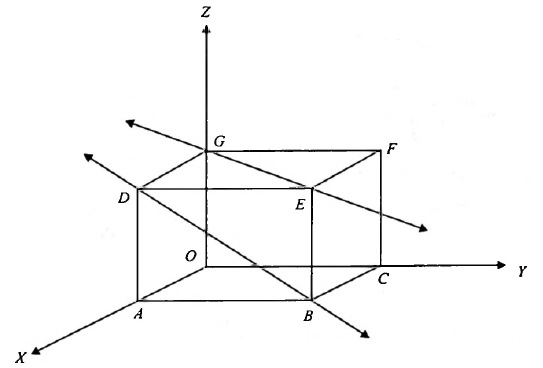
Line \(G E\) goes diagonally across the ceiling and line \(D B\) passes through one comer of the ceiling directly above \(A\) and goes diagonally down the wall. These lines are skew because they are not parallel and also never meet.
By the shortest distance between two lines, we mean the join of a point in one line with one point on the other line so that the length of the segment so obtained is the smallest. For skew lines, the line of the shortest distance will be perpendicular to both the lines.
Note: Non-coplanar lines are lines that do not lie in the same plane. They are also referred to as skew lines if they do not intersect. In other words, if you have two or more lines that are not situated on a single flat surface, they are considered non-coplanar.
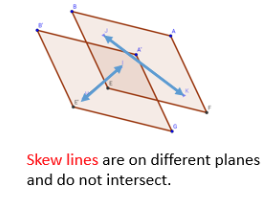
Shortest Distance between Two Non-coplanar Lines
Vector form
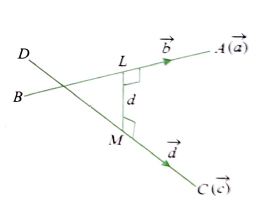
Let the given lines be \(\vec{r}=\vec{a}+t \vec{b}\) and \(\vec{r}=\vec{c}+t_1 \vec{d}\).
If two lines \(A B\) and \(C D\) do not intersect, there is always a line intersecting both the lines perpendicularly.
The intercept on this line made by \(A B\) and \(C D\) is called the shortest distance between lines \(A B\) and \(C D\).
In Figure above, the shortest distance \(=L M\), where \(\angle A L M=\angle C M L=90^{\circ}\). In the figure, the shortest distance
\(
\begin{aligned}
L M & =\mid \text { Projection of } \overrightarrow{A C} \text { along } \overrightarrow{M L} \mid \\
& =\left|\overrightarrow{A C} \cdot \frac{\overrightarrow{M L}}{|\overrightarrow{M L}|}\right|=\frac{|(\vec{a}-\vec{c}) \cdot \overrightarrow{L M}|}{|\overrightarrow{L M}|}
\end{aligned}
\)
Now \(\overrightarrow{L M}\) is perpendicular to both \(\vec{b}\) and \(\vec{d}\). Thus,
\(
\begin{aligned}
\overrightarrow{L M} & =\vec{b} \times \vec{d} \\
& =\frac{|(\vec{a}-\vec{c}) \cdot(\vec{b} \times \vec{d})|}{|\vec{b} \times \vec{d}|} \\
& =\frac{|[\vec{b} \vec{d} \vec{a}-\vec{c}]|}{|\vec{b} \times \vec{d}|}
\end{aligned}
\)
Cartesian form
Let the two skew lines be \(\frac{x-a_1}{b_1}=\frac{y-a_2}{b_2}=\frac{z-a_3}{b_3}\) and \(\frac{x-c_1}{d_1}=\frac{y-c_2}{d_2}=\frac{z-c_3}{d_3}\)
\(
\text { Then Shortest distance }=\frac{\left\|\begin{array}{ccc}
c_1-a_1 & c_2-a_2 & c_3-a_3 \\
b_1 & b_2 & b_3 \\
d_1 & d_2 & d_3
\end{array}\right\|}{\left\|\begin{array}{ccc}
\hat{i} & \hat{j} & \hat{k} \\
b_1 & b_2 & b_3 \\
d_1 & d_2 & d_3
\end{array}\right\|}
\)
Condition for Lines to Intersect
Two lines \(\vec{r}=\vec{a}+t \vec{b}\) and \(\vec{r}=\vec{c}+t_1 \vec{d}\) are intersecting if
\(
\begin{aligned}
& \left|\frac{(\vec{a}-\vec{c}) \cdot(\vec{b}-\vec{d})}{\vec{b} \times \vec{d}}\right|=0 \\
& \left|\begin{array}{ccc}
c_1-a_1 & c_2-a_2 & c_3-a_3 \\
b_1 & b_2 & b_3 \\
d_1 & d_2 & d_3
\end{array}\right|=0
\end{aligned}
\)
Distance between Two Parallel Lines
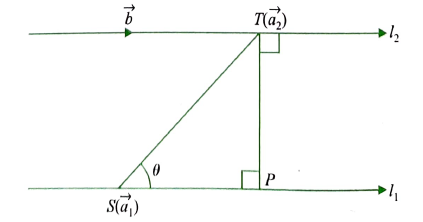
If two lines \(l_1\) and \(l_2\) are parallel, then they are coplanar. Let the lines be given by
\(
\begin{aligned}
& \vec{r}=\overrightarrow{a_1}+\lambda \vec{b} \dots(i) \\
& \vec{r}=\overrightarrow{a_2}+\mu \vec{b} \dots(ii)
\end{aligned}
\)
where \(\vec{a}_1\) is the position vector of a point \(S\) on \(l_1\) and \(\vec{a}_2\) is the position vector of a point \(T\) on \(l_2\).
As \(l_1\) and \(l_2\) are coplanar. if the foot of the perpendicular from \(T\) on iine \(l_1\) is \(P\), then the distance between the lines \(l_1\) and \(l_2=|T P|\).
Let \(\theta\) be the angle between vectors \(\overrightarrow{S T}\) and \(\vec{b}\).
Then \(\vec{b} \times \overrightarrow{S T}=(|\vec{b}||\overrightarrow{S T}| \sin \theta) \hat{n} \dots(iii)\)
where \(\hat{n}\) is the unit vector perpendicular to the plane of the lines \(l_1\) and \(l_2\).
But \(\quad \overrightarrow{S T}=\vec{a}_2-\vec{a}_1\)
Therefore, from (iii), we get
\(
\vec{b} \times\left(\vec{a}_2-\vec{a}_1\right)=|\vec{b}| ~P T~ \hat{n} \text { (since } P T=S T \sin \theta \text { ) }
\)
i.e., \(\left|\vec{b} \times\left(\overrightarrow{a_2}-\overrightarrow{a_1}\right)\right|=|\vec{b}| P T \cdot 1 (\text { as }|\hat{n}|=1)\)
Hence, the distance between the given parallel lines is
\(
d=|\overrightarrow{P T}|=\left|\frac{\vec{b} \times\left(\vec{a}_2-\vec{a}_1\right)}{|\vec{b}|}\right|
\)
Example 19: Find the shortest distance between the lines \(\frac{x-1}{2}=\frac{y-2}{3}=\frac{z-3}{4}\) and \(\frac{x-2}{3}=\frac{y-4}{4} =\frac{z-5}{5}\). Also obtain the equation of the line of the shortest distance.
Solution: (i) The two given lines are \(\frac{x-1}{2}=\frac{y-2}{3}=\frac{z-3}{4}=r_1 \text { (say) } \dots(i)\)
\(
\frac{x-2}{3}=\frac{y-4}{4}=\frac{z-5}{5}=r_2(\mathrm{say}) \dots(ii)
\)
Any point on (i) is given by \(P\left(2 r_1+1,3 r_1+2,4 r_1+3\right)\)
And any point on (ii) is given by \(Q\left(3 r_2+2,4 r_2+4,5 r_2+5\right)\)
Direction ratios of \(P Q\) are given by \(3 r_2-2 r_1+1,4 r_2-3 r_1+2\) and \(5 r_2-4 r_1+2\)
Since \(P Q\) is perpendicular to (i), we get
\(
2\left(3 r_2-2 r_1+1\right)+3\left(4 r_2-3 r_1+2\right)+4\left(5 r_2-4 r_1+2\right)=0
\)
\(
38 r_2-29 r_1+16=0 \dots(iii)
\)
Also \(P Q\) is perpendicular to (ii), we get
\(
\begin{aligned}
& 3\left(3 r_2-2 r_1+1\right)+4\left(4 r_2-3 r_1+2\right)+5\left(5 r_2-4 r_1+2\right)=0 \\
& 50 r_2-38 r_1+21=0 \dots(iv)
\end{aligned}
\)
Solving (iii) and (iv), we obtain \(r_2=-(1 / 6), r_1=(1 / 3)\).
Therefore, coordinates of \(P\) and \(Q\) are \(\left(\frac{5}{3}, 3, \frac{13}{3}\right)\) and \(\left(\frac{3}{2}, \frac{10}{3}, \frac{25}{6}\right)\), respectively. Thus,
\(
P Q^2=\left(\frac{3}{2}-\frac{5}{3}\right)^2+\left(\frac{10}{3}-3\right)^2+\left(\frac{25}{6}-\frac{13}{3}\right)^2=\left(-\frac{1}{6}\right)^2+\left(\frac{1}{3}\right)^2+\left(-\frac{1}{6}\right)^2=\frac{1}{6}
\)
\(P Q=\frac{1}{\sqrt{6}}\)
The equation of the line of the shortest distance is given by
\(
\begin{aligned}
& \frac{x-(5 / 3)}{(3 / 2)-(5 / 3)}=\frac{y-3}{(10 / 3)-3}=\frac{z-(13 / 3)}{(25 / 6)-(13 / 3)} \\
& \frac{x-(5 / 3)}{-(1 / 6)}=\frac{y-3}{(1 / 3)}=\frac{z-(13 / 3)}{-(1 / 6)} \\
& \frac{x-(5 / 3)}{1}=\frac{y-3}{-2}=\frac{z-(13 / 3)}{1}
\end{aligned}
\)
Alternative method for finding the shortest distance:
Line (i) is passing through the point \(\left(x_1, y_1, z_1\right) \equiv(1,2,3)\) and is parallel to vector
\(
a_1 \hat{i}+b_1 \hat{j}+c_1 \hat{k} \equiv 2 \hat{i}+3 \hat{j}+4 \hat{k}
\)
Line (ii) is passing through the point \(\left(x_2, y_2, z_2\right) \equiv(2,4,5)\) and is parallel to the vector
\(
a_2 \hat{i}+b_2 \hat{j}+c_2 \hat{k} \equiv 3 \hat{i}+4 \hat{j}+5 \hat{k}
\)
Hence, the shortest distance between the lines using the formula
\(
\frac{\left\|\begin{array}{ccc}
x_2-x_1 & y_2-y_1 & z_2-z_1 \\
a_1 & b_1 & c_1 \\
a_2 & b_2 & c_2
\end{array}\right\|}{\left\|\begin{array}{ccc}
\hat{i} & \hat{j} & \hat{k} \\
a_1 & b_1 & c_1 \\
a_2 & b_2 & c_2
\end{array}\right\|}
\)
is
\(
\frac{\left\|\begin{array}{ccc}
2-1 & 4-2 & 5-3 \\
2 & 3 & 4 \\
3 & 4 & 5
\end{array}\right\|}{\left\|\begin{array}{ccc}
\hat{i} & \hat{j} & \hat{k} \\
2 & 3 & 4 \\
3 & 4 & 5
\end{array}\right\|}=\frac{1}{\sqrt{6}}
\)
Example 20: Determine whether the following pair of lines intersect or not.
i. \(\vec{r}=\hat{i}-\hat{j}+\lambda(2 \hat{i}+\hat{k}) ; \vec{r}=2 \hat{i}-\hat{j}+\mu(\hat{i}+\hat{j}-\hat{k})\)
ii. \(\quad \vec{r}=\hat{i}+\hat{j}-\hat{k}+\lambda(3 \hat{i}-\hat{j}) ; \vec{r}=4 \hat{i}-\hat{k}+\mu(2 \hat{i}+3 \hat{k})\)
Solution: (i) Here \(\vec{a}_1=\hat{i}-\hat{j}, \vec{a}_2=2 \hat{i}-\hat{j}, \vec{b}_1=2 \hat{i}+\hat{k}\)
and \(\vec{b}_2=\hat{i}+\hat{j}-\hat{k}\)
\(
\begin{aligned}
&\text { Now }\\
&\begin{aligned}
{\left[\overrightarrow{a_2}-\overrightarrow{a_1} \vec{b}_1 \vec{b}_2\right] } & =\left|\begin{array}{ccc}
2-1 & -1+1 & 0 \\
2 & 0 & 1 \\
1 & 1 & -1
\end{array}\right| \\
& =\left|\begin{array}{ccc}
1 & 0 & 0 \\
2 & 0 & 1 \\
1 & 1 & -1
\end{array}\right| \\
& =-1 \neq 0
\end{aligned}
\end{aligned}
\)
Thus, the two given lines do not intersect.
(ii) Here \(\overrightarrow{a_1}=\hat{i}+\hat{j}-\hat{k}, \overrightarrow{a_2}=4 \hat{i}-\hat{k}, \overrightarrow{b_1}=3 \hat{i}-\hat{j}\)
and \(\overrightarrow{b_2}=2 \hat{i}+3 \hat{k}\)
\(
\begin{aligned}
\Rightarrow \quad\left[\vec{a}_2-\vec{a}_1 \vec{b}_1 \vec{b}_2\right] & =\left|\begin{array}{ccc}
4-1 & 0-1 & -1+1 \\
3 & -1 & 0 \\
2 & 0 & 3
\end{array}\right| \\
& =\left|\begin{array}{ccc}
3 & -1 & 0 \\
3 & -1 & 0 \\
2 & 0 & 3
\end{array}\right|=0
\end{aligned}
\)
Thus, the two given lines intersect. Let us obtain the point of intersection of the two given lines.
For some values of \(\lambda\) and \(\mu\), the two values of \(\vec{r}\) must coincide. Thus,
\(
\hat{i}+\hat{j}-\hat{k}+\lambda(3 \hat{i}-\hat{j})=4 \hat{i}-\hat{k}+\mu(2 \hat{i}+3 \hat{k})
\)
\(
\begin{aligned}
& (3+2 \mu-3 \lambda) \hat{i}+(\lambda-1) \hat{j}+3 \mu \hat{k}=0 \\
& 3+2 \mu-3 \lambda=0, \lambda-1=0,3 \mu=0
\end{aligned}
\)
Solving, we obtain \(\lambda=1\) and \(\mu=0\)
Therefore, the point of intersection is \(\vec{r}=4 \hat{i}-\hat{k}\) (by putting \(\mu=0\) in the second equation).
Example 21: Find the shortest distance between lines \(\vec{r}=(\hat{i}+2 \hat{j}+\hat{k})+\lambda(2 \hat{i}+\hat{j}+2 \hat{k})\) and \(\vec{r}=2 \hat{i}-\hat{j}-\hat{k}+\mu(2 \hat{i}+\hat{j}+2 \hat{k})\).
Solution: Here lines (i) ane (ii) are passing through the points \(\overrightarrow{a_1}=\hat{i}+2 \hat{j}+\hat{k}\) and \(\overrightarrow{a_2}=2 \hat{i}-\hat{j}-\hat{k}\), respectively, and are parallel to the vector \(\vec{b}=2 \hat{i}+\hat{j}+2 \hat{k}\).
Hence, the distance between the lines using the formula is given by
\(
\frac{\left|\vec{b} \times\left(\vec{a}_2-\vec{a}_1\right)\right|}{|\vec{b}|}=\frac{\left|\begin{array}{ccc}
\hat{i} & \hat{j} & \hat{k} \\
2 & 1 & 2 \\
1 & -3 & -2
\end{array}\right|}{3}=\frac{|4 \hat{i}-6 \hat{j}-7 \hat{k}|}{3}=\frac{\sqrt{16+36+49}}{3}=\frac{\sqrt{101}}{3}
\)
Example 22: If the straight lines \(x=-1+s, y=3-\lambda s, z=1+\lambda s\) and \(x=\frac{t}{2}, y=1+t, z=2-t\), with parameters \(s\) and \(t\), respectively, are coplanar, then find \(\lambda\).
Solution: The given lines \(\frac{x+1}{1}=\frac{y-3}{-\lambda}=\frac{z-1}{\lambda}=s\)
\(
\frac{x-0}{1 / 2}=\frac{y-1}{1}=\frac{y-2}{-1}=t
\)
are coplanar if \(\left|\begin{array}{ccc}0+1 & 1-3 & 2-1 \\ 1 & -\lambda & \lambda \\ 1 / 2 & 1 & -1\end{array}\right|=0 \quad[latex] or [latex]\quad\left|\begin{array}{ccc}1 & -2 & 1 \\ 1 & -\lambda & \lambda \\ 1 / 2 & 1 & -1\end{array}\right|=0\)
\(
\begin{aligned}
& 1(\lambda-\lambda)+2\left(-1-\frac{\lambda}{2}\right)+1\left(1+\frac{\lambda}{2}\right)=0 \\
& \lambda=-2
\end{aligned}
\)
Example 23: Find the equation of a line which passes through the point \((1,1,1)\) and intersects the lines \(\frac{x-1}{2}=\frac{y-2}{3}=\frac{z-3}{4}\) and \(\frac{x+2}{1}=\frac{y-3}{2}=\frac{z+1}{4}\).
Solution: Any line passing through the point \((1,1,1)\) is \(\frac{x-1}{a}=\frac{y-1}{b}=\frac{z-1}{c} \dots(i)\)
This line intersects the line \(\frac{x-1}{2}=\frac{y-2}{3}=\frac{z-3}{4}\).
If \(a: b: c \neq 2: 3: 4\)
and \(\left|\begin{array}{ccc}1-1 & 2-1 & 3-1 \\ a & b & c \\ 2 & 3 & 4\end{array}\right|=0 \Rightarrow \quad a-2 b+c=0 \dots(ii)\)
Again, line (i) intersects line \(\frac{x-(-2)}{1}=\frac{y-3}{2}=\frac{z-(-1)}{4}\).
If \(a: b: c \neq 1: 2: 4\)
and \(\left|\begin{array}{ccc}-2-1 & 3-1 & -1-1 \\ a & b & c \\ 1 & 2 & 4\end{array}\right|=0 \Rightarrow \quad 6 a+5 b-4 c=0 \dots(iii)\)
From (ii) and (iii) by cross multiplication, we have \(\frac{a}{8-5}=\frac{b}{6+4}=\frac{c}{5+12}\)
\(
\frac{a}{3}=\frac{b}{10}=\frac{c}{17}
\)
So, the required line is \(\frac{x-1}{3}=\frac{y-1}{10}=\frac{z-1}{17}\)
PLANE IN SPACE
A plane is a surface such that if any two points are taken on it, the line segment joining them lies completely on the surface.
A plane is determined uniquely if:
- The normal to the plane and its distance from the origin is given, i.e., the equation of a plane in normal form.
- It passes through a point and is perpendicular to a given direction.
- It passes through three given non-collinear points.
Equation of a Plane in Normal Form
Vector form
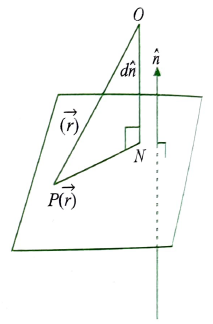
Consider a plane whose perpendicular distance from the origin is \(d(d \neq 0)\).
If \(\overrightarrow{O N}\) is the normal from the origin to the plane, and \(\hat{n}\) is the unit normal vector along \(\overrightarrow{O N}\), then \(\overrightarrow{O N}=d \hat{n}\). Let \(P\) be any point on the plane. Therefore, \(\overrightarrow{N P}\) is perpendicular to \(\overrightarrow{O N}\).
\(
\therefore \quad \overrightarrow{N P} \cdot \overrightarrow{O N}=0 \dots(i)
\)
Let \(\vec{r}\) be the position vector of the point \(P\). Then
\(
\overrightarrow{N P}=\vec{r}-d \hat{n}(\text { as } \overrightarrow{O N}+\overrightarrow{N P}=\overrightarrow{O P})
\)
Therefore, (i) becomes
\(
\begin{array}{ll}
& (\vec{r}-d \hat{n}) \cdot d \hat{n}=0 \\
\text { or } & (\vec{r}-d \hat{n}) \cdot \hat{n}=0 \quad(d \neq 0) \\
\text { or } & (\vec{r} \cdot \hat{n})-d \hat{n} \cdot \hat{n}=0 \\
\text { or } & \vec{r} \cdot \hat{n}=d \quad \text { (as } \hat{n} \cdot \hat{n}=1) \dots(ii)
\end{array}
\)
This is the vector form of the equation of the plane.
Cartesian form
Equation (ii) gives the vector equation of a plane, where \(\hat{n}\) is the unit vector normal to the plane. Let \(P(x\), \(y, z)\) be any point on the plane. Then
\(
\overrightarrow{O P}=\vec{r}=x \hat{i}+y \hat{j}+z \hat{k}
\)
Let \(l, m\) and \(n\) be the direction cosines of \(\hat{n}\). Then
\(
\hat{n}=\hat{l} \hat{i}+m \hat{j}+n \hat{k}
\)
Therefore, (ii) gives
\(
\begin{aligned}
& (x \hat{i}+y \hat{j}+z \hat{k}) \cdot(l \hat{i}+m \hat{j}+n \hat{k})=d \\
& l x+m y+n z=d \dots(iii)
\end{aligned}
\)
This is the Cartesian equation of the plane in the normal form.
Note: Equation (iii) shows that if \(\vec{r} \cdot(a \hat{i}+b \hat{j}+c \hat{k})=d\) is the vector equation of a plane, then \(a x +b y+c z=d\) is the Cartesian equation of the plane, where \(a, b\) and \(c\) are the direction ratios of the normal to the plane.
Example 24: Find the equation of plane which is at a distance \(\frac{4}{\sqrt{14}}\) from the origin and is normal to vector \(2 \hat{i}+\hat{j}-3 \hat{k}\).
Solution: Here \(\vec{n}=2 \hat{i}+\hat{j}-3 \hat{k}\). Then \(\frac{\vec{n}}{|\vec{n}|}=\frac{2 \hat{i}+\hat{j}-3 \hat{k}}{\sqrt{2^2+1^2+(-3)^2}}=\frac{2 \hat{i}+\hat{j}-3 \hat{k}}{\sqrt{14}}\)
Hence, required equation of plane is \(\vec{r} \cdot \frac{1}{\sqrt{14}}(2 \hat{i}+\hat{j}-3 \hat{k})= \pm \frac{1}{\sqrt{14}}\)
\(
\vec{r} \cdot(2 \hat{i}+\hat{j}-3 \hat{k})= \pm 1 \text { (vector form) }
\)
\(
2 x+y-3 z= \pm 1(\text { Cartesian form })
\)
Example 25: Find the distance of the plane \(2 x-y-2 z-9=0\) from the origin.
Solution: The distance of a plane \(A x+B y+C z+D=0\) from the origin \((0,0,0)\) is calculated using the formula:
\(
d=\frac{|D|}{\sqrt{A^2+B^2+C^2}}
\)
The given equation of the plane is \(2 x-y-2 z-9=0\).
The coefficients are identified as \(A=2, B=-1, C=-2\), and \(D=-9\).
The absolute value of \(D\) is calculated as \(|-9|=9\).
The square root of the sum of the squares of the coefficients \(A, B\), and \(C\) is calculated as \(\sqrt{2^2+(-1)^2+(-2)^2}=\sqrt{4+1+4}=\sqrt{9}=3\).
The distance \(d\) is calculated by dividing the absolute value of \(D\) by the calculated square root: \(d=\frac{9}{3}=3\).
Example 26: Find the unit vector perpendicular to the plane \(\vec{r} \cdot(2 \hat{i}+\hat{j}+2 \hat{k})=5\).
Solution: Identifying the Normal Vector:
The equation of a plane is given in the form \(\vec{r} \cdot \vec{n}=d\), where \(\vec{n}\) is the normal vector to the plane.
From the given equation, \(\vec{r} \cdot(2 \hat{i}+\hat{j}+2 \hat{k})=5\), the normal vector \(\vec{n}\) is identified as \(\vec{n}=2 \hat{i}+\hat{j}+2 \hat{k}\).
Calculating the Magnitude of the Normal Vector:
The magnitude of the normal vector \(\vec{n}\) is calculated using the formula \(\|\vec{n}\|=\sqrt{n_x^2+n_y^2+n_z^2}\). Substituting the components of \(\vec{n}\), the magnitude is found as \(\|\vec{n}\|=\sqrt{2^2+1^2+2^2}=\sqrt{4+1+4}=\sqrt{9}=3\).
Finding the Unit Vector:
The unit vector perpendicular to the plane is obtained by dividing the normal vector by its magnitude. The unit vector \(\hat{n}\) is calculated as \(\hat{n}=\frac{\vec{n}}{\|\vec{n}\|}=\frac{2 \hat{i}+\hat{j}+2 \hat{k}}{\sqrt{2^2+1^2+2^2}}=\frac{1}{3}(2 \hat{i}+\hat{j}+2 \hat{k})\).
The unit vector perpendicular to the plane is \(\frac{2}{3} \hat{i}+\frac{1}{3} \hat{j}+\frac{2}{3} \hat{k}\).
Example 27: Find the vector equation of a line passing through \(3 \hat{i}-5 \hat{j}+7 \hat{k}\) and perpendicular to the plane \(3 x-4 y+5 z=8\).
Solution: The line is stated to pass through the point with position vector \(\vec{a}=3 \hat{i}-5 \hat{j}+7 \hat{k}\).
Determine the direction vector of the line:
The line is perpendicular to the plane \(3 x-4 y+5 z=8\). The normal vector to a plane \(A x+B y+C z=D\) is given by \(\vec{n}=A \hat{i}+B \hat{j}+C \hat{k}\). Therefore, the normal vector to the given plane is \(\vec{n}=3 \hat{i}-4 \hat{j}+5 \hat{k}\). Since the line is perpendicular to the plane, its direction vector \(\vec{b}\) will be parallel to the normal vector of the plane. Thus, the direction vector of the line can be taken as \(\vec{b}=3 \hat{i}-4 \hat{j}+5 \hat{k}\).
Formulate the vector equation of the line:
The vector equation of a line passing through a point with position vector \(\vec{a}\) and having a direction vector \(\vec{b}\) is given by \(\vec{r}=\vec{a}+\lambda \vec{b}\), where \(\lambda\) is a scalar parameter. Substituting the identified values, the vector equation of the line is \(\vec{r}=(3 \hat{i}-5 \hat{j}+7 \hat{k})+\lambda(3 \hat{i}-4 \hat{j}+5 \hat{k})\).
Equation of a Plane Passing through a Given Point and Normal to a Given Vector
Vector Form
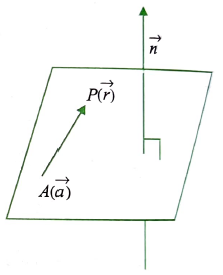
Suppose the plane passes through a point having position vector \(\vec{a}\) and is normal to vector \(\vec{n}\).
Then for any position of point \(P(\vec{r})\) on the plane, \(\overrightarrow{A P} \perp \vec{n}\). Thus,
\(
\begin{array}{ll}
& \overrightarrow{A P} \cdot \vec{n}=0 \\
\text { or } & (\vec{r}-\vec{a}) \cdot \vec{n}=0 \quad(\because \overrightarrow{A P}=\vec{r}-\vec{a})
\end{array}
\)
Hence, the required equation of the plane is \((\vec{r}-\vec{a}) \cdot \vec{n}=0\).
Note: The above equation can be written as \(\vec{r} \cdot \vec{n}=d\), where \(d=\vec{a} \cdot \vec{n}\) (known as scalar product form of plane). The equation \(\vec{r} \cdot \vec{n}=d\) is in normal form if \(\vec{n}\) is a unit vector and \(d\) is the distance of the plane from the origin. If \(\vec{n}\) is not a unit vector, then we reduce the equation \(\vec{r} \cdot \vec{n}=d\) to the normal form by dividing both sides by \(|\vec{n}|\); we get \(\frac{\vec{r} \cdot \vec{n}}{|\vec{n}|}=\frac{d}{|\vec{n}|}\) or \(\vec{r} \cdot \hat{n}=\frac{d}{|n|}=p\) (distance from the origin).
Cartesian Form
If \(\vec{r}=x \hat{i}+y \hat{j}+z \hat{k}, \vec{a}=x_1 \hat{i}+y_1 \hat{j}+z_1 \hat{k}\) and \(\vec{n}=a \hat{i}+b \hat{j}+c \hat{k}\), then
\(
(\vec{r}-\vec{a})=\left(x-x_1\right) \hat{i}+\left(y-y_1\right) \hat{j}+\left(z-z_1\right) \hat{k}
\)
Then equation of the plane can be written as
\(
\left(\left(x-x_1\right) \hat{i}+\left(y-y_1\right) \hat{j}+\left(z-z_1\right) \hat{k}\right) \cdot(a \hat{i}+b \hat{j}+c \hat{k})=0
\)
\(
a\left(x-x_1\right)+b\left(y-y_1\right)+c\left(z-z_1\right)=0
\)
Thus, the coefficients of \(x, y\) and \(z\) in the Cartesian equation of a plane are the direction ratios of the normal to the plane.
Example 28: Find the equation of the plane passing through the point \((2,3,1)\) having \((5,3,2)\) as the direction ratios of the normal to the plane.
Solution: The equation of a plane passing through a point \(\left(x_0, y_0, z_0\right)\) and having direction ratios \((a, b, c)\) of the normal to the plane is given by the formula: \(a\left(x-x_0\right)+b\left(y-y_0\right)+c\left(z-z_0\right)=0\).
The given point on the plane is \(\left(x_0, y_0, z_0\right)=(2,3,1)\).
The given direction ratios of the normal to the plane are \((a, b, c)=(5,3,2)\).
These values are substituted into the general equation of the plane:
\(
5(x-2)+3(y-3)+2(z-1)=0 .
\)
\(
5 x+3 y+2 z=21
\)
Example 29: Find the equation of the plane such that image of point \((1,2,3)\) in it is \((-1,0,1)\).
Solution: Determine the Midpoint of the Segment Connecting the Point and its Image
The plane acts as a mirror, so the midpoint of the line segment connecting the original point \(P_1=(1,2,3)\) and its image \(P_2=(-1,0,1)\) lies on the plane. The coordinates of the midpoint \(M\) are calculated as follows:
\(
M=\left(\frac{1+(-1)}{2}, \frac{2+0}{2}, \frac{3+1}{2}\right)=\left(\frac{0}{2}, \frac{2}{2}, \frac{4}{2}\right)=(0,1,2)
\)
Determine the Normal Vector to the Plane:
The line segment connecting the original point and its image is perpendicular to the plane. Therefore, the vector \(\overrightarrow{P_1 P_2}\) serves as the normal vector to the plane. The components of this vector are found by subtracting the coordinates of \(P_1\) from \(P_2\) :
\(
\vec{n}=\overrightarrow{P_1 P_2}=-2 \hat{i}-2 \hat{j}-2 \hat{k} \quad (-1-1,0-2,1-3)=(-2,-2,-2)
\)
Hence, the equation of the plane is \(-2(x-0)-2(y-1)-2(z-2)=0\) or \(x+y+z=3\)
Equation of a Plane Passing through Three Given Points
Cartesian form
Let the plane be passing through points \(A\left(x_1, y_1, z_1\right), B\left(x_2, y_2, z_2\right)\) and \(C\left(x_3, y_3, z_3\right)\).
Let \(P(x, y, z)\) be any point on the plane.
Then vectors \(\overrightarrow{P A}, \overrightarrow{B A}\) and \(\overrightarrow{C A}\) are coplanar.
\(\left[\begin{array}{lll}\overrightarrow{P A} & \overrightarrow{B A} & \overrightarrow{C A}\end{array}\right]=0\)
\(\left|\begin{array}{lll}x-x_1 & y-y_1 & z-z_1 \\ x_2-x_1 & y_2-y_1 & z_2-z_1 \\ x_3-x_1 & y_3-y_1 & z_3-z_1\end{array}\right|=0\), which is the required equation of the plane
Vector form
Vector form of the equation of the plane passing through three points \(A, B\) and \(C\) having position vectors \(\vec{a}, \vec{b}\) and \(\vec{c}\), respectively.
Let \(\vec{r}\) be the position vector of any point \(P\) in the plane.
Hence, vectors \(\overrightarrow{A P}=\vec{r}-\vec{a} \overrightarrow{A B}=\vec{b}-\vec{a}\) and \(\overrightarrow{A C}=\vec{c}-\vec{a}\) are coplanar, i.e.,
\(
\begin{array}{ll}
& (\vec{r}-\vec{a}) \cdot\{(\vec{b}-\vec{a}) \times(\vec{c}-\vec{a})\}=0 \\
\text { or } & (\vec{r}-\vec{a}) \cdot(\vec{b} \times \vec{c}-\vec{b} \times \vec{a}-\vec{a} \times \vec{c}+\vec{a} \times \vec{a})=0 \\
\text { or } & (\vec{r}-\vec{a}) \cdot(\vec{b} \times \vec{c}+\vec{a} \times \vec{b}+\vec{c} \times \vec{a})=0 \\
\text { or } & \vec{r} \cdot(\vec{b} \times \vec{c}+\vec{a} \times \vec{b}+\vec{c} \times \vec{a})=\vec{a} \cdot(\vec{b} \times \vec{c})+\vec{a} \cdot(\vec{a} \times \vec{b})+\vec{a} \cdot(\vec{c} \times \vec{a}) \\
\text { or } & {[\vec{r~} \vec{b~} \vec{c}]+[\vec{r~} \vec{a~} \vec{b}]+[\vec{r~} \vec{c~} \vec{a}]=[\vec{a~} \vec{b~} \vec{c}]}
\end{array}
\)
which is the required equation of the plane.
Note:
- If \(p\) is the length of perpendicular from the origin on this plane, then \(p=[\vec{a~} \vec{b~} \vec{c}] / n\), where \(n=|\vec{a} \times \vec{b}+\vec{b} \times \vec{c}+\vec{c} \times \vec{a}|\).
- Four point \(\vec{a}, \vec{b}, \vec{c}\) and \(\vec{d}\) are coplanar if \(\vec{d}\) lies on the plane containing \(\vec{a}, \vec{b}\) and \(\vec{c}\), i.e.,
\(
\begin{aligned}
& \vec{d} \cdot[\vec{a} \times \vec{b}+\vec{b} \times \vec{c}+\vec{c} \times \vec{a}]=\left[\begin{array}{lll}
\vec{a} & \vec{b} & \vec{c}
\end{array}\right] \\
& {[\vec{d~} \vec{a~} \vec{b}]+[\vec{d~} \vec{b~} \vec{c}]+[\vec{d~} \vec{c~} \vec{a}]=\left[\begin{array}{lll}
\vec{a} & \vec{b} & \vec{c}
\end{array}\right]}
\end{aligned}
\)
Example 30: Find the equation of the plane passing through \(A(2,2,-1), B(3,4,2)\) and \(C(7,0,6)\) Also find a unit vector perpendicular to this plane.
Solution: Here \(\left(x_1, y_1, z_1\right) \equiv(2,2,-1),\left(x_2, y_2, z_2\right) \equiv(3,4,2)\) and \(\left(x_3, y_3, z_3\right) \equiv(7,0,6)\)
Then the equation of the plane is
\(
\left|\begin{array}{lll}
x-x_1 & y-y_1 & z-z_1 \\
x_2-x_1 & y_2-y_1 & z_2-z_1 \\
x_3-x_1 & y_3-y_1 & z_3-z_1
\end{array}\right|=0 \text { or }\left|\begin{array}{lllr}
x-2 & y-2 & z -(-1) \\
3-2 & 4-2 & 2-(-1) \\
7-2 & 0-2 & 6-(-1)
\end{array}\right|=0
\)
\(
5 x+2 y-3 z=17
\)
A normal vector to this plane is \(\vec{d}=5 \hat{i}+2 \hat{j}-3 \hat{k} \dots(i) \)
Therefore, a unit vector normal to (i) is given by
\(
\hat{n}=\frac{\vec{d}}{|\vec{d}|}=\frac{5 \hat{i}+2 \hat{j}-3 \hat{k}}{\sqrt{25+4+9}}=\frac{1}{\sqrt{38}}(5 \hat{i}+2 \hat{j}-3 \hat{k})
\)
Example 31: Show that the line of intersection of the planes \(\vec{r} \cdot(\hat{i}+2 \hat{j}+3 \hat{k})=0\) and \(\vec{r} \cdot(3 \hat{i}+2 \hat{j}+\hat{k}) =0\) is equally inclined to \(\hat{i}\) and \(\hat{k}\). Also find the angle it makes with \(\hat{j}\).
Solution: The line of intersection of the two planes will be perpendicular to the normals to the planes. Hence, it is parallel to the vector \((\hat{i}+2 \hat{j}+3 \hat{k}) \times(3 \hat{i}+2 \hat{j}+\hat{k})=(-4 \hat{i}+8 \hat{j}-4 \hat{k})\). Now,
\(
(-4 \hat{i}+8 \hat{j}-4 \hat{k}) \cdot \hat{i}=-4 \text { and }(-4 \hat{i}+8 \hat{j}-4 \hat{k}) \cdot \hat{k}=-4
\)
Hence, the line is equally inclined to \(\hat{i}\) and \(\hat{k}\). Also,
\(
\frac{(-4 \hat{i}+8 \hat{j}-4 \hat{k})}{\sqrt{16+64+16}} \cdot \hat{j}=\frac{8}{\sqrt{96}}=\sqrt{\frac{2}{3}}
\)
If \(\theta\) is the required angle, then \(\cos \theta=\sqrt{\frac{2}{3}}\) or \(\theta=\cos ^{-1} \sqrt{\frac{2}{3}}\).
Equation of the Plane that Passes through Point A with Position Vector \(\vec{a}\) and is Parallel to Given Vectors \(\vec{b}\) and \(\vec{c}\)
Vector form
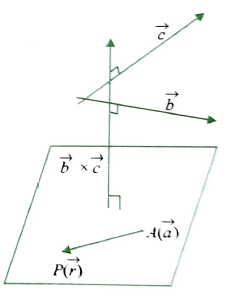
Let \(\vec{r}\) be the position vector of any point \(P\) in the plane. Then
\(
\overrightarrow{A P}=\overrightarrow{O P}-\overrightarrow{O A}=\vec{r}-\vec{a}
\)
Since vectors \(\vec{r}-\vec{a}, \vec{b}\) and \(\vec{c}\) are coplanar, we have
\(
\begin{aligned}
& (\vec{r}-\vec{a}) \cdot(\vec{b} \times \vec{c})=0 \\
& \vec{r} \cdot(\vec{b} \times \vec{c})=\vec{a} \cdot(\vec{b} \times \vec{c}) \text { or }[\vec{r} \vec{b} \vec{c}]=[\vec{a} \vec{b} \vec{c}]
\end{aligned}
\)
which is the required equation of the plane.
Cartesian form
From \((\vec{r}-\vec{a}) \cdot(\vec{b} \times \vec{c})=0\), we have \([\vec{r}-\vec{a} \vec{b} \vec{c}]\)
\(\Rightarrow \quad\left|\begin{array}{ccc}x-x_1 & y-y_1 & z-z_1 \\ x_2 & y_2 & z_2 \\ x_3 & y_3 & z_3\end{array}\right|=0\), which is the required equation of the plane,
where \(\vec{b}=x_2 \hat{i}+y_2 \hat{j}+z_2 \hat{k}\) and \(\vec{c}=x_3 \hat{i}+y_3 \hat{j}+z_3 \hat{k}\).
Example 32: Find the vector equation of the following planes in cartesian form:
\(
\vec{r}=\hat{i}-\hat{j}+\lambda(\hat{i}+\hat{j}+\hat{k})+\mu(\hat{i}-2 \hat{j}+3 \hat{k})
\)
Solution: The equation of the plane is \(\vec{r}=\hat{i}-\hat{j}+\lambda(\hat{i}+\hat{j}+\hat{k})+\mu(\hat{i}-2 \hat{j}+3 \hat{k})\).
Let \(\vec{r}=x \hat{i}+y \hat{j}+z \hat{k}\)
Hence, the equation is \((x \hat{i}+y \hat{j}+z \hat{k})-(\hat{i}-\hat{j})=\lambda(\hat{i}+\hat{j}+\hat{k})+\mu(\hat{i}-2 \hat{j}+3 \hat{k})\)
Thus, vectors \((x \hat{i}+y \hat{j}+z \hat{k})-(\hat{i}-\hat{j}), \hat{i}+\hat{j}+\hat{k}, \hat{i}-2 \hat{j}+3 \hat{k}\) are coplanar (Coplanar means to exist on the same plane).
Therefore, the equation of the plane is \(\left|\begin{array}{ccc}x-1 & y-(-1) & z-0 \\ 1 & 1 & 1 \\ 1 & -2 & 3\end{array}\right|=0\) or \(5 x-2 y-3 z-7=0\)
Equation of a Plane Passing through a Given Point and Line
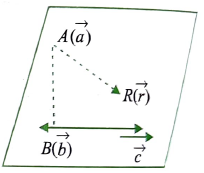
Let the plane pass through a given point \(A(\vec{a})\) and line \(\vec{r}=\vec{b}+\lambda \vec{c}\).
For any position of point \(R(\vec{r})\) on the plane, vectors \(\overrightarrow{A B}, \overrightarrow{R A}\) and \(\vec{c}\) are coplanar. Then \(\left[\begin{array}{lll}\vec{r}-\vec{a} & \vec{b}-\vec{a} & \vec{c}\end{array}\right]=0\), which is required equation of the plane.
Example 33: Prove that the plane \(\vec{r} \cdot(\hat{i}+2 \hat{j}-\hat{k})=3\) contains the line \(\vec{r}=\hat{i}+\hat{j}+\lambda(2 \hat{i}+\hat{j}+4 \hat{k})\).
Solution: To show that \(\vec{r}=\hat{i}+\hat{j}+\lambda(2 \hat{i}+\hat{j}+4 \hat{k}) \dots(i)\)
lies in the plane \(\vec{r} \cdot(\hat{i}+2 \hat{j}-\hat{k})=3 \dots(ii)\)
we must show that each point of (i) lies in (ii). In other words, we must show that \(\vec{r}\) in (i) satisfies (ii) for every value of \(\lambda\). We have
\(
\begin{aligned}
{[\hat{i}} & +\hat{j}+\lambda(2 \hat{i}+\hat{j}+4 \hat{k})] \cdot(\hat{i}+2 \hat{j}-\hat{k}) \\
& =(\hat{i}+\hat{j}) \cdot(\hat{i}+2 \hat{j}-\hat{k})+\lambda(2 \hat{i}+\hat{j}+4 \hat{k}) \cdot(\hat{i}+2 \hat{j}-\hat{k}) \\
& =(1)(1)+(1)(2)+\lambda[(2)(1)+(1)(2)+4(-1)]=3+\lambda(0)=3
\end{aligned}
\)
Hence, line (i) lies in plane (ii).
Example 34: Find the equation of the plane which is parallel to the lines \(\vec{r}=\hat{i}+\hat{j}+\lambda(2 \hat{i}+\hat{j}+4 \hat{k})\) and \(\frac{x+1}{-3}=\frac{y-3}{2}=\frac{z+2}{1}\) and is passing through the point \((0,1,-1)\).
Solution: The plane is parallel to the given lines, which are directed along vectors \(\vec{a}=2 \hat{i}+\hat{j}+4 \hat{k}\) and \(\vec{b}=-3 \hat{i}+\hat{2 j}+1 \hat{k}\).
Then the plane is normal to vector \(\vec{a} \times \vec{b} \equiv\left|\begin{array}{ccc}\hat{i} & \hat{j} & \hat{k} \\ 2 & 1 & 4 \\ -3 & 2 & 1\end{array}\right|=-7 \hat{i}-14 \hat{j}+7 \hat{k}\)
Also, the plane passes through the point \((0,1,-1)\).
Therefore, the equation of the plane is \(-7(x-0)-14(y-1)+7(z+1)=0\) or \(7 x+14 y-7 z=21\)
INTERCEPT FORM OF A Plane
Let \(O\) be the origin and let \(O X, O Y\) and \(O Z\) be the coordinate axes.
Let the plane meet the coordinate axes at the points \(A, B\) and \(C\), respectively, such that \(O A=a, O B=b\) and \(O C=c\). Then, the coordinates of points are \(A(a, 0,0), B(0, b, 0)\) and \(C(0,0, c)\).
Let the equation of the plane be \(A x+B y+C z+D=0 \dots(i)\)
Since (i) passes through \((a, 0,0),(0, b, 0)\) and \((0,0, c)\), we have
\(
A a+D=0 \text { or } A=\frac{-D}{a} ; B b+D=0 \text { or } B=\frac{-D}{b} ; C c+D=0 \text { or } C=\frac{-D}{c}
\)
Putting these values in (i), we get the required equation of the plane as
\(
\frac{-D}{a} x-\frac{D}{b} y-\frac{D}{c} z=-D \text { or } \frac{x}{a}+\frac{y}{b}+\frac{z}{c}=1
\)
Example 35: If a plane meets the coordinate axes at \(A, B\) and \(C\) such that the centroid of the triangle is \((1,2,4)\), then find the equation of the plane.
Solution: Let the plane meet the coordinate axes at \(A(a, 0,0), B(0, b, 0)\), and \(C(0,0, c)\). Then,
\(
a=3, b=6, c=12 \text {. }
\)
Hence, the equation of required plane is \(\frac{x}{3}+\frac{y}{6}+\frac{z}{12}=1\) or \(4 x+2 y+z=12\)
Equation of a Plane Passing through Two Parallel Lines
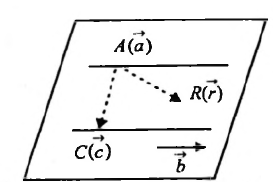
Let the plane pass through parallel lines \(\vec{r}=\vec{a}+\lambda \vec{b}\) and \(\vec{r}=\vec{c}+\mu \vec{b}\). As shown in the diagram, for any position of \(R\) in the plane, vectors \(\overrightarrow{R A}\), \(\overrightarrow{A C}\) and \(\vec{b}\) are coplanar. Then \([\vec{r}-\vec{a} \vec{c}-\vec{a} \vec{b}]=0\), which is the required equation of the plane.
Equation of a Plane Parallel to a Given Plane
The general equation of the plane parallel to the plane \(a x+b y+c z+d=0\) is \(a x+b y+c z+k=0\), where \(k\) is any scalar, as normal to both the planes is \(a \hat{i}+b \hat{j}+c \hat{k}\).
Example 36: Find the equation of the plane passing through \((3,4,-1)\), which is parallel to the plane
\(
\vec{r} \cdot(2 \hat{i}-3 \hat{j}+5 \hat{k})+7=0
\)
Solution: The equation of any plane which is parallel to \(\vec{r} \cdot(2 \hat{i}-3 \hat{j}+5 \hat{k})+7=0\) is
\(
\vec{r} \cdot(2 \hat{i}-3 \hat{j}+5 \hat{k})+\lambda=0 \dots(i)
\)
or \(\quad 2 x-3 y+5 z+\lambda=0\)
Further (i) will pass through \((3,4,-1)\) if (2) (3) \(+(-3)(4)+5(-1)+\lambda=0\) or \(-11+\lambda=0\) or \(\lambda=11\)
Thus, equation of the required plane is \(\vec{r} \cdot(2 \hat{i}-3 \hat{j}+5 \hat{k})+11=0\).
Angle between Two Planes
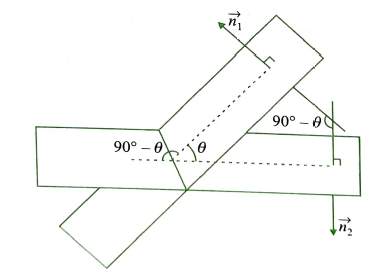
The angle between two planes is defined as the angle between their normals.
Let \(\theta\) be the angle between planes \(\vec{r} \cdot \overrightarrow{n_1}=d_1\) and \(\vec{r} \cdot \overrightarrow{n_2}=d_2\). Then
\(
\cos \theta=\frac{\overrightarrow{n_1} \cdot \overrightarrow{n_2}}{\left|\overrightarrow{n_1}\right|\left|\overrightarrow{n_2}\right|}
\)
Condition for Perpendicularity
If the planes \(\vec{r} \cdot \vec{n}_1=d_1\) and \(\vec{r} \cdot \vec{n}_2=d_2\) are perpendicular, then \(\vec{n}_1\) and \(\vec{n}_2\) are perpendicular. Therefore, \(\overrightarrow{n_1} \cdot \overrightarrow{n_2}=0\)
Condition for Parallelism
If the planes \(\vec{r} \cdot \vec{n}_1=d_1\) and \(\vec{r} \cdot \vec{n}_2=d_2\) are parallel, there exists the scalar \(\lambda\) such that \(\overrightarrow{n_1}=\lambda \overrightarrow{n_2}\).
Cartesian Form
If the planes are \(a_1 x+b_1 y+c_1 z+d_1=0\) and \(a_2 x+b_2 y+c_2 z+d_2=0\), then
\(
\cos \theta=\frac{a_1 a_2+b_1 b_2+c_1 c_2}{\sqrt{a_1^2+b_1^2+c_1^2} \sqrt{a_2^2+b_2^2+c_2^2}}
\)
Condition for parallelism: \(\frac{a_1}{a_2}=\frac{b_1}{b_2}=\frac{c_1}{c_2}=\lambda\)
Condition for perpendicularity: \(a_1 a_2+b_1 b_2+c_1 c_2=0\)
Example 37: Find the angle between the planes \(2 x+y-2 x+3=0\) and \(\vec{r} \cdot(6 \hat{i}+3 \hat{j}+2 \hat{k})=5\).
Solution: Normals along the given planes are \(2 \hat{i}+\hat{j}-2 \hat{k}\) and \(6 \hat{i}+3 \hat{j}+2 \hat{k}\).
Then angle between planes, \(\theta=\cos ^{-1} \frac{(2 \hat{i}+\hat{j}-2 \hat{k}) \cdot(6 \hat{i}+3 \hat{j}+2 \hat{k})}{\sqrt{(2)^2+(1)^2+(-2)^2} \sqrt{(6)^2+(3)^2+(2)^2}}=\cos ^{-1} \frac{11}{21}\)
Example 38: Show that \(a x+b y+r=0, b y+c z+p=0\) and \(c z+a x+q=0\) are perpendicular to \(x-y\). \(y-z\) and \(z-x\) planes, respectively.
Solution: The planes \(a_1 x+b_1 y+c_1 z+d_1=0\) and \(a_2 x+b_2 y+c_2 z+d_2=0\) are perpendicular to each other if and only if \(a_1 a_2+b_1 b_2+c_1 c_2=0\).
The equation of \(x-y, y-z\) and \(z-x\) planes are \(z=0, x=0\) and \(y=0\), respectively.
Now we have to show that \(z=0\) is perpendicular to \(a x+b y+r=0\).
It follows immediately, since \(a(0)+b(0)+(0)(1)=0\), other parts can be done similarly.
LINE OF INTERSECTION OF TWO PLANES
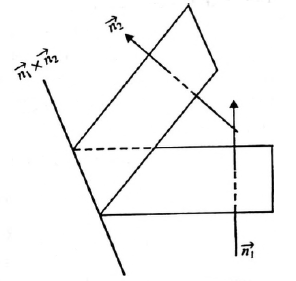
Let two non-parallel planes be \(\vec{r} \cdot \vec{n}_1=d_1\) and \(\vec{r} \cdot \vec{n}_2=d_2\)
Now line of intersection of planes is perpendicular to vectors \(\vec{n}_1\) and \(\vec{n}_2\).
Therefore, line of intersection is parallel to vector \(\overrightarrow{n_1} \times \overrightarrow{n_2}\).
If we wish to find the equation of line of intersection of planes \(a_1 x \div b_y y+c_1 z-d_1=0\) and \(a_2 x+b_y y+c_2 z-d_2=0\), then we find any point on the line by putting \(z=0\) (say), then we can find corresponding values of \(x\) and \(y\) by solving equations \(a_1 x+b_1 y-d_1=0\) and \(a_2 x+b_2 y-d_2 =0\). Thus, by fixing the value of \(z=\lambda\), we can find the corresponding value of \(x\) and \(y\) in terms of \(\lambda\). After getting \(x, y\) and \(z\) in terms of \(\lambda\), we can find the equation of line in symmetric form.
Example 39: Reduce the equation of line \(x-y+2 z=5\) and \(3 x+y+z=6\) in symmetrical form.
or
Find the line of intersection of planes \(x-y+2 z=5\) and \(3 x+y+z=6\).
Solution: Given \(x-y+2 z=5,3 x+y+z=6\).
Let \(\quad z=\lambda\)
Then \(x-y=5-2 \lambda\) and \(3 x+y=6-\lambda\).
Solving these two equations, \(4 x=11-3 \lambda\) and \(4 y=4 x-20+8 \lambda=-9+5 \lambda\).
The equation of the line is \(\frac{4 x-11}{-3}=\frac{4 y+9}{5}=\frac{z-0}{1}\).
Example 40: Find the angle between the lines \(x-3 y-4=0,4 y-z+5=0\) and \(x+3 y-11=0,2 y-z+6=0\).
Solution: Line \(x-3 y-4=0=4 y-z+5\) is line of intersection of planes \(x-3 y-4=0\) and \(4 y-z+5=0\).
Vector along the line of intersection is \(\left|\begin{array}{ccc}\hat{i} & \hat{j} & \hat{k} \\ 1 & -3 & 0 \\ 0 & 4 & -1\end{array}\right|=3 \hat{i}+\hat{j}+4 \hat{k}=\vec{a}\)
Line \(x+3 y-11=0=2 y-z+6\) is line of intersection of planes \(x+3 y-11=0\) and \(2 y-z+6=0\).
Vector along line of intersection is \(\left|\begin{array}{ccc}\hat{i} & \hat{j} & \hat{k} \\ 1 & 3 & 0 \\ 0 & 2 & -1\end{array}\right|=-3 \hat{i}+\hat{j}+2 \hat{k}=\vec{b}\)
\(
\vec{a} \cdot \vec{b}=(3)(-3)+(1)(1)+(4)(2)=0
\)
Therefore, lines are perpendicular.
Example 41: If the line \(x=y=z\) intersect the line \(\sin A \cdot x+\sin B \cdot y+\sin C \cdot z=2 d^2, \sin 2 A \cdot x+\sin 2 B \cdot y +\sin 2 C \cdot z=d^2\), then find the value of \(\sin \frac{A}{2} \cdot \sin \frac{B}{2} \cdot \sin \frac{C}{2}\), where \(A, B, C\) are the angles of a triangle.
Solution: Any point on the line \(x=y=z\) is \((\lambda, \lambda, \lambda)\)
This point lies on the planes
\(
\begin{array}{ll}
& \sin A \cdot x+\sin B \cdot y+\sin C \cdot z=2 d^2 \\
\text { and } & \sin 2 A \cdot x+\sin 2 B \cdot y+\sin 2 C \cdot z=d^2 \\
\therefore & \sin A \lambda+\sin B \lambda+\sin C \lambda=2 d^2 \\
\text { and } & \sin 2 A \lambda+\sin 2 B \lambda+\sin 2 C \lambda=d^2
\end{array}
\)
Eliminating \(d^2\), we get
\(
\sin A+\sin B+\sin C=2(\sin 2 A+\sin 2 B \cdot+\sin 2 C)
\)
\(\begin{aligned} & 4 \cos \frac{A}{2} \cos \frac{B}{2} \cos \frac{C}{2}=8 \sin A \sin B \sin C \\ & \sin \frac{A}{2} \sin \frac{B}{2} \sin \frac{C}{2}=\frac{1}{16}\end{aligned}\)
Example 42: Find the point of intersection of line passing through \((0,0,1)\) and intersecting lines \(x+2 y+z=1\), \(-x+y-2 z=2\) and \(x+y=2, x+z=2\) with the \(x y\) plane.
Solution: Equation of line is
\(
\begin{aligned}
& x+2 y+z-1+\lambda(-x+y-2 z-2)=0 \\
& x+y-2+\mu(x+z-2)=0
\end{aligned}
\)
This line passes through the point \((0,0,1)\). Thus,
\(
\lambda=0, \mu=-2
\)
Hence, equation of line is \(x+2 y+z-1=0=-x+y-2 z+2\)
For its point of intersection with \(x y\) plane, put \(z=0\).
\(
\therefore \quad x+2 y=1,-x+y+2=0
\)
Solving we get point of intersection as \(\left(\frac{5}{3}, \frac{-1}{3}, 0\right)\)
Example 43: A horizontal plane \(4 x-3 y+7 z=0\) is given. Find a line of greatest slope passes through the point \((2,1,1)\) in the plane \(2 x+y-5 z=0\).
Solution: The required line through the point \(P(2,1,1)\) in the plane \(2 x+y-5 z=0\) and of greatest slope is perpendicular to line of intersection of the planes
\(
2 x+y-5 z=0 \text { and } 4 x-3 y+7 z=0
\)
Vector along line of intersection of planes is
\(
\left|\begin{array}{ccc}
\hat{i} & \hat{j} & \hat{k} \\
2 & 1 & -5 \\
4 & -3 & 7
\end{array}\right|=-8 \hat{i}-34 \hat{j}-10 \hat{k}
\)
Then equation of line is \(\frac{x-2}{-8}=\frac{y-1}{-34}=\frac{z-1}{-10}\) or \(\frac{x-2}{4}=\frac{y-1}{17}=\frac{z-1}{5}\)
Example 44: Find the equation of the plane passing through the points \((-1,1,1)\) and \((1,-1,1)\) and perpendicular to the plane \(x+2 y+2 z=5\).
Solution: The equation of any plane which passes through \((-1,1,1)\) is
\(
a(x+1)+b(y-1)+c(z-1)=0 \dots(i)
\)
This plane will pass through \((1,-1,1)\) if
\(
2 a-2 b=0 \text { or } a=b \dots(ii)
\)
Next, (i) will be perpendicular to \(x+2 y+2 z=5\) if
\(
a+2 b+2 c=0 \dots(iii)
\)
Using (ii), we can write (iii) as \(a+2 a+2 c=0\) or \(c=-3 a / 2\). Thus,
\(
a: b: c=a: a:\left(\frac{-3}{2}\right) a=2: 2:-3
\)
Putting these values in (i), we get \(2(x+1)+2(y-1)-3(z-1)=0\) or \(2 x+2 y-3 z+3=0\), which is the equation of the required plane.
Alternate method:
The plane is passing through the points \(A(-1,1,1)\) and \(B(1,-1,1)\).
Let any point on the plane be \(P(x, y, z)\).
Then vector \(\overrightarrow{A P} \times \overrightarrow{A B}\) is perpendicular to vector \(\hat{i}+2 \hat{j}+2 \hat{k}\), which is normal to the plane \(x+2 y+2 z=5\).
Hence, the equation of the plane is \(\left|\begin{array}{ccc}x-(-1) & y-1 & z-1 \\ 1-(-1) & -1-1 & 1-1 \\ 1 & 2 & 2\end{array}\right|=0\) or \(2 x+2 y-3 z+3=0\)
Example 45: Find the equation of the plane containing line \(\frac{x+1}{-3}=\frac{y-3}{2}=\frac{z+2}{1}\) and point \((0,7,-7)\).
Solution: The equation of the plane containing line \(\frac{x+1}{-3}=\frac{y-3}{2}=\frac{z+2}{1}\) is
\(
\begin{aligned}
& a(x+1)+b(y-3)+c(z+2)=0 \dots(i) \\
& \text { where } -3 a+2 b+c=0 \dots(ii)
\end{aligned}
\)
This passes through \((0,7,-7)\). Thus,
\(
a+4 b-5 c=0 \dots(iii)
\)
From (ii) and (iii), \(\frac{a}{-14}=\frac{b}{-14}=\frac{c}{-14}\) or \(\frac{a}{1}=\frac{b}{1}=\frac{c}{1}\)
So, the required plane is \(x+y+z=0\).
Example 46: Find the distance of the point \(P(3,8,2)\) from the line \(\frac{1}{2}(x-1)=\frac{1}{4}(y-3)=\frac{1}{3}(z-2)\) measured parallel to the plane \(3 x+2 y-2 z+15=0\).
Solution:
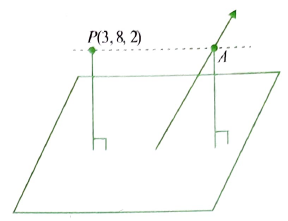
Let the general point of the line be \(A(2 \lambda+1,4 \lambda+3,3 \lambda+2)\). Let this point lie on the line such that \(A P\) is parallel to the plane. Then
\(
\begin{array}{ll}
& \overrightarrow{A P} \perp(3 \hat{i}+2 \hat{j}-2 \hat{k}) \\
\text { or } & 3 \cdot(2 \lambda-2)+2(4 \lambda-5)-2(3 \lambda)=0 \\
\text { or } & \lambda=2
\end{array}
\)
Therefore, \(A\) is \((5,11,8)\).
\(
\begin{aligned}
P A & =\sqrt{(5-3)^2+(11-8)^2+(8-2)^2} \\
& =\sqrt{4+9+36}=7
\end{aligned}
\)
Example 47: Find the distance of the point (1, 0, – 3) from the plane \(\boldsymbol{x}-\boldsymbol{y}-\boldsymbol{z}=9\) measured parallel to the line \(\frac{x-2}{2}=\frac{y+2}{3}=\frac{z-6}{-6}\).
Solution:
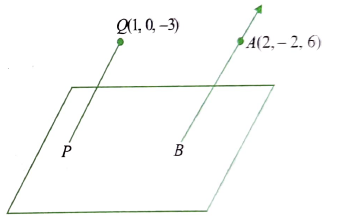
The given plane is \(x-y-z=9 \dots(i)\)
The given line \(A B\) is \(\frac{x-2}{2}=\frac{y+2}{3}=\frac{z-6}{-6} \dots(ii)\)
The equation of the line passing through \((1,0,-3)\) and parallel to \(\frac{x-2}{2}=\frac{y+2}{3}=\frac{z-6}{-6}\) is
\(
\frac{x-1}{2}=\frac{y-0}{3}=\frac{z+3}{-6}=r \dots(iii)
\)
Coordinate of any point on (iii) may be given as \(P(2 r+1,3 r,-6 r-3)\). If \(P\) is the point of the intersection of (i) and (iii), then it must lie on (i). Therefore,
\(
\begin{aligned}
& (2 r+1)-(3 r)-(-6 r-3)=9 \\
& 2 r+1-3 r+6 r+3=9 \text { or } r=1
\end{aligned}
\)
Therefore, the coordinates of \(P\) are \(3,3,-9\).
Distance between \(Q(1,0,-3)\) and \(P(3,3,-9)=\sqrt{(3-1)^2+(3-0)^2+(-9+3)^2}\)
\(
=\sqrt{4+9+36}=7
\)
Example 48: Find the equation of the projection of the line \(\frac{x-1}{2}=\frac{y+1}{-1}=\frac{z-3}{4}\) on the plane \(x+2 y+z=9\).
Solution: Projection of given line \(L \equiv \frac{x-1}{2}=\frac{y+1}{-1}=\frac{z-3}{4}\) on given plane \(P \equiv x+2 y+z=9\) is the line of intersection of plane \(P\) and plane \((A B C D)\) through the line \(L\) and perpendicular to the plane \(P\).
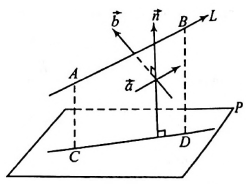
Now line \(L\) is parallel to vector \(\vec{a}=2 \hat{i}-\hat{j}+4 \hat{k} \dots(i)\)
Vector normal to plane \(P\) is \(\vec{n}=\hat{i}+2 \hat{j}+\hat{k} \dots(ii) \)
\(\therefore\) Vector normal plane \(A B C D\) is \(\vec{b}=\vec{a} \times \vec{n}=\left|\begin{array}{ccc}\hat{i} & \hat{j} & \hat{k} \\ 2 & -1 & 4 \\ 1 & 2 & 1\end{array}\right|=-9 \hat{i}+2 \hat{j}+5 \hat{k}\)
Plane \(A B C D\) passes through the line \(L\), i.e., passes through the point \((1,-1,3)\). Thus,
Equation of plane \(A B C D=(-9)(x-1)+2(y+1)+5(z-3)=0\) or \(9 x-2 y-5 z+4=0 \dots(iii)\)
Now required projection is line of intersection of given plane \(P\) and plane \(A B C D\)
\(
x+2 y+z-9=9 x-2 y-5 z+4
\)
Angle between a Line and a Plane
The angle between a line and a plane is the complement of the angle between the line and the normal to the plane.
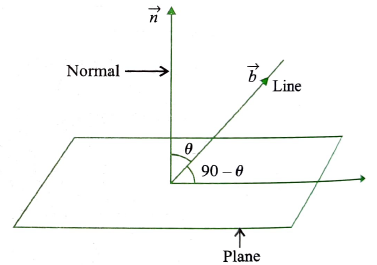
If the equation of the line is \(\vec{r}=\vec{a}+\lambda \vec{b}\) and that of the plane is \(\vec{r} \cdot \vec{n}=d\), then angle \(\theta\) between the line and the normal to the plane is \(\cos \theta=\left|\frac{\vec{b} \cdot \vec{n}}{|\vec{b}||\vec{n}|}\right|\).
So the angle \(\phi\) between the line and the plane is given by \(90^{\circ}-\theta\). Thus,
\(
\sin \phi=\left|\frac{\vec{b} \cdot \vec{n}}{|\vec{b}||\vec{n}|}\right| \text { or } \phi=\sin ^{-1}\left|\frac{\vec{b} \cdot \vec{n}}{|\vec{b}||\vec{n}|}\right|
\)
Line \(\vec{r}=\vec{a}+\lambda \vec{b}\) and plane \(\vec{r} \cdot \vec{n}=d\) are perpendicular if \(\vec{b}=\lambda \vec{n}\) or \(\vec{b} \times \vec{n}=\overrightarrow{0}\) and parallel if \(\vec{b} \perp \vec{n}\) or \(\vec{b} \cdot \vec{n}=0\).
Example 49: Find the angle between the line \(\vec{r}=\hat{i}+2 \hat{j}-\hat{k}+\lambda(\hat{i}-\hat{j}+\hat{k})\) and the plane \(\vec{r} \cdot(2 \hat{i}-\hat{j}+\hat{k})=4\).
Solution: We know that if \(\theta\) is the angle between the lines \(\vec{r}=\vec{a}+\lambda \vec{b}\) and \(\vec{r} \cdot \vec{n}=p\), then \(\sin \theta=\left|\frac{\vec{b} \cdot \vec{n}}{|\vec{b}||\vec{n}|}\right|\) Therefore, if \(\theta\) is the angle between \(\vec{r}=\hat{i}+2 \hat{j}-\hat{k}+\lambda(\hat{i}-\hat{j}+\hat{k})\) and \(\vec{r} \cdot(2 \hat{i}-\hat{j}+\hat{k})=4\), then
\(
\sin \theta=\left|\frac{(\hat{i}-\hat{j}+\hat{k}) \cdot(2 \hat{i}-\hat{j}+\hat{k})}{|\hat{i}-\hat{j}+\hat{k}||2 \hat{i}-\hat{j}+\hat{k}|}\right|
\)
\(
\begin{aligned}
&=\frac{2+1+1}{\sqrt{1+1+1} \sqrt{4+1+1}} \\
&=\frac{4}{\sqrt{3} \sqrt{6}}=\frac{4}{3 \sqrt{2}} \\
& \theta=\sin ^{-1}\left(\frac{4}{3 \sqrt{2}}\right)
\end{aligned}
\)
Equation of a Plane Passing through the Line of Intersection of Two Planes
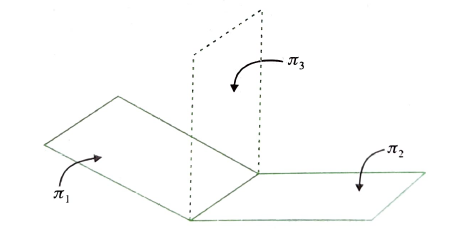
Let \(\pi_1\) and \(\pi_2\) be two planes with equations \(\vec{r} \cdot \hat{n}_1=d_1\) and \(\vec{r} \cdot \hat{n}_2=d_2\), respectively. The position vector of any point on the line of intersection must satisfy both the equations.
If \(\vec{t}\) is the position vector of a point on the line, then
\(
\vec{t} \cdot \hat{n}_1=d_1 \text { and } \vec{t} \cdot \hat{n_2}=d_2
\)
Therefore, for all real values of \(\lambda\), we have
\(
\vec{t} \cdot\left(\hat{n}_1+\lambda \hat{n}_2\right)=d_1+\lambda d_2 \dots(i)
\)
Since \(\vec{t}\) is arbitrary, it satisfies for any point on the line.
Hence, the equation \(\vec{r} \cdot\left(\overrightarrow{n_1}+\lambda \overrightarrow{n_2}\right)=d_1+\lambda d_2\) represents a plane \(\pi_1\) which is such that if any vector \(r\) satisfies \(b_{0 \text { th }}\) the equations \(\pi_1\) and \(\pi_2\), it also satisfies the equation \(\pi_3\).
Cartesian Form
In Cartesian system, let \(\vec{n_1}=A_1 \hat{i}+B_1 \hat{j}+C_1 \hat{k}, \vec{n_2}=A_2 \hat{i}+B_2 \hat{j}+C_2 \hat{k}\) and \(\vec{r}=x \hat{i}+y \hat{j}+z \hat{k}\). Then (i) becomes
\(
\begin{aligned}
& x\left(A_1+\lambda A_2\right)+y\left(B_1+\lambda B_2\right)+z\left(C_1+\lambda C_2\right)=d_1+\lambda d_2 \\
& \left(A_1 x+B_1 y+C_1 z-d_1\right)+\lambda\left(A_2 x+B_2 y+C_2 z-d_2\right)=0 \dots(ii)
\end{aligned}
\)
which is the required Cartesian form of the equation of the plane passing through the intersection of the given planes for each value of \(\lambda\).
Example 50: Find the equation of the plane which contains the line of intersection of the planes \(\vec{r} \cdot(\hat{i}+2 \hat{j}+3 \hat{k})-4=0\) and \(\vec{r} \cdot(2 \hat{i}+\hat{j}-\hat{k})+5=0\) and which is perpendicular to the plane \(\vec{r} \cdot(5 \hat{i}+3 \hat{j}-6 \hat{k})+8=0\).
Solution: The equation of the given planes are
\(
\begin{aligned}
& \vec{r} \cdot(\hat{i}+2 \hat{j}+3 \hat{k})-4=0 \dots(i) \\
& \vec{r} \cdot(2 \hat{i}+\hat{j}-\hat{k})+5=0 \dots(ii)
\end{aligned}
\)
The equation of the plane passing through the line of intersection of the plane given in (i) and (ii) is
\(
\begin{aligned}
& {[\vec{r} \cdot(\hat{i}+2 \hat{j}+3 \hat{k})-4]+\lambda[\vec{r} \cdot(2 \hat{i}+\hat{j}-\hat{k})+5]=0} \\
& \vec{r} \cdot[(2 \lambda+1) \hat{i}+(\lambda+2) \hat{j}+(3-\lambda) \hat{k}]+(5 \lambda-4)=0 \dots(iii)
\end{aligned}
\)
The plane in (iii) is perpendicular to the plane, \(\vec{r} \cdot(5 \hat{i}+3 \hat{j}-6 \hat{k})+8=0\). Thus,
\(
5(2 \lambda+1)+3(\lambda+2)-6(3-\lambda)=0
\)
\(
19 \lambda-7=0
\)
\(
\lambda=\frac{7}{19}
\)
Substituting \(\lambda=\frac{7}{19}\) in (iii), we get
\(
\vec{r} \cdot\left[\frac{33}{19} \hat{i}+\frac{45}{19} \hat{j}+\frac{50}{19} \hat{k}\right]-\frac{41}{19}=0
\)
\(
\vec{r} \cdot(33 \hat{i}+45 \hat{j}+50 \hat{k})-41=0
\)
\(
33 x+45 y+50 z-41=0
\)
Example 51: Find the equation of a plane containing the line of intersection of the planes \(x+y+z -6=0\) and \(2 x+3 y+4 z+5=0\) and passing through \((1,1,1)\).
Solution: The equation of a plane passing through the line of intersection of the given planes is
\(
(x+y+z-6)+\lambda(2 x+3 y+4 z+5)=0 \dots(i)
\)
If it is passes through \((1,1,1),(1+1+1-6)+\lambda(2+3+4+5)=0\), then
\(
\lambda=\frac{3}{14}
\)
Putting \(\lambda=3 / 14\) in (i), we get
\(
\begin{aligned}
& (x+y+z-6)+\frac{3}{14}(2 x+3 y+4 z+5)=0 \\
& 20 x+23 y+26 z-69=0
\end{aligned}
\)
Example 52: The plane \(a x+b y=0\) is rotated through an angle \(\alpha\) about its line of intersection with the plane \(z=0\). Show that the equation to the plane in the new position is \(a x+b y \pm z \sqrt{a^2+b^2} \tan \alpha=0\).
Solution: Given planes are \(a x+b y=0 \dots(i)\)
\(
z=0 \dots(ii)
\)
Therefore, the equation of any plane passing through the line of intersection of planes (i) and (ii) may be taken as
\(
a x+b y+k z=0 \dots(iii)
\)
The direction cosines of a normal to the plane (iii) are
\(
\frac{a}{\sqrt{a^2+b^2+k^2}}, \frac{b}{\sqrt{a^2+b^2+k^2}} \text { and } \frac{k}{\sqrt{a^2+b^2+k^2}}
\)
The direction cosines of a normal to the plane (i) are
\(
\frac{a}{\sqrt{a^2+b^2}}, \frac{b}{\sqrt{a^2+b^2}} \text { and } 0
\)
Since the angle between the planes (i) and (iii) is \(\alpha\), we have
\(
\cos \alpha=\frac{a \cdot a+b \cdot b+k \cdot 0}{\sqrt{a^2+b^2+k^2} \sqrt{a^2+b^2}}=\sqrt{\frac{a^2+b^2}{a^2+b^2+k^2}}
\)
\(
k^2 \cos ^2 \alpha=a^2\left(1-\cos ^2 \alpha\right) \div b^2\left(1-\cos ^2 \alpha\right)
\)
\(
k^2=\frac{\left(a^2+b^2\right) \sin ^2 \alpha}{\cos ^2 \alpha} \text { or } k= \pm \sqrt{a^2+b^2} \tan \alpha
\)
Putting this in (iii), we get the equation of the plane as \(a x+b y \pm z \sqrt{a^2+b^2} \tan \alpha=0\)
DISTANCE OF A POINT FROM A PLANE
Vector Form
Let \(\pi(\vec{r} \cdot \vec{n}=d)\) be the given plane and \(P(\vec{a})\) be the given point.
Let \(P M\) be the length of the perpendicular from \(P\) to the plane \(\pi\).
Since line \(P M\) passes through \(P(\vec{a})\) and is parallel to vector \(\vec{n}\), which is normal to the plane \(\pi\), the vector equation of line \(P M\) is \(\vec{r}=\vec{a}+\lambda \vec{n} \dots(i)\)
Point \(M\) is the intersection of (i) and the given plane \(\pi\). Therefore,
\(
(\vec{a}+\lambda \vec{n}) \cdot \vec{n}=d
\)
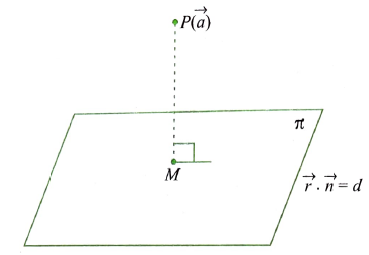
\(
\begin{aligned}
& \vec{a} \cdot \vec{n}+\lambda \vec{n} \cdot \vec{n}=d \\
& \lambda=\frac{d-(\vec{a} \cdot \vec{n})}{|\vec{n}|^2}
\end{aligned}
\)
Putting the value of \(\lambda\) in (i), we obtain the position vector of \(M\) given by
\(
\vec{r}=\vec{a}+\left(\frac{d-\vec{a} \cdot \vec{n}}{|\vec{n}|^2}\right) \vec{n}
\)
\(\overrightarrow{P M}=\) P.V. of \(M-\) P.V. of \(P\)
\(
\begin{aligned}
& =\vec{a}+\left(\frac{d-(\vec{a} \cdot \vec{n})}{|\vec{n}|^2}\right) \vec{n}-\vec{a} \\
& =\left(\frac{d-(\vec{a} \cdot \vec{n})}{|\vec{n}|^2}\right) \vec{n}
\end{aligned}
\)
\(P M=|\overrightarrow{P M}|=\left|\frac{(d-\vec{a} \cdot \vec{n}) \vec{n}}{|\vec{n}|^2}\right|=\frac{|d-(\vec{a} \cdot \vec{n})||\vec{n}|}{|\vec{n}|^2}=\frac{|d-(\vec{a} \cdot \vec{n})|}{|\vec{n}|}\), which is the required length.
Cartesian Form
Let \(P M\) be the length of the perpendicular from a point \(P\left(x_1, y_1, z_1\right)\) to the plane \(a x+b y+c z+d=0\).
Then the equation of \(P M\) is \(\frac{x-x_1}{a}=\frac{y-y_1}{b}=\frac{z-z_1}{c}=r \text { (let) } \dots(i)\)
The coordinates of any point on this line are ( \(x_1+a r, y_1+b r, z_1+c r\) ).
Thus, the point coincides with \(M\) if and only if it lies on the plane, i.e.,
\(
\begin{aligned}
& a\left(x_1+a r\right)+b\left(y_1+b r\right)+c\left(z_1+c r\right)+d=0 \\
& r=-\frac{\left(a x_1+b y_1+c z_1+d\right)}{a^2+b^2+c^2} \dots(ii)
\end{aligned}
\)
Now,
\(
\begin{aligned}
P M & =\sqrt{\left(x_1+a r-x_1\right)^2+\left(y_1+b r-y_1\right)^2+\left(z_1+c r-z_1\right)^2} \\
& =\sqrt{\left(a^2+b^2+c^2\right) r^2} \\
& =\sqrt{a^2+b^2+c^2}|r| \\
& =\sqrt{a^2+b^2+c^2}\left|\frac{-\left(a x_1+b y_1+c z_1+d\right)}{a^2+b^2+c^2}\right| \quad \text { [from (ii)] }\\
& =\frac{\left|\left(a x_1+b y_1+c z_1+d\right)\right|}{\sqrt{a^2+b^2+c^2}}
\end{aligned}
\)
Also, if coordinates of \(M\) are \(\left(x_2, y_2, z_2\right)\), then
\(
\frac{x_2-x_1}{a}=\frac{y_2-y_1}{b}=\frac{z_2-z_1}{c}=-\frac{\left(a x_1+b y_1+c z_1+d\right)}{a^2+b^2+c^2} \dots(iii)
\)
Image of a Point in a Plane
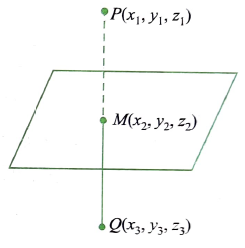
Here \(Q\) is the image of \(P\) in the plane.
Therefore, \(M\) is the midpoint of \(P Q\).
Therefore, from (iii), we have
\(
\begin{aligned}
\frac{\frac{x_3+x_1}{2}-x_1}{a} & =\frac{\frac{y_3-y_1}{2}-y_1}{b}=\frac{\frac{z_3-z_1}{2}-z_1}{c} \\
& =-\frac{\left(a x_1+b y_1+c z_1+d\right)}{a^2+b^2+c^2}
\end{aligned}
\)
\(
\frac{x_3-x_1}{a}=\frac{y_3-y_1}{b}=\frac{z_3-z_1}{c}=\frac{-2\left(a x_1+b y_1+c z_1+d\right)}{a^2+b^2+c^2}
\)
DISTANCE BETWEEN PARALLEL PLANES
The distance between two parallel planes \(a x+b y+c z+d_1=0\) and \(a x+b y+c z+d_2=0\) is given by
\(
d=\left|\frac{\left(d_2-d_1\right)}{\sqrt{a^2+b^2+c^2}}\right|
\)
Proof:
Let \(P\left(x_1, y_1, z_1\right)\) be point on plane \(a x+b y+c z+d_1=0\).
Then distance of this point from plane \(a x+b y+c z+d_2=0\) is
Also \(d=\frac{\left|a x_1+b y_1+c z_1+d_2\right|}{\sqrt{a^2+b^2+c^2}}\)
\(
\Rightarrow \quad d=\frac{\left|d_2-d_1\right|}{\sqrt{a^2+b^2+c^2}}
\)
Example 53: Find the length and the foot of the perpendicular from the point \((7,14,5)\) to the plane \(2 x+4 y-z=2\).
Solution: The required length \(=\frac{2(7)+4(14)-(5)-2}{\sqrt{2^2+4^2+1^2}}=\frac{14+56-5-2}{\sqrt{4+16+1}}=\frac{63}{\sqrt{21}}\)
Let the coordinates of the foot of the perpendicular from the point \(P(7,14,5)\) be \(M(\alpha, \beta, \gamma)\).
Then the direction ratios of \(P M\) are \(\alpha-7, \beta-14\) and \(\gamma-5\).
Therefore, the direction ratios of the normal to the plane are \(\alpha-7, \beta-14\) and \(\gamma-5\).
But the direction ratios of normal to the given plane \(2 x+4 y-z=2\) are 2,4 and -1 . Hence,
\(
\frac{\alpha-7}{2}=\frac{\beta-14}{4}=\frac{\gamma-5}{-1}=k
\)
\(\therefore \quad \alpha=2 k+7, \beta=4 k+14\) and \(\gamma=-k+5 \dots(i)\)
Since \(\alpha, \beta\) and \(\gamma\) lie on the plane \(2 x+4 y-z=2,2 \alpha+4 \beta-\gamma=2\)
or \(\quad 2(7+2 k)+4(14+4 k)-(5-k)=2\)
or \(14+4 k+56+16 k-5+k=2\)
or \(\quad 21 k=-63\)
or \(\quad k=-3\)
Now, putting \(k=-3\) in (i), we get
\(
\alpha=1, \beta=2, \gamma=8
\)
Hence, the foot of the perpendicular is \((1,2,8)\).
Example 54: Find the locus of a point, the sum of squares of whose distances from the planes \(x-z =0, x-2 y+z=0\) and \(x+y+z=0\) is 36.
Solution: Given planes are
\(
x-z=0, x-2 y+z=0, x+y+z=0
\)
Let the point whose locus is required be \(P(\alpha, \beta, \gamma)\).
According to question,
\(
\frac{|\alpha-\gamma|^2}{2}+\frac{|\alpha-2 \beta+\gamma|^2}{6}+\frac{|\alpha+\beta+\gamma|^2}{3}=36
\)
\(
\begin{aligned}
& 3\left(\alpha^2+\gamma^2-2 \alpha \gamma\right)+\alpha^2+4 \beta^2+\gamma^2-4 \alpha \beta-4 \beta \gamma+2 \alpha \gamma \\
& +2\left(\alpha^2+\beta^2+\gamma^2+2 \alpha \beta+2 \beta \gamma+2 \alpha \gamma\right)=36 \times 6
\end{aligned}
\)
\(
6 \alpha^2+6 \beta^2+6 \gamma^2=36 \times 6
\)
\(
\alpha^2+\beta^2+\gamma^2=36
\)
Hence, the required equation of locus is \(x^2+y^2+z^2=36\).
Example 55: A ray of light passing through the point \(A(1,2,3)\), strikes the plane \(x+y+z=12\) at \(B\) and on reflection passes through point \(C(3,5,9)\). Find the coordinates of point \(B\).
Solution: Let the image of point \(A(1,2,3)\) about \(x+y+z=12\) be \(D(p, q, r)\). Then
\(
\begin{array}{ll}
\therefore \quad & \frac{p-1}{1}=\frac{q-2}{1}=\frac{z-3}{1}=\frac{-2(1+2+3-12)}{1^2+1^2+1^2} \\
\therefore \quad & D(p, q, r) \equiv D(5,6,7)
\end{array}
\)
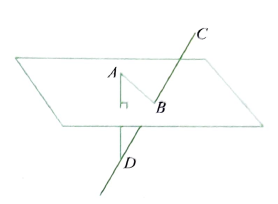
Now equation of line \(C D\) is \(\frac{x-5}{3-5}=\frac{y-6}{5-6}=\frac{z-7}{9-7}\) or \(\frac{x-5}{-2}=\frac{y-6}{-1}=\frac{z-7}{2}=\lambda\) (say)
Point \(B\) is point of intersection of \(A C\) with the plane.
Let \(B \equiv(-2 \lambda+5,-\lambda+6,2 \lambda+7)\)
This point lies on the plane. Therefore,
\(
\begin{array}{ll}
& -2 \lambda+5-\lambda+6+2 \lambda+7=12 \\
\text { or } & \lambda=6 \\
\therefore & B \equiv(-7,0,19)
\end{array}
\)
Example 56: Find the distance between the parallel planes \(x+2 y-2 z+1=0\) and \(2 x+4 y-4 z+5=0\).
Solution: We know that the distance between parallel planes \(a x+b y+c z+d_1=0\) and \(a x+b y+c z+d_2=0\) is
\(
d=\frac{\left|d_1-d_2\right|}{\sqrt{a^2+b^2+c^2}}
\)
Therefore, the distance between \(x+2 y-2 z+1=0\) and \(x+2 y-2 z+\frac{5}{2}=0\) is
\(
\frac{|(5 / 2)-1|}{\sqrt{1+4+4}}=\frac{1}{2}
\)
Example 57: Find the image of the line \(\frac{x-1}{9}=\frac{y-2}{-1}=\frac{z+3}{-3}\) in the plane \(3 x-3 y+10 z-26=0\).
Solution:
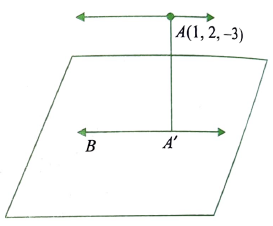
\(
\begin{aligned}
& \frac{x-1}{9}=\frac{y-2}{-1}=\frac{z+3}{-3} \dots(i)\\
& 3 x-3 y+10 z-26=0 \dots(ii)
\end{aligned}
\)
The direction ratios of the line are \(9,-1\) and -3 and direction ratios of the normal to the given plane are \(3,-3\) and 10.
Since \(9 \cdot 3+(-1)(-3)+(-3) 10=0\) and the point \((1,2,-3)\) of line (i) does not lie in plane (ii) for \(3 \cdot 1-3 \cdot 2+10 \cdot(-3)-26 \neq 0\), line (i) is parallel to plane (ii).
Let \(A^{\prime}\) be the image of point \(A(1,2,-3)\) in plane (ii). Then the image of the line (i) in the plane (ii) is the line through \(A^{\prime}\) and parallel to the line (i).
Let point \(A^{\prime}\) be \((p, q, r)\). Then
\(
\frac{p-1}{3}=\frac{q-2}{-3}=\frac{r+3}{10}=-\frac{(3(1)-3(2)+10(-3)-26)}{9+9+100}=\frac{1}{2}
\)
The point is \(A^{\prime}(5 / 2,1 / 2,2)\).
The equation of line \(B A^{\prime}\) is \(\frac{x-(5 / 2)}{9}=\frac{y-(1 / 2)}{-1}=\frac{z-2}{-3}\)
EQUATION OF A PLANE BISECTING THE ANGLE BETWEEN TWO PLANES
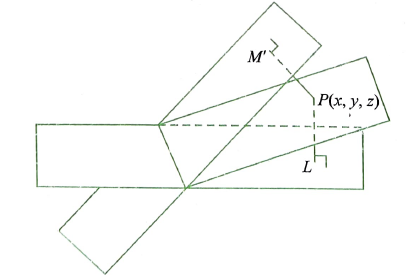
Given planes are
\(
\begin{aligned}
& a_1 x+b_1 y+c_1 z+d_1=0 \dots(i) \\
& a_2 x+b_2 y+c_2 z+d_2=0 \dots(ii)
\end{aligned}
\)
Let \(P(x, y, z)\) be a point on the plane bisecting the angle between (i) and (ii).
Let \(P L\) and \(P M\) be the length of the perpendiculars from \(P\) to planes (i) and (ii). Therefore, \(P L=P M\)
\(
\Rightarrow \quad\left|\frac{a_1 x+b_1 y+c_1 z+d_1}{\sqrt{a_1^2+b_1^2+c_1^2}}\right|=\left|\frac{a_2 x+b_2 y+c_2 z+d_2}{\sqrt{a_2^2+b_2^2+c_2^2}}\right|
\)
\(
\frac{a_1 x+b_1 y+c_1 z+d_1}{\sqrt{a_1^2+b_1^2+c_1^2}}= \pm \frac{a_2 x+b_2 y+c_2 z+d_2}{\sqrt{a_2^2+b_2^2+c_2^2}}
\)
This is the equation of the plane bisecting the angles between planes (i) and (ii).
Vector form
The equation of the plane bisecting the angle between planes \(\vec{r} \cdot \vec{n}_1=d_1\) and \(\vec{r} \cdot \vec{n}_2=d_2\) is
\(
\left|\frac{\vec{r} \cdot \overrightarrow{n_1}-d_1}{\overrightarrow{n_1}}\right|=\left|\frac{\vec{r} \cdot \overrightarrow{n_2}-d_2}{\overrightarrow{n_2}}\right|
\)
Bisector of the Angle between the Two Planes Containing the Origin
Let the equation of the two planes be
\(
\begin{aligned}
& a_1 x+b_1 y+c_1 z+d_1=0 \dots(i) \\
& \text { and } a_2 x+b_2 y+c_2 z+d_2=0 \dots(ii)
\end{aligned}
\)
where \(d_1\) and \(d_2\) are positive.
The equation of the bisector of the angle between the planes (i) and (ii) containing the origin is
\(
\frac{a_1 x+b_1 y+c_1 z+d_1}{\sqrt{a_1^2+b_1^2+c_1^2}}=\frac{a_2 x+b_2 y+c_2 z+d_2}{\sqrt{a_2^2+b_2^2+c_2^2}}
\)
Bisector of the Acute and Obtuse Angles between Two Planes
Let the two planes be
\(
\begin{aligned}
& a_1 x+b_1 y+c_1 z+d_1=0 \dots(i) \\
& a_2 x+b_2 y+c_2 z+d_2=0 \dots(ii)
\end{aligned}
\)
where \(d_1, d_2>0\)
i. If \(a_1 a_2+b_1 b_2+c_1 c_2>0\), the origin lies in the obtuse angle between the two planes and the equation of the bisector of the obtuse angle is \(\frac{a_1 x+b_1 y+c_1 z+d_1}{\sqrt{a_1^2+b_1^2+c_1^2}}=-\frac{a_2 x+b_2 y+c_2 z+d_2}{\sqrt{a_2^2+b_2^2+c_2^2}}\).
ii. If \(a_1 a_2+b_1 b_2+c_1 c_2<0\), the origin lies in the acute angle between the two planes and the equation of the bisector of the acute angle between the two planes is \(\frac{a_1 x+b_1 y+c_1 z+d_1}{\sqrt{a_1^2+b_1^2+c_1^2}}=-\frac{a_2 x+b_2 y+c_2 z+d_2}{\sqrt{a_2^2+b_2^2+c_2^2}}\).
Example 58: Find the equations of the bisectors of the angles between the planes \(2 x-y+2 z+3=0\) and \(3 x-2 y+6 z+8=0\) and specify the plane which bisects the acute angle and the plane which bisects the obtuse angle.
Solution: The given planes are \(2 x-y+2 z+3=0\) and \(3 x-2 y+6 z+8=0\), where \(d_1, d_2>0\) and \(a_1 a_2+b_1 b_2+c_1 c_2 =6+2+12>0\).
i.e.,
\(
\begin{aligned}
& \frac{a_1 x+b_1 y+c_1 z+d_1}{\sqrt{a_1^2+b_1^2+c_1^2}}=-\frac{a_2 x+b_2 y+c_2 z+d_2}{\sqrt{a_2^2+b_2^2+c_2^2}} \text { (obtuse angle bisector) }\\
& \frac{a_1 x+b_1 y+c_1 z+d}{\sqrt{a_2^2+b_2^2+c_2^2}}=\frac{a_2 x+b_2 y+c_2 z+d_2}{\sqrt{a_2^2+b_2^2+c_2^2}} \text { (acute angle bisector) } \\
& \frac{2 x-y+2 z+3}{\sqrt{4+1+4}}= \pm \frac{3 x-2 y+6 z+8}{\sqrt{9+4+36}} \\
& (14 x-7 y+14 z+21)= \pm(9 x-6 y+18 z+24)
\end{aligned}
\)
Taking the positive sign on the right hand side, we get
\(
5 x-y-4 z-3=0 \text { (obtuse angle bisector) }
\)
Taking the negative sign on the right hand side, we get
\(
23 x-13 y+32 z+45=0 \quad \text { (acute angle bisector) }
\)
TWO SIDES OF A PLANE
Let \(a x+b y+c z+d=0\) be the plane. Then the points \(\left(x_1, y_1, z_1\right)\) and \(\left(x_2, y_2, z_2\right)\) lie on the same side or the opposite sides as \(\frac{a x_1+b y_1+c z_1+d}{a x_2+b y_2+c z_2+d} >0\) or \(<0\), respectively.
Proof:
Here the equation of the plane is \(a x+b y+c z+d=0 \dots(i)\).
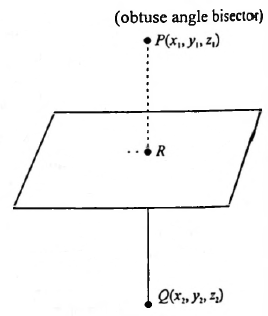
Let (i) divide the line segment joining \(P\) and \(Q\) at \(R\) internally in the ratio \(m: n\). Then
\(
R\left(\frac{m x_2+n x_1}{m+n}, \frac{m y_2+n y_1}{m+n}, \frac{m z_2+n z_1}{m+n}\right)
\)
\(R\) lies on plane (i). Therefore,
\(
\begin{aligned}
& a\left(\frac{m x_2+n x_1}{m+n}\right)+b\left(\frac{m y_2+n y_1}{m+n}\right)+c\left(\frac{m z_2+n z_1}{m+n}\right)+d=0 \\
& a\left(m x_2+n x_1\right)+b\left(m y_2+n y_1\right)+c\left(m z_2+n z_1\right)+d(m+n)=0 \\
& m\left(a x_2+b y_2+c z_2+d\right)+n\left(a x_1+b y_1+c z_1+d\right)=0 \\
& \frac{m}{n}=-\frac{\left(a x_1+b y_1+c z_1+d\right)}{\left(a x_2+b y_2+c z_2+d\right)} \dots(ii)
\end{aligned}
\)
Now, if \(a x_1+b y_1+c z_1+d\) and \(a x_2+b y_2+c z_2+d\)
are of same sign, \(\frac{m}{n}<0 \quad\) (external division)
are of opposite signs, \(\frac{m}{n}>0 \quad\) (internal division)
If \(\quad \frac{a x_1+b y_1+c z_1+d}{a x_2+b y_2+c z_2+d}>0 \quad\) (same side)
\(\frac{a x_1+b y_1+c z_1+d}{a x_2+b y_2+c z_2+d}<0 \quad\) (opposite side)
REGULAR TETRAHEDRON
A regular tetrahedron is one in which all four faces are equilateral triangles.
Angle between Any Edge and Face Not Containing That Edge of Regular Tetrahedron
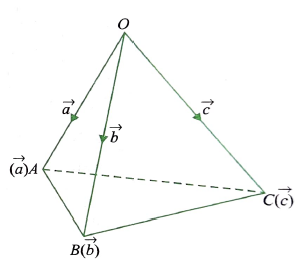
Let us find the angle between edge \(O A\) and face \(O B C\).
Since tetrahedron is regular and its face is an equilateral triangle, the required angle is the angle between vector \(\vec{a}\) and vector along angle bisector of \(\angle B O C\).
Let \(\vec{a}, \vec{b}, \vec{c}\) be the unit vectors.
Angle bisector of \(\angle B O C\) in \(\triangle O B C\) is along vector \(\vec{b}+\vec{c}\).
Therefore, required angle \(\theta\) is the angle between vectors \(\dot{a}\) and \(\vec{b}+\vec{c}\), i.e.,
Now
\(
|\vec{b}+\vec{c}|^2=b^2+c^2+2 \vec{b} \cdot \vec{c}
\)
\(
\begin{aligned}
& =1+1+2(1)(1) \cos 60^{\circ} \\
& =3
\end{aligned}
\)
\(
\begin{aligned}
& |\vec{b}+\vec{c}|=\sqrt{3} \\
& \cos \theta=\frac{1 \cdot 1 \cdot \cos 60^{\circ}+1 \cdot 1 \cdot \cos 60^{\circ}}{1 \cdot \sqrt{3}}=\frac{1}{\sqrt{3}} \\
& \theta=\cos ^{-1} \frac{1}{\sqrt{3}}
\end{aligned}
\)
Angle between the Two Faces of Regular Tetrahedron
Let us find the angle between face \(O A B\) and face \(O A C\).
Angle between faces \(O A B\) and \(O A C\) is the angle between the normal to the faces.
Normal to face \(O A B\) is \(\vec{a} \times \vec{b}\); normal to face \(O A C\) is \(\vec{a} \times \vec{c}\). Thus,
\(
\begin{aligned}
\cos \theta & =\frac{(\vec{a} \times \vec{b}) \cdot(\vec{a} \times \vec{c})}{|\vec{a} \times \vec{b}| \cdot|\vec{a} \times \vec{c}|} \\
& =\frac{\vec{a} \cdot(\vec{b} \times(\vec{a} \times \vec{c}))}{\left(1 \cdot 1 \cdot \sin 60^{\circ}\right)^2} \\
& =\frac{\vec{a} \cdot((\vec{b} \cdot \vec{c}) \vec{a}-(\vec{a} \cdot \vec{b}) \vec{c})}{\frac{3}{4}} \\
& =\frac{(\vec{a} \cdot \vec{a})(\vec{b} \cdot \vec{c})-(\vec{a} \cdot \vec{b})(\vec{a} \cdot \vec{c})}{(3 / 4)} \\
& =\frac{1\left(1 \cdot 1 \cdot \cos 60^{\circ}\right)-\left(1 \cdot 1 \cdot \cos 60^{\circ}\right)^2}{(3 / 4)} \\
& =\frac{\frac{1}{2}-\frac{1}{4}}{\frac{3}{4}}=\frac{1}{3}
\end{aligned}
\)
\(
\therefore \quad \theta=\cos ^{-1} \frac{1}{3}
\)
Height of Regular Tetrahedron
Let \(\lambda\) be the length of any edge of a regular tetrahedron.
Now \(h\) is the projection of \(O A\) on vector normal to the base \(A B C\)
Vector normal to the plane \(A B C\) is \((\vec{b}-\vec{a}) \times(\vec{c}-\vec{a})=\vec{a} \times \vec{b}+\vec{b} \times \vec{c}+\vec{c} \times \vec{a}\). Therefore,
\(
\begin{array}{ll}
\therefore & h=\frac{\vec{a} \cdot(\vec{a} \times \vec{b}+\vec{b} \times \vec{c}+\vec{c} \times \vec{a})}{|\vec{a} \times \vec{b}+\vec{b} \times \vec{c}+\vec{c} \times \vec{a}|} \\
& =\frac{\vec{a} \cdot(\vec{b} \times \vec{c})}{2(\text { Area of base })} \\
\text { Now } & |\vec{a} \cdot \vec{b}|=|\vec{b} \cdot \vec{c}|=|\vec{c} \cdot \vec{a}|=\lambda^2 \cos 60^{\circ}=\frac{\lambda^2}{2} \\
\text { and } & |\vec{a} \cdot \vec{a}|=|\vec{b} \cdot \vec{b}|=|\vec{c} \cdot \vec{c}|=\lambda^2 \\
& {[\vec{a} \vec{b} \vec{c}]^2=\left|\begin{array}{lll}
\vec{a} \cdot \vec{a} & \vec{a} \cdot \vec{b} & \vec{a} \cdot \vec{c} \\
\vec{b} \cdot \vec{a} & \vec{b} \cdot \vec{b} & \vec{b} \cdot \vec{c} \\
\vec{c} \cdot \vec{a} & \vec{c} \cdot \vec{b} & \vec{c} \cdot \vec{c}
\end{array}\right|=\frac{\lambda^6}{2}} \\
\text { Also } & \text { Area of } \triangle A B C=\frac{\sqrt{3}}{2} \lambda^2 \\
\therefore & h=\frac{\lambda^3 / \sqrt{2}}{\frac{\sqrt{3} \lambda^2}{2}}=\lambda \sqrt{\frac{2}{3}}
\end{array}
\)