1.13 NCERT Exercise Q & A
Exercise 1.1
Q1. Which of the following are sets? Justify your answer.
(i) The collection of all the months of a year beginning with the letter J.
(ii) The collection of ten most talented writers of India.
(iii) A team of eleven best-cricket batsmen of the world.
(iv) The collection of all boys in your class.
(v) The collection of all natural numbers less than 100.
(vi) A collection of novels written by the writer Munshi Prem Chand.
(vii) The collection of all even integers.
(viii) The collection of questions in this Chapter.
(ix) A collection of most dangerous animals of the world.
Answer: (i) The collection of all months of a year beginning with the letter J is a well-defined collection of objects because one can definitely identify a month that belongs to this collection.
Hence, this collection is a set.
(ii) The collection of ten most talented writers of India is not a well-defined collection because the criteria for determining a writer’s talent may vary from person to person. Hence, this collection is not a set.
(iii) A team of eleven best cricket batsmen of the world is not a well-defined collection because the criteria for determining a batsman’s talent may vary from person to person.
Hence, this collection is not a set.
(iv) The collection of all boys in your class is a well-defined collection because you can definitely identify a boy who belongs to this collection.
Hence, this collection is a set.
(v) The collection of all natural numbers less than 100 is a well-defined collection because one can definitely identify a number that belongs to this collection. Hence, this collection is a set.
(vi) A collection of novels written by the writer Munshi Prem Chand is a well-defined collection because one can definitely identify a book that belongs to this collection. Hence, this collection is a set.
(vii) The collection of all even integers is a well-defined collection because one can definitely identify an even integer that belongs to this collection. Hence, this collection is a set.
(viii) The collection of questions in this chapter is a well-defined collection because one can definitely identify a question that belongs to this chapter. Hence, this collection is a set.
(ix) The collection of most dangerous animals of the world is not a well-defined collection because the criteria for determining the dangerousness of an animal can vary from person to person.
Hence, this collection is not a set.
Q2. Let \(\mathrm{A}=\{1,2,3,4,5,6\}\). Insert the appropriate symbol \(\in\) or \(\notin\) in the blank spaces:
(i) \(5 \ldots \mathrm{~A}\)
(ii) \(8 \ldots \mathrm{~A}\)
(iii) \(0 \ldots \mathrm{~A}\)
(iv) \(4 \ldots \mathrm{~A}\)
(v) \(2 \ldots \mathrm{~A}\)
(vi) \(10 \ldots \mathrm{~A}\)
Answer: (i) \(\quad 5 \in A\)
(ii) \(8 \notin A\)
(iii) \(0 \notin A\)
(iv) \(\quad 4 \in A\)
(v) \(2 \in A\)
(vi) \(10 \notin A\)
Q3. Write the following sets in roster form:
(i) \(\mathrm{A}=\{x: x\) is an integer and \(-3 \leq x<7\}\).
(ii) \(\mathrm{B}=\{x: x\) is a natural number less than 6\(\}\).
(iii) \(\mathrm{C}=\{x: x\) is a two-digit natural number such that the sum of its digits is 8\(\}\)
(iv) \(\mathrm{D}=\{x: x\) is a prime number which is divisor of 60\(\}\).
(v) \(\mathrm{E}=\) The set of all letters in the word TRIGONOMETRY.
(vi) \(\mathrm{F}=\) The set of all letters in the word BETTER.
Solution:
(i) \(\quad \mathrm{A}=\{x: x\) is an integer and \(-3 \leq x<7\}\)
The elements of this set are \(-3,-2,-1,0,1,2,3,4,5\), and 6 only.
Therefore, the given set can be written in roster form as
\(
A=\{-3,-2,-1,0,1,2,3,4,5,6\}
\)
(ii) \(\quad \mathrm{B}=\{x: x\) is a natural number less than 6\(\}\)
The elements of this set are \(1,2,3,4\), and 5 only.
Therefore, the given set can be written in roster form as
\(
B=\{1,2,3,4,5\}
\)
(iii) \(\mathrm{C}=\{x: x\) is a two-digit natural number such that the sum of its digits is 8\(\}\)
The elements of this set are \(17,26,35,44,53,62,71\), and 80 only.
Therefore, this set can be written in roster form as
\(
C=\{17,26,35,44,53,62,71,80\}
\)
(iv) \(\quad \mathrm{D}=\{x: x\) is a prime number which is a divisor of 60\(\}\)
\(
\begin{aligned}
& 2 \underline{60} \\
& \frac{2 \mid 30}{3 \mid 15} \\
& \frac{5}{5}
\end{aligned}
\)
Hence, \(60=2 \times 2 \times 3 \times 5\)
The elements of this set are 2,3 , and 5 only.
Therefore, this set can be written in roster form as
\(
D=\{2,3,5\}
\)
(v) \(\mathrm{E}=\) The set of all letters in the word TRIGONOMETRY
There are 12 letters in the word TRIGONOMETRY, out of which letters T, R, and O are repeated.
Therefore, this set can be written in roster form as
\(
E=\{T, R, I, G, O, N, M, E, Y\}
\)
(vi) \(\mathrm{F}=\) The set of all letters in the word BETTER
There are 6 letters in the word BETTER, out of which letters E and T are repeated. Therefore, this set can be written in roster form as
\(
F=\{B, E, T, R\}
\)
Q4. Write the following sets in the set-builder form:
(i) \(\quad\{3,6,9,12\}\)
(ii) \(\quad\{2,4,8,16,32\}\)
(iii) \(\quad\{5,25,125,625\}\)
(iv) \(\quad\{2,4,6 \ldots\}\)
(v) \(\quad\{1,4,9 \ldots 100\}\)
Solution:
(i) \(\quad\{3,6,9,12\}\)
We see that
\(
\begin{aligned}
3 & =3 \times 1 \\
6 & =3 \times 2 \\
9 & =3 \times 3 \\
12 & =3 \times 4
\end{aligned}
\)
Therefore, \(\{3,6,9,12\}=\{x: x=3 n, n \in N \text { and } 1 \leq n \leq 4\}\)
(ii) \(\{2,4,8,16,32\}\)
We see that
\(
2=2^1, 4=2^2, 8=2^3, 16=2^4, 32=2^5
\)
Therefore,
\(
\{2,4,8,16,32\}=\left\{x: x=2^n, n \in N \text { and } 1 \leq n \leq 5\right\}
\)
(iii) \(\{5,25,125,625\}\)
We see that
\(
5=5^1, 25=5^2, 125=5^3, 625=5^4
\)
Therefore,
\(
\{5,25,125,625\}=\left\{x: x=5^n, n \in N \text { and } 1 \leq n \leq 4\right\}
\)
(iv) \(\quad\{2,4,6 \ldots\}\)
We see that it is a set of all even natural numbers.
Therefore,
\(
\{2,4,6 \ldots\}=\{x: x \text { is an even natural number }\}
\)
(v) \(\quad\{1,4,9 \ldots 100\}\)
We see that
\(
1=1^2, 4=2^2, 9=3^2, \ldots 100=10^2
\)
Therefore,
\(
\{1,4,9 \ldots 100\}=\left\{x: x=n^2, n \in N \text { and } 1 \leq n \leq 10\right\}
\)
Q5. List all the elements of the following sets:
(i) \(\mathrm{A}=\{x: x\) is an odd natural number \(\}\)
(ii) \(\mathrm{B}=\left\{x: x\right.\) is an integer, \(\left.-\frac{1}{2}<x<\frac{9}{2}\right\}\)
(iii) \(\mathrm{C}=\left\{x: x\right.\) is an integer, \(\left.x^2 \leq 4\right\}\)
(iv) \(\mathrm{D}=\{x: x\) is a letter in the word “LOYAL” \(\}\)
(v) \(\mathrm{E}=\{x: x\) is a month of a year not having 31 days \(\}\)
(vi) \(\mathrm{F}=\{x: x\) is a consonant in the English alphabet which proceeds k\(\}\).
Solution:
(i) \(\quad \mathrm{A}=\{x: x\) is an odd natural number \(\}\)
\(
A=\{1,3,5,7,9 \ldots\}
\)
(ii) \(\quad \mathrm{B}=\left\{x: x\right.\) is an integer; \(\left.-\frac{1}{2}<x<\frac{9}{2}\right\}\) We see that
\(
-\frac{1}{2}=-0.5 \text { and } \frac{9}{2}=4.5
\)
Therefore,
\(
B=\{0,1,2,3,4\}
\)
(iii) \(\quad \mathrm{C}=\left\{x: x\right.\) is an integer; \(\left.x^2 \leq 4\right\}\)
We see that
\(
\begin{gathered}
(0)^2=0, \quad \text { i.e., }(0)^2<4 \\
(-1)^2=1, \quad \text { i.e., }(-1)^2<4 \\
(-2)^2=4, \quad \text { i.e., }(-2)^2=4 \\
(-3)^2=9, \quad \text { i.e., }(-3)^2>9
\end{gathered}
\)
Therefore,
\(
\mathrm{C}=\{-2,-1,0,1,2\}
\)
(iv) \(\quad \mathrm{D}=(x: x\) is a letter in the word “LOYAL”)
\(
D=\{L, O, Y, A\}
\)
(v) \(\mathrm{E}=\{x: x\) is a month of a year not having 31 days \(\}\)
\(E=\{\) February, April, June, September, November \(\}\)
(vi) \(\quad \mathrm{F}=\{x: x\) is a consonant in the English alphabet which precedes \(k\}\)
Q6. Match each of the sets on the left in the roster form with the same set on the right described in set-builder form:
(i) \(\{1,2,3,6\}\)
(a) \(\{x: x\) is a prime number and a divisor of 6\(\}\)
(ii) \(\{2,3\}\)
(b) \(\{x: x\) is an odd natural number less than 10\(\}\)
(iii) \(\{\mathrm{M}, \mathrm{A}, \mathrm{T}, \mathrm{H}, \mathrm{E}, \mathrm{I}, \mathrm{C}, \mathrm{S}\}\)
(c) \(\{x: x\) is natural number and divisor of 6\(\}\)
(iv) \(\{1,3,5,7,9\}\)
(d) \(\{x: x\) is a letter of the word MATHEMATICS \(\}\)
Solution:
(i) All the elements of this set are natural numbers, as well as the divisors of 6. Therefore, (i) matches with (c).
(ii) We see that 2 and 3 are prime numbers. They are also the divisors of 6. Therefore, (ii) matches with (a).
(iii) All the elements of this set are letters of the word MATHEMATICS. Therefore, (iii) matches with (d).
(iv) All the elements of this set are odd natural numbers less than 10. Therefore, (iv) matches with (b).
Exercise 1.2
Q1. Which of the following are examples of the null set
(i) Set of odd natural numbers divisible by 2
(ii) Set of even prime numbers
(iii) \(\quad\{x: x\) is a natural numbers, \(x<5\) and \(x>7\}\)
(iv) \(\quad\{y: y\) is a point common to any two parallel lines \(\}\)
Solution:
(i) A set of odd natural numbers divisible by 2 is a null set because no odd number is divisible by 2.
(ii) A set of even prime numbers is not a null set because 2 is an even prime number.
(iii) \(\quad\{x: x\) is a natural number, \(x<5\) and \(x>7\}\) is a null set because a number cannot be simultaneously less than 5 and greater than 7.
(iv) \(\quad\{y: y\) is a point common to any two parallel lines \(\}\) is a null set because parallel lines do not intersect. Hence, they have no common point.
Q2. Which of the following sets are finite or infinite?
(i) The set of months of a year
(ii) \(\{1,2,3 \ldots\}\)
(iii) \(\{1,2,3 \ldots 99,100\}\)
(iv) The set of positive integers greater than 100
(v) The set of prime numbers less than 99
Solution:
(i) The set of months of a year is a finite set because it has 12 elements.
(ii) \(\quad\{1,2,3 \ldots\}\) is an infinite set as it has infinite number of natural numbers.
(iii) \(\{1,2,3 \ldots 99,100\}\) is a finite set because the numbers from 1 to 100 are finite.
(iv) The set of positive integers greater than 100 is an infinite set because positive integers greater than 100 are infinite in number.
(v) The set of prime numbers less than 99 is a finite set because prime numbers less than 99 are finite in number.
Q3. State whether each of the following set is finite or infinite:
(i) The set of lines which are parallel to the \(x\)-axis
(ii) The set of letters in the English alphabet
(iii) The set of numbers which are multiple of 5
(iv) The set of animals living on the earth
(v) The set of circles passing through the origin \((0,0)\)
Solution:
(i) The set of lines which are parallel to the x -axis is an infinite set because lines parallel to the \(x\)-axis are infinite in number.
(ii) The set of letters in the English alphabet is a finite set because it has 26 elements.
(iii) The set of numbers which are multiple of 5 is an infinite set because multiples of 5 are infinite in number.
(iv) The set of animals living on the earth is a finite set because the number of animals living on the earth is finite (but it is quite a large number).
(v) The set of circles passing through the origin \((0,0)\) is an infinite set because an infinite number of circles can pass through the origin.
Q4. In the following, state whether \(\mathrm{A}=\mathrm{B}\) or not:
(i) \(A=\{a, b, c, d\}\)
\(B=\{d, c, b, a\}\)
(ii) \(A=\{4,8,12,16\}\)
\(B=\{8,4,16,18\}\)
(iii) \(A=\{2,4,6,8,10\}\)
\(B=\{x: x\) is positive even integer and \(x \leq 10\}\)
(iv) \(A=\{x: x\) is a multiple of 10\(\}\)
\(B=\{10,15,20,25,30 \ldots\}\)
Solution:
(i) \(A=\{a, b, c, d\} \quad B=\{d, c, b, a\}\)
The elements of sets A and B are the same.
Therefore, \(A=B\)
(ii) \(\mathrm{A}=\{4,8,12,16\} ; \mathrm{B}=\{8,4,16,18\}\)
We see that \(12 \in A\) but \(12 \notin B\).
Therefore, \(A \neq B\)
(iii) \(A=\{2,4,6,8,10\}; B=\{x: x\) is positive even integer and \(x \leq 10\}\)
We see that \(B=\{2,4,6,8,10\}\)
Therefore, \(A=B\)
(iv)
\(
\begin{aligned}
& A=\{x: x \text { is a multiple of } 10\} \quad B=\{10,15,20,25,30 \ldots\} \\
& A=\{10,20,30 \ldots\}
\end{aligned}
\)
We see that \(15 \in B\) but \(15 \notin A\).
Therefore, \(A \neq B\)
Q5. Are the following pair of sets equal? Give reasons.
(i) \(\quad A=\{2,3\} ; B=\left\{x: x\right.\) is a solution of \(\left.x^2+5 x+6=0\right\}\)
(ii) \(A=\{x: x\) is a letter in the word FOLLOW \(\}\)
\(
B=\{y: y \text { is a letter in the word } W O L F\}
\)
Solution:
\(
A=\{2,3\} ; B=\left\{x: x \text { is solution of } x^2+5 x+6=0\right\}
\)
The equation \(x^2+5 x+6=0\) can be solved as:
\(
\begin{aligned}
& x(x+3)+2(x+3)=0 \\
& (x+2)(x+3)=0 \\
& x=-2 \text { or } x=-3
\end{aligned}
\)
Hence, \(A=\{2,3\} ; B=\{-2,-3\} \mathrm{A}=\{2,3\} ; \mathrm{B}=\{-2,-3\}\)
Therefore, \(A \neq B\)
(iii)
\(
\begin{aligned}
& A=\{x: x \text { is a letter in the word } F O L L O W\} \\
& B=\{y: y \text { is a letter in the word } W O L F\}
\end{aligned}
\)
Hence, \(A=\{F, L, O, W\} ; B=\{W, O, L, F\}\)
The elements of sets A and B are the same.
Therefore, \(A=B\)
Q6. From the sets given below, select equal sets:
\(
\begin{array}{llll}
A=\{2,4,8,12\}, & B=\{1,2,3,4\}, & C=\{4,8,12,14\} & D=\{3,1,4,2\} \\
E=\{-1,1\}, & F=\{0, a\}, & G=\{1,-1\}, & H=\{0,1\}
\end{array}
\)
Solution:
\(
\begin{aligned}
&\begin{array}{llll}
A=\{2,4,8,12\}, & B=\{1,2,3,4\}, & C=\{4,8,12,14\} & D=\{3,1,4,2\} \\
E=\{-1,1\}, & F=\{0, a\}, & G=\{1,-1\}, & H=\{0,1\}
\end{array}
\end{aligned}
\)
We see that
\(
8 \in A, 8 \notin B, 8 \notin D, 8 \notin E, 8 \notin F, 8 \notin G, 8 \notin H
\)
Therefore,
\(
A \neq B, A \neq D, A \neq E, A \neq F, A \neq G, A \neq H
\)
Also, \(2 \in A, 2 \notin C\)
Therefore, \(A \neq C\)
\(
3 \in B, 3 \notin C, 3 \notin E, 3 \notin F, 3 \notin G, 3 \notin H
\)
Therefore, \(B \neq C, B \neq E, B \neq F, B \neq G, B \neq H\)
Again, \(12 \in C, 12 \notin D, 12 \notin E, 12 \notin F, 12 \notin G, 12 \notin H\)
Therefore, \(C \neq D, C \neq E, C \neq F, C \neq G, C \neq H\)
Now,
\(
4 \in D, 4 \notin E, 4 \notin F, 4 \notin G, 4 \notin H
\)
Therefore, \(D \neq E, D \neq F, D \neq G, D \neq H\)
Similarly, \(E \neq F, E \neq G, E \neq H, F \neq G, F \neq H, G \neq H\)
The elements of sets B and D are the same also, the elements of sets E and G are the same.
Therefore, \(B=D\) and \(E=G\)
Hence, sets, \(B=D\) and \(E=G\)
Exercise 1.3
Q1. Make correct statements by filling in the symbols \(\subset\) or \(\not \subset\) in the blank spaces:
(i) \(\{2,3,4\} \ldots\{1,2,3,4,5\}\)
(ii) \(\{a, b, c\} \ldots\{b, c, d\}\)
(iii) \(\{x: x\) is a student of Class XI of your school \(\} \ldots\{x: x\) student of your school \(\}\)
(iv) \(\{x: x\) is a circle in the plane \(\} \ldots\{x: x\) is a circle in the same plane with radius 1 unit \(\}\)
(v) \(\{x: x\) is a triangle in a plane \(\} \ldots\{x: x\) is a rectangle in the plane \(\}\)
(vi) \(\{x: x\) is an equilateral triangle in a plane \(\} \ldots\{x: x\) is a triangle in the same plane \(\}\)
(vii) \(\{x: x\) is an even natural number \(\} \ldots\{x: x\) is an integer \(\}\)
Solution:
(i) \(\{2,3,4\} \subset\{1,2,3,4,5\}\)
(ii) \(\{a, b, c\} \not \subset\{b, c, d\}\)
(iii) \(\{x: x\) is a student of class XI of your school \(\} \subset\{x: x\) is student of your school \(\}\)
(iv) \(\{x: x\) is a circle in the plane \(\} \not \subset\{x: x\) is a circle in the same plane with radius 1 unit \(\}\)
(v) \(\{x: x\) is a triangle in a plane \(\} \not \subset\{x: x\) is a rectangle in the plane \(\}\)
(vi) \(\{x: x\) is an equilateral triangle in a plane \(\} \subset\{x: x\) in a triangle in the same plane \(\}\)
(vii) \(\{x: x\) is an even natural number \(\} \subset\{x: x\) is an integer \(\}\)
Q2. Examine whether the following statements are true or false:
(i) \(\{a, b\} \not \subset\{b, c, a\}\)
(ii) \(\{a, e\} \subset\{x: x\) is a vowel in the English alphabet \(\}\)
(iii) \(\{1,2,3\} \subset\{1,3,5\}\)
(iv) \(\{a\} \subset\{a, b, c\}\)
(v) \(\{a\} \in\{a, b, c\}\)
(vi) \(\{x: x\) is an even natural number less than 6\(\} \subset\{x: x\) is a natural number which divides 36 \(\}\)
Solution:
(i) False. Each element of \(\{a, b\}\) is also an element of \(\{b, c, a\}\).
(ii) True. \(\{a, e\}\) are two vowels of the English alphabet.
(iii) False. \(2 \in\{1,2,3\}\); however, \(2 \notin\{1,3,5\}\)
(iv) True. Each element of \(\{a\}\) is also an element of \(\{a, b, c\}\).
(v) False. The elements of \(\{a, b, c\}\) are \(a, b, c\). Therefore, \(\{a\} \subset\{a, b, c\}\)
(vi) True. \(\{x: x\) is an even natural number less than 6\(\}=\{2,4\}\) \(\{x: x\) is a natural number which divides 36\(\}=\{1,2,3,4,6,9,12,18,36\}\)
Q3. Let \(A=\{1,2,\{3,4\}, 5\),\(\}\). Which of the following statements are incorrect and why?
(i) \(\{3,4\} \subset A\)
(ii) \(\{3,4\} \in A\)
(iii) \(\{\{3,4\}\} \subset A\)
(iv) \(1 \in A\)
(v) \(1 \subset A\)
(vi) \(\{1,2,5\} \subset A\)
(vii) \(\{1,2,5\} \in A\)
(viii) \(\{1,2,3\} \subset A\)
(ix) \(\phi \in A\)
(x) \(\phi \subset A\)
(xi) \(\{\phi\} \subset A\)
Solution: \(A=\{1,2,\{3,4,\}, 5\}\)
(i) Incorrect because \(3 \in\{3,4\}\); however, \(3 \notin A\).
(ii) Correct because \(\{3,4\}\) is an element of A .
(iii) Correct because \(\{3,4\} \in\{\{3,4\}\}\) and \(\{3,4\} \in A\).
(iv) Correct because 1 is an element of A.
(v) Incorrect because an element of a set can never be a subset of itself.
(vi) Correct because each element of \(\{1,2,5\}\) is also an element of A.
(vii) Incorrect because \(\{1,2,5\}\) is not an element of A.
(viii) Incorrect because \(3 \in\{1,2,3\}\); however, \(3 \notin A\).
(ix) Incorrect because \(\phi\) is not an element of A.
(x) Correct because \(\phi\) is a subset of every set.
(xi) Incorrect because \(\phi \in\{\phi\}\); however, \(\phi \in A\).
Q4. Write down all the subsets of the following sets:
(i) \(\{a\}\)
(ii) \(\{a, b\}\)
(iii) \(\{1,2,3\}\)
(iv) \(\phi\)
Solution:
(i) The subsets of \(\{a\}\) are \(\phi\) and \(\{a\}\).
(ii) The subsets of \(\{a, b\}\) are \(\phi,\{a\},\{b\}\) and \(\{a, b\}\).
(iii) The subsets of \(\{1,2,3\}\) are \(\phi,\{1\},\{2\},\{3\},\{1,2\},\{2,3\},\{1,3\}\) and \(\{1,2,3\}\)
(iv) The only subset of \(\phi\) is \(\phi\).
Q5. How many elements has \(P(A)\), if \(A=\phi\) ?
Solution:
We know that if A is a set with \(m\) elements, i.e., \(n(A)=m\), then \(n[P(A)]=2^m\). If \(A=\phi\), then \(n(A)=0\).
Therefore,
\(
\begin{aligned}
n[P(A)] & =2^0 \\
& =1
\end{aligned}
\)
Hence, \(\mathrm{P}(\mathrm{A})\) has one element.
Q6. Write the following as intervals:
(i) \(\quad\{x: x \in R,-4<x \leq 6\}\)
(ii) \(\quad\{x: x \in R,-12<x<-10\}\)
(iii) \(\quad\{x: x \in R, 0 \leq x<7\}\)
(iv) \(\quad\{x: x \in R, 3 \leq x \leq 4\}\)
Solution:
(i) \(\quad\{x: x \in R,-4<x \leq 6\}=(-4,6]\)
(ii) \(\quad\{x: x \in R,-12<x<-10\}=(-12,-10)\)
(iii) \(\quad\{x: x \in R, 0 \leq x<7\}=[0,7)\)
(iv) \(\quad\{x: x \in R, 3 \leq x \leq 4\}=[3,4]\)
Q7. Write the following intervals in set-builder form:
(i) \(\quad(-3,0)\)
(ii) \(\quad[6,12]\)
(iii) \(\quad(6,12]\)
(iv) \(\quad[-23,5)\)
Solution:
(i) \(\quad(-3,0)=\{x: x \in R,-3<x<0\}\)
(ii) \(\quad[6,12]=\{x: x \in R, 6 \leq x \leq 12\}\)
(iii) \(\quad(6,12]=\{x: x \in R, 6<x \leq 12\}\)
(iv) \(\quad[-23,5)=\{x: x \in R,-23 \leq x<5\}\)
Q8. What universal set(s) would you propose for each of the following:
(i) The set of right triangles
(ii) The set of isosceles triangles
Solution:
(i) For the set of right triangles, the universal set can be the set of triangles or the set of polygons.
(ii) For the set of isosceles triangles, the universal set can be the set of triangles or the set of polygons or the set of two-dimensional figures.
Q9. Given the sets \(A=\{1,3,5\}, B=\{2,4,6\}\) and \(C=\{0,2,4,6,8\}\) which of the following may be considered as universals set(s) for all the three sets \(\mathrm{A}, \mathrm{B}\) and \(\mathrm{C}\)
(i) \(\quad\{0,1,2,3,4,5,6\}\)
(ii) \(\quad \phi\)
(iii) \(\quad\{0,1,2,3,4,5,6,7,8,9,10\}\)
(iv) \(\quad\{1,2,3,4,5,6,7,8\}\)
Solution:
(i) We see that
\(
\begin{aligned}
& A \subset\{0,1,2,3,4,5,6\} \\
& B \subset\{0,1,2,3,4,5,6\} \\
& C \not \subset\{0,1,2,3,4,5,6\}
\end{aligned}
\)
Therefore, the set \(\{0,1,2,3,4,5,6\}\) cannot be the universal set for the sets \(A, B\), and \(C\).
(ii) \(A \not \subset \phi, B \not \subset \phi, C \not \subset \phi\) Therefore, \(\phi\) cannot be the universal set for the sets \(\mathrm{A}, \mathrm{B}\), and \(\mathrm{C}\).
(iii) We see that
\(
\begin{aligned}
& A \subset\{0,1,2,3,4,5,6,7,8,9,10\} \\
& B \subset\{0,1,2,3,4,5,6,7,8,9,10\} \\
& C \subset\{0,1,2,3,4,5,6,7,8,9,10\}
\end{aligned}
\)
Therefore, the set \(\{0,1,2,3,4,5,6,7,8,9,10\}\) is the universal set for the sets A, B, and C.
(iv) We see that
\(
\begin{aligned}
& A \subset\{1,2,3,4,5,6,7,8\} \\
& B \subset\{1,2,3,4,5,6,7,8\} \\
& C \not \subset\{1,2,3,4,5,6,7,8\}
\end{aligned}
\)
Therefore, the set \(\{1,2,3,4,5,6,7,8\}\) cannot be the universal set for the sets \(\mathrm{A}, \mathrm{B}\), and \(\mathrm{C}\).
Exercise 1.4
Q1. Find the union of each of the following pairs of sets:
(i) \(\quad X=\{1,3,5\} \quad Y=\{1,2,3\}\)
(ii) \(\quad A=\{a, e, i, o, u\} \quad B=\{a, b, c\}\)
(iii) \(\quad \mathrm{A}=\{x: x\) is a natural number and multiple of 3\(\}\)
\(\mathrm{B}=\{x: x\) is a natural number less than 6\(\}\)
(iv) \(\quad \mathrm{A}=\{x: x\) is a natural number and \(1<x \leq 6\}\)
\(\mathrm{B}=\{x: x\) is a natural number and \(6<x<10\}\)
(v) \(\quad A=\{1,2,3\} \quad B=\phi\)
Solution:
(i)
\(
\begin{gathered}
X=\{1,3,5\} \quad Y=\{1,2,3\} \\
X \cup Y=\{1,2,3,5\}
\end{gathered}
\)
(ii)
\(
\begin{aligned}
& A=\{a, e, i, o, u\} \quad B=\{a, b, c\} \\
& A \cup B=\{a, b, c, e, i, o, u\}
\end{aligned}
\)
(iii)
\(
\begin{aligned}
& \mathrm{A}=\{x: x \text { is a natural number and multiple } \\
& \mathrm{A}=\{3,6,9 \ldots\} \\
& \mathrm{B}=\{x: x \text { is a natural number less than } 6\} \\
& \quad B=\{1,2,3,4,5,6\} \\
& A \cup B=\{1,2,4,5,3,6,9,12 \ldots\}
\end{aligned}
\)
Therefore, \(A \cup B=\{x: x=1,2,4,5\) or a multiple of 3\(\}\)
(iv)
\(
\begin{aligned}
& \mathrm{A}=\{x: x \text { is a natural number and } 1<x \leq 6\} \\
& \quad A=\{2,3,4,5,6\} \\
& \mathrm{B}=\{x: x \text { is a natural number and } 6<x<10\} \\
& \quad B=\{7,8,9\} \\
& A \cup B=\{2,3,4,5,6,7,8,9\}
\end{aligned}
\)
Therefore, \(A \cup B=\{x: x \in N\) and \(1<x<10\}\)
(v)
\(
\begin{aligned}
& A=\{1,2,3\} \quad B=\phi \\
& A \cup B=\{1,2,3\}
\end{aligned}
\)
Q2. Let \(A=\{a, b\}, B=\{a, b, c\}\). Is \(A \subset B\)? What is \(A \cup B\)?
Solution:
Here, \(A=\{a, b\}\) and \(B=\{a, b, c\}\) We see, B consists all the elements of A Hence, Yes \(A \subset B\).
\(A \cup B=\{a, b, c\}\)
Q3. If A and B are two sets such that \(A \subset B\), then what is \(A \cup B\)?
Solution:
If A and B are two sets such that \(A \subset B\), that means B consists all the elements of A Then, \(A \cup B=B\).
Q4. If \(A=\{1,2,3,4\}, B=\{3,4,5,6\}, C=\{5,6,7,8\}\) and \(D=\{7,8,9,10\}\); find
(i) \(\quad A \cup B\)
(ii) \(\quad A \cup C\)
(iii) \(B \cup C\)
(iv) \(\quad B \cup D\)
(v) \(\quad A \cup B \cup C\)
(vi) \(\quad A \cup B \cup D\)
(vii) \(B \cup C \cup D\)
Solution:
\(
A=\{1,2,3,4\}, B=\{3,4,5,6\}, C=\{5,6,7,8\} \text { and } D=\{7,8,9,10\}
\)
(i) \(\quad A \cup B=\{1,2,3,4,5,6\}\)
(ii) \(\quad A \cup C=\{1,2,3,4,5,6,7,8\}\)
(iii) \(\quad B \cup C=\{3,4,5,6,7,8\}\)
(iv) \(\quad B \cup D=\{3,4,5,6,7,8,9,10\}\)
(v) \(\quad A \cup B \cup C=\{1,2,3,4,5,6,7,8\}\)
(vi) \(\quad A \cup B \cup D=\{1,2,3,4,5,6,7,8,9,10\}\)
(vii) \(\quad B \cup C \cup D=\{3,4,5,6,7,8,9,10\}\)
Q5. Find the intersection of each pair of sets of question 1 above.
(i) \(\quad X=\{1,3,5\} \quad Y=\{1,2,3\}\)
(ii) \(\quad A=\{a, e, i, o, u\} \quad B=\{a, b, c\}\)
(iii) \(\quad \mathrm{A}=\{x: x\) is a natural number and multiple of 3\(\}\)
\(\mathrm{B}=\{x: x\) is a natural number less than 6\(\}\)
(iv) \(\quad \mathrm{A}=\{x: x\) is a natural number and \(1<x \leq 6\}\)
\(\mathrm{B}=\{x: x\) is a natural number and \(6<x<10\}\)
(v) \(\quad A=\{1,2,3\} \quad B=\phi\)
Solution:
(i) \(X=\{1,3,5\} \quad Y=\{1,2,3\}\)
\(X \cap Y=\{1,3\}\)
(ii) \(\quad A=\{a, e, i, o, u\} \quad B=\{a, b, c\}\)
\(A \cap B=\{a\}\)
(iii) \(\quad \mathrm{A}=\{x: x\) is a natural number and multiple of 3\(\}\)
\(\mathrm{B}=\{x: x\) is a natural number less than 6\(\}\)
\(A \cap B=\{3\}\)
(iv) \(\quad \mathrm{A}=\{x: x\) is a natural number and \(1<x \leq 6\}\)
\(\mathrm{B}=\{x: x\) is a natural number and \(6<x<10\}\)
\(A \cap B=\phi\)
(v)
\(
\begin{aligned}
& A=\{1,2,3\} \quad B=\phi \\
& A \cap B=\phi
\end{aligned}
\)
Q6. If \(A=\{3,5,7,9,11\}, B=\{7,9,11,13\}, C=\{11,13,15\}\) and \(D=\{15,17\}\); find
(i) \(\quad A \cap B\)
(ii) \(\quad B \cap C\)
(iii) \(A \cap C \cap D\)
(iv) \(A \cap C\)
(v) \(B \cap D\)
(vi) \(A \cap(B \cup C)\)
(vii) \(A \cap D\)
(viii) \(A \cap(B \cup D)\)
(ix) \(\quad(A \cap B) \cap(B \cup C)\)
(x) \((A \cup D) \cap(B \cup C)\)
Solution:
(i) \(\quad A \cap B=\{7,9,11\}\)
(ii) \(\quad B \cap C=\{11,13\}\)
(iii) \(A \cap C \cap D=\{A \cap C\} \cap D=\{11\} \cap\{15,17\}=\phi\)
(iv) \(\quad A \cap C=\{11\}\)
(v) \(B \cap D=\phi\)
(vi) \(\quad A \cap(B \cup C)=(A \cap B) \cup(A \cap C)=\{7,9,11\} \cup\{11\}=\{7,9,11\}\)
(vii) \(\quad A \cap D=\phi\)
(viii) \(\quad A \cap(B \cup D)=(A \cap B) \cup(A \cap D)=\{7,9,11\} \cup \phi=\{7,9,11\}\)
(ix) \(\quad(A \cap B) \cap(B \cup C)=\{7,9,11\} \cap\{7,9,11,13,15\}=\{7,9,11\}\)
(x) \(\quad(A \cup D) \cap(B \cup C)=\{3,5,7,9,11,15,17\} \cap\{7,9,11,13,15\}=\{7,9,11,15\}\)
Q7. If \(\mathrm{A}=\{x: x\) is a natural number \(\}, \mathrm{B}=\{x: x\) is an even natural number \(\}\)
\(\mathrm{C}=\{x: x\) is an odd natural number \(\}\) and \(\mathrm{D}=\{x: x\) is a prime number \(\}\), find
(i) \(\quad A \cap B\)
(ii) \(\quad A \cap C\)
(iii) \(\quad A \cap D\)
(iv) \(\quad B \cap C\)
(v) \(\quad B \cap D\)
(vi) \(\quad C \cap D\)
Solution:
\(
\begin{aligned}
& \mathrm{A}=\{x: x \text { is a natural number }\}=\{1,2,3,4,5 \ldots\} \\
& \mathrm{B}=\{x: x \text { is an even natural number }\}=\{2,4,6,8 \ldots\} \\
& \mathrm{C}=\{x: x \text { is an odd natural number }\}=\{1,3,5,7,9 \ldots\} \\
& \mathrm{D}=\{x: x \text { is a prime number }\}=\{2,3,5,7 \ldots\}
\end{aligned}
\)
(i) \(\quad A \cap B=\{x: x\) is a even natural number \(\}=\mathrm{B}\)
(ii) \(\quad A \cap C=\{x: x\) is an odd natural number \(\}=\mathrm{C}\)
(iii) \(\quad A \cap D=\{x: x\) is a prime number \(\}=\mathrm{D}\)
(iv) \(\quad B \cap C=\phi\)
(v) \(\quad B \cap D=\{2\}\)
(vi) \(\quad C \cap D=\{x: x\) is an odd prime number \(\}\)
Q8. Which of the following pairs of sets are disjoint
(i) \(\quad\{1,2,3,4\}\) and \(\{x: x\) is a natural number and \(4 \leq x \leq 6\}\)
(ii) \(\{a, e, i, o, u\}\) and \(\{c, d, e, f\}\)
(iii) \(\quad\{x: x\) is an even integer \(\}\) and \(\{x: x\) is an odd integer \(\}\)
Solution:
(i) \(\quad\{1,2,3,4\}\)
\(\{x: x\) is a natural number and \(4 \leq x \leq 6\}=\{4,5,6\}\)
Now, \(\{1,2,3,4\} \cap\{4,5,6\}=\{4\}\)
Therefore, this pair of sets is not disjoint.
(ii) \(\quad\{a, e, i, o, u\} \cap\{c, d, e, f\}=\{e\}\)
Therefore, this pair of sets are not disjoint.
(iii) \(\quad\{x: x\) is an even integer \(\} \cap\{x: x\) is an odd integer \(\}=\phi\)
Therefore, this pair of sets is disjoint.
Q9. If \(A=\{3,6,9,12,15,18,21\}, B=\{4,8,12,16,20\}, C=\{2,4,6,8,10,12,14,16\}, D=\{5,10,15,20\}\); find
(i) \(\quad A-B\)
(ii) \(\quad A-C\)
(iii) \(\quad A-D\)
(iv) \(\quad B-A\)
(v) \(\quad C-A\)
(vi) \(D-A\)
(vii) \(\quad B-C\)
(viii) \(\quad B-D\)
(ix) \(\quad C-B\)
(x) \(\quad D-B\)
(xi) \(\quad C-D\)
(xii) \(D-C\)
Solution:
(i) \(\quad A-B=\{3,6,9,15,18,21\}\)
(ii) \(\quad A-C=\{3,9,15,18,21\}\)
(iii) \(\quad A-D=\{3,6,9,12,18,21\}\)
(iv) \(\quad B-A=\{4,8,16,20\}\)
(v) \(\quad C-A=\{2,4,8,10,14,16\}\)
(vi) \(\quad D-A=\{5,10,20\}\)
(vii) \(\quad B-C=\{20\}\)
(viii) \(\quad B-D=\{4,8,12,16\}\)
(ix) \(\quad C-B=\{2,6,10,14\}\)
(x) \(\quad D-B=\{5,10,15\}\)
(xi) \(\quad C-D=\{2,4,6,8,12,14,16\}\)
(xii) \(\quad D-C=\{5,15,20\}\)
Q10. If \(X=\{a, b, c, d\}\) and \(Y=\{f, b, d, g\}\), find
(i) \(\quad X-Y\)
(ii) \(\quad Y-X\)
(iii) \(\quad X \cap Y\)
Solution:
(i) \(\quad X-Y=\{a, c\}\)
(ii) \(\quad Y-X=\{f, g\}\)
(iii) \(X \cap Y=\{b, d\}\)
Q11. If \(R\) is the set of real numbers and \(Q\) is the set of rational numbers, then what is \(R-Q\)?
Solution:
R: set of real numbers
Q: set of rational numbers
Therefore, \(\mathrm{R}-\mathrm{Q}\) is a set of irrational numbers.
Q12. State whether each of the following statement is true or false. Justify your answer.
(i) \(\{2,3,4,5\}\) and \(\{3,6\}\) are disjoint sets.
(ii) \(\{a, e, i, o, u\}\) and \(\{a, b, c, d\}\) are disjoint sets.
(iii) \(\{2,6,10,14\}\) and \(\{3,7,11,15\}\) are disjoint sets.
(iv) \(\{2,6,10\}\) and \(\{3,7,11\}\) are disjoint sets.
Solution:
(i) False
Since, \(3 \in\{2,3,4,5\}\) and \(3 \in\{3,6\}\)
Therefore, \(\{2,3,4,5\} \cap\{3,6\}=\{3\}\)
(ii) False
Since, \(a \in\{a, e, i, o, u\}\) and \(a \in\{a, b, c, d\}\)
Therefore, \(\{a, e, i, o, u\} \cap\{a, b, c, d\}=\{a\}\)
(iii) True
Since, \(\{2,6,10,14\} \cap\{3,7,11,15\}=\phi\)
(iv) True
Since, \(\{2,6,10\} \cap\{3,7,11\}\)
Exercise 1.5
Q1. Let \(U=\{1,2,3,4,5,6,7,8,9\}, A=\{1,2,3,4\}, B=\{2,4,6,8\}\) and \(C=\{3,4,5,6\}\). Find
(i) \(A^{\prime}\)
(ii) \(\quad B^{\prime}\)
(iii) \(\quad(A \cup C)^{\prime}\)
(iv) \(\quad(A \cup B)^{\prime}\)
(v) \(\left(A^{\prime}\right)^{\prime}\)
(vi) \(\quad(B-C)^{\prime}\)
Solution:
\(
U=\{1,2,3,4,5,6,7,8,9\}, A=\{1,2,3,4\}, B=\{2,4,6,8\} \text { and } C=\{3,4,5,6\}
\)
(i) \(\quad A^{\prime}=\{5,6,7,8,9\}\)
(ii) \(\quad B^{\prime}=\{1,3,5,7,9\}\)
(iii) \(A \cup C=\{1,2,3,4,5,6\}\)
Therefore, \((A \cup C)^{\prime}=\{7,8,9\}\)
(iv) \(\quad A \cup b=\{1,2,3,4,6,8\}\)
Therefore, \((A \cup C)^{\prime}=\{7,8,9\}\)
(v) \(\left(A^{\prime}\right)^{\prime}=A=\{1,2,3,4\}\)
(vi) \(\quad B-C=\{2,8\}\)
Therefore, \((B-C)^{\prime}=\{1,3,4,5,6,7,9\}\)
Q2. If \(U=\{a, b, c, d, e, f, g, h\}\), find the complements of the following sets:
(i) \(\quad A=\{a, b, c\}\)
(ii) \(\quad B=\{d, e, f, g\}\)
(iii) \(\quad C=\{a, c, e, g\}\)
(iv) \(D=\{f, g, h, a\}\)
Solution:
(i) \(\quad A^{\prime}=\{d, e, f, g, h\}\)
(ii) \(\quad B^{\prime}=\{a, b, c, h\}\)
(iii) \(\quad C^{\prime}=\{b, d, f, h\}\)
(iv) \(\quad D^{\prime}=\{b, c, d, e\}\)
Q3. Taking the set of natural numbers as the universal set, write down the complements of the following sets:
(i) \(\quad\{x: x\) is an even natural number \(\}\)
(ii) \(\quad\{x: x\) is an odd natural number \(\}\)
(iii) \(\quad\{x: x\) is a positive multiple of 3\(\}\)
(iv) \(\quad\{x: x\) is a prime number \(\}\)
(v) \(\quad\{x: x\) is a natural number divisible by 3 and 5\(\}\)
(vi) \(\quad\{x: x\) is a perfect square \(\}\)
(vii) \(\quad\{x: x\) is perfect cube \(\}\)
(viii) \(\quad\{x: x+5=8\}\)
(ix) \(\quad\{x: 2 x+5=9\}\)
(x) \(\quad\{x: x \geq 7\}\)
(xi) \(\quad\{x: x \in N\) and \(2 x+1>10\}\)
Solution:
\(\mathrm{U}=\mathrm{N}\) : Set of natural numbers
(i) \(\quad\{x: x \text { is an even natural number }\}^{\prime}=\{x: x\) is an odd natural number \(\}\)
(ii) \(\quad\{x: x\) is an odd natural number \(\}=\{x: x\) is an even natural number \(\}\)
(iii) \(\quad\{x: x \text { is a positive multiple of } 3\}^{\prime}=\{x: x \in \mathrm{~N}\) and x is not a multiple of 3\(\}\)
(iv) \(\quad\{x: x \text { is a prime number }\}^{\prime}=\{x: x\) is a positive composite number and \(x=1\}\)
(v) \(\quad\{x: x \text { is a natural number divisible by } 3 \text { and } 5\}^{\prime}=\{x: x\) is a natural number that is not divisible by 3 or 5 \(\}\)
(vi) \(\quad\{x: x \text { is a perfect square }\}^{\prime}=\{x: x \in N\) and \(x\) is not a perfect square \(\}\)
(vii) \(\quad\{x: x \text { is a perfect cube }\}^{\prime}=\{x: x \in N\) and \(x\) is not a perfect cube \(\}\)
(viii) \(\quad\{x: x+5=8\}^{\prime}=\{x: x \in N\) and \(x \neq 3\}\)
(ix) \(\quad\{x: 2 x+5=9\}^{\prime}=\{x: x \in N\) and \(x \neq 2\}\)
(x) \(\quad\{x: x \geq 7\}^{\prime}=\{x: x \in N\) and \(x<7\}\)
(xi) \(\quad\{x: x \in N \text { and } 2 x+1>10\}^{\prime}=\left\{x: x \in N\right.\) and \(\left.x \leq \frac{9}{2}\right\}\)
Q4. If \(U=\{1,2,3,4,5,6,7,8,9\}, A=\{2,4,6,8\}\) and \(B=\{2,3,5,7\}\). Verify that
(i) \((A \cup B)^{\prime}=A^{\prime} \cap B^{\prime}\)
(ii) \((A \cap B)^{\prime}=A^{\prime} \cup B^{\prime}\)
Solution:
(i)
\(
\begin{aligned}
U= & \{1,2,3,4,5,6,7,8,9\}, A=\{2,4,6,8\} \text { and } B=\{2,3,5,7\} \\
& A \cup B=\{2,3,4,5,6,7,8\}
\end{aligned}
\)
\(
(A \cup B)^{\prime}=\{1,9\}
\)
\(
A^{\prime}=\{1,3,5,7,9\}
\)
\(
B^{\prime}=\{1,4,6,8,9\}
\)
\(
A^{\prime} \cap B^{\prime}=\{1,9\}
\)
\(
(A \cup B)^{\prime}=A^{\prime} \cap B^{\prime}
\)
(ii)
\(
\begin{aligned}
& U=\{1,2,3,4,5,6,7,8,9\}, A=\{2,4,6,8\} \text { and } B=\{2,3,5,7\} \\
& A \cap B=\{2\} \\
& (A \cap B)^{\prime}=\{1,3,4,5,6,7,8,9\} \\
& A^{\prime} \cup B^{\prime}=\{1,3,4,5,6,7,8,9\} \\
& (A \cap B)^{\prime}=A^{\prime} \cup B^{\prime}
\end{aligned}
\)
Q5. Draw appropriate Venn diagram for each of the following:
(i) \(\quad(A \cup B)^{\prime}\)
(ii) \(\quad A^{\prime} \cap B^{\prime}\)
(iii) \(\quad (A \cap B)^{\prime}\)
(iv) \(\quad A^{\prime} \cup B^{\prime}\)
Solution: (i) We know that \((A \cup B)^{\prime}=U-(A \cup B)\).
Thus, in the Venn diagram of \((A \cup B)^{\prime}\), we have to shade the entire region of \(U\) excluding \(A \cup B\).
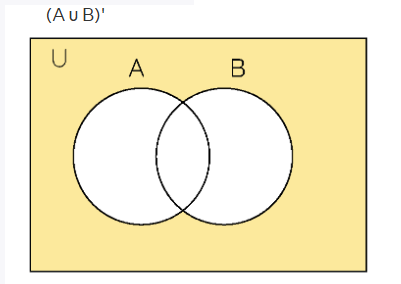
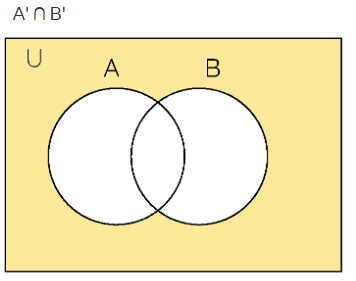
(ii) (ii) \(A^{\prime} \cap B^{\prime}\)
By a Demorgan law of sets, \(A^{\prime} \cap B^{\prime}=(A \cup B)^{\prime}\). Thus, its Venn diagram is as same as that of (i).
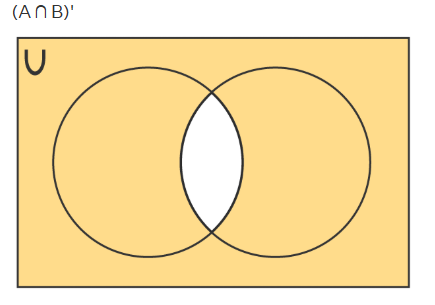
(iii) We know that \((A \cap B)^{\prime}=U-(A \cap B)\). Thus, in the Venn diagram of \((A \cap B)^{\prime}\), we have to shade the entire region of \(U\) excluding \(A \cap B\).
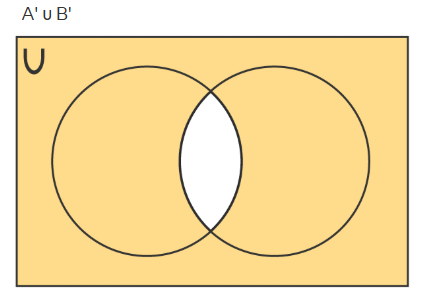
(iv) \(A^{\prime} \cup B^{\prime}\)
By a Demorgan law of sets, \(A^{\prime} u B^{\prime}=(A \cap B)^{\prime}\). Thus, its Venn diagram is as same as that of (iii).
Q6. Let \(U\) be the set of all triangles in a plane. If \(A\) is the set of all triangles with at least one angle different from \(60^{\circ}\), what is \(\mathrm{A}^{\prime}\)?
Solution:
Set \(A\) includes triangles where at least one angle is not equal to \(60^{\circ}\).
\(A^{\prime}\) consists of all triangles in \(U\) that are not in \(A\). This means \(A^{\prime}\) contains triangles where no angle is different from \(60^{\circ}\).
If no angle is different from \(60^{\circ}\), then all angles must be \(60^{\circ}\).
Triangles with all angles equal to \(60^{\circ}\) are equilateral triangles.
\(A^{\prime}\) is the set of all equilateral triangles.
Q7. Fill in the blanks to make each of the following a true statement:
(i) \(\quad A \cup A^{\prime}=\ldots\)
(ii) \(\quad \phi^{\prime} \cap A=\ldots\)
(iii) \(A \cap A^{\prime}=\ldots\)
(iv) \(U^{\prime} \cap A=\ldots\)
Solution:
(i) \(\quad A \cup A^{\prime}=U\)
(ii) \(\quad \phi^{\prime} \cap A=U \cap A=A\)
(iii) \(\quad A \cap A^{\prime}=\phi\)
(iv) \(\quad U^{\prime} \cap A=\phi \cap A=\phi\)
Exercise 1.6
Q1. If \(X\) and \(Y\) are two sets such that \(n(X)=17, n(Y)=23\) and \(n(X \cup Y)=38\), find \(n(X \cap Y)\).
Solution:
It is given that: \(n(X)=17, n(Y)=23\) and \(n(X \cup Y)=38\)
We know that:
\(
\begin{aligned}
n(X \cup Y) & =n(X)+n(Y)-n(X \cap Y) \\
n(X \cap Y) & =n(X)+n(Y)-n(X \cup Y) \\
& =17+23-38 \\
& =40-38 \\
& =2
\end{aligned}
\)
Therefore, \(n(X \cap Y)=2\)
Q2. If X and Y are two sets such that \(X \cup Y\) has 18 elements, X has 8 elements and Y has 15 elements; how many elements does \(X \cap Y\) have?
Solution:
It is given that:
\(n(X)=8, n(Y)=15\) and \(n(X \cup Y)=18\)
We know that:
\(
\begin{aligned}
n(X \cup Y) & =n(X)+n(Y)-n(X \cap Y) \\
n(X \cap Y) & =n(X)+n(Y)-n(X \cup Y) \\
& =8+15-18 \\
& =23-18 \\
& =5
\end{aligned}
\)
Therefore, \(n(X \cap Y)=5\)
Q3. In a group of 400 people, 250 can speak Hindi and 200 can speak English. How many people can speak both Hindi and English?
Solution: Let H be the set of people who speak Hindi, and E be the set of people who speak English
Therefore, \(n(H)=250, n(E)=200\) and \(n(H \cup E)=400\)
We know that:
\(
\begin{aligned}
n(H \cup E) & =n(H)+n(E)-n(H \cap E) \\
n(H \cap E) & =n(H)+n(E)-n(H \cup E) \\
& =250+200-400 \\
& =450-400 \\
& =50
\end{aligned}
\)
Therefore, 50 people can speak both Hindi and English.
Q4. If S and T are two sets such that S has 21 elements, T has 32 elements, and \(S \cap T\) has 11 elements; how many elements does \(S \cup T\) have?
Solution:
It is given that: \(n(S)=21, n(T)=32\) and \(n(S \cap T)=11\)
We know that:
\(
\begin{aligned}
n(S \cup T) & =n(S)+n(T)-n(S \cap T) \\
& =21+32-11 \\
& =53-11 \\
& =42
\end{aligned}
\)
Therefore, \(S \cup T\) has 42 elements.
Q5. If X and Y are two sets such that X has 40 elements, \(X \cup Y\) has 60 elements and \(X \cap Y\) has 10 elements, how many elements does Y have?
Solution:
It is given that:
\(n(X)=40, n(X \cup Y)=60\) and \(n(X \cap Y)=10\)
We know that:
\(
\begin{aligned}
n(X \cup Y) & =n(X)+n(Y)-n(X \cap Y) \\
n(Y) & =n(X \cap Y)+n(X \cup Y)-n(X) \\
& =60+10-40 \\
& =70-40 \\
& =30
\end{aligned}
\)
Therefore, \(n(Y)=30\)
Thus, the set Y has 30 elements.
Q6. In a group of 70 people, 37 like coffee, 52 like tea, and each person likes at least one of the two drinks. How many people like both coffee and tea?
Solution:
Let C denote the set of people who like coffee, and T denote the set of people who like tea
Therefore, \(n(C)=37, n(T)=52\) and \(n(C \cup T)=70\)
We know that:
\(
\begin{aligned}
n(C \cup T) & =n(C)+n(T)-n(C \cap T) \\
n(C \cap T) & =n(C)+n(T)-n(C \cup T) \\
& =37+52-70 \\
& =89-70 \\
& =11
\end{aligned}
\)
Therefore, 19 people like both coffee and tea.
Q7. In a group of 65 people, 40 like cricket, 10 like both cricket and tennis. How many like tennis only and not cricket? How many like tennis?
Solution:
Let C denote the set of people who like cricket, and T denote the set of people who like tennis
Therefore, \(n(C)=40, n(C \cup T)=65\) and \(n(C \cap T)=10\) We know that:
\(
\begin{aligned}
n(C \cup T) & =n(C)+n(T)-n(C \cap T) \\
n(T) & =n(C \cup T)+n(C \cap T)-n(C) \\
& =65+10-40 \\
& =75-40 \\
& =35
\end{aligned}
\)
Hence, the number of people who like tennis, \(n(T)=35\)
Now, the number of people like tennis only and not cricket \(=n(T-C)\)
As we know
\(
\begin{aligned}
n(T) & =n(T-C)+n(C \cap T) \\
n(T-C) & =n(T)-n(C \cap T) \\
& =35-10 \\
& =25
\end{aligned}
\)
Therefore, 35 people like tennis and 25 people like tennis only and not cricket.
Q8. In a committee, 50 people speak French, 20 speak Spanish and 10 speak both Spanish and French. How many speak at least one of these two languages?
Solution:
Let F be the set of people in the committee who speak French, and S be the set of people in the committee who speak Spanish
Therefore, \(n(F)=50, n(S)=20\) and \(n(S \cap F)=10\)
We know that:
\(
\begin{aligned}
n(S \cup F) & =n(S)+n(F)-n(S \cap F) \\
& =50+20-10 \\
& =70-10 \\
& =60
\end{aligned}
\)
Hence, 60 people in the committee speak at least one of the two languages.
Miscellaneous Exercise
Q1. Decide, among the following sets, which sets are subsets of one and another:
\(
\begin{aligned}
& A=\left\{x: x \in \mathbf{R} \text { and } x \text { satisfy } x^2-8 x+12=0\right\}, \\
& B=\{2,4,6\}, \quad C=\{2,4,6,8 \ldots\}, \quad D=\{6\} .
\end{aligned}
\)
Solution:
\(
A=\left\{x: x \in \mathbf{R} \text { and } x \text { satisfy } x^2-8 x+12=0\right\}
\)
2 and 6 are the only solutions of \(x^2-8 x+12=0\).
Hence,
\(
A=\{2,6\}, \quad B=\{2,4,6\}, \quad C=\{2,4,6,8 \ldots\}, \quad D=\{6\}
\)
Therefore, \(D \subset A \subset B \subset C\)
Hence, \(A \subset B, A \subset C, B \subset C, D \subset A, D \subset B, D \subset C\)
Q2. In each of the following, determine whether the statement is true or false. If it is true, prove it. If it is false, give an example.
(i) If \(x \in A\) and \(A \in B\), then \(x \in B\)
(ii) If \(A \subset B\) and \(B \in C\), then \(A \in C\)
(iii) If \(A \subset B\) and \(B \subset C\), then \(A \subset C\)
(iv) If \(A \not \subset B\) and \(B \not \subset C\), then \(A \not \subset C\)
(v) If \(x \in A\) and \(A \not \subset B\), then \(x \in B\)
(vi) If \(A \subset B\) and \(x \notin B\), then \(x \notin A\)
Solution:
(i) False.
Let \(A=\{2,3\}\) and \(B=\{1,\{2,3\}, 4\}\)
Now, \(2 \in A\) and \(A \in B\)
But, \(2 \notin B\)
(ii) False.
Let \(A=\{2\}, B=\{1,2\}\) and \(C=\{0,\{1,2\}, 3\}\)
Now, \(2 \in\{1,2\}\) and \(\{1,2\} \in\{0,\{1,2\}, 3\}\)
Hence, \(A \subset B\) and \(B \in C\)
But, \(2 \notin\{0,\{1,2\}, 3\}\)
(iii) True.
It is given that; \(A \subset B\) and \(B \subset C\)
Let \(x \in A\)
Now,
\(
\begin{array}{ll}
x \in B & {[\because A \subset B]} \\
x \in C & {[\because B \subset C]}
\end{array}
\)
Hence, \(A \subset C\) proved.
(iv) False.
Let \(A=\{1,2\}, B=\{3,4\}\) and \(C=\{0,1,2,5\}\)
Here, \(\{1,2\} \not \subset\{3,4\}\) and \(\{3,4\} \not \subset\{0,1,2,5\}\)
However, \(\{1,2\} \subset\{0,1,2,5\}\)
Hence, \(A \not \subset B\) and \(B \not \subset C\)
But, \(A \subset C\)
(v) False
Let \(A=\{1,2,3\}\) and \(B=\{3,4,5\}\)
Here, \(3 \in\{1,2,3\}\) and \(\{1,2,3\} \not \subset\{3,4,5\}\)
However, \(3 \notin B\)
Hence, \(x \in A\) and \(A \not \subset B\),
But, \(x \notin B\)
(vi) True
It is given that; \(A \subset B\) and \(x \notin B\), then \(x \notin A\)
Let \(x \in A\), if possible
Now,
\(
x \in B \quad[\because A \subset B]
\)
But it is given that \(x \notin B\)
Which is a contradiction
So, \(x \notin A\)
Hence, if \(A \subset B\) and \(x \notin B\), then \(x \notin A\) proved.
Q3. Let \(\mathrm{A}, \mathrm{B}\) and C be the sets such that \(A \cup B=A \cup C\) and show that \(B=C\).
Solution:
It is given that \(\mathrm{A}, \mathrm{B}\) and C be the sets such that \(A \cup B=A \cup C\) and
Let \(x \in B\)
Therefore, \(x \in A \cup B\)
Since, \(A \cup B=A \cup C ; x \in A \cup C\)
Hence, \(x \in A\) or \(x \in C\)
If \(x \in A\)
Then \(x \in A \cap B\), since \(x \in B\)
Now,
Therefore, \(x \in A \cap C\)
That means, \(x \in A\) and \(x \in C\)
So, \(B \subset C\)
Similarly, we can show that \(C \subset B\)
Hence, \(B=C\) proved.
Q4. Show that the following four conditions are equivalent:
(i) \(A \subset B\)
(ii) \(\quad A-B=\phi\)
(iii) \(\quad A \cup B=B\)
(iv) \(A \cap B=A\)
Solution:
(i) \(A \subset B\)
If possible, suppose \(A-B \neq \phi\)
This means that there exists \(x \in A\) and \(x \neq B\), which is not possible as \(A \subset B\). Hence, if \(A \subset B\), then, \(A-B=\phi\)
(ii) \(A-B=\phi\)
Let \(x \in A\)
Clearly, \(x \in B\) because if \(x \notin B\), then \(A-B \neq \phi\)
Hence, if \(A-B=\phi\), then, \(A \subset B\)
Therefore,
\(
\begin{gathered}
(i) \Leftrightarrow(i i) \\
A \subset B \Leftrightarrow A-B=\phi
\end{gathered}
\)
(iii) \(A \cup B=B\)
It is clear that, \(B \subset(A \cup B)\) since, \(A \subset B\)
Let \(x \in(A \cup B)\)
Hence, \(x \in A\) or \(x \in B\)
If \(x \in A\)
Then, \(x \in B \quad[\because A \subset B]\)
Therefore, \((A \cup B) \subset B\)
If \(x \in B\)
Then, \(A \cup B=B\)
Hence, if \(A \subset B\), then, \(A \cup B=B\)
Conversely, \(A \cup B=B\)
Let \(x \in A\)
Then,
\(
\begin{array}{ll}
x \in(A \cup B) & {[\because A \subset(A \cup B)]} \\
x \in B & {[\because A \cup B=B]}
\end{array}
\)
Therefore, \(A \subset B\)
Hence, if \(A \cup B=B\), then, \(A \subset B\)
Therefore,
\(
\begin{gathered}
(i) \Leftrightarrow(i i i) \\
A \subset B \Leftrightarrow A \cup B=B
\end{gathered}
\)
(iv) \(A \cap B=A\)
It is clear that, \((A \cap B) \subset A\) since, \(A \subset B\)
Let \(x \in A\)
Then,
\(
x \in B \quad[\because A \subset B]
\)
Therefore, \(x \in(A \cap B)\) and then \(A \subset(A \cap B)\)
Hence, \(A=(A \cap B)\)
Conversely, \(A \cap B=A\)
Let \(x \in A\)
Then,
\(
x \in(A \cap B)
\)
So, \(x \in A\) and \(x \in B\)
Therefore, \(A \subset B\)
Hence, if \(A \cap B=A\), then, \(A \subset B\)
Therefore,
\(
\begin{gathered}
(i) \Leftrightarrow(i v) \\
A \subset B \Leftrightarrow A \cap B=A
\end{gathered}
\)
Hence, it is proved that \(A \subset B \Leftrightarrow A-B=\phi \Leftrightarrow A \cup B=B \Leftrightarrow A \cap B=A\).
Q5. Show that if \(A \subset B\), then \(C-B \subset C-A\).
Solution:
Let \(A \subset B\) and \(x \in(C-B)\)
Then,
\(
x \in C \text { and } x \notin B
\)
Now,
\(
x \notin A \quad[\because A \subset B]
\)
Hence, \(x \in(C-A)\)
Therefore, \(C-B \subset C-A\)
Q6. Assume that \(P(A)=P(B)\). Show that \(A=B\).
Solution:
Let \(P(A)=P(B)\)
Let \(x \in A\)
\(
A \in P(A)=P(B)
\)
Therefore, \(x \in C\), for some \(C \in P(B)\)
Now, \(C \subset B\)
Hence, \(x \in B\)
So, \(A \subset B\)
Similarly, \(B \subset A\)
Therefore, \(A=B\) proved.
Q7. Is it true that for any sets A and \(\mathrm{B}, P(A) \cup P(B)=P(A \cup B)\)? Justify your answer.
Solution:
False.
Let \(A=\{1,2\}\) and \(B=\{2,3\}\)
Hence, \(A \cup B=\{1,2,3\}\)
\(
P(A)=\{\phi,\{1\},\{2\},\{1,2\}\}
\)
\(
P(B)=\{\phi,\{2\},\{3\},\{2,3\}\}
\)
Now,
\(
\begin{aligned}
P(A) \cup P(B) & =\{\phi,\{1\},\{2\},\{1,2\}\} \cup\{\phi,\{2\},\{3\},\{2,3\}\} \\
& =\{\phi,\{1\},\{2\},\{3\},\{1,2\},\{2,3\}\}
\end{aligned}
\)
\(
P(A \cup B)=\{\phi,\{1\},\{2\},\{3\},\{1,2\},\{2,3\},\{1,2,3\}\}
\)
We can see that
\(
P(A) \cup P(B) \neq P(A \cup B)
\)
Therefore, it is not true that for any sets A and \(\mathrm{B}, P(A) \cup P(B)=P(A \cup B)\).
Q8. Show that for any sets A and B,
\(
A=(A \cap B) \cup(A-B) \text { and } A \cup(B-A)=(A \cup B)
\)
Solution:
To prove: \(A=(A \cap B) \cup(A-B)\)
Let \(x \in A\)
Case I:
\(
x \in A \cap B
\)
Then, \(x \in(A \cap B) \subset(A \cup B) \cup(A-B)\)
Case II:
\(
x \notin(A \cap B)
\)
Then, \(x \notin A\) or \(x \notin B\)
\(
\begin{aligned}
& x \notin(A-B) \subset(A \cup B) \cup(A-B) \\
& A \subset(A \cap B) \cup(A-B) \dots(1)
\end{aligned}
\)
It is clear that
\(
\begin{aligned}
& A \cap B \subset A \text { and }(A-B) \subset A \\
& (A \cap B) \cup(A-B) \subset A \dots(2)
\end{aligned}
\)
From (1) and (2), we obtain
\(
A=(A \cap B) \cup(A-B)
\)
To prove: \(A \cup(B-A)=(A \cup B)\)
Let \(x \in A \cup(B-A)\)
\(
\begin{aligned}
& x \in A \text { or } x \in(B-A) \\
& x \in A \text { or }(x \in B \text { and } x \notin A) \\
& (x \in A \text { or } x \in B) \text { and }(x \in A \text { or } x \notin A) \\
& x \in(A \cup B) \\
& A \cup(B-A) \subset(A \cup B) \dots(3)
\end{aligned}
\)
Next, we show that \((A \cup B) \subset A \cup(B-A)\).
Let \(y \in(A \cup B)\)
\(
\begin{aligned}
& y \in A \text { or } y \in B \\
& (y \in A \text { or } y \in B) \text { and }(y \in A \text { or } y \notin A) \\
& y \in A \text { or }(y \in B \text { and } y \notin A) \\
& y \in A \cup(B-A) \\
& A \cup B \subset A \cup(B-A) \dots(4)
\end{aligned}
\)
Hence, from (3) and (4), we obtain \(A \cup(B-A)=(A \cup B)\).
Q9. Using properties of sets show that
(i) \(\quad A \cup(A \cap B)=A\)
(ii) \(\quad A \cap(A \cup B)=A\)
Solution:
(i)
\(
A \cup(A \cap B)=A
\)
We know that
\(
\begin{aligned}
& A \subset A \\
& A \cap B \subset A \\
& A \cup(A \cap B) \subset A \dots(1)
\end{aligned}
\)
Also,
\(
A \subset A \cup(A \cap B) \dots(2)
\)
From (1) and (2),
\(
A \cup(A \cap B)=A
\)
(ii) \(\quad A \cap(A \cup B)=A\)
\(
\begin{aligned}
A \cap(A \cup B) & =(A \cap A) \cup(A \cap B) \\
& =A \cup(A \cap B) \\
& =A \quad[\text { from }(\mathrm{i})]
\end{aligned}
\)
Q10. Show that \(A \cap B=A \cap C\) need not imply \(\mathrm{B}=\mathrm{C}\).
Solution:
Let \(A=\{0,1\}, B=\{0,2,3\}\) and \(C=\{0,4,5\}\)
Accordingly,
\(
A \cap B=\{0\} \text { and } A \cap C=\{0\}
\)
Here, \(A \cap B=A \cap C=\{0\}\)
However, \(B \neq C\)
\(
[\because 2 \in B \text { and } 2 \notin C]
\)
Q11. Let A and B be sets. If \(A \cap X=B \cap X=\phi\) and \(A \cup X=B \cup X\) for some set X , show that \(A=B\).
(Hints \(A=A \cap(A \cup X), B=B \cap(B \cup X)\) and use distributive law)
Solution:
Let A and B be two sets such that \(A \cap X=B \cap X=\phi\) and \(A \cup X=B \cup X\) for some set X.
We know that
\(
\begin{array}{rlr}
A & =A \cap(A \cup X) & \\
& =A \cap(B \cup X) & {[\because A \cup X=B \cup X]} \\
& =(A \cap B) \cup(A \cap X) & \\
& =(A \cap B) \cup \phi & {[\because(A \cap X)=\phi]} \\
& =(A \cap B) & \ldots(1)
\end{array}
\)
Now,
\(
\begin{array}{rlr}
B & =B \cap(B \cup X) & \\
& =B \cap(A \cup X) & {[\because A \cup X=B \cup X]} \\
& =(B \cap A) \cup(B \cap X) & \\
& =(B \cap A) \cup \phi & {[\because(B \cap X)=\phi]} \\
& =(A \cap B) & \ldots(2)
\end{array}
\)
From (1) and (2), we obtain \(A=B\). Hence proved.
Q12. Find sets A, B and C such that \(A \cap B, B \cap C\) and \(A \cap C\) are non-empty sets and \(A \cap B \cap C=\phi\).
Solution:
Let \(A=\{1,2\}, B=\{2,3\}\), and \(C=\{1,3\}\).
We can see that
\(
A \cap B=\{2\}, B \cap C=\{3\} \text { and } A \cap C=\{1\}
\)
Hence, \(A \cap B, B \cap C\) and \(A \cap C\) are non-empty.
However, \(A \cap B \cap C=\phi\)
Q13. In a survey of 600 students in a school, 150 students were found to be taking tea and 225 taking coffee, and 100 were taking both tea and coffee. Find how many students were taking neither tea nor coffee?
Solution:
Let U be the set of all students who took part in the survey T be the set of students taking tea.
C be the set of students taking coffee.
Students taking neither tea nor coffee, ( \(T^{\prime} \cap C^{\prime}\) )
It is given that
\(
n(U)=600, \quad n(T)=150, \quad n(C)=225, \quad n(T \cap C)=100
\)
We know that
\(
\begin{aligned}
n\left(T^{\prime} \cap C^{\prime}\right) & =n(T \cup C)^{\prime} \\
& =n(U)-n(T \cup C) \\
& =n(U)-[n(T)+n(C)-n(T \cap C)] \\
& =600-[150+225-100] \\
& =600-275 \\
& =325
\end{aligned}
\)
Hence, 325 students were taking neither tea nor coffee.
Q14. In a group of students 100 students know Hindi, 50 know English and 25 know both. Each of the students knows either Hindi or English. How many students are there in the group?
Solution:
Let U be the set of all students in the group.
\(E\) be the set of all students who know English.
H be the set of all students who know Hindi.
It is given that
\(
n(H)=100, \quad n(E)=50, \quad n(H \cap E)=25
\)
We know that
\(
\begin{aligned}
n(H \cup E) & =n(H)+n(E)-n(H \cap E) \\
& =100+50-25 \\
& =150-25 \\
& =125
\end{aligned}
\)
Hence, there are 125 students in the group.
Q15. In a survey of 60 people, it was found that 25 people read newspaper \(H, 26\) read newspaper \(T\), 26 read newspaper I, 9 read both H and I, 11 read both H and T, 8 read both T and I, 3 read all three newspapers. Find:
(i) the number of people who read at least one of the newspapers.
(ii) the number of people who read exactly one newspaper.
Solution:
Let \(H\) be the set of people who read newspaper \(H\).
\(T\) be the set of people who read the newspaper \(T\).
\(I\) be the set of people who read the newspaper \(I\).
It is given that
\(
n(H)=25, \quad n(T)=26, \quad n(I)=26, \quad n(H \cap T)=11, \quad n(H \cap I)=9, \quad n(T \cap I)=8, \quad n(H \cap T \cap I)=3
\)
(i) The number of people who read at least one of the newspapers.
We know that
\(
\begin{aligned}
n(H \cup T \cup I) & =n(H)+n(T)+n(I)-n(H \cap T)-n(H \cap I)-n(T \cap I)+n(H \cap T \cap I) \\
& =25+26+26-11-9-8+3 \\
& =80-28 \\
& =52
\end{aligned}
\)
Hence, 52 people read at least one of the newspapers.
(ii) Let \(x\) people read newspapers \(H\) and \(T\) only \(y\) people read newspapers \(T\) and \(I\) only and \(z\) people read newspapers \(H\) and \(I\) only.
Now, draw the Venn diagram for the given problem
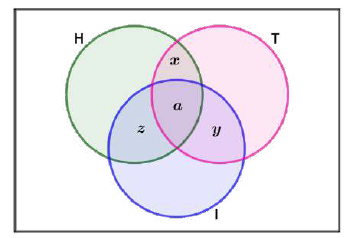
We can see that,
\(
\begin{aligned}
n(H \cap T \cap I) & =a=3 \\
n(H \cap T) & =x+a=11 \\
n(H \cap I) & =z+a=9 \\
n(T \cap I) & =y+a=8
\end{aligned}
\)
Now,
\(
\begin{aligned}
(x+a)+(y+a)+(z+a) & =11+8+9 \\
x+3+y+3+z+3 & =28 \\
x+y+z & =28-9 \\
x+y+z & =19
\end{aligned}
\)
Number of people who read exactly two newspapers \(=x+y+z=19\)
Number of people who read two or more newspapers \(=19+3=22\)
Therefore, the Number of people who read 3 exactly one newspaper \(=52-22=30\)
Hence, 30 people read exactly one newspaper.
Q16. In a survey it was found that 21 people liked product A, 26 liked product B and 29 liked product C. If 14 people liked products A and B, 12 people liked products C and A, 14 people liked products B and C and 8 liked all the three products. Find how many liked product C only.
Solution:
Let A be the set of people who liked product A.
\(B\) be the set of people who liked product \(B\).
C be the set of people who liked product C.
It is given that
\(
n(A)=21, n(B)=26, n(C)=29, n(A \cap B)=14, n(A \cap C)=12, n(B \cap C)=14, n(A \cap B \cap C)=8
\)
Let’s draw the Venn diagram for the given problem
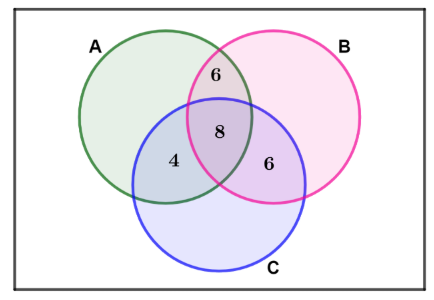
We can see that
Number of people who like product C only
\(
\begin{aligned}
& =n(C)-(4+8+6) \\
& =29-18 \\
& =11
\end{aligned}
\)
Hence, 11 liked product C only.