Overview
Random experiment
An experiment is random means that the experiment has more than one possible outcome and it is not possible to predict with certainty which outcome that will be. For instance, in an experiment of tossing an ordinary coin, it can be predicted with certainty that the coin will land either heads up or tails up, but it is not known for sure whether heads or tails will occur. If a die is thrown once, any of the six numbers, i.e., \(1,2,3,4,5,6\) may turn up, not sure which number will come up.
The sample space for the experiment of tossing a coin twice is given by
\(
S =\{ HH , HT , TH , TT \}
\)
The sample space for the experiment of drawing a card out of a deck is the set of all cards in the deck.
Event
An event is a subset of a sample space S. For example, the event of drawing an ace from a deck is
\(A=\{\) Ace of Heart, Ace of Club, Ace of Diamond, Ace of Spade \(\}\)
Types of events
Event ‘ \(A\) or \(B\) ‘
If \(A\) and \(B\) are two events associated with same sample space, then the event ‘\(A\) or \(B\) ‘ is same as the event \(A \cup B\) and contains all those elements which are either in \(A\) or in \(B\) or in both. Further more, \(P ( A \cup B )\) denotes the probability that \(A\) or \(B\) (or both) will occur.
Event ‘ \(A\) and \(B\) ‘
If \(A\) and \(B\) are two events associated with a sample space, then the event ‘ \(A\) and \(B\) ‘ is same as the event \(A \cap B\) and contains all those elements which are common to both \(A\) and \(B\) . Further more, \(P ( A \cap B )\) denotes the probability that both \(A\) and \(B\) will simultaneously occur.
\(\text { The Event ‘A but not B’ (Difference A-B) }\)
An event \(A-B\) is the set of all those elements of the same space \(S\) which are in \(A\) but not in \(B\) , i.e., \(A – B = A \cap B ^{\prime}\).
Mutually exclusive event:
Two events \(A\) and \(B\) of a sample space S are mutually exclusive if the occurrence of any one of them excludes the occurrence of the other event. Hence, the two events \(A\) and \(B\) cannot occur simultaneously, and thus \(P ( A \cap B )=0\).
Remark
Simple or elementary events of a sample space are always mutually exclusive. For example, the elementary events \(\{1\},\{2\},\{3\},\{4\},\{5\}\) or \(\{6\}\) of the experiment of throwing a dice are mutually exclusive.
Consider the experiment of throwing a die once.
The events \(E =\) getting a even number and \(F =\) getting an odd number are mutually exclusive events because \(E \cap F =\phi\).
Note For a given sample space, there may be two or more mutually exclusive events.
Exhaustive events
If \(E _1, E _2, \ldots, E _n\) are \(n\) events of a sample space S and if
\(
E _1 \cup E _2 \cup E _3 \cup \ldots \cup E _n=\bigcup_{i=1}^n E _i= S
\)
then \(E _1, E _2, \ldots, E _n\) are called exhaustive events.
In other words, events \(E _1, E _2, \ldots, E _n\) of a sample space S are said to be exhaustive if atleast one of them necessarily occur whenever the experiment is performed.
Consider the example of rolling a die. We have \(S=\{1,2,3,4,5,6\}\). Define the two events.
\(A\): ‘a number less than or equal to 4 appears.’
\(B\) : ‘a number greater than or equal to 4 appears.’
Now
A: \(\{1,2,3,4\}, B=\{4,5,6\}\)
\(A \cup B=\{1,2,3,4,5,6\}=S\)
Such events \(A\) and \(B\) are called exhaustive events.
Mutually exclusive and exhaustive events
If \(E _1, E _2, \ldots, E _n\) are \(n\) events of a sample space S and if \(E _i \cap E _j=\phi\) for every \(i \neq j\), i.e., \(E _i\) and \(E _j\) are pairwise disjoint and \(\bigcup_{i=1}^n E _i= S\), then the events \(E _1, E _2, \ldots, E _n\) are called mutually exclusive and exhaustive events.
Consider the example of rolling a die.
We have \(\quad S=\{1,2,3,4,5,6\}\)
Let us define the three events as
\(A = \) a number which is a perfect square
\(B =\) a prime number
\(C = \) a number which is greater than or equal to 6
Now \(A=\{1,4\}, B=\{2,3,5\}, C=\{6\}\)
Note that \(A \cup B \cup C =\{1,2,3,4,5,6\}= S\). Therefore, \(A , B\) and \(C\) are exhaustive events.
Also \(A \cap B = B \cap C = C \cap A =\phi\)
Hence, the events are pairwise disjoint and thus mutually exclusive.
Classical approach is useful, when all the outcomes of the experiment are equally likely. We can use logic to assign probabilities. To understand the classical method consider the experiment of tossing a fair coin. Here, there are two equally likely outcomes – head \(( H )\) and tail \(( T )\). When the elementary outcomes are taken as equally likely, we have a uniform probablity model. If there are \(k\) elementary outcomes in \(S\) , each is assigned the probability of \(\frac{1}{k}\). Therefore, logic suggests that the probability of observing a head, denoted by \(P ( H )\), is \(\frac{1}{2}=0.5\), and that the probability of observing a tail,denoted \(P ( T )\), is also \(\frac{1}{2}=0.5\). Notice that each probability is between 0 and 1 , Further H and T are all the outcomes of the experiment and \(P ( H )+ P ( T )=1\).
Classical definition
If all of the outcomes of a sample space are equally likely, then the probability that an event will occur is equal to the ratio :
The number of outcomes favourable to the event
The total number of outcomes of the sample space
Suppose that an event \(E\) can happen in \(m\) ways out of a total of \(n\) possible equally likely ways.
Then the classical probability of occurrence of the event is denoted by
\(
P ( E )=\frac{m}{n}
\)
The probability of non occurrence of the event E is denoted by
\(
P (\text { not } E )=\frac{n-m}{n}=1-\frac{m}{n}=1- P ( E )
\)
Thus \(\quad P ( E )+ P (\) not \(E\) \()=1\)
The event ‘not \(E\) ‘ is denoted by \(\overline{ E }\) or \(E^{\prime}\) (complement of \(E\) )
Therefore \(P (\overline{ E })=1- P ( E )\)
Axiomatic approach to probability
It follows from the axiomatic definition of probability that
For example, if a fair coin is tossed once
\(P ( H )= P ( T )=\frac{1}{2}\) satisfies the three axioms of probability.
Now suppose the coin is not fair and has double the chances of falling heads up as compared to the tails, then \(P ( H )=\frac{2}{3}\) and \(P ( T )=\frac{1}{3}\).
This assignment of probabilities are also valid for \(H\) and \(T\) as these satisfy the axiomatic definitions.
Probabilities of equally likely outcomes
Let a sample space of an experiment be \(S =\left\{w_1, w_2, \ldots, w_n\right\}\) and suppose that all the outcomes are equally likely to occur i.e., the chance of occurrence of each simple event must be the same i.e., \(P \left(w_i\right)=p\) for all \(w_i \in S\), where \(0 \leq p \leq 1\)
Since
\(
\begin{aligned}
& \sum_{i=1}^n P\left(w_i\right)=1 \\
& p+p+p+\ldots+p(n \text { times })=1 \\
& \Rightarrow \quad n p=1, \text { i.e. } \quad p=\frac{1}{n} \\
&
\end{aligned}
\)
i.e.,
\(
\begin{aligned}
& p+p+p+\ldots+p(n \text { times })=1 \\
\Rightarrow \quad & n p=1, \quad \text { i.e. } \quad p=\frac{1}{n}
\end{aligned}
\)
Let S be the sample space and E be an event, such that \(n(S)=n\) and \(n( E )=m\). If each outcome is equally likely, then it follows that
\(
P ( E )=\frac{m}{n}=\frac{\text { Number of outcomes favourable to } E }{\text { Total number of possible outcomes }}
\)
Odds Against and Odds in Favour of an Event:
Let there be \(m + n\) equally likely, mutually exclusive and exhaustive cases out of which an event A can occur in m cases and does not occur in n cases. Then by definition, probability of occurrences of event \(A=P(A)=\frac{m}{m+n}\)
The probability of non-occurrence of event \(A=P\left(A^{\prime}\right)=\frac{n}{m+n}\) \(\therefore P ( A ): P \left( A ^{\prime}\right)= m : n\)
Thus the odd in favour of occurrences of the event A are defined by \(m : n\) i.e. \(P ( A ): P \left( A ^{\prime}\right)\); and the odds against the occurrence of the event \(A\) are defined by \(n\) : \(m\) i.e. \(P \left( A ^{\prime}\right)\) : \(P ( A )\).
Addition rule of probability
If \(A\) and \(B\) are any two events in a sample space \(S\) , then the probability that atleast one of the events \(A\) or \(B\) will occur is given by
\(
P ( A \cup B )= P ( A )+ P ( B )- P ( A \cap B )
\)
Similarly, for three events \(A\), \(B\) and \(C\), we have
\(
\begin{aligned}
& P ( A \cup B \cup C )= P ( A )+ P ( B )+ P ( C )- P ( A \cap B )- P ( A \cap C )- P ( B \cap C )+ \\
& P ( A \cap B \cap C )
\end{aligned}
\)
General form of addition theorem (Principle of Inclusion-Exclusion)
For \(n\) events \(A_1, A_2, A_3, \ldots . . . A_n\) in \(S\), we have
\(
P\left(A_1 \cup A_2 \cup A_3 \cup A_4 \ldots \ldots . . \cup A_n\right)
\)
\(
=\sum_{i=1}^{ n } P \left( A _i\right)-\sum_{i<j} P \left( A _i \cap A _j\right)+\sum_{i<i<k} P \left( A _i \cap A _j \cap A _k\right)+\ldots .+(-1)^{ n -1} P \left( A _1 \cap A _2 \cap A _3 \ldots \ldots \cap A _{ n }\right)
\)
Addition rule for mutually exclusive events
If \(A\) and \(B\) are disjoint sets, then
\(P ( A \cup B )= P ( A )+ P ( B ) \quad [\) since \(P ( A \cap B )= P (\phi)=0\), where A and B are disjoint \(]\).
The addition rule for mutually exclusive events can be extended to more than two events.
Conditional Probability
If \(A\) and \(B\) are any events in \(S\) then the conditional probability of \(B\) relative to \(A\), i.e. probability of occurence of \(B\) when \(A\) has occured, is given by
\(
P(B / A)=\frac{P(B \cap A)}{P(A)} \text {. If } P(A) \neq 0
\)
Bayes’ Theorem
It is a way of finding a probability when we know certain other probabilities.
The formula is:
\(
P(A \mid B)=\frac{P(A) P(B \mid A)}{P(B)}
\)
Which tells us: how often \(A\) happens given that \(B\) happens, written \(P ( A \mid B )\),
When we know: how often \(B\) happens given that \(A\) happens, written \(P ( B \mid A )\)
and how likely \(A\) is on its own, written \(P ( A )\)
and how likely B is on its own, written \(P ( B )\)
“A” With Three (or more) Cases
We just saw “\(A\)” with two cases ( \(A\) and not \(A\) ), which we took care of in the bottom line.
When “\(A\)” has 3 or more cases we include them all in the bottom line:
\(
P(A 1 \mid B)=\frac{P(A 1) P(B \mid A 1)}{P(A 1) P(B \mid A 1)+P(A 2) P(B \mid A 2)+P(A 3) P(B \mid A 3)+\ldots \text { etc }}
\)
0 of 26 Questions completed
Questions:
You have already completed the quiz before. Hence you can not start it again.
Quiz is loading…
You must sign in or sign up to start the quiz.
You must first complete the following:
0 of 26 Questions answered correctly
Your time:
Time has elapsed
You have reached 0 of 0 point(s), (0)
Earned Point(s): 0 of 0, (0)
0 Essay(s) Pending (Possible Point(s): 0)
The probability distribution of a random variable \(X\) is given below :
\(
\begin{array}{|l|c|c|c|c|c|c|c|c|}
\hline \mathrm{x} & 4 \mathrm{k} & \frac{30}{7} k & \frac{32}{7} k & \frac{34}{7} k & \frac{36}{7} k & \frac{38}{7} k & \frac{40}{7} k & 6 \mathrm{k} \\
\hline \mathrm{P}(\mathrm{X}) & \frac{2}{15} & \frac{1}{15} & \frac{2}{15} & \frac{1}{5} & \frac{1}{15} & \frac{2}{15} & \frac{1}{5} & \frac{1}{15} \\
\hline
\end{array}
\)
If \(E(X)=\frac{263}{15}\), then \(P(X<20)\) is equal to : [JEE Main 2026 (Online) 28th January Evening Shift]
(d) To solve for \(P(X<20)\), we first need to determine the value of the constant \(k\) using the definition of the Expected Value \(E(X)\).
Step 1: Calculate \(E(X)\) in terms of \(k\)
The expected value is the sum of the products of each value and its corresponding probability \(\left(E(X)=\sum x_i P\left(x_i\right)\right)\).
Let’s calculate the sum:
\(
E(X)=\left(4 k \cdot \frac{2}{15}\right)+\left(\frac{30}{7} k \cdot \frac{1}{15}\right)+\left(\frac{32}{7} k \cdot \frac{2}{15}\right)+\left(\frac{34}{7} k \cdot \frac{3}{15}\right)+\left(\frac{36}{7} k \cdot \frac{1}{15}\right)+\left(\frac{38}{7} k \cdot \frac{2}{15}\right.
\)
(Note: I converted \(\frac{1}{5}\) to \(\frac{3}{15}\) to keep a common denominator for the probabilities).
Factoring out \(\frac{k}{105}\) (since \(7 \times 15=105\)):
\(
\begin{gathered}
E(X)=\frac{k}{105}[(28 \cdot 2)+30+64+102+36+76+120+(42 \cdot 1)] \\
E(X)=\frac{k}{105}[56+30+64+102+36+76+120+42] \\
E(X)=\frac{k}{105}[526]
\end{gathered}
\)
Step 2: Solve for \(k\)
We are given that \(E(X)=\frac{263}{15}\). Equating the two:
\(
\frac{526 k}{105}=\frac{263}{15}
\)
Multiply both sides by 105:
\(
\begin{gathered}
526 k=\frac{263 \times 105}{15}=263 \times 7 \\
526 k=1841 \\
k=\frac{1841}{526}=3.5\left(\text { or } \frac{7}{2}\right)
\end{gathered}
\)
Step 3: Determine which values of \(X\) are less than 20
Now we substitute \(k=3.5\) into the \(x\) values to check the condition \(X<20\) :
\(x_1=4(3.5)=14(<20)\)
\(x_2=\frac{30}{7}(3.5)=15(<20)\)
\(x_3=\frac{32}{7}(3.5)=16(<20)\)
\(x_4=\frac{34}{7}(3.5)=17(<20)\)
\(x_5=\frac{36}{7}(3.5)=18(<20)\)
\(x_6=\frac{38}{7}(3.5)=19(<20)\)
\(x_7=\frac{40}{7}(3.5)=20\) (Not less than 20)
\(x_8=6(3.5)=21\) (Not less than 20)
Step 4: Calculate \(P(X<20)\)
We sum the probabilities for the first 6 values:
\(
\begin{gathered}
P(X<20)=P\left(x_1\right)+P\left(x_2\right)+P\left(x_3\right)+P\left(x_4\right)+P\left(x_5\right)+P\left(x_6\right) \\
P(X<20)=\frac{2}{15}+\frac{1}{15}+\frac{2}{15}+\frac{1}{5}+\frac{1}{15}+\frac{2}{15}
\end{gathered}
\)
Converting \(\frac{1}{5}\) to \(\frac{3}{15}\) :
\(
P(X<20)=\frac{2+1+2+3+1+2}{15}=\frac{11}{15}
\)
A bag contains 10 balls out of which \(k\) are red and (\(10-k\)) are black, where \(0 \leq k \leq 10\). If three balls are drawn at random without replacement and all of them are found to be black, then the probability that the bag contains 1 red and 9 black balls is: [JEE Main 2026 (Online) 28th January Morning Shift]
(d) Step 1: Identify the Hypotheses (\(E_k\))
Let \(E_k\) be the event that the bag contains exactly \(k\) red balls. Since the problem states \(0 \leq k \leq 10\), there are 11 possible compositions for the bag \((k=0,1,2, \ldots, 10)\).
Assuming each composition is equally likely:
\(
P\left(E_k\right)=\frac{1}{11}
\)
Step 2: Define the Observed Event (\(\boldsymbol{A}\))
Let \(A\) be the event that 3 balls drawn at random without replacement are all black. To find the probability of \(A\) occurring given a specific bag composition \(E_k\), we calculate:
\(
P\left(A \mid E_k\right)=\frac{\text { Ways to choose } 3 \text { black balls }}{\text { Total ways to choose } 3 \text { balls }}=\frac{\binom{10-k}{3}}{\binom{10}{3}}
\)
Note: This probability is 0 if \(10-k<3\) (i.e., if \(k>7\)).
Step 3: Apply Bayes’ Theorem
We need to find the probability that the bag had 1 red ball (\(E_1\)) given that we observed 3 black balls (A):
\(
P\left(E_1 \mid A\right)=\frac{P\left(E_1\right) \cdot P\left(A \mid E_1\right)}{\sum_{k=0}^7 P\left(E_k\right) \cdot P\left(A \mid E_k\right)}
\)
Step 4: Simplify and Calculate
Since \(P\left(E_k\right)=\frac{1}{11}\) for all \(k\), it cancels out of the equation. We are left with:
\(
P\left(E_1 \mid A\right)=\frac{\binom{9}{3}}{\binom{10}{3}+\binom{9}{3}+\binom{8}{3}+\binom{7}{3}+\binom{6}{3}+\binom{5}{3}+\binom{4}{3}+\binom{3}{3}}
\)
Using the Hockey-stick Identity \(\left(\sum_{i=r}^n\binom{i}{r}=\binom{n+1}{r+1}\right.\)), the denominator simplifies:
\(
\text { Denominator }=\sum_{j=3}^{10}\binom{j}{3}=\binom{11}{4}
\)
Step 5: Final Result
Numerator: \(\binom{9}{3}=\frac{9 \times 8 \times 7}{3 \times 2 \times 1}=84\)
Denominator: \(\binom{11}{4}=\frac{11 \times 10 \times 9 \times 8}{4 \times 3 \times 2 \times 1}=330\)
\(
P\left(E_1 \mid A\right)=\frac{84}{330}=\frac{14}{55}
\)
From a lot containing 10 defective and 90 non-defective bulbs, 8 bulbs are selected one by one with replacement. Then the probability of getting at least 7 defective bulbs is [JEE Main 2026 (Online) 24th January Morning Shift]
(a) This problem can be solved using the Binomial Distribution since the bulbs are selected with replacement, making the trials independent.
Step 1: Identify the Parameters
Let \(X\) be the random variable representing the number of defective bulbs in 8 selections.
Total number of trials: \(n=8\)
Probability of selecting a defective bulb: \(p=\frac{10}{100}=\frac{1}{10}=0.1\)
Probability of selecting a non-defective bulb: \(q=1-p=\frac{9}{10}=0.9\)
Since the selections are made with replacement, \(X\) follows a binomial distribution: \(X \sim B(n, p)\).
Step 2: Define the Required Probability
We need to find the probability of getting at least 7 defective bulbs, which is given by:
\(
P(X \geq 7)=P(X=7)+P(X=8)
\)
The general formula for binomial probability is:
\(
P(X=k)=\binom{n}{k} \cdot p^k \cdot q^{n-k}
\)
Step 3: Calculate Individual Probabilities
For \(k=7\) :
\(
\begin{gathered}
P(X=7)=\binom{8}{7} \cdot\left(\frac{1}{10}\right)^7 \cdot\left(\frac{9}{10}\right)^{8-7} \\
P(X=7)=8 \cdot \frac{1}{10^7} \cdot \frac{9}{10}=\frac{72}{10^8}
\end{gathered}
\)
For \(k=8\) :
\(
\begin{gathered}
P(X=8)=\binom{8}{8} \cdot\left(\frac{1}{10}\right)^8 \cdot\left(\frac{9}{10}\right)^{8-8} \\
P(X=8)=1 \cdot \frac{1}{10^8} \cdot 1=\frac{1}{10^8}
\end{gathered}
\)
Step 4: Sum the Probabilities
Adding the two results:
\(
P(X \geq 7)=\frac{72}{10^8}+\frac{1}{10^8}=\frac{73}{10^8}
\)
The probability of getting at least 7 defective bulbs is \(\frac{73}{10^8}\).
Bag A contains 9 white and 8 black balls, while bag B contains 6 white and 4 black balls. One ball is randomly picked up from the bag B and mixed up with the balls in the bag A . Then a ball is randomly drawn from the bag A. If the probability, that the ball drawn is white, is \(\frac{\mathrm{p}}{\mathrm{q}}, \operatorname{gcd}(\mathrm{p}, \mathrm{q})=1\), then \(\mathrm{p}+\mathrm{q}\) is equal to [JEE Main 2026 (Online) 23rd January Evening Shift]
(c) This is a total probability problem involving two stages: first, moving a ball from Bag B to Bag A, and second, drawing a ball from Bag A.
Step 1: Analyze Bag B (The Source)
Bag B contains 6 white balls and 4 black balls (Total \(=10\)).
When we pick one ball from Bag B to put into Bag A, there are two possibilities:
Event \(B_W\) : A white ball is moved.
\(
P\left(B_W\right)=\frac{6}{10}
\)
Event \(B_B\) : A black ball is moved.
\(
P\left(B_B\right)=\frac{4}{10}
\)
Step 2: Analyze Bag A (The Destination)
Bag A originally contains 9 white and 8 black balls (Total \(=17\) ). After adding one ball from Bag B, the total becomes 18.
Case 1: If a white ball was moved (\(B_W\) is true)
Bag A now has 10 white and 8 black balls.
Probability of drawing a white ball: \(P\left(W \mid B_W\right)=\frac{10}{18}\)
Case 2: If a black ball was moved (\(B_B\) is true)
Bag A now has 9 white and 9 black balls.
Probability of drawing a white ball: \(P\left(W \mid B_B\right)=\frac{9}{18}\)
Step 3: Calculate Total Probability
Using the Law of Total Probability:
\(
P(W)=P\left(B_W\right) \cdot P\left(W \mid B_W\right)+P\left(B_B\right) \cdot P\left(W \mid B_B\right)
\)
Substitute the values:
\(
\begin{gathered}
P(W)=\left(\frac{6}{10} \times \frac{10}{18}\right)+\left(\frac{4}{10} \times \frac{9}{18}\right) \\
P(W)=\frac{60}{180}+\frac{36}{180}=\frac{96}{180}
\end{gathered}
\)
Step 4: Simplify to find \(p\) and \(q\)
We need to simplify \(\frac{96}{180}\) such that \(\operatorname{gcd}(p, q)=1\) :
Divide both by 12:
\(
\frac{96 \div 12}{180 \div 12}=\frac{8}{15}
\)
So, \(p=8\) and \(q=15\).
Since \(\operatorname{gcd}(8,15)=1\), these values are correct.
Step 5: Final Calculation
The question asks for \(p+q\) :
\(
p+q=8+15=23
\)
Two distinct numbers \(a\) and \(b\) are selected at random from \(1,2,3, \ldots, 50\). The probability, that their product \(a b\) is divisible by 3 , is [JEE Main 2026 (Online) 22nd January Morning Shift]
(c) To find the probability that the product \(a b\) is divisible by 3 , it is often easier to find the complement: the probability that \(a b\) is not divisible by 3.
Step 1: Determine the Sample Space
We are selecting 2 distinct numbers from the set \(\{1,2,3, \ldots, 50\}\).
The total number of ways to choose 2 numbers is:
\(
n(S)=\binom{50}{2}=\frac{50 \times 49}{2}=1225
\)
Step 2: Identify Numbers Divisible and Not Divisible by 3
In the set \(\{1,2, \ldots, 50\}\) :
Numbers divisible by \(3(3 k)\) : These are \(3,6,9, \ldots, 48\).
The count is \(\left\lfloor\frac{50}{3}\right\rfloor=16\).
Numbers NOT divisible by \(3(3 k+1,3 k+2)\) :
The count is \(50-16=34\).
Step 3: Calculate the Complement Event (\(E^{\prime}\))
The product \(a b\) is not divisible by 3 if and only if neither \(a\) nor \(b\) is divisible by 3.
We must choose both numbers from the 34 numbers that are not multiples of 3.
\(
n\left(E^{\prime}\right)=\binom{34}{2}=\frac{34 \times 33}{2}=17 \times 33=561
\)
Step 4: Calculate the Probability of the Complement
\(
P\left(E^{\prime}\right)=\frac{n\left(E^{\prime}\right)}{n(S)}=\frac{561}{1225}
\)
Step 5: Find the Required Probability
The probability that the product \(a b\) is divisible by 3 is:
\(
\begin{gathered}
P(E)=1-P\left(E^{\prime}\right) \\
P(E)=1-\frac{561}{1225} \\
P(E)=\frac{1225-561}{1225}=\frac{664}{1225}
\end{gathered}
\)
If a random variable \(x\) has the probability distribution
\(
\begin{array}{|c|c|c|c|c|c|c|c|c|}
\hline x & 0 & 1 & 2 & 3 & 4 & 5 & 6 & 7 \\
\hline \mathrm{P}(x) & 0 & 2 \mathrm{k} & \mathrm{k} & 3 \mathrm{k} & 2 \mathrm{k}^2 & 2 \mathrm{k} & \mathrm{k}^2+\mathrm{k} & 7 \mathrm{k}^2 \\
\hline
\end{array}
\)
then \(\mathrm{P}(3<x \leq 6)\) is equal to [JEE Main 2026 (Online) 22nd January Morning Shift]
(d) To solve for \(P(3<x \leq 6)\), we first need to determine the value of the constant \(k\) using the fundamental property of probability distributions.
Step 1: Find the value of \(k\)
The sum of all probabilities in a distribution must equal 1:
\(
\sum P(x)=1
\)
Summing the terms from the table:
\(
0+2 k+k+3 k+2 k^2+2 k+\left(k^2+k\right)+7 k^2=1
\)
Group the \(k^2\) and \(k\) terms:
\(
\begin{gathered}
\left(2 k^2+k^2+7 k^2\right)+(2 k+k+3 k+2 k+k)=1 \\
10 k^2+9 k-1=0
\end{gathered}
\)
Now, solve this quadratic equation using factoring:
\(
\begin{gathered}
10 k^2+10 k-k-1=0 \\
10 k(k+1)-1(k+1)=0 \\
(10 k-1)(k+1)=0
\end{gathered}
\)
This gives \(k=\frac{1}{10}\) or \(k=-1\). Since probability cannot be negative and \(P(x=1)=2 k, k\) must be positive.
Therefore, \(k=0.1\).
Step 2: Identify the required range
We need to find \(P(3<x \leq 6)\). This interval includes the discrete values \(x=4,5\), and 6.
\(
P(3<x \leq 6)=P(4)+P(5)+P(6)
\)
From the table:
\(P(4)=2 k^2\)
\(P(5)=2 k\)
\(P(6)=k^2+k\)
Summing them up:
\(
\begin{gathered}
P(3<x \leq 6)=\left(2 k^2\right)+(2 k)+\left(k^2+k\right) \\
P(3<x \leq 6)=3 k^2+3 k
\end{gathered}
\)
Step 3: Calculate the final probability
Substitute \(k=0.1\) into the expression:
\(
P(3<x \leq 6)=3(0.1)^2+3(0.1)
\)
\(
\begin{gathered}
P(3<x \leq 6)=3(0.01)+0.3 \\
P(3<x \leq 6)=0.03+0.3=0.33
\end{gathered}
\)
Expressing it as a fraction:
\(
P(3<x \leq 6)=\frac{33}{100}
\)
The probability \(P(3<x \leq 6)\) is equal to \(\mathbf{0 . 3 3}\).
Let the mean and variance of 7 observations \(2,4,10, x, 12,14, y, x>y\), be 8 and 16 respectively. Two numbers are chosen from \(\{1,2,3, x-4, y, 5\}\) one after another without replacement, then the probability, that the smaller number among the two chosen numbers is less than 4 , is : [JEE Main 2026 (Online) 21st January Morning Shift]
(a) To solve this, we first need to find the missing values \(x\) and \(y\) from the statistics of the first set, and then calculate the probability for the second set.
Step 1: Find \(x\) and \(y\)
We are given 7 observations: \(2,4,10, x, 12,14, y\).
Mean (\(\mu\)):
\(
\frac{2+4+10+x+12+14+y}{7}=8 \Longrightarrow 42+x+y=56 \Longrightarrow x+y=14
\)
Variance \(\left(\sigma^2\right)\) :
\(
\begin{gathered}
\sigma^2=\frac{\sum x_i^2}{n}-\mu^2=16 \\
\frac{2^2+4^2+10^2+x^2+12^2+14^2+y^2}{7}-8^2=16 \\
\frac{4+16+100+x^2+144+196+y^2}{7}=16+64=80 \\
460+x^2+y^2=560 \Longrightarrow x^2+y^2=100
\end{gathered}
\)
We have the system:
\(x+y=14\)
\(x^2+y^2=100\)
Using \((x+y)^2=x^2+y^2+2 x y\) :
\(
14^2=100+2 x y \Longrightarrow 196=100+2 x y \Longrightarrow x y=48 .
\)
The numbers whose sum is 14 and product is 48 are 8 and 6 . Since \(x>y\), we have: \(x=8\) and \(y=6\).
Step 2: Identify the second set
The second set is \(\{1,2,3, x-4, y, 5\}\). Substituting \(x=8\) and \(y=6\) :
\(
\{1,2,3,(8-4), 6,5\}=\{1,2,3,4,6,5\}
\)
Sorted, the set is \(S=\{1,2,3,4,5,6\}\).
Step 3: Calculate the Probability
Two numbers are chosen one after another without replacement.
Total ways \(n(S)=6 \times 5=30\).
We want the probability that the smaller of the two numbers is less than 4.
It is easier to find the complement: the probability that the smaller number is \(\geq 4\).
For the smaller number to be \(\geq 4\), both numbers must be chosen from the subset \(\{4,5,6\}\).
Number of ways to choose 2 numbers from these \(3: 3 \times 2=6\) ways.
(The pairs are (4,5), (4,6), (5,4), (5,6), (6,4), (6,5))
Probability (Smaller \(\geq 4)=\frac{6}{30}=\frac{1}{5}\).
The required probability (Smaller < 4) is:
\(
P=1-\frac{1}{5}=\frac{4}{5}
\)
If \(A\) and \(B\) are two events such that \(P(A)=0.7, P(B)=0.4\) and \(P(A \cap \bar{B})=0.5\), where \(\bar{B}\) denotes the complement of \(B\), then \(P(B \mid(A \cup \bar{B}))\) is equal to [JEE Main 2025 (Online) 8th April Evening Shift]
(c) To solve this, we can use the properties of set theory and the definition of conditional probability.
Step 1: Find the Intersection \(P(A \cap B)\)
We are given \(P(A)=0.7\) and \(P(A \cap \bar{B})=0.5\).
Since the set \(A\) is the union of two disjoint sets \((A \cap B)\) and \((A \cap \bar{B})\) :
\(
\begin{gathered}
P(A)=P(A \cap B)+P(A \cap \bar{B}) \\
0.7=P(A \cap B)+0.5 \Longrightarrow P(A \cap B)=0.2
\end{gathered}
\)
Step 2: Identify the Conditional Probability Formula
The question asks for \(P(B \mid(A \cup \bar{B}))\). By definition:
\(
P(B \mid(A \cup \bar{B}))=\frac{P(B \cap(A \cup \bar{B}))}{P(A \cup \bar{B})}
\)
Step 3: Calculate the Numerator
Apply the distributive law: \(B \cap(A \cup \bar{B})=(B \cap A) \cup(B \cap \bar{B})\).
Since \(B \cap \bar{B}=\phi\) (an empty set):
\(
\text { Numerator }=P(B \cap A)=0.2
\)
Step 4: Calculate the Denominator
Using the addition rule for \(P(A \cup \bar{B})\) :
\(
P(A \cup \bar{B})=P(A)+P(\bar{B})-P(A \cap \bar{B})
\)
We know \(P(\bar{B})=1-P(B)=1-0.4=0.6\).
\(
P(A \cup \bar{B})=0.7+0.6-0.5=0.8
\)
Step 5: Final Result
Substitute the values back into the conditional probability formula:
\(
P(B \mid(A \cup \bar{B}))=\frac{0.2}{0.8}=\frac{2}{8}=\frac{1}{4}
\)
A bag contains 19 unbiased coins and one coin with head on both sides. One coin drawn at random is tossed and head turns up. If the probability that the drawn coin was unbiased, is \(\frac{m}{n}, \operatorname{gcd}(m, n)=1\), then \(n^2-m^2\) is equal to: [JEE Main 2025 (Online) 7th April Evening Shift]
(b) This is a classic application of Bayes’ Theorem, where we need to find the probability of a cause (which coin was picked) given an observed effect (the result of the toss).
Step 1: Define the Events
\(E_1\) : The coin drawn is unbiased (there are 19 such coins).
\(E_2\) : The coin drawn is the two-headed coin (there is 1 such coin).
\(H\) : The event that the toss results in a Head.
Step 2: Determine the Probabilities
Prior Probabilities:
\(P\left(E_1\right)=\frac{19}{20}\)
\(P\left(E_2\right)=\frac{1}{20}\)
Conditional Probabilities (Likelihoods):
\(P\left(H \mid E_1\right)=\frac{1}{2}\) (An unbiased coin has one head)
\(P\left(H \mid E_2\right)=1\) (A two-headed coin always shows head)
Step 3: Apply Bayes’ Theorem
We want to find the probability that the coin was unbiased given that a head turned up, i.e., \(P\left(E_1 \mid H\right)\) :
\(
P\left(E_1 \mid H\right)=\frac{P\left(E_1\right) \cdot P\left(H \mid E_1\right)}{P\left(E_1\right) \cdot P\left(H \mid E_1\right)+P\left(E_2\right) \cdot P\left(H \mid E_2\right)}
\)
Step 4: Calculation
Substitute the values into the formula:
\(
P\left(E_1 \mid H\right)=\frac{\frac{19}{20} \times \frac{1}{2}}{\left(\frac{19}{20} \times \frac{1}{2}\right)+\left(\frac{1}{20} \times 1\right)}
\)
Multiply numerator and denominator by 40 to clear the fractions:
\(
P\left(E_1 \mid H\right)=\frac{19}{19+2}=\frac{19}{21}
\)
Step 5: Find \(n^2-m^2\)
Given \(P\left(E_1 \mid H\right)=\frac{m}{n}=\frac{19}{21}\), where \(\operatorname{gcd}(19,21)=1\) :
\(m=19\)
\(n=21\)
Now, calculate \(n^2-m^2\) :
\(
n^2-m^2=21^2-19^2
\)
Using the identity \(a^2-b^2=(a-b)(a+b)\) :
\(
n^2-m^2=(21-19)(21+19)=(2)(40)=80
\)
Let a random variable \(X\) take values \(0,1,2,3\) with \(P(X=0)=P(X=1)=p, P(X=2)=P(X=3)\) and \(E\left(X^2\right)=2 E(X)\). Then the value of \(8 p-1\) is : [JEE Main 2025 (Online) 7th April Evening Shift]
(a) To solve for \(p\), we first need to determine the probability distribution of \(X\).
Step 1: Set up the Probability Distribution
Let \(P(X=0)=P(X=1)=p\).
Let \(P(X=2)=P(X=3)=q\).
Since the sum of all probabilities must be 1:
\(
\begin{aligned}
& P(X=0)+P(X=1)+P(X=2)+P(X=3)=1 \\
& p+p+q+q=1 \Longrightarrow 2 p+2 q=1 \Longrightarrow q=\frac{1-2 p}{2}
\end{aligned}
\)
Step 2: Calculate \(E(X)\) and \(E\left(X^2\right)\)
The expected value \(E(X)\) is given by \(\sum x_i P\left(x_i\right)\) :
\(
\begin{gathered}
E(X)=(0 \cdot p)+(1 \cdot p)+(2 \cdot q)+(3 \cdot q) \\
E(X)=p+5 q
\end{gathered}
\)
The expected value \(E\left(X^2\right)\) is given by \(\sum x_i^2 P\left(x_i\right)\) :
\(
\begin{gathered}
E\left(X^2\right)=\left(0^2 \cdot p\right)+\left(1^2 \cdot p\right)+\left(2^2 \cdot q\right)+\left(3^2 \cdot q\right) \\
E\left(X^2\right)=p+4 q+9 q=p+13 q
\end{gathered}
\)
Step 3: Use the Given Condition \(E\left(X^2\right)=2 E(X)\)
Substitute the expressions from Step 2:
\(
\begin{gathered}
p+13 q=2(p+5 q) \\
p+13 q=2 p+10 q \\
3 q=p
\end{gathered}
\)
Step 4: Solve for \(p\)
Substitute \(q=\frac{1-2 p}{2}\) into the equation \(3 q=p\) :
\(
\begin{gathered}
3\left(\frac{1-2 p}{2}\right)=p \\
3-6 p=2 p \\
8 p=3 \Longrightarrow p=\frac{3}{8}
\end{gathered}
\)
Step 5: Final Calculation
The question asks for the value of \(8 p-1\) :
\(
8\left(\frac{3}{8}\right)-1=3-1=2
\)
The probability, of forming a 12 persons committee from 4 engineers, 2 doctors and 10 professors containing at least 3 engineers and at least 1 doctor, is [JEE Main 2025 (Online) 4th April Morning Shift]
(a) To solve this, we define the total number of ways to form the committee and then use the complement method to subtract the cases that don’t meet our criteria.
Step 1: Total Possible Committees
There are a total of \(4(\mathrm{E})+2(\mathrm{D})+10(\mathrm{P})=16\) people. We need to choose 12.
\(
n(S)=\binom{16}{12}=\binom{16}{4}=\frac{16 \times 15 \times 14 \times 13}{4 \times 3 \times 2 \times 1}=1820
\)
Step 2: Define Constraints
We need:
Engineers \((E) \geq 3\)
Doctors \((D) \geq 1\)
It is easier to calculate the favorable cases \(n(A)\) by looking at the possible distributions of the 12 members. Let the number of engineers, doctors, and professors be \(e, d, p\) respectively, where \(e+d+p=12\).
Given constraints: \(e \in\{3,4\}, d \in\{1,2\}\), and \(p \leq 10\).
\(
\begin{array}{llllll}
\text { Case } & \text { Engineers }(e) & \text { Doctors }(d) & \text { Professors }(p) & \text { Calculation } & \text { Ways } \\
1 & 3 & 1 & 8 & \binom{4}{3} \times\binom{ 2}{1} \times\binom{ 10}{8} & 4 \times 2 \times 45=360 \\
2 & 3 & 2 & 7 & \binom{4}{3} \times\binom{ 2}{2} \times\binom{ 10}{7} & 4 \times 1 \times 120=480 \\
3 & 4 & 1 & 7 & \binom{4}{4} \times\binom{ 2}{1} \times\binom{ 10}{7} & 1 \times 2 \times 120=240 \\
4 & 4 & 2 & 6 & \binom{4}{4} \times\binom{ 2}{2} \times\binom{ 10}{6} & 1 \times 1 \times 210=210
\end{array}
\)
Step 3: Calculate Favorable Outcomes
Summing the cases:
\(
n(A)=360+480+240+210=1290
\)
Step 4: Find the Probability
\(
P(A)=\frac{n(A)}{n(S)}=\frac{1290}{1820}
\)
Simplify the fraction by dividing by 10 :
\(
P(A)=\frac{129}{182}
\)
A box contains 10 pens of which 3 are defective. A sample of 2 pens is drawn at random and let \(X\) denote the number of defective pens. Then the variance of \(X\) is [JEE Main 2025 (Online) 4th April Morning Shift]
(d) To find the variance of \(X\) (the number of defective pens), we first need to determine the probability distribution.
Step 1: Determine the Probability Distribution
Total pens = 10 ( 3 defective, 7 non-defective). Sample size = 2 .
The possible values for \(X\) are \(\{0,1,2\}\).
\(P(X=0)\) : No defective pens (both from 7 non-defective)
\(
P(X=0)=\frac{\binom{7}{2}}{\binom{10}{2}}=\frac{21}{45}
\)
\(P(X=1)\) : One defective and one non-defective
\(
P(X=1)=\frac{\binom{3}{1} \times\binom{ 7}{1}}{\binom{10}{2}}=\frac{3 \times 7}{45}=\frac{21}{45}
\)
\(P(X=2)\) : Both defective pens
\(
P(X=2)=\frac{\binom{3}{2}}{\binom{10}{2}}=\frac{3}{45}
\)
Step 2: Calculate the Mean \(E(X)\)
\(
\begin{gathered}
E(X)=\sum x_i P\left(x_i\right)=\left(0 \times \frac{21}{45}\right)+\left(1 \times \frac{21}{45}\right)+\left(2 \times \frac{3}{45}\right) \\
E(X)=\frac{21+6}{45}=\frac{27}{45}=\frac{3}{5}(\text { or } 0.6)
\end{gathered}
\)
Step 3: Calculate \(E\left(X^2\right)\)
\(
\begin{gathered}
E\left(X^2\right)=\sum x_i^2 P\left(x_i\right)=\left(0^2 \times \frac{21}{45}\right)+\left(1^2 \times \frac{21}{45}\right)+\left(2^2 \times \frac{3}{45}\right) \\
E\left(X^2\right)=\frac{21+12}{45}=\frac{33}{45}=\frac{11}{15}
\end{gathered}
\)
Step 4: Calculate Variance
\(
\begin{gathered}
\operatorname{Var}(X)=E\left(X^2\right)-[E(X)]^2 \\
\operatorname{Var}(X)=\frac{11}{15}-\left(\frac{3}{5}\right)^2 \\
\operatorname{Var}(X)=\frac{11}{15}-\frac{9}{25}
\end{gathered}
\)
To subtract, find a common denominator (75):
\(
\operatorname{Var}(X)=\frac{55}{75}-\frac{27}{75}=\frac{28}{75}
\)
If the probability that the random variable \(X\) takes the value \(x\) is given by \(P(X=x)=k(x+1) 3^{-x}, x=0,1,2,3 \ldots\), where \(k\) is a constant, then \(P(X \geq 3)\) is equal to [JEE Main 2025 (Online) 3rd April Evening Shift]
(a) To find the probability \(P(X \geq 3)\), we first need to determine the value of the constant \(k\).
Step 1: Find the value of \(k\)
The sum of all probabilities in a discrete distribution must equal 1:
\(
\begin{gathered}
\sum_{x=0}^{\infty} P(X=x)=1 \Longrightarrow \sum_{x=0}^{\infty} k(x+1) 3^{-x}=1 \\
k \sum_{x=0}^{\infty}(x+1)\left(\frac{1}{3}\right)^x=1
\end{gathered}
\)
The summation \(\sum_{n=0}^{\infty}(n+1) r^n\) is a standard Arithmetico-Geometric series expansion, which equals \(\frac{1}{(1-r)^2}\) for \(|r|<1\).
Here, \(r=\frac{1}{3}\) :
\(
\begin{gathered}
k\left[\frac{1}{(1-1 / 3)^2}\right]=1 \\
k\left[\frac{1}{(2 / 3)^2}\right]=1 \Longrightarrow k\left(\frac{9}{4}\right)=1 \\
k=\frac{4}{9}
\end{gathered}
\)
Step 2: Calculate \(P(X<3)\)
It is easier to calculate the complement \(P(X \geq 3)=1-P(X<3)\).
The values of \(x\) less than 3 are 0,1 , and 2.
For \(x=0: P(X=0)=\frac{4}{9}(0+1) 3^0=\frac{4}{9}\)
For \(x=1: P(X=1)=\frac{4}{9}(1+1) 3^{-1}=\frac{4}{9} \cdot \frac{2}{3}=\frac{8}{27}\)
For \(x=2: P(X=2)=\frac{4}{9}(2+1) 3^{-2}=\frac{4}{9} \cdot \frac{3}{9}=\frac{12}{81}=\frac{4}{27}\)
Summing these probabilities:
\(
P(X<3)=\frac{4}{9}+\frac{8}{27}+\frac{4}{27}=\frac{12}{27}+\frac{8}{27}+\frac{4}{27}=\frac{24}{27}=\frac{8}{9}
\)
Step 3: Find \(P(X \geq 3)\)
\(
\begin{gathered}
P(X \geq 3)=1-P(X<3) \\
P(X \geq 3)=1-\frac{8}{9}=\frac{1}{9}
\end{gathered}
\)
\(
\begin{aligned}
&\text { Given three indentical bags each containing } 10 \text { balls, whose colours are as follows : }\\
&\begin{array}{lccc}
& \text { Red } & \text { Blue } & \text { Green } \\
\text { Bag I } & 3 & 2 & 5 \\
\text { Bag II } & 4 & 3 & 3 \\
\text { Bag III } & 5 & 1 & 4
\end{array}
\end{aligned}
\)
A person chooses a bag at random and takes out a ball. If the ball is Red, the probability that it is from bag I is \(p\) and if the ball is Green, the probability that it is from bag III is \(q\), then the value of \(\left(\frac{1}{p}+\frac{1}{q}\right)\) is: [JEE Main 2025 (Online) 2nd April Evening Shift]
(c) This problem requires the application of Bayes’ Theorem twice: once for the red ball and once for the green ball.
Step 1: Define Events and Prior Probabilities
Let \(B_1, B_2\), and \(B_3\) be the events of choosing Bag I, Bag II, and Bag III respectively. Since the bags are identical and chosen at random:
\(
P\left(B_1\right)=P\left(B_2\right)=P\left(B_3\right)=\frac{1}{3}
\)
Step 2: Calculate \(\boldsymbol{p}\) (Probability of Bag I given Red)
Let \(R\) be the event that a Red ball is drawn. The conditional probabilities are:
\(P\left(R \mid B_1\right)=\frac{3}{10}\)
\(P\left(R \mid B_2\right)=\frac{4}{10}\)
\(P\left(R \mid B_3\right)=\frac{5}{10}\)
Using Bayes’ Theorem for \(p=P\left(B_1 \mid R\right)\) :
\(
p=\frac{P\left(B_1\right) P\left(R \mid B_1\right)}{P\left(B_1\right) P\left(R \mid B_1\right)+P\left(B_2\right) P\left(R \mid B_2\right)+P\left(B_3\right) P\left(R \mid B_3\right)}
\)
Since \(P\left(B_i\right)=\frac{1}{3}\) for all \(i\), they cancel out:
\(
p=\frac{\frac{3}{10}}{\frac{3}{10}+\frac{4}{10}+\frac{5}{10}}=\frac{3}{12}=\frac{1}{4}
\)
Therefore, \(\frac{1}{p}=4\).
Step 3: Calculate \(q\) (Probability of Bag III given Green)
Let \(G\) be the event that a Green ball is drawn. The conditional probabilities are:
\(P\left(G \mid B_1\right)=\frac{5}{10}\)
\(P\left(G \mid B_2\right)=\frac{3}{10}\)
\(P\left(G \mid B_3\right)=\frac{4}{10}\)
Using Bayes’ Theorem for \(q=P\left(B_3 \mid G\right)\) :
\(
q=\frac{P\left(B_3\right) P\left(G \mid B_3\right)}{P\left(B_1\right) P\left(G \mid B_1\right)+P\left(B_2\right) P\left(G \mid B_2\right)+P\left(B_3\right) P\left(G \mid B_3\right)}
\)
Again, \(P\left(B_i\right)\) cancels out:
\(
q=\frac{\frac{4}{10}}{\frac{5}{10}+\frac{3}{10}+\frac{4}{10}}=\frac{4}{12}=\frac{1}{3}
\)
Therefore, \(\frac{1}{q}=3\).
Step 4: Final Calculation
We need the value of \(\left(\frac{1}{p}+\frac{1}{q}\right)\) :
\(
\frac{1}{p}+\frac{1}{q}=4+3=7
\)
Bag 1 contains 4 white balls and 5 black balls, and Bag 2 contains \(n\) white balls and 3 black balls. One ball is drawn randomly from Bag 1 and transferred to Bag 2. A ball is then drawn randomly from Bag 2. If the probability, that the ball drawn is white, is \(\frac{29}{45}\), then \(n\) is equal to: [JEE Main 2025 (Online) 29th January Evening Shift]
(b) To solve for \(n\), we use the Law of Total Probability. The outcome of the draw from Bag 2 depends on whether a white ball or a black ball was transferred from Bag 1.
Step 1: Analyze Bag 1 (The Transfer)
Bag 1 contains 4 White (W) and 5 Black (B) balls (Total = 9).
Probability of transferring a White ball \(\left(W_1\right): P\left(W_1\right)=\frac{4}{9}\)
Probability of transferring a Black ball \(\left(B_1\right)\) : \(P\left(B_1\right)=\frac{5}{9}\)
Step 2: Analyze Bag 2 (The Final Draw)
Initially, Bag 2 has \(n\) White and 3 Black balls. After the transfer, it contains \(n+4\) balls.
Case 1: \(W_1\) was transferred
Bag 2 now has \((n+1)\) White and 3 Black balls.
\(
P\left(W_2 \mid W_1\right)=\frac{n+1}{n+4}
\)
Case 2: \(B_1\) was transferred
Bag 2 now has \(n\) White and 4 Black balls.
\(
P\left(W_2 \mid B_1\right)=\frac{n}{n+4}
\)
Step 3: Set up the Total Probability Equation
The total probability of drawing a white ball from Bag 2 is:
\(
P\left(W_2\right)=P\left(W_1\right) \cdot P\left(W_2 \mid W_1\right)+P\left(B_1\right) \cdot P\left(W_2 \mid B_1\right)
\)
Substitute the known values:
\(
\frac{29}{45}=\left(\frac{4}{9} \times \frac{n+1}{n+4}\right)+\left(\frac{5}{9} \times \frac{n}{n+4}\right)
\)
Step 4: Solve for \(n\)
Combine the terms on the right side (they share a common denominator of \(9(n+4)\)):
\(
\begin{gathered}
\frac{29}{45}=\frac{4(n+1)+5 n}{9(n+4)} \\
\frac{29}{45}=\frac{4 n+4+5 n}{9(n+4)} \\
\frac{29}{45}=\frac{9 n+4}{9(n+4)}
\end{gathered}
\)
\(
\begin{aligned}
&29(n+4)=5(9 n+4)\\
&29 n+116=45 n+20\\
&116-20=45 n-29 n\\
&96=16 n\\
&n=\frac{96}{16}=6
\end{aligned}
\)
Bag \(B_1\) contains 6 white and 4 blue balls, Bag \(B_2\) contains 4 white and 6 blue balls, and Bag \(B_3\) contains 5 white and 5 blue balls. One of the bags is selected at random and a ball is drawn from it. If the ball is white, then the probability that the ball is drawn from Bag \(B_2\) is: [JEE Main 2025 (Online) 28th January Evening Shift]
(b) This is a standard application of Bayes’ Theorem. We need to find the probability of a specific cause (Bag \(B_2\)) given that we have observed a specific effect (a white ball was drawn).
Step 1: Define the Events
\(E_1, E_2, E_3\) : The events of selecting Bag \(B_1, B_2\), and \(B_3\) respectively.
\(W\): The event that the ball drawn is white.
Step 2: Determine the Probabilities
Since one of the three bags is selected at random:
\(P\left(E_1\right)=P\left(E_2\right)=P\left(E_3\right)=\frac{1}{3}\)
Now, we find the conditional probabilities of drawing a white ball from each bag:
Bag \(B_1(6 \mathrm{~W}, 4 \mathrm{~B}): P\left(W \mid E_1\right)=\frac{6}{10}\)
Bag \(B_2(4 \mathrm{~W}, 6 \mathrm{~B}): P\left(W \mid E_2\right)=\frac{4}{10}\)
Bag \(B_3(5 \mathrm{~W}, 5 \mathrm{~B}): P\left(W \mid E_3\right)=\frac{5}{10}\)
Step 3: Apply Bayes’ Theorem
We want to find \(P\left(E_2 \mid W\right)\), the probability that Bag \(B_2\) was chosen given the ball is white:
\(
P\left(E_2 \mid W\right)=\frac{P\left(E_2\right) \cdot P\left(W \mid E_2\right)}{P\left(E_1\right) \cdot P\left(W \mid E_1\right)+P\left(E_2\right) \cdot P\left(W \mid E_2\right)+P\left(E_3\right) \cdot P\left(W \mid E_3\right)}
\)
Step 4: Calculation
Since \(P\left(E_1\right)=P\left(E_2\right)=P\left(E_3\right)=\frac{1}{3}\), these terms cancel out from the numerator and the denominator:
\(
P\left(E_2 \mid W\right)=\frac{P\left(W \mid E_2\right)}{P\left(W \mid E_1\right)+P\left(W \mid E_2\right)+P\left(W \mid E_3\right)}
\)
Substitute the values:
\(
\begin{gathered}
P\left(E_2 \mid W\right)=\frac{\frac{4}{10}}{\frac{6}{10}+\frac{4}{10}+\frac{5}{10}} \\
P\left(E_2 \mid W\right)=\frac{4}{6+4+5}=\frac{4}{15}
\end{gathered}
\)
Let S be the set of all the words that can be formed by arranging all the letters of the word GARDEN. From the set \(S\) , one word is selected at random. The probability that the selected word will NOT have vowels in alphabetical order is: [JEE Main 2025 (Online) 28th January Evening Shift]
(b) To solve this, we can find the probability of the complement-the probability that the vowels are in alphabetical order-and subtract it from 1.
Step 1: Total Number of Words (\(n(S)\))
The word GARDEN has 6 distinct letters: \(\{\mathrm{G}, \mathrm{A}, \mathrm{R}, \mathrm{D}, \mathrm{E}, \mathrm{N}\}\).
The total number of ways to arrange these 6 letters is:
\(
n(S)=6!=720
\)
Step 2: Words with Vowels in Alphabetical Order
The vowels in GARDEN are A and E. In alphabetical order, A must come before E (A…E).
In any random arrangement of the 6 letters, there are only two possibilities for the relative order of A and E :
A comes before E (e.g., GARDEN)
E comes before A (e.g., GERDAN)
Since the letters are distinct and the positions are symmetric, exactly half of the total arrangements will have A before E , and the other half will have E before A .
Alternatively, you can calculate it by:
Choosing 2 positions out of 6 for the vowels: \(\binom{6}{2}=15\)
Placing A and E in those positions in exactly \(\mathbf{1}\) way (Alphabetical: A first, then E).
Arranging the remaining 4 consonants in the remaining 4 spots: \(4!=24\) ways.
Total favorable: \(15 \times 1 \times 24=360\).
Step 3: Calculate Probabilities
Let \(E\) be the event that vowels are in alphabetical order.
\(
P(E)=\frac{360}{720}=\frac{1}{2}
\)
The question asks for the probability that the vowels are NOT in alphabetical order \(\left(P\left(E^{\prime}\right)\right)\) :
\(
\begin{aligned}
& P\left(E^{\prime}\right)=1-P(E) \\
& P\left(E^{\prime}\right)=1-\frac{1}{2}=\frac{1}{2}
\end{aligned}
\)
Two number \(\mathrm{k}_1\) and \(\mathrm{k}_2\) are randomly chosen from the set of natural numbers. Then, the probability that the value of \(\mathrm{i}^{\mathrm{k}_1}+\mathrm{i}^{\mathrm{k}_2},(\mathrm{i}=\sqrt{-1})\) is non-zero, equals [JEE Main 2025 (Online) 28th January Morning Shift]
(a) To find the probability that \(i^{k_1}+i^{k_2} \neq 0\), where \(k_1\) and \(k_2\) are randomly chosen natural numbers, we analyze the cyclic nature of the powers of the imaginary unit \(i\).
Step 1: Identify Possible Values of \(\boldsymbol{i}^{\boldsymbol{k}}\)
The powers of \(i=\sqrt{-1}\) repeat in a cycle of 4 :
\(i^1=i\)
\(i^2=-1\)
\(i^3=-i\)
\(i^4=1\)
\(i^5=i, \ldots\) and so on.
For any natural number \(k, i^k\) belongs to the set \(V=\{i,-1,-i, 1\}\). Each of these values is equally likely to occur (probability \(\frac{1}{4}\) each) when \(k\) is chosen at random.
Step 2: Determine when the Sum is Zero
Let \(x=i^{k_1}\) and \(y=i^{k_2}\). We want to find when \(x+y=0\), which implies \(y=-x\).
There are 4 possible values for \(x\), and for each \(x\), there is exactly one value of \(y\) that makes the sum zero:
If \(x=i\), then \(y\) must be \(-i\).
If \(x=-1\), then \(y\) must be 1.
If \(x=-i\), then \(y\) must be \(i\).
If \(x=1\), then \(y\) must be -1.
Step 3: Calculate the Total and Favorable Outcomes
Since \(k_1\) and \(k_2\) are chosen independently, we consider the pairs of remainders modulo 4.
Total possible pairs of \(\left(i^{k_1}, i^{k_2}\right)\) are \(4 \times 4=16\).
Number of pairs where the sum is zero = 4 (as listed in Step 2).
Number of pairs where the sum is non-zero \(=16-4=12\).
Step 4: Find the Probability
The probability that the sum is non-zero is:
\(
\begin{gathered}
P(\text { non-zero })=\frac{\text { Non-zero outcomes }}{\text { Total outcomes }} \\
P(\text { non-zero })=\frac{12}{16}=\frac{3}{4}
\end{gathered}
\)
Three defective oranges are accidently mixed with seven good ones and on looking at them, it is not possible to differentiate between them. Two oranges are drawn at random from the lot. If \(x\) denote the number of defective oranges, then the variance of \(x\) is [JEE Main 2025 (Online) 28th January Morning Shift]
(d) To find the variance of the number of defective oranges \((x)\), we need to determine the probability distribution for drawing 2 oranges from a lot of 10.
Step 1: Identify the Parameters
Total oranges \((N)=10\)
Defective oranges \((D)=3\)
Good oranges \((G)=7\)
Oranges drawn \((n)=2\)
Possible values for \(x\) : \(\{0,1,2\}\)
Step 2: Determine the Probability Distribution
The total number of ways to select 2 oranges out of 10 is:
\(
n(S)=\binom{10}{2}=\frac{10 \times 9}{2}=45
\)
For \(x=0\) (No defective oranges):
\(
P(x=0)=\frac{\binom{3}{0} \times\binom{ 7}{2}}{45}=\frac{1 \times 21}{45}=\frac{21}{45}
\)
For \(x=1\) (One defective orange):
\(
P(x=1)=\frac{\binom{3}{1} \times\binom{ 7}{1}}{45}=\frac{3 \times 7}{45}=\frac{21}{45}
\)
For \(x=2\) (Two defective oranges):
\(
P(x=2)=\frac{\binom{3}{2} \times\binom{ 7}{0}}{45}=\frac{3 \times 1}{45}=\frac{3}{45}
\)
Step 3: Calculate the Mean \(E(x)\)
\(
\begin{gathered}
E(x)=\sum x_i P\left(x_i\right)=\left(0 \times \frac{21}{45}\right)+\left(1 \times \frac{21}{45}\right)+\left(2 \times \frac{3}{45}\right) \\
E(x)=\frac{21+6}{45}=\frac{27}{45}=\frac{3}{5}
\end{gathered}
\)
Step 4: Calculate \(E\left(x^2\right)\)
\(
\begin{gathered}
E\left(x^2\right)=\sum x_i^2 P\left(x_i\right)=\left(0^2 \times \frac{21}{45}\right)+\left(1^2 \times \frac{21}{45}\right)+\left(2^2 \times \frac{3}{45}\right) \\
E\left(x^2\right)=\frac{21+12}{45}=\frac{33}{45}=\frac{11}{15}
\end{gathered}
\)
Step 5: Calculate the Variance
\(
\begin{gathered}
\operatorname{Var}(x)=E\left(x^2\right)-[E(x)]^2 \\
\operatorname{Var}(x)=\frac{11}{15}-\left(\frac{3}{5}\right)^2=\frac{11}{15}-\frac{9}{25}
\end{gathered}
\)
To subtract these fractions, we use the common denominator 75:
\(
\operatorname{Var}(x)=\frac{55}{75}-\frac{27}{75}=\frac{28}{75}
\)
Let \(\mathrm{A}=\left[\mathrm{a}_{\mathrm{ij}}\right]\) be a square matrix of order 2 with entries either 0 or 1. Let E be the event that A is an invertible matrix. Then the probability \(\mathrm{P}(\mathrm{E})\) is : [JEE Main 2025 (Online) 24th January Evening Shift]
(a) To solve for the probability \(P(E)\), we need to find the total number of possible \(2 \times 2\) matrices with entries \(\{0,1\}\) and the number of those matrices that are invertible.
Step 1: Calculate the Total Number of Matrices
A \(2 \times 2\) matrix \(A=\left[\begin{array}{ll}a & b \\ c & d\end{array}\right]\) has 4 entries. Each entry can be either 0 or 1 (2 choices).
Total matrices \(n(S)=2^4=16\)
Step 2: Determine the Condition for Invertibility
A matrix is invertible if and only if its determinant is non-zero (\(\operatorname{det}(A) \neq 0\)).
\(
\operatorname{det}(A)=a d-b c
\)
For \(a, b, c, d \in\{0,1\}\), the possible values of \(a d\) and \(b c\) are either 0 or 1.
Thus, \(a d-b c \neq 0\) occurs in two cases:
\(a d-b c=1\) : This happens if \(a d=1\) and \(b c=0\).
\(a d-b c=-1\) : This happens if \(a d=0\) and \(b c=1\).
Step 3: Count the Favorable Outcomes
Case 1: \(a d=1\) and \(b c=0\)
For \(a d=1\), both \(a\) and \(d\) must be 1 (1 way).
For \(b c=0\), the pairs (\(b, c\)) can be ( 0,0 ), ( 0,1 ), or ( 1,0 ) (3 ways).
Subtotal \(=1 \times 3=3\) matrices.
Case 2: \(a d=0\) and \(b c=1\)
For \(a d=0\), the pairs (\(a, d\)) can be ( 0,0 ), ( 0,1 ), or ( 1,0 ) (3 ways).
For \(b c=1\), both \(b\) and \(c\) must be 1 (1 way).
Subtotal \(=3 \times 1=3\) matrices.
Step 4: Calculate the Probability
The total number of invertible matrices \(n(E)\) is:
\(
n(E)=3+3=6
\)
The probability \(P(E)\) is:
\(
P(E)=\frac{n(E)}{n(S)}=\frac{6}{16}=\frac{3}{8}
\)
\(A\) and \(B\) alternately throw a pair of dice. A wins if he throws a sum of 5 before \(B\) throws a sum of 8 , and \(B\) wins if he throws a sum of 8 before \(A\) throws a sum of 5 . The probability, that A wins if A makes the first throw, is [JEE Main 2025 (Online) 24th January Morning Shift]
(b) This problem can be solved by modeling the win conditions as an infinite geometric series. We need to determine the probability of each player throwing their target sum in a single toss first.
Step 1: Calculate Individual Probabilities
A pair of dice has \(6 \times 6=36\) total outcomes.
For Player A (Sum of 5):
The pairs are (1,4), (4,1), (2,3), (3,2).
\(
P(A)=p_1=\frac{4}{36}=\frac{1}{9}
\)
Probability that A does not throw 5: \(q_1=1-\frac{1}{9}=\frac{8}{9}\)
For Player B (Sum of 8):
The pairs are (2,6), (6,2), (3,5), (5,3), (4,4).
\(
P(B)=p_2=\frac{5}{36}
\)
Probability that B does not throw 8: \(q_2=1-\frac{5}{36}=\frac{31}{36}\)
Step 2: Sequence of Events for A to Win
Since A starts first, A can win on the 1st throw, or the 3rd throw (after A and B both fail once), or the 5th throw, and so on.
The sequence of probabilities for A winning is:
A wins on 1st throw: \(p_1\)
A wins on 3rd throw: \(q_1 \cdot q_2 \cdot p_1\) (A fails, B fails, then A wins)
A wins on 5 th throw: \(q_1 \cdot q_2 \cdot q_1 \cdot q_2 \cdot p_1=\left(q_1 q_2\right)^2 \cdot p_1\)
Step 3: Calculate the Total Probability
The total probability \(P\) is the sum of this infinite geometric progression (GP):
\(
P=p_1+\left(q_1 q_2\right) p_1+\left(q_1 q_2\right)^2 p_1+\ldots
\)
This is an infinite GP with first term \(a=p_1\) and common ratio \(r=q_1 q_2\).
The sum is \(S_{\infty}=\frac{a}{1-r}\) :
\(
P=\frac{p_1}{1-q_1 q_2}
\)
Step 4: Substitute the Values
\(
P=\frac{\frac{1}{9}}{1-\left(\frac{8}{9} \times \frac{31}{36}\right)}=\frac{9}{19}
\)
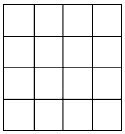
A board has 16 squares as shown in the figure:

Out of these 16 squares, two squares are chosen at random. The probability that they have no side in common is :
(b) To solve this, we can calculate the total number of ways to choose two squares and subtract the number of cases where the squares do have a side in common.
Step 1: Calculate the Total Outcomes
There are 16 squares in a \(4 \times 4\) grid. The total number of ways to choose any 2 squares is:
\(
n(S)=\binom{16}{2}=\frac{16 \times 15}{2}=120
\)
Step 2: Calculate the Favorable Cases for Common Sides
Two squares have a side in common if they are adjacent either horizontally or vertically.
Horizontal Adjacency:
In each row of 4 squares, there are 3 adjacent pairs.
With 4 rows, the total horizontal pairs \(=4 \times 3=12\).
Vertical Adjacency:
In each column of 4 squares, there are 3 adjacent pairs.
With 4 columns, the total vertical pairs \(=4 \times 3=12\).
Total number of pairs with a side in common \(=12+12=24\).
Step 3: Calculate the Probability
Let \(E\) be the event that the squares have a side in common.
\(
P(E)=\frac{24}{120}=\frac{1}{5}
\)
The question asks for the probability that they have no side in common \(\left(P\left(E^{\prime}\right)\right)\) :
\(
P\left(E^{\prime}\right)=1-P(E)=1-\frac{1}{5}=\frac{4}{5}
\)
One die has two faces marked 1 , two faces marked 2 , one face marked 3 and one face marked 4. Another die has one face marked 1 , two faces marked 2 , two faces marked 3 and one face marked 4. The probability of getting the sum of numbers to be 4 or 5, when both the dice are thrown together, is [JEE Main 2025 (Online) 23rd January Morning Shift]
(d) To solve this, we need to account for the specific probabilities of each face on the two biased dice. Let \(D_1\) be the first die and \(D_2\) be the second die.
Step 1: Identify Face Probabilities
For Die \(1\left(D_1\right)\) :
\(P(1)=\frac{2}{6}=\frac{1}{3}\)
\(P(2)=\frac{2}{6}=\frac{1}{3}\)
\(P(3)=\frac{1}{6}\)
\(P(4)=\frac{1}{6}\)
For Die \(2\left(D_2\right)\) :
\(P(1)=\frac{1}{6}\)
\(P(2)=\frac{2}{6}=\frac{1}{3}\)
\(P(3)=\frac{2}{6}=\frac{1}{3}\)
\(P(4)=\frac{1}{6}\)
Step 2: Calculate Probability for Sum = 4
The possible pairs \(\left(D_1, D_2\right)\) that sum to 4 are \((1,3),(2,2),(3,1)\).
\(P(1,3)=\frac{1}{3} \times \frac{1}{3}=\frac{1}{9}\)
\(P(2,2)=\frac{1}{3} \times \frac{1}{3}=\frac{1}{9}\)
\(P(3,1)=\frac{1}{6} \times \frac{1}{6}=\frac{1}{36}\)
Summing these up: \(P(\operatorname{Sum} 4)=\frac{4}{36}+\frac{4}{36}+\frac{1}{36}=\frac{9}{36}=\frac{1}{4}\)
Step 3: Calculate Probability for Sum = 5
The possible pairs \(\left(D_1, D_2\right)\) that sum to 5 are \((1,4),(2,3),(3,2),(4,1)\).
\(P(1,4)=\frac{1}{3} \times \frac{1}{6}=\frac{1}{18}\)
\(P(2,3)=\frac{1}{3} \times \frac{1}{3}=\frac{1}{9}\)
\(P(3,2)=\frac{1}{6} \times \frac{1}{3}=\frac{1}{18}\)
\(P(4,1)=\frac{1}{6} \times \frac{1}{6}=\frac{1}{36}\)
Summing these up: \(P(\) Sum 5\()=\frac{2}{36}+\frac{4}{36}+\frac{2}{36}+\frac{1}{36}=\frac{9}{36}=\frac{1}{4}\)
Step 4: Final Probability
We want the probability of getting a sum of 4 OR 5:
\(
\begin{gathered}
P(\text { Sum } 4 \cup \text { Sum } 5)=P(\text { Sum } 4)+P(\text { Sum } 5) \\
P=\frac{1}{4}+\frac{1}{4}=\frac{2}{4}=\frac{1}{2}
\end{gathered}
\)
If \(A\) and \(B\) are two events such that \(P(A \cap B)=0.1\), and \(P(A \mid B)\) and \(P(B \mid A)\) are the roots of the equation \(12 x^2-7 x+1=0\), then the value of \(\frac{P(\bar{A} \cup \bar{B})}{P(\bar{A} \cap \bar{B})}\) is : [JEE Main 2025 (Online) 22nd January Evening Shift]
(c) Step 1: Find the roots of the quadratic equation
The given equation is \(12 x^2-7 x+1=0\). To find the roots \(x_1\) and \(x_2\), we use the quadratic formula or factorization:
\(
(4 x-1)(3 x-1)=0
\)
The roots are \(x_1=\frac{1}{4}\) and \(x_2=\frac{1}{3}\). Thus, \(\{P(A \mid B), P(B \mid A)\}=\left\{\frac{1}{4}, \frac{1}{3}\right\}\).
Step 2: Calculate \(P(A)\) and \(P(B)\)
Using the definition of conditional probability \(P(X \mid Y)=\frac{P(X \cap Y)}{P(Y)}\), and knowing \(P(A \cap B)=0.1\), we set up the following:
\(P(B)=\frac{P(A \cap B)}{P(A \mid B)}\) and \(P(A)=\frac{P(A \cap B)}{P(B \mid A)}\)
Case 1: \(P(A \mid B)=\frac{1}{4}\) and \(P(B \mid A)=\frac{1}{3} \Longrightarrow P(B)=\frac{0.1}{1 / 4}=0.4\) and \(P(A)=\frac{0.1}{1 / 3}=0.3\).
Case 2: \(P(A \mid B)=\frac{1}{3}\) and \(P(B \mid A)=\frac{1}{4} \Longrightarrow P(B)=0.3\) and \(P(A)=0.4\).
In both cases, \(\{P(A), P(B)\}=\{0.3,0.4\}\).
Step 3: Determine \(P(A \cup B)\)
Using the addition rule of probability:
\(
\begin{gathered}
P(A \cup B)=P(A)+P(B)-P(A \cap B) \\
P(A \cup B)=0.3+0.4-0.1=0.6
\end{gathered}
\)
Step 4: Evaluate the required ratio
By De Morgan’s Laws, we have \(P(\bar{A} \cup \bar{B})=P(\overline{A \cap B})\) and \(P(\bar{A} \cap \bar{B})=P(\overline{A \cup B})\).
Numerator: \(P(\bar{A} \cup \bar{B})=1-P(A \cap B)=1-0.1=0.9\)
Denominator: \(P(\bar{A} \cap \bar{B})=1-P(A \cup B)=1-0.6=0.4\)
Calculating the ratio:
\(
\frac{P(\bar{A} \cup \bar{B})}{P(\bar{A} \cap \bar{B})}=\frac{0.9}{0.4}=\frac{9}{4}
\)
A coin is tossed three times. Let \(X\) denote the number of times a tail follows a head. If \(\mu\) and \(\sigma^2\) denote the mean and variance of \(X\), then the value of \(64\left(\mu+\sigma^2\right)\) is: [JEE Main 2025 (Online) 22nd January Morning Shift]
(d)
\(
\begin{array}{|l|c|c|}
\hline \text { Outcome } & x_i & p_i \\
\hline \text { HHH } & 0 & \frac{1}{8} \\
\hline \text { TTT } & 0 & \frac{1}{8} \\
\hline \text { HHT } & 1 & \frac{1}{8} \\
\hline \text { HTH } & 1 & \frac{1}{8} \\
\hline \text { THH } & 0 & \frac{1}{8} \\
\hline \text { TTH } & 0 & \frac{1}{8} \\
\hline \text { THT } & 1 & \frac{1}{8} \\
\hline \text { HTT } & 1 & \frac{1}{8} \\
\hline
\end{array}
\)
\(
\begin{aligned}
& \mu=\sum x_i P_i=\frac{1}{2} \\
& \sigma^2=\sum x_i^2 P_i-\mu^2 \\
& =\frac{1}{2}-\frac{1}{4}=\frac{1}{4} \\
& 64\left(\mu+\sigma^2\right)=64\left[\frac{1}{2}+\frac{1}{4}\right] \\
& =64 \times \frac{3}{4}=48
\end{aligned}
\)
Two balls are selected at random one by one without replacement from a bag containing 4 white and 6 black balls. If the probability that the first selected ball is black, given that the second selected ball is also black, is \(\frac{m}{n}\), where \(\operatorname{gcd}(m, n)=1\), then \(m+n\) is equal to : [JEE Main 2025 (Online) 22nd January Morning Shift]
(b) This problem is a classic application of conditional probability. We are looking for \(P\left(B_1 \mid B_2\right)\), the probability that the first ball is black given that the second ball is black.
Step 1: Define the Events
\(B_1\) : The first ball selected is black.
\(W_1\) : The first ball selected is white.
\(B_2\) : The second ball selected is black.
The bag contains 4 White (W) and 6 Black (B) balls, for a total of 10.
Step 2: Calculate the Probability of the Intersection
We need \(P\left(B_1 \cap B_2\right)\), which is the probability that both the first and second balls are black.
\(
P\left(B_1 \cap B_2\right)=P\left(B_1\right) \times P\left(B_2 \mid B_1\right)
\)
Since the selection is without replacement:
\(
P\left(B_1 \cap B_2\right)=\frac{6}{10} \times \frac{5}{9}=\frac{30}{90}=\frac{1}{3}
\)
Step 3: Calculate the Total Probability of the Condition (\(B_2\))
The second ball being black can happen in two mutually exclusive ways:
First is black, then second is black (\(B_1 \cap B_2\)).
First is white, then second is black (\(W_1 \cap B_2\)).
\(
\begin{gathered}
P\left(B_2\right)=P\left(B_1 \cap B_2\right)+P\left(W_1 \cap B_2\right) \\
P\left(B_2\right)=\left(\frac{6}{10} \times \frac{5}{9}\right)+\left(\frac{4}{10} \times \frac{6}{9}\right) \\
P\left(B_2\right)=\frac{30}{90}+\frac{24}{90}=\frac{54}{90}=\frac{3}{5}
\end{gathered}
\)
Step 4: Apply the Conditional Probability Formula
We want to find \(P\left(B_1 \mid B_2\right)\) :
\(
\begin{aligned}
& P\left(B_1 \mid B_2\right)=\frac{P\left(B_1 \cap B_2\right)}{P\left(B_2\right)} \\
& P\left(B_1 \mid B_2\right)=\frac{30 / 90}{54 / 90}=\frac{30}{54}
\end{aligned}
\)
Simplify the fraction:
\(
\frac{30}{54}=\frac{5}{9}
\)
Step 5: Final Result
We have \(\frac{m}{n}=\frac{5}{9}\).
Since \(\operatorname{gcd}(5,9)=1\) :
\(m=5\)
\(n=9\)
The question asks for \(m+n\) :
\(
m+n=5+9=14
\)
You cannot copy content of this page