Past JEE Main Entrance Papers
Definition of Limits
Let \(\lim _{x \rightarrow a} f(x)=L\). It would mean that when we approach the point \(x=a\) from the values which are just greater than or smaller than \(x=a, f(x)\) would have a tendency to move closer to the value ‘ \(L\) ‘.
Left Hand Limit and Right Hand Limit of a Function:
- The left hand limit (LHL) at \(x=a: \lim _{x \rightarrow a^{-}} f(x)\), Describes the behaviour of \(f(x)\) to the immediate left of \(x=a\).
- The left hand limit (RHL) at \(x=a: \lim _{x \rightarrow a^{+}} f(x)\), Describes the behaviour of \(f(x)\) to the immediate right of \(x=a\).
- The value of \(f(x)\) at \(x=a: f(a)\) Gives the precise value that \(f(x)\) takes at \(x=a\)
- The limit of \(f ( x )\) at \(x = a\) is said to exist if the function approaches the same value from both sides. That is Limit of a function \(f(x)\) is said to exist as \(x \rightarrow\) a when \(\operatorname{Lim}_{x \rightarrow a^{-}} f(x)=\underset{x \rightarrow a^{+}}{\operatorname{Lim}} f(x)=\) Finite and fixed quantity.
- In \(\operatorname{Lim}_{ x \rightarrow a } f(x), x \rightarrow a\) necessarily implies \(x \neq a\). That is while evaluating limit at \(x = a\), we are not concerned with the value of the function at \(x = a\). In fact the function may or may not be defined at \(x = a\).
Note: We have used the concept of \(\infty\) (infinity) in the discussions above. Lets discuss this concept in some what more detail:
\(\Rightarrow\) Infinity does not stand for any particular real number. In fact, it cannot be defined precisely.This is a deep concept. For any number you can think of, no matter how large, infinity is still larger. When we say that \(x \rightarrow \infty\), we mean that \(x\) increase in an unbounded fashion, that is, becomes indefinitely large.
\(\Rightarrow\) We cannot apply the normal rules of arithmetic to infinity. For example, saying that
\(
\infty-\infty=0 \text { or } \frac{\infty}{\infty}=1
\)
is absurd because such quantities are not defined.
Limit Laws
Let \(f(x)\) and \(g(x)\) be defined for all \(x \neq a\) over some open interval containing \(a\). Assume that \(L\) and \(M\) are real numbers such that \(\lim _{x \rightarrow a} f(x)=L\) and \(\lim _{x \rightarrow a} g(x)=M\). Let \(c\) be a constant. Then, each of the following statements holds:
- Sum law for limits: \(\lim _{x \rightarrow a}(f(x)+g(x))=\lim _{x \rightarrow a} f(x)+\lim _{x \rightarrow a} g(x)=L+M\)
- Difference law for limits: \(\lim _{x \rightarrow a}(f(x)-g(x))=\lim _{x \rightarrow a} f(x)-\lim _{x \rightarrow a} g(x)=L-M\)
- Constant multiple law for limits: \(\lim _{x \rightarrow a} c f(x)=c \cdot \lim _{x \rightarrow a} f(x)=c L\)
- Product law for limits: \(\lim _{x \rightarrow a}(f(x) \cdot g(x))=\lim _{x \rightarrow a} f(x) \cdot \lim _{x \rightarrow a} g(x)=L \cdot M\)
- Quotient law for limits: \(\lim _{x \rightarrow a} \frac{f(x)}{g(x)}=\frac{\lim _{x \rightarrow a} f(x)}{\lim _{x \rightarrow a} g(x)}=\frac{L}{M}\) for \(M \neq 0\)
- Power law for limits: \(\lim _{x \rightarrow a}(f(x))^n=\left(\lim _{x \rightarrow a} f(x)\right)^n=L^n\) for every positive integer \(n\).
- Root law for limits: \(\lim _{x \rightarrow a} \sqrt[n]{f(x)}=\sqrt[n]{\lim _{x \rightarrow a} f(x)}=\sqrt[n]{L}\) for all \(L\) if \(n\) is odd and for \(L \geq 0\) if \(n\) is even and \(f(x) \geq 0\).
Indeterminate Forms
If direct substitution of \(x=a\) while evaluating \(\lim _{x \rightarrow a}(x)\) leads to one of the following forms \(\frac{0}{0}, \infty, \infty-\infty, 1^{\infty}, 0^0, \infty{ }^0, \infty \times 0\) then it is called indeterminate form.
e.g. \(\lim _{x \rightarrow 1} \frac{x^2-1}{x-1}=\frac{0}{0}\) indeterminate form.
\(\lim _{x \rightarrow a} \frac{x^n-a^n}{x-a}=\frac{0}{0}\) indeterminate form.
\(\lim _{x \rightarrow 0} \frac{\sin x}{x}=\frac{0}{0}\) indeterminate form.
Infinity \((\infty)\) is a symbol and not a number. It is a symbol for the behaviour of a variable which continuously increases and passes through all limits. Thus, the statement \(x=\infty\) is meaningless, we should write \(x \rightarrow \infty\).
Similarly, \(-\infty\) is a symbol for the behaviour of a variable which continuously decreases and passes through all limits. Thus, the statement \(x=-\infty\) is meaningless, we should write \(x \rightarrow-\infty\).
Also, \(\frac{1}{x} \rightarrow 0\), if \(x \rightarrow+\infty\) and \(\frac{1}{x} \rightarrow 0\), if \(x \rightarrow-\infty\).
We cannot plot \(\infty\) on paper. Infinity does not obey laws of elementary algebra.
- \(\infty+\infty=\infty\) is indeterminate
- \(\infty-\infty\) is indeterminate.
L’Hospital’s Rule
This rule states that, if \(\lim _{x \rightarrow a} \frac{f(x)}{g(x)}\), reduces to \(\frac{0}{0}\) or \(\frac{\infty}{\infty}\).
Then, differentiate numerator and denominator till this form is removed.
i.e. \(\lim _{x \rightarrow a} \frac{f(x)}{g(x)}=\lim _{x \rightarrow a} \frac{f^{\prime}(x)}{g^{\prime}(x)}\), provided the later limit exists.
But, if it again take form \(\left(\frac{0}{0}\right.\) or \(\left.\frac{\infty}{\infty}\right)\),
then \(\lim _{x \rightarrow a} \frac{f(x)}{g(x)}=\lim _{x \rightarrow a} \frac{f^{\prime}(x)}{g^{\prime}(x)}=\lim _{x \rightarrow a} \frac{f^{\prime \prime}(x)}{g^{\prime \prime}(x)}\)
and this process is continued till \(\left(\frac{0}{0}\right.\) or \(\left.\frac{\infty}{\infty}\right)\) form is removed.
Note: L’Hospital’s rule is applicable to only two indeterminate forms \(\left(\frac{0}{0}\right.\) or \(\left.\frac{\infty}{\infty}\right)\).
General Methods used to Evaluate Limits
Case-I: Factorization :
Important factors :
- \(x^n-a^n=(x-a)\left(x^{n-1}+a x^{n-2}+\ldots \ldots \ldots \ldots+a^{n-1}\right), n \in N\)
- \(x^n+a^n=(x+a)\left(x^{n-1}-a x^{n-2}+\ldots \ldots \ldots . .+a^{n-1}\right), n\) is an odd natural number. \(\text { Note : } \operatorname{Lim}_{ x \rightarrow a } \frac{ x ^{ n }- a ^{ n }}{ x – a }= na ^{ n -1}\)
Case-II: Rationalization or double rationalization :
In this method we rationalise the factor containing the square root and simplify. An Example is given below:
\(
\lim _{x \rightarrow-1} \frac{x+1}{\sqrt{x+5}-2}
\)
\(
\lim _{x \rightarrow-1} \frac{(x+1)(\sqrt{x+5}+2)}{(\sqrt{x+5}-2)(\sqrt{x+5}+2)}=\lim _{x \rightarrow-1} \frac{(x+1)(\sqrt{x+5}+2)}{x+1}
\)
\(
\lim _{x \rightarrow-1} \sqrt{x+5}+2=\sqrt{-1+5}+2=4
\)
Case-III: Limit when \(x \rightarrow \infty\) :
- Divide by greatest power of \(x\) in numerator and denominator.
- Put \(x=1 / y\) and apply \(y \rightarrow 0\)
Case-IV: Sandwich Theorem
If \(g(x) \leq f(x) \leq h(x)\) and
\(
\begin{aligned}
& \lim _{x \rightarrow a} g(x)=L \text { and } \\
& \lim _{x \rightarrow a} h(x)=L
\end{aligned}
\)
Then \(\lim _{x \rightarrow a} f(x)=L\)
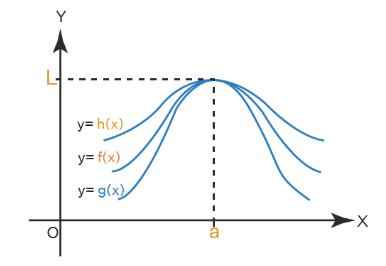
Example: Prove using sandwich theorem \(\operatorname{Lim}_{x \rightarrow 0}(\sin x / x)=1\)
Solution: In this case \(g(x)=\cos x\) and \(h(x)=1\)
Using the above inequality, \(\cos x<(\sin x) / x<1\). Also, it is very clear that \(\lim _{x \rightarrow 0} \cos x=\cos 0=1\) and \(\lim _{x \rightarrow 0} 1=1\). Hence, by squeeze theorem (sandwich theorem), \(\lim _{x \rightarrow 0}(\sin x) / x=1\).
Hence, we proved that \(\lim _{x \rightarrow 0}(\sin x) / x=1\).
Case-V: Using substitution
\(\operatorname{Lim}_{x \rightarrow a} f(x)=\underset{h \rightarrow 0}{\operatorname{Lim}} f(a-h)\) or \(\underset{h \rightarrow 0}{\operatorname{Lim}} f(a+h)\) i.e. by substituting \(x\) by \(a – h\) or \(a + h\)
Limit of Trigonometric Functions
- \(\lim _{x \rightarrow 0} \frac{\sin x}{x}=1\)
- \(\lim _{x \rightarrow 0} \frac{\tan x}{x}=1\)
- \(\lim _{x \rightarrow 0} \frac{\sin ^{-1} x}{x}=1\)
- \(\lim _{x \rightarrow 0} \frac{\tan ^{-1} x}{x}=1\)
- \(\lim _{x \rightarrow 0} \frac{\sin x^0}{x}=\frac{\pi}{180^{\circ}}\)
- \(\lim _{x \rightarrow 0} \cos x=1\)
- \(\lim _{x \rightarrow a} \frac{\sin (x-a)}{x-a}=1\)
- \(\lim _{x \rightarrow a} \frac{\tan (x-a)}{x-a}=1\)
Limit of Exponential Functions
There are two types of exponential limits discussed below
Case-I: Based on Series Expansion
\(e^x=1+x+\frac{x^2}{2!}+\frac{x^3}{3!}+\ldots \infty\)To evaluate the exponential limit, we use the following results.
- \(\lim _{x \rightarrow 0} \frac{e^x-1}{x}=1\)
- \(\lim _{x \rightarrow 0} \frac{a^x-1}{x}=\log _e a\)
Case-II: Evaluation of Exponential Limits of the Form \(1^{\infty}\)
- \(\operatorname{Lim}_{x \rightarrow 0}(1+x)^{1 / x}=e=\operatorname{Lim}_{x \rightarrow \infty}\left(1+\frac{1}{x}\right)^x\)
- \(\lim _{x \rightarrow 0}(1+\lambda x)^{1 / x}=e^\lambda = \lim _{x \rightarrow \infty}\left(1+\frac{\lambda}{x}\right)^x\)
- \(
\operatorname{Lim}_{x \rightarrow 0} \frac{\operatorname{\ell n}(1+x)}{x}=1,
\) - \(\text { In general, if } \underset{x \rightarrow a}{\operatorname{Lim}} f(x)=0 \text {, then } \underset{x \rightarrow a}{\operatorname{Lim}}(1+f(x))^{1 / f(x)}=e\)
- If \(\lim _{x \rightarrow a} f(x)=\lim _{x \rightarrow a} g(x)=0\), then \(\lim _{x \rightarrow a}\{1+f(x)\}^{1 / g(x)}=e^{\lim _{x \rightarrow a} \frac{f(x)}{g(x)}}\)
- \(\text { If } \lim _{x \rightarrow a} f(x)=1 \text { and } \lim _{x \rightarrow a} g(x)=\infty\), then \(\lim _{x \rightarrow a}\{f(x)\}^{g(x)}=\lim _{x \rightarrow a}[1+f(x)-1]^{g(x)} =e^{\lim _{x \rightarrow a}(f(x)-1) g(x)}\)
- If \(\operatorname{Lim}_{x \rightarrow a} f(x)=A>0 \& \operatorname{Lim}_{x \rightarrow a} g(x)=B\) (a finite quantity), then \(\operatorname{Lim}_{ x \rightarrow a }[ f ( x )]^{\phi( x )}=e^{ B \ln A }= A ^{ B }\)
Limit Using Series Expansion
Binomial expansion, exponential & logarithmic expansion, expansion of \(\sin x, \cos x, \tan x\) should be remembered by heart which are given below :
- \(a^x=1+\frac{x ln a}{1!}+\frac{x^2 ln^2 a}{2!}+\frac{x^3 ln^3 a}{3!}+\ldots, a>0\)
- \(\frac{1}{1-x}=1+x+x^2+x^3+\ldots \quad(\text { for }:-1<x<1)\)
- \(\frac{1}{1+x}=1-x+x^2-x^3+\ldots \quad(\text { for }:-1<x<1)\)
- \(e^x=1+x+\frac{x^2}{2!}+\frac{x^3}{3!}+\ldots\)
- \(\ln (1+x)=x-\frac{x^2}{2}+\frac{x^3}{3}-\frac{x^4}{4}+\frac{x^5}{5} \ldots \quad(\text { for }:-1<x<1)\)
- \(\sin x=x-\frac{x^3}{3!}+\frac{x^5}{5!}-\frac{x^7}{7!}+\frac{x^9}{9!} \ldots\)
- \(\cos x=1-\frac{x^2}{2!}+\frac{x^4}{4!}-\frac{x^6}{6!}+\frac{x^8}{8!} \ldots\)
- \(\tan x=x+\frac{x^3}{3}+\frac{2 x^5}{15}+\frac{17 x^7}{315}+\ldots \quad\left(\text { for: }:-\frac{\pi}{2}<x<\frac{\pi}{2}\right)\)
- \(\sinh x=x+\frac{x^3}{3!}+\frac{x^5}{5!}+\frac{x^7}{7!}+\frac{x^9}{9!} \ldots\)
- \(\cosh x=1+\frac{x^2}{2!}+\frac{x^4}{4!}+\frac{x^6}{6!}+\frac{x^8}{8!} \ldots\)
- \(\tanh x=x-\frac{x^3}{3}+\frac{2 x^5}{15}-\frac{17 x^7}{315}+\ldots \quad\left(\text { for }:-\frac{\pi}{2}<x<\frac{\pi}{2}\right)\)
- \(\sin ^{-1} x=x+\frac{1}{2} \frac{x^3}{3}+\frac{1 \cdot 3}{2 \cdot 4} \frac{x^5}{5}+\frac{1 \cdot 3 \cdot 5}{2 \cdot 4 \cdot 6} \frac{x^7}{7}+\cdots \quad|x|<1\)
- \(\cos ^{-1} x=\frac{\pi}{2}-\sin ^{-1} x=\frac{\pi}{2}-\left(x+\frac{1}{2} \frac{x^3}{3}+\frac{1 \cdot 3}{2 \cdot 4} \frac{x^5}{5}+\frac{1 \cdot 3 \cdot 5}{2 \cdot 4 \cdot 6} \frac{x^7}{7}+\cdots\right)|x|<1\)
- \(\tan ^{-1} x=x-\frac{x^3}{3}+\frac{x^5}{5}-\frac{x^7}{7}+\cdots \quad|x|<1\)
- \((1+x)^n=1+n x+\frac{n(n-1)}{2!} x^2+\ldots, n \in R, x \in(-1,1)\)
Quiz Summary
0 of 199 Questions completed
Questions:
Information
You have already completed the quiz before. Hence you can not start it again.
Quiz is loading…
You must sign in or sign up to start the quiz.
You must first complete the following:
Results
Results
0 of 199 Questions answered correctly
Your time:
Time has elapsed
You have reached 0 of 0 point(s), (0)
Earned Point(s): 0 of 0, (0)
0 Essay(s) Pending (Possible Point(s): 0)
Categories
- Not categorized 0%
- 1
- 2
- 3
- 4
- 5
- 6
- 7
- 8
- 9
- 10
- 11
- 12
- 13
- 14
- 15
- 16
- 17
- 18
- 19
- 20
- 21
- 22
- 23
- 24
- 25
- 26
- 27
- 28
- 29
- 30
- 31
- 32
- 33
- 34
- 35
- 36
- 37
- 38
- 39
- 40
- 41
- 42
- 43
- 44
- 45
- 46
- 47
- 48
- 49
- 50
- 51
- 52
- 53
- 54
- 55
- 56
- 57
- 58
- 59
- 60
- 61
- 62
- 63
- 64
- 65
- 66
- 67
- 68
- 69
- 70
- 71
- 72
- 73
- 74
- 75
- 76
- 77
- 78
- 79
- 80
- 81
- 82
- 83
- 84
- 85
- 86
- 87
- 88
- 89
- 90
- 91
- 92
- 93
- 94
- 95
- 96
- 97
- 98
- 99
- 100
- 101
- 102
- 103
- 104
- 105
- 106
- 107
- 108
- 109
- 110
- 111
- 112
- 113
- 114
- 115
- 116
- 117
- 118
- 119
- 120
- 121
- 122
- 123
- 124
- 125
- 126
- 127
- 128
- 129
- 130
- 131
- 132
- 133
- 134
- 135
- 136
- 137
- 138
- 139
- 140
- 141
- 142
- 143
- 144
- 145
- 146
- 147
- 148
- 149
- 150
- 151
- 152
- 153
- 154
- 155
- 156
- 157
- 158
- 159
- 160
- 161
- 162
- 163
- 164
- 165
- 166
- 167
- 168
- 169
- 170
- 171
- 172
- 173
- 174
- 175
- 176
- 177
- 178
- 179
- 180
- 181
- 182
- 183
- 184
- 185
- 186
- 187
- 188
- 189
- 190
- 191
- 192
- 193
- 194
- 195
- 196
- 197
- 198
- 199
- Current
- Review
- Answered
- Correct
- Incorrect
- Question 1 of 199
1. Question
If \(\alpha\) is the positive root of the equation, \(p(x)=x^2-x-2=0\), then \(\lim _{x \rightarrow \alpha^{+}} \frac{\sqrt{1-\cos (\mathrm{p}(x))}}{x+\alpha-4}\) is equal to: [Main Sep. 05, 2020 I]
CorrectIncorrectHint
(b) \(x^2-x-2=0 \Rightarrow(x-2)(x+1)=0\)
\(
\Rightarrow x=2,-1 \Rightarrow \alpha=2
\)
\(\therefore \lim _{x \rightarrow 2^{+}} \frac{\sqrt{1-\cos \left(x^2-x-2\right)}}{x-2}=\lim _{x \rightarrow 2^{+}} \frac{\sqrt{2}\left|\sin \left(\frac{\left.x^2-x-2\right)}{2}\right)\right|}{x-2}\)
\(=\lim _{x \rightarrow 2^{+}} \frac{\sqrt{2} \sin \frac{\left(x^2-x-2\right)}{2}}{\left(\frac{x^2-x-2}{2}\right)} \times \frac{\left(x^2-x-2\right)}{2(x-2)}\)
\(=\frac{1}{\sqrt{2}} \lim _{x \rightarrow 2^{-}}\left(\frac{\sin \left(\frac{x^2-x-2}{2}\right)}{\frac{x^2-x-2}{2}}\right) \times \lim _{x \rightarrow 2^{+}} \frac{(x-2)(x+1)}{(x-2)}\)
\(
=\frac{1}{\sqrt{2}} \times 1 \times 3=\frac{3}{\sqrt{2}}
\) - Question 2 of 199
2. Question
\(\lim _{x \rightarrow 0} \frac{x\left(e^{\left(\sqrt{\left.1+x^2+x^4-1\right) / x}-1\right)}\right.}{\sqrt{1+x^2+x^4}-1}\) [Main Sept. 05, 2020(II)]
CorrectIncorrectHint
(b) Let
\(L=\lim _{x \rightarrow 0} \frac{x\left(e^{\frac{\sqrt{1+x^2+x^4}-1}{x}-1}\right)}{\sqrt{1+x^2+x^4}-1}=\lim _{x \rightarrow 0} \frac{e^{\frac{\sqrt{1+x^2+x^4}-1}{x}}-1}{\frac{\sqrt{1+x^2+x^4}-1}{x}}\)
Put \(\frac{\sqrt{1+x^2+x^4}-1}{x}=t\) when \(x \rightarrow 0 \Rightarrow t \rightarrow 0\)
\(
\therefore L=\lim _{t \rightarrow 0} \frac{e^t-1}{t}=1
\) - Question 3 of 199
3. Question
Let \([t]\) denote the greatest integer \(\leq t\). If for some \(\lambda \in \mathbf{R}-\{0,1\}\), \(\lim _{x \rightarrow 0}\left|\frac{1-x+|x|}{\lambda-x+[x]}\right|=L\), then \(L\) is equal to: [Main Sept. 03, 2020(I)]
CorrectIncorrectHint
(b) Given \(\lim _{x \rightarrow 0}\left|\frac{1-x+|x|}{\lambda-x+[x]}\right|=L\)
Here, L.H.L. \(=\lim _{h \rightarrow 0^{-}}\left|\frac{1+h+h}{\lambda+h-1}\right|=\left|\frac{1}{\lambda-1}\right|\)
\(
\text { R.H.L. }=\lim _{h \rightarrow 0^{+}}\left|\frac{1-h+h}{\lambda+h+0}\right|=\left|\frac{1}{\lambda}\right|
\)
Given that limit exists. Hence L.H.L. = R.H.L.
\(
\begin{aligned}
&\Rightarrow|\lambda-1|=|\lambda| \\
&\Rightarrow \lambda=\frac{1}{2} \text { and } L=\left|\frac{1}{\lambda}\right|=2
\end{aligned}
\) - Question 4 of 199
4. Question
Let \(f(x)=5-|x-2|\) and \(g(x)=|x+1|, x \in \mathrm{R}\). If \(f(x)\) attains maximum value at \(\alpha\) and \(g(x)\) attains minimum value at \(\beta\), then \(\lim _{x \rightarrow-\alpha \beta} \frac{(x-1)\left(x^2-5 x+6\right)}{x^2-6 x+8}\) is equal to: [Main April 12, 2019 (II)]
CorrectIncorrectHint
(a)
Maxima of \(\mathrm{f}(\mathrm{x})\) occured at \(\mathrm{x}=2\) i.e. \(\alpha=2\)
Minima of \(\mathrm{g}(\mathrm{x})\) occured at \(\mathrm{x}=-1\) i.e. \(\beta=-1\)
\(
\therefore \lim _{x \rightarrow 2} \frac{(x-1)(x-2)(x-3)}{(x-2)(x-4)}=\frac{1}{2}
\) - Question 5 of 199
5. Question
If \(\lim _{x \rightarrow 1} \frac{x^2-a x+b}{x-1}=5\), then \(a+b\) is equal to: [Main April 10, 2019(II)]
CorrectIncorrectHint
(c)
Step 1: Find a condition between \(a\) and \(b\) using indeterminate form of limit.
Given, \(\lim _{x \rightarrow 1} \frac{x^2-a x+b}{x-1}=5\)
(Since denominators become zero on putting limit means numerators must be zero when \(x \rightarrow 1\) otherwise limit does not exist.
It can shown that if \(\lim _{x \rightarrow c} g(x)=0\) and \(\lim _{x \rightarrow c} f(x) \neq 0\), then \(\lim _{x \rightarrow c} \frac{f(x)}{g(x)}\) does not exist.
Hence, in order for the limit to exist, it must be the case that \(\lim _{x \rightarrow c} f(x)=0\).)\(
(1)^2-a(1)+b=0 \quad \rightarrow \quad b-a+1=0 \quad \cdots(1)
\)
Step 2: Use L’hospital rule to find \(a\).
\(
\begin{aligned}
& \lim _{x \rightarrow 1} \frac{x^2-a x+b}{x-1}=5 \\
\Rightarrow & \lim _{x \rightarrow 1} \frac{2 x-a}{1}=5 \quad\left[\because \lim _{x \rightarrow a} \frac{f(x)}{g(x)}=\lim _{x \rightarrow a} \frac{f^{\prime}(x)}{g^{\prime}(x)}\right] \\
\Rightarrow & 2-a =5 \\
\Rightarrow & a=-3
\end{aligned}
\)
Substitute a= -3 in equation (1), we get
\(
b=-4
\)
\(
\therefore a+b=-7
\) - Question 6 of 199
6. Question
\(\lim _{x \rightarrow 0} \frac{\sin ^2 x}{\sqrt{2}-\sqrt{1+\cos x}} \text { equals : }\) [Main April 8, 2019 (I)]
CorrectIncorrectHint
(a) \(\lim _{x \rightarrow 0} \frac{\sin ^2 x}{\sqrt{2}-\sqrt{1+\cos x}}=\lim _{x \rightarrow 0} \frac{\sin ^2 x}{\sqrt{2}-\sqrt{2 \cos ^2 \frac{x}{2}}}, \left[\frac{0}{0}\right]\)
\(
\begin{aligned}
&=\lim _{x \rightarrow 0} \frac{\sin ^2 x}{\sqrt{2}\left[1-\cos \frac{x}{2}\right]}=\lim _{x \rightarrow 0} \frac{\sin ^2 x}{2 \sqrt{2} \sin ^2 \frac{x}{4}} \\
&=\lim _{x \rightarrow 0} \frac{\left(\frac{\sin x}{x}\right)^2 \cdot 16}{2 \sqrt{2}\left(\frac{\sin \frac{x}{4}}{\frac{x}{4}}\right)^2}=\frac{16}{2 \sqrt{2}}=4 \sqrt{2}
\end{aligned}
\) - Question 7 of 199
7. Question
\(\lim _{x \rightarrow \frac{\pi}{4}} \frac{\cot ^3 x-\tan x}{\cos \left(x+\frac{\pi}{4}\right)}\) [Main Jan. 12, 2019 (I)]
CorrectIncorrectHint
(d) \(\lim _{x \rightarrow \frac{\pi}{4}} \frac{\cot ^3 x-\tan x}{\cos \left(x+\frac{\pi}{4}\right)}=\lim _{x \rightarrow \frac{\pi}{4}} \frac{\cot ^3 x\left(1-\frac{\tan x}{\cot ^3 x}\right)}{\cos (x+\pi / 4)}\) \(=\lim _{x \rightarrow \frac{\pi}{4}} \frac{\left(1-\tan ^4 x\right)}{\tan ^3 x \cos (x+\pi / 4)}\)
\(
\begin{aligned}
&=\lim _{x \rightarrow \frac{\pi}{4}} \frac{\left(1+\tan ^2 x\right)(1-\tan x)(1+\tan x)}{\tan ^3 x\left(\frac{\cos x-\sin x}{\sqrt{2}}\right)}\\
&=\lim _{x \rightarrow \frac{\pi}{4}} \frac{\left(1+\tan ^2 x\right)(1+\tan x)(\cos x-\sin x)}{\frac{\sin ^3 x}{\cos ^2 x}\left(\frac{\cos x-\sin x}{\sqrt{2}}\right)}={(2)(2)}{(\sqrt{2})(\sqrt{2})}=8
\end{aligned}
\) - Question 8 of 199
8. Question
\(\lim _{x \rightarrow 0} \frac{x \cot (4 x)}{\sin ^2 x \cot ^2(2 x)}\) is equal to: [Main Jan. 11, 2019 (II)]
CorrectIncorrectHint
(d) \(\lim _{x \rightarrow 0} \frac{x \cot 4 x}{\sin ^2 x \cdot \cot ^2 2 x}=\lim _{x \rightarrow 0} \frac{x \cdot \tan ^2 2 x}{\sin ^2 x \cdot \tan 4 x}\)
\(
=\lim _{x \rightarrow 0}\left(\frac{x}{\sin x}\right)^2 \cdot\left(\frac{\tan 2 x}{2 x}\right)^2 \cdot\left(\frac{4 x}{\tan 4 x}\right) \cdot \frac{4}{2^2}=1
\)Explanation:
Rewrite in sine and cosine using the identity \(\tan x=\frac{\sin x}{\cos x}\).
\(
\begin{aligned}
&=\lim _{x \rightarrow 0} \frac{\tan (4 x)}{x} \\
&=\lim _{x \rightarrow 0} \frac{\frac{\sin (4 x)}{\cos (4 x)}}{x} \\
&=\lim _{x \rightarrow 0} \frac{\sin (4 x)}{x \cos (4 x)}
\end{aligned}
\)
Rewrite so that that one expression is \(\frac{\sin (4 x)}{x}\).
\(
=\lim _{x \rightarrow 0} \frac{\sin (4 x)}{x} \times \frac{1}{\cos (4 x)}
\)
Use the well know limit that \(\lim _{x \rightarrow 0} \frac{\sin x}{x}=1\) to deduce the fact that \(\lim _{x \rightarrow 0} \frac{\sin (4 x)}{x}=4\)
\(
\begin{aligned}
&=4 \times \frac{1}{\cos (0)} \\
&=4 \times 1 \\
&=4
\end{aligned}
\) - Question 9 of 199
9. Question
\(\text { For each } t \in R \text {, let [t] be the greatest integer less than or equal to } t \text {. Then, }\) [Main Jan. 10, 2019 (I)]
\(
\lim _{x \rightarrow 1+} \frac{(1-|x|+\sin |1-x|) \sin \left(\frac{\pi}{2}[1-x]\right)}{|1-x|[1-x]}
\)CorrectIncorrectHint
(b) \(\lim _{x \rightarrow 1^{+}} \frac{(1-|x|+\sin (|1-x|)) \sin \left(\frac{\pi}{2}[1-x]\right)}{|1-x|[1-x]}\)
\(
=\lim _{h \rightarrow 0} \frac{(1-|1+h|+\sin (|1-1-h|)) \sin \left(\frac{\pi}{2}[1-1-h]\right)}{|1-1-h|[1-1-h]}
\)
\(
\begin{aligned}
&=\lim _{h \rightarrow 0} \frac{(1-1-h+\sinh ) \sin \left(\frac{\pi}{2}(-1)\right)}{h([0-h])} \\
&=\lim _{h \rightarrow 0} \frac{(-h+\sin h) \sin \left(-\frac{\pi}{2}\right)}{h(-1)}=0
\end{aligned}
\) - Question 10 of 199
10. Question
\(\lim _{y \rightarrow 0} \frac{\sqrt{1+\sqrt{1+y^4}}-\sqrt{2}}{y^4}\) [Main Jan. 9, 2019(I)]
CorrectIncorrectHint
(a)
\(
L=\lim _{y \rightarrow 0} \frac{\sqrt{1+\sqrt{1+y^4}}-\sqrt{2}}{y^4}
\)
\(
\begin{aligned}
&=\lim _{y \rightarrow 0} \frac{\left(\sqrt{1+\sqrt{1+y^4}}-\sqrt{2}\right)\left(\sqrt{1+\sqrt{1+y^4}}+\sqrt{2}\right)}{y^4\left(\sqrt{1+\sqrt{1+y^4}}+\sqrt{2}\right)} \\
&=\lim _{y \rightarrow 0} \frac{1+\sqrt{1+y^4}-2}{y^4\left(\sqrt{1+\sqrt{1+y^4}}+\sqrt{2}\right)} \\
&=\lim _{y \rightarrow 0} \frac{\left(\sqrt{1+y^4}-1\right)\left(\sqrt{1+y^4}+1\right)}{y^4\left(\sqrt{1+\sqrt{1+y^4}+\sqrt{2}}\right)\left(\sqrt{1+y^4}+1\right)} \\
&=\lim _{y \rightarrow 0} \frac{1+y^4-1}{y^4\left(\sqrt{1+\sqrt{1+y^4}+\sqrt{2}}\right)\left(\sqrt{1+y^4}+1\right)} \\
&=\frac{1}{2 \sqrt{2} \times 2}=\frac{1}{4 \sqrt{2}}
\end{aligned}
\) - Question 11 of 199
11. Question
For each \(x \in \mathbf{R}\), let \([x]\) be greatest integer less than or equal to \(x\). Then
\(\lim _{x \rightarrow 0} \frac{x([x]+|x|) \sin [x]}{|x|}\) is equal to: [Main Jan. 09, 2019 (II)]CorrectIncorrectHint
(a) \(\lim _{x \rightarrow 0^{-}} \frac{x([x]+|x|) \cdot \sin [x]}{|x|}\)
\(
\begin{aligned}
&=\lim _{h \rightarrow 0} \frac{(0-h)([0-h]+|0-h|) \cdot \sin [0-h]}{|0-h|} \\
&=\lim _{h \rightarrow 0} \frac{(-h)(-1+h) \sin (-1)}{h} \\
&=\lim _{h \rightarrow 0}(1-h) \sin (-1)=-\sin 1
\end{aligned}
\) - Question 12 of 199
12. Question
\(\lim _{x \rightarrow 0} \frac{x \tan 2 x-2 x \tan x}{(1-\cos 2 x)^2}\) equals. [Main Online April 15, 2018]
CorrectIncorrectHint
\(
\text { (d) Let, } L=\lim _{x \rightarrow 0} \frac{(x \tan 2 x-2 x \tan x)}{(1-\cos 2 x)^2}=\lim _{x \rightarrow 0} K \text { (say) }
\)
\(
\begin{aligned}
&\Rightarrow K=\frac{x\left[\frac{2 \tan x}{1-(\tan x)^2}\right]-2 x \tan x}{\left(1-\left(1-2 \sin ^2 x\right)\right)^2}\\
&=\frac{2 x \tan x-\left[2 x \tan x-2 x \tan ^3 x\right]}{4 \sin ^4 x \times\left(1-\tan ^2 x\right)}\\
&=\frac{2 x \tan ^3 x}{4 \sin ^4 x \times\left(1-\tan ^2 x\right)}=\frac{2 x \tan ^3 x}{4 \sin ^4 x \times\left(\frac{\cos ^2 x-\sin ^2 x}{\cos ^2 x}\right)}\\
&=\frac{2 x \frac{\sin ^3 x}{\cos ^3 x}}{4 \sin ^4 x \times\left(\frac{\cos ^2 x-\sin ^2 x}{\cos ^2 x}\right)}\\
&\Rightarrow K=\frac{x}{2 \sin x \times\left(\cos ^2 x-\sin ^2 x\right) \cos x}\\
&\therefore L=\lim _{x \rightarrow 0} \frac{x}{2 \sin x} \times \lim _{x \rightarrow 0} \frac{1}{\cos x\left(\cos ^2 x-\sin ^2 x\right)}\\
&=\lim _{x \rightarrow 0} \frac{x}{2 \sin x} \times \lim _{x \rightarrow 0} \frac{1}{\cos 0\left(\cos ^2 0-\sin ^2 0\right)}=\frac{1}{2}
\end{aligned}
\) - Question 13 of 199
13. Question
\(\lim _{x \rightarrow \frac{\pi}{2}} \frac{\cot x-\cos x}{(\pi-2 x)^3} \text { equals : }\) [Main 2017]
CorrectIncorrectHint
(c) \(\lim _{x \rightarrow \frac{\pi}{2}} \frac{\cot x(1-\sin x)}{-8\left(x-\frac{\pi}{2}\right)^3}=\lim _{x \rightarrow \frac{\pi}{2}} \frac{\cot x(1-\sin x)}{8\left(\frac{\pi}{2}-x\right)^3}\)
Put \(\frac{\pi}{2}-\mathrm{x}=\mathrm{t} \Rightarrow\) as \(\mathrm{x} \rightarrow \frac{\pi}{2} \Rightarrow \mathrm{t} \rightarrow 0\)
\(
\begin{aligned}
&=\lim _{t \rightarrow 0} \frac{\cot \left(\frac{\pi}{2}-t\right)\left(1-\sin \left(\frac{\pi}{2}-t\right)\right)}{8 t^3} \\
&=\lim _{t \rightarrow 0} \frac{\tan t(1-\cos t)}{8 t^3}=\lim _{t \rightarrow 0} \frac{\tan t}{8 t} \cdot \frac{1-\cos t}{t^2}=\frac{1}{8} \cdot 1 \cdot \frac{1}{2}=\frac{1}{16}
\end{aligned}
\) - Question 14 of 199
14. Question
\(\lim _{x \rightarrow 0} \frac{(1-\cos 2 x)(3+\cos x)}{x \tan 4 x}\) is equal to: [Main 2015]
CorrectIncorrectHint
(a) Multiply and divide by \(x\) in the given expression, we get
\(
\begin{aligned}
& \lim _{x \rightarrow 0} \frac{(1-\cos 2 x)}{x^2} \frac{(3+\cos x)}{1} \cdot \frac{x}{\tan 4 x} \\
=& \lim _{x \rightarrow 0} \frac{2 \sin ^2 x}{x^2} \cdot \frac{3+\cos x}{1} \cdot \frac{x}{\tan 4 x} \\
=& 2 \lim _{x \rightarrow 0} \frac{\sin ^2 x}{x^2} \cdot \lim _{x \rightarrow 0} 3+\cos x \cdot \lim _{x \rightarrow 0} \frac{x}{\tan 4 x} \\
=& 2.4 \frac{1}{4} \lim _{x \rightarrow 0} \frac{4 x}{\tan 4 x}=2.4 . \frac{1}{4}=2
\end{aligned}
\) - Question 15 of 199
15. Question
\(\lim _{x \rightarrow 0} \frac{e^{x^2}-\cos x}{\sin ^2 x} \text { is equal to : }\) [Main Online April 10, 2015]
CorrectIncorrectHint
(c) \(\lim _{x \rightarrow 0} \frac{2 x e^{x^2}+\sin x}{2 \sin x \cos x}\)
\(
\lim _{x \rightarrow 0}\left(\frac{x}{\sin x} e^{x^2}+\frac{1}{2}\right) \frac{1}{\cos x}=1+\frac{1}{2}=\frac{3}{2}
\) - Question 16 of 199
16. Question
\(\lim _{x \rightarrow 0} \frac{\sin \left(\pi \cos ^2 x\right)}{x^2}\) is equal to: [Main 2014]
CorrectIncorrectHint
(b) \(\lim _{x \rightarrow 0} \frac{\sin \left(\pi \cos ^2 x\right)}{x^2}=\lim _{x \rightarrow 0} \frac{\sin \left[\pi\left(1-\sin ^2 x\right)\right]}{x^2}\) \(=\lim _{x \rightarrow 0} \sin \frac{\left(\pi-\pi \sin ^2 x\right)}{x^2} \quad[\because \sin (\pi-\theta)=\sin \theta]\) \(=\lim _{x \rightarrow 0} \sin \frac{\left(\pi \sin ^2 x\right)}{\pi \sin ^2 x} \times \frac{\pi \sin ^2 x}{x^2}\)
\(
=\lim _{x \rightarrow 0} 1 \times \pi\left(\frac{\sin x}{x}\right)^2=\pi
\) - Question 17 of 199
17. Question
\(\lim _{x \rightarrow 0} \frac{(1-\cos 2 x)(3+\cos x)}{x \tan 4 x} \text { is equal to }\) [JEE Main 2013]
CorrectIncorrectHint
(d) Multiply and divide by \(x\) in the given expression, we get
\(
\begin{aligned}
& \lim _{x \rightarrow 0} \frac{(1-\cos 2 x)}{x^2} \frac{(3+\cos x)}{1} \cdot \frac{x}{\tan 4 x} \\
=& \lim _{x \rightarrow 0} \frac{2 \sin ^2 x}{x^2} \cdot \frac{3+\cos x}{1} \cdot \frac{x}{\tan 4 x} \\
=& 2 \lim _{x \rightarrow 0} \frac{\sin ^2 x}{x^2} \cdot \lim _{x \rightarrow 0}(3+\cos x) \cdot \lim _{x \rightarrow 0} \frac{4 x}{\tan 4 x} \times \frac{1}{4}=2 \cdot 4 \cdot \frac{1}{4}=2
\end{aligned}
\) - Question 18 of 199
18. Question
Let \(\alpha(a)\) and \(\beta(a)\) be the roots of the equation \((\sqrt[3]{1+a}-1) x^2+(\sqrt{1+a}-1) x+(\sqrt[6]{1+a}-1)=0\) where \(a>-1\). Then \(\lim _{a \rightarrow 0^{+}} \alpha(a)\) and \(\lim _{a \rightarrow 0^{+}} \beta(a)\) are [JEE Main 2012]
CorrectIncorrectHint
(b) \((\sqrt[3]{1+a}-1) x^2+(\sqrt{1+a}-1) x+(\sqrt[6]{1+a}-1)=0\)
Let \(a+1=y\), then equation reduces to
\(
\left(y^{1 / 3}-1\right) x^2+\left(y^{1 / 2}-1\right) x+\left(y^{1 / 6}-1\right)=0
\)
On dividing both sides by \(y-1\), we get
\(
\left(\frac{y^{1 / 3}-1}{y-1}\right) x^2+\left(\frac{y^{1 / 2}-1}{y-1}\right) x+\left(\frac{y^{1 / 6}-1}{y-1}\right)=0
\)
On taking limit as \(y \rightarrow 1\) i.e. \(a \rightarrow 0\) on both sides, we get \(\frac{1}{3} x^2+\frac{1}{2} x+\frac{1}{6}=0 \Rightarrow 2 x^2+3 x+1=0\) \(\Rightarrow x=-1,-\frac{1}{2}\) (roots of the equation)
\(
\therefore \quad \lim _{a \rightarrow 0^{+}} \alpha(a)=-1, \lim _{a \rightarrow 0^{+}} \beta(a)=-\frac{1}{2}
\) - Question 19 of 199
19. Question
\(
\text { If } \lim _{x \rightarrow \infty}\left(\frac{x^2+x+1}{x+1}-a x-b\right)=4 \text {, then }
\) [JEE Main 2012]CorrectIncorrectHint
\(
\text { (b) Given: } \lim _{x \rightarrow \infty}\left(\frac{x^2+x+1}{x+1}-a x-b\right)=4
\)
\(
\begin{aligned}
&\Rightarrow \lim _{x \rightarrow \infty} \frac{x^2+x+1-a x^2-a x-b x-b}{x+1}=4 \\
&\Rightarrow \lim _{x \rightarrow \infty} \frac{(1-a) x^2+(1-a-b) x+(1-b)}{x+1}=4
\end{aligned}
\)
For this limit to be finite \(1-a=0 \Rightarrow a=1\) then the given limit reduces to
\(
\begin{aligned}
&\lim _{x \rightarrow \infty} \frac{-b x+(1-b)}{x+1}=4 \Rightarrow \lim _{x \rightarrow \infty} \frac{-b+\frac{(1-b)}{x}}{1+\frac{1}{x}}=4 \\
&\Rightarrow-b=4 \text { or } b=-4, \quad \therefore a=1, b=-4
\end{aligned}
\) - Question 20 of 199
20. Question
If \(\lim _{x \rightarrow 0} \frac{((a-n) n x-\tan x) \sin n x}{x^2}=0\), where \(\mathrm{n}\) is nonzero real number, then \(a\) is equal to [JEE Main 2003]
CorrectIncorrectHint
(d) \(\lim _{x \rightarrow 0} \frac{[(a-n) n x-\tan x] \sin n x}{x^2}=0\)
\(
\Rightarrow \lim _{x \rightarrow 0} n . \frac{\sin n x}{n x}\left[\left\{(a-n) n-\frac{\tan x}{x}\right\}\right]=0
\)
\(
\Rightarrow n .1[(a-n) n-1]=0 \Rightarrow a=\frac{1}{n}+n
\)
[where \(n\) is non zero real number] - Question 21 of 199
21. Question
\(\lim _{x \rightarrow 0} \frac{\sin \left(\pi \cos ^2 x\right)}{x^2}\) equals [JEE Main 2001]
CorrectIncorrectHint
(b) \(\lim _{x \rightarrow 0} \frac{\sin \left(\pi \cos ^2 x\right)}{x^2}=\lim _{x \rightarrow 0} \frac{\sin \left(\pi-\pi \sin ^2 x\right)}{x^2}\) \(=\lim _{x \rightarrow 0} \frac{\sin \left(\pi \sin ^2 x\right)}{\pi \sin ^2 x} \times \frac{\left(\pi \sin ^2 x\right)}{x^2}=\pi\)
- Question 22 of 199
22. Question
\(\lim _{n \rightarrow \infty}\left\{\frac{1}{1-n^2}+\frac{2}{1-n^2}+\ldots .+\frac{n}{1-n^2}\right\}\) is equal to [1984 – 2 Marks]
CorrectIncorrectHint
(b) \(\lim _{n \rightarrow \infty}\left(\frac{1}{1-n^2}+\frac{2}{1-n^2}+\ldots+\frac{n}{1-n^2}\right)\)
\(
=\lim _{n \rightarrow \infty} \frac{1+2+3+\ldots+n}{1-n^2}=\lim _{n \rightarrow \infty} \frac{\Sigma n}{1-n^2}=\lim _{n \rightarrow \infty} \frac{n(n+1)}{2\left(1-n^2\right)}
\)
\(
=\lim _{n \rightarrow \infty} \frac{1+1 / n}{2\left[\frac{1}{n^2}-1\right]}=-1 / 2
\) - Question 23 of 199
23. Question
If \(G(x)=-\sqrt{25-x^2}\) then \(\lim _{x \rightarrow 1} \frac{G(x)-G(1)}{x-1}\) has the value [1983 – 1 Mark]
CorrectIncorrectHint
(d)
\(\lim _{x \rightarrow 1} \frac{G(x)-G(1)}{x-1}, \frac{0}{0}\) form
\(=\mathrm{G}^{\prime}(1)\)
Now G \({ }^{\prime}(x)=-\frac{1}{2 \sqrt{25-x^2}}(-2 x)\), differentiate using chain rule \(\Rightarrow \mathrm{G}^{\prime}(\mathrm{x})=\frac{\mathrm{x}}{\sqrt{25-\mathrm{x}^2}}\)
\(\therefore G^{\prime}(1)=\frac{1}{\sqrt{24}}\), which is required limit - Question 24 of 199
24. Question
If \(f(x)=\sqrt{\frac{x-\sin x}{x+\cos ^2 x}}\), then \(\lim _{x \rightarrow \infty} f(x)\) is [1979]
CorrectIncorrectHint
(c) \(f(x)=\sqrt{\frac{x-\sin x}{x+\cos ^2 x}}\)
\(
\therefore \lim _{x \rightarrow \infty} f(x)=\lim _{x \rightarrow \infty} \sqrt{\frac{1-\frac{\sin x}{x}}{1+\frac{\cos ^2 x}{x}}}=\sqrt{\frac{1-0}{1+0}}=1
\) - Question 25 of 199
25. Question
The value of the limit
\(\lim _{x \rightarrow \frac{\pi}{2}} \frac{4 \sqrt{2}(\sin 3 x+\sin x)}{\left(2 \sin 2 x \sin \frac{3 x}{2}+\cos \frac{5 x}{2}\right)-\left(\sqrt{2}+\sqrt{2} \cos 2 x+\cos \frac{3 x}{2}\right)}
\) is _____ [Adv. 2020]CorrectIncorrectHint
\(
\begin{aligned}
&\lim _{x \rightarrow \frac{\pi}{2}} \frac{4 \sqrt{2} \cdot 2 \sin 2 x \cos x}{2 \sin 2 x \sin \frac{3 x}{2}+\left(\cos \frac{5 x}{2}-\cos \frac{3 x}{2}\right)-\sqrt{2}(1+\cos 2 x)} \\
&=\lim _{x \rightarrow \frac{\pi}{2}} \frac{8 \sqrt{2} \cdot 2 \sin x \cos x \cos x}{2 \sin 2 x \sin \frac{3 x}{2}-2 \sin 2 x \sin \frac{x}{2}-2 \sqrt{2} \cos ^2 x}
\end{aligned}
\)
\(
\begin{aligned}
&=\lim _{x \rightarrow \frac{\pi}{2}} \frac{16 \sqrt{2} \sin x \cos ^2 x}{2 \sin 2 x\left(\sin \frac{3 x}{2}-\sin \frac{x}{2}\right)-2 \sqrt{2} \cos ^2 x} \\
&=\lim _{x \rightarrow \frac{\pi}{2}} \frac{16 \sqrt{2} \sin x \cos ^2 x}{4 \sin x \cos x\left(2 \cos x \cdot \sin \frac{x}{2}\right)-2 \sqrt{2} \cos ^2 x} \\
&=\frac{16 \sqrt{2} \sin x \cos ^2 x}{2 \cos ^2 x\left(4 \sin x \sin \frac{x}{2}-\sqrt{2}\right)} \\
&=\lim _{x \rightarrow \frac{\pi}{2}} \frac{8 \sqrt{2} \sin x}{4 \sin x \cdot \sin \frac{x}{2}-\sqrt{2}}=8
\end{aligned}
\) - Question 26 of 199
26. Question
Let \(m\) and \(n\) be two positive integers greater than 1 . If \(\lim _{\alpha \rightarrow 0}\) \(\left(\frac{e^{\cos \left(\alpha^n\right)}-e}{\alpha^m}\right)=-\left(\frac{e}{2}\right)\) then the value of \(\frac{m}{n}\) is [Adv. 2015]
CorrectIncorrectHint
\(\lim _{\alpha \rightarrow 0} \frac{e^{\cos \alpha^n}-e}{\alpha^m}=\frac{-e}{2}\)
\(\Rightarrow \lim _{\alpha \rightarrow 0} \frac{e\left[e^{\cos \alpha^n-1}-1\right]}{\cos \alpha^n-1} \times \frac{\cos \alpha^n-1}{\alpha^m}=\frac{-e}{2}\)
\(
\begin{aligned}
&\Rightarrow e \lim _{\alpha \rightarrow 0} \frac{-2 \sin ^2 \frac{\alpha^n}{2}}{\left(\frac{\alpha^n}{2}\right)^2} \times \frac{\left(\frac{\alpha^n}{2}\right)^2}{\alpha^m}=\frac{-e}{2} \\
&\Rightarrow \frac{-e}{2} \alpha^{2 n-m}=\frac{-e}{2} \Rightarrow \frac{m}{n}=2
\end{aligned}
\) - Question 27 of 199
27. Question
The largest value of non-negative integer a for which
\(
\lim _{x \rightarrow 1}\left\{\frac{-a x+\sin (x-1)+a}{x+\sin (x-1)-1}\right\}^{\frac{1-x}{1-\sqrt{x}}}=\frac{1}{4} \text { is }
\) [Adv. 2014]CorrectIncorrectHint
\(
\begin{aligned}
&\lim _{x \rightarrow 1}\left\{\frac{-a x+\sin (x-1)+a}{x+\sin (x-1)-1}\right\}^{\frac{1-x}{1-\sqrt{x}}}=\frac{1}{4} \\
&\Rightarrow \lim _{x \rightarrow 1}\left\{\frac{a(1-x)+\sin (x-1)}{(x-1)+\sin (x-1)}\right\}^{1+\sqrt{x}} \\
&\Rightarrow \lim _{x \rightarrow 1}\left\{\frac{-a+\frac{\sin (x-1)}{x-1}}{1+\frac{\sin (x-1)}{x-1}}\right\}^{1+\sqrt{x}} \Rightarrow\left(\frac{-a+1}{2}\right)^2=\frac{1}{4} \\
&\Rightarrow a=0 \text { or } 2
\end{aligned}
\)
\(\therefore\) Largest value of a is 2. - Question 28 of 199
28. Question
If \(\lim _{x>0}\left\{\frac{1}{x^8}\left(1-\cos \frac{x^2}{2}-\cos \frac{x^2}{4}+\cos \frac{x^2}{2} \cos \frac{x^2}{4}\right)\right\}=2^{-k}\), then the value of \(k\) is ______ [Main Sep. 03, 2020 (I)]
CorrectIncorrectHint
\(
\begin{aligned}
&\lim _{x \rightarrow 0} \frac{1}{x^8}\left[\left(1-\cos \frac{x^2}{2}\right)-\cos \frac{x^2}{4}\left(1-\cos \frac{x^2}{2}\right)\right] \\
&=\lim _{x \rightarrow 0} \frac{1}{x^8}\left[\left(1-\cos \frac{x^2}{2}\right)\left(1-\cos \frac{x^2}{4}\right)\right] \\
&=\lim _{x \rightarrow 0} \frac{1}{x^8}\left[2 \sin ^2 \frac{x^2}{4} 2 \sin ^2 \frac{x^2}{8}\right] \\
&=\lim _{x \rightarrow 0} \frac{1}{256}\left(\frac{\sin \frac{x^2}{4}}{\left(\frac{x^2}{4}\right)}\right)^2\left(\frac{\sin \frac{x^2}{8}}{\left(\frac{x^2}{8}\right)}\right) \\
&=\frac{1}{256}=2^{-8} \\
&\therefore k=8
\end{aligned}
\) - Question 29 of 199
29. Question
\(\lim _{x \rightarrow 2} \frac{3^x+3^{3-x}-12}{3^{-x / 2}-3^{1-x}}\) is equal to ____ [Main Jan. 7, 2020 (I)]
CorrectIncorrectHint
\(
\text { Let } 3^x=t^2
\)
\(
\begin{aligned}
&\lim _{t \rightarrow 3} \frac{t^2+\frac{27}{t^2}-12}{\frac{1}{t}-\frac{3}{t^2}}=\lim _{t \rightarrow 3} \frac{t^4-12 t^2+27}{t-3} \\
&=\lim _{t \rightarrow 3} \frac{\left(t^2-3\right)(t+3)(t-3)}{t-3} \\
&=\left(3^2-3\right)(3+3)=36 .
\end{aligned}
\) - Question 30 of 199
30. Question
Let \(e\) denote the base of the natural logarithm. The value of the real number \(a\) for which the right-hand limit
\(
\lim _{x \rightarrow 0^{+}} \frac{(1-x)^{\frac{1}{x}}-e^{-1}}{x^a}
\) is equal to a nonzero real number, is ____ [Adv. 2020]CorrectIncorrectHint
\(\begin{aligned}
&\lim _{x \rightarrow 0^{+}} \frac{(1-x)^{1 / x}-e^{-1}}{x^a}=\lim _{x \rightarrow 0^{+}} \frac{e^{\left(\frac{\ln (1-x)}{x}\right)}-\frac{1}{e}}{x^a}\\
&\left[\because(1-x)^{1 / x}=e^{1 / x(1-x)}\right]
\end{aligned}\)
\(
\lim _{x \rightarrow 0^{+}} \frac{1}{e} \frac{e^{\left(1+\frac{\ln (1-x)}{x}\right)}-1}{x^a}=\frac{1}{e} \lim _{x \rightarrow 0^{+}} \frac{\ln (1-x)+x}{x^{(a+1)}}
\)
\(
=\frac{1}{e} \lim _{x \rightarrow 0^{+}} \frac{\left(-x-\frac{x^2}{2}-\frac{x^3}{3}-\ldots\right)+x}{x^{a+1}} \quad \therefore a=1
\) - Question 31 of 199
31. Question
If \(f(9)=9, f^{\prime}(9)=4\), then \(\lim _{x \rightarrow 9} \frac{\sqrt{f(x)}-3}{\sqrt{x}-3}\) equals [1988 – 2 Marks]
CorrectIncorrectHint
Given : \(f(9)=9, f^{\prime}(9)=4\)
\(
\begin{aligned}
& \therefore \quad \lim _{x \rightarrow 9} \frac{\sqrt{f(x)}-3}{\sqrt{x}-3}=\lim _{x \rightarrow 9} \frac{(\sqrt{f(x)}-3)(\sqrt{f(x)}+3)}{(\sqrt{x}-3)(\sqrt{x}+3)} \\
=& \lim _{x \rightarrow 9} \frac{\sqrt{x}+3}{\sqrt{f(x)}+3} \times \lim _{x \rightarrow 9} \frac{f(x)-9}{x-9} \\
=& {\left[\frac{3+3}{3+3}\right] \cdot f^{\prime}(9)=1 \times 4=4 }
\end{aligned}
\) - Question 32 of 199
32. Question
\(
\lim _{x \rightarrow-\infty}\left[\frac{x^4 \sin \left(\frac{1}{x}\right)+x^2}{\left(1+|x|^3\right)}\right]= ?
\) [1987 – 2 Marks]CorrectIncorrectHint
\(
\begin{aligned}
&\lim _{x \rightarrow-\infty}\left[\frac{x^4 \sin \left(\frac{1}{x}\right)+x^2}{\left(1+|x|^3\right)}\right]\\
&=\lim _{x \rightarrow-\infty} \frac{x^3}{1+|x|^3}\left[x \sin \left(\frac{1}{x}\right)+\frac{1}{x}\right]\\
&=\lim _{x \rightarrow-\infty} \frac{x^3}{|x|^3}\left[\frac{1}{1+\frac{1}{|x| x^2}}\right]\left[x \sin \left(\frac{1}{x}\right)+\frac{1}{x}\right]\\
&=\lim _{x \rightarrow-\infty} \frac{x^3}{|x|^3} .1=\lim _{x \rightarrow-\infty} \frac{x^3}{-x^3}=-1
\end{aligned}
\) - Question 33 of 199
33. Question
\(
\text { If } f(x)\left\{\begin{array}{cc}
\sin x, & x \neq n \pi, n=0, \pm 1, \pm 2, \pm 3, \ldots \ldots \ldots \ldots \\
2, & \text { otherwise }
\end{array}\right.
\)
and \(g(x)\left\{\begin{array}{cc}x^2+1, & x \neq 0,2 \\ 4, & x=0 \\ 5, & x=2\end{array}\right.\) then \(\lim _{x \rightarrow 0} g[f(x)]\) is [1986 – 2 Marks]CorrectIncorrectHint
Given :
\(
f(x)=\left\{\begin{array}{cc}
\sin x, x \neq \pi, n=0, \pm 1, \pm 2, \ldots \\
2, & \text { otherwise }
\end{array}\right.
\)
And \(g(x)= \begin{cases}x^2+1, & x \neq 0,2 \\ 4, & x=0 \\ 5, & x=2\end{cases}\)
\(
\therefore \quad \lim _{x \rightarrow 0} g[f(x)]=\lim _{x \rightarrow 0} g(\sin x) \Rightarrow \lim _{x \rightarrow 0}\left(\sin ^2 x+1\right)=1
\) - Question 34 of 199
34. Question
If \(\underset{x \rightarrow a}{L t}[f(x) g(x)]\) exists then both \(\underset{x \rightarrow a}{L t} f(x)\) and \(\underset{x \rightarrow a}{L t} g(x)\) exist. [1981 – 2 Marks]
CorrectIncorrectHint
The answer is False. \(f(x)=\frac{|x-a|}{x-a}\) and \(g(x)=\frac{x-a}{|x-a|}\) then \(\lim _{x \rightarrow a}(f(x) g(x))\) exists but neither \(\lim _{x \rightarrow a} f(x)\) nor \(\lim _{x \rightarrow a} g(x)\) exists.
- Question 35 of 199
35. Question
Let \(\mathrm{f}(\mathrm{x})=\frac{1-\mathrm{x}(1+|1-\mathrm{x}|)}{|1-\mathrm{x}|} \cos \left(\frac{1}{1-\mathrm{x}}\right)\) for \(\mathrm{x} \neq 1\). Then [Adv. 2017]
CorrectIncorrectHint
Given:
\(f(x)=\frac{1-x(1+|1-x|)}{|1-x|} \cos \left(\frac{1}{1-x}\right)\) for \(x \neq 1\)
\(
\begin{aligned}
& \lim _{\mathrm{x} \rightarrow 1^{-}} \mathrm{f}(\mathrm{x})=\lim _{\mathrm{h} \rightarrow 0} \frac{1-(1-\mathrm{h})(1+\mathrm{h})}{\mathrm{h}} \cos \left(\frac{1}{\mathrm{~h}}\right) \\
=& \lim _{\mathrm{h} \rightarrow 0} \frac{1-1+\mathrm{h}^2}{\mathrm{~h}} \cos \left(\frac{1}{\mathrm{~h}}\right)=\lim _{\mathrm{h} \rightarrow 0} \mathrm{~h} \cos \left(\frac{1}{\mathrm{~h}}\right)=0 \\
& \lim _{\mathrm{x} \rightarrow 1^{+}} \mathrm{f}(\mathrm{x})=\lim _{\mathrm{h} \rightarrow 0} \frac{1-(1+\mathrm{h})(1+\mathrm{h})}{\mathrm{h}} \cos \left(\frac{1}{\mathrm{~h}}\right) \\
=& \lim _{\mathrm{h} \rightarrow 0} \frac{-2 \mathrm{~h}-\mathrm{h}^2}{\mathrm{~h}} \cos \left(\frac{1}{\mathrm{~h}}\right)=\lim _{\mathrm{h} \rightarrow 0}(-2-\mathrm{h}) \cos \left(\frac{1}{\mathrm{~h}}\right) \\
=&-2 \times(\text { Some value oscillating between }-1 \text { and } 1) \\
& \therefore \quad \lim _{x \rightarrow 1^{+}} f(x) \text { does not exist. }
\end{aligned}
\) - Question 36 of 199
36. Question
For \(a \in \mathbb{R}\) (the set of all real numbers), \(\mathrm{a} \neq-1\), [Adv. 2013]
\(\lim _{\mathrm{n} \rightarrow \infty} \frac{\left(1^{\mathrm{a}}+2^{\mathrm{a}}+\ldots+\mathrm{n}^{\mathrm{a}}\right)}{(\mathrm{n}+1)^{\mathrm{a}-1}[(\mathrm{na}+1)+(\mathrm{na}+2)+\ldots+(\mathrm{na}+\mathrm{n})]}=\frac{1}{60} .
\)
Then \(a=\)CorrectIncorrectHint
\((\mathbf{b}, \mathbf{d})\) Given:
\(
\lim _{n \rightarrow \infty} \frac{1^a+2^a+—+n^a}{(n+1)^{a-1}[(n a+1)+(n a+2)+—+(n a+n)]}=\frac{1}{60}
\)
\(
\Rightarrow \lim _{n \rightarrow \infty} \frac{n^a}{(n+1)^{a-1}} \frac{\left(\frac{1}{n}\right)^a+\left(\frac{2}{n}\right)^a+—+\left(\frac{n}{n}\right)^a}{n^2 a+\frac{n(n+1)}{2}}=\frac{1}{60}
\)
\(
\Rightarrow \lim _{n \rightarrow \infty} \frac{n^{a-1}}{(n+1)^{a-1}} \frac{\frac{1}{n} \sum_{r=1}^n\left(\frac{r}{n}\right)^a}{a+\frac{1}{2}\left(1+\frac{1}{n}\right)}=\frac{1}{60}
\)
\(
\Rightarrow \lim _{\mathrm{n} \rightarrow \infty}\left(\frac{1}{1+\frac{1}{\mathrm{n}}}\right)^{\mathrm{a}-1} \frac{\frac{1}{\mathrm{n}} \sum_{\mathrm{r}=1}^{\mathrm{n}}\left(\frac{\mathrm{r}}{\mathrm{n}}\right)^{\mathrm{a}}}{\mathrm{a}+\frac{1}{2}\left(1+\frac{1}{\mathrm{n}}\right)}=\frac{1}{60}
\)
\(
\begin{aligned}
&\Rightarrow \frac{\int_0^1 x^a d x}{a+\frac{1}{2}}=\frac{1}{60} \Rightarrow \frac{\left[x^{a+1}\right]_0^1}{(a+1)\left(a+\frac{1}{2}\right)}=\frac{1}{60} \\
&\Rightarrow \frac{1}{(a+1)\left(a+\frac{1}{2}\right)}=\frac{1}{60} \\
&\therefore 2 a^2+3 a-119=0 \Rightarrow(a-7)(2 a+17)=0 \\
&\therefore a=7 \text { or }-\frac{17}{2}
\end{aligned}
\) - Question 37 of 199
37. Question
\(\lim _{x \rightarrow 1} \frac{\sqrt{1-\cos 2(x-1)}}{x-1}\) [1998 – 2 Marks]
CorrectIncorrectHint
\(
\begin{aligned}
&\frac{\sqrt{1-\cos [2(x-1)]}}{x-1}=\frac{\sqrt{2 \sin ^2(x-1)}}{x-1}\\
&=\sqrt{2} \cdot \frac{\sqrt{\sin ^2(x-1)}}{x-1}=\sqrt{2} \frac{|\sin (x-1)|}{x-1}\\
&\text { L.H.L. }=\sqrt{2} \cdot \lim _{x \rightarrow 1} \frac{|\sin (x-1)|}{x-1}=\sqrt{2} . \lim _{h \rightarrow 0} \frac{|\sin (-h)|}{-h}\\
&=\sqrt{2} \lim _{h \rightarrow 0} \frac{\sin \mathrm{h}}{-h}=-\sqrt{2}\\
&\text { R.H.L. }=\sqrt{2} \lim _{x \rightarrow 1^{+}} \frac{|\sin (x-1)|}{x-1}\\
&=\sqrt{2} \lim _{h \rightarrow 0} \frac{|\sin h|}{h}=\sqrt{2} \lim _{h \rightarrow 0} \frac{\sin h}{h}=\sqrt{2}\\
&\text { L.H.L. } \neq \text { R.H.L., } \quad \therefore \lim _{x \rightarrow 1} f(x) \text { does not exist. }
\end{aligned}
\) - Question 38 of 199
38. Question
The value of \(\lim _{x \rightarrow 0} \frac{\sqrt{\frac{1}{2}(1-\cos 2 x)}}{x}\) [1991 – 2 Marks]
CorrectIncorrectHint
\(
\begin{aligned}
&\lim _{x \rightarrow 0} \frac{\sqrt{\frac{1}{2}(1-\cos 2 x)}}{x} \\
&=\lim _{x \rightarrow 0} \frac{\sqrt{\left.\frac{1}{2} \cdot 2 \sin ^2 x\right)}}{x}=\lim _{x \rightarrow 0} \frac{|\sin x|}{x} \\
&\therefore \quad \text { L.H.L. }=\lim _{h \rightarrow 0} \frac{|\sin (0-h)|}{0-h}=\lim _{h \rightarrow 0} \frac{|-\sin h|}{-h} \\
&=\lim _{h \rightarrow 0} \frac{\sin h}{-h}=-1 \\
&\text { R.H.L. }=\lim _{h \rightarrow 0} \frac{|\sin (0+h)|}{0+h}=\lim _{h \rightarrow 0} \frac{\sin h}{h}=1
\end{aligned}
\)
Thus, L.H.L. \(\neq\) R.H.L.
Therefore, the given limit does not exist. - Question 39 of 199
39. Question
Let \(f: R \rightarrow R\) be a function. We say that \(f\) has
PROPERTY 1: If \(\lim _{h \rightarrow 0} \frac{f(h)-f(0)}{\sqrt{|h|}}\) exists and is finite, and
PROPERTY 2: If \(\lim _{h \rightarrow 0} \frac{f(h)-f(0)}{h^2}\) exists and is finite
Then which of the following options is/are correct? [Adv. 2019]CorrectIncorrectHint
(a) \(f(x)=x^{2 / 3}\) for Property 1
\(
\lim _{h \rightarrow 0} \frac{h^{2 / 3}-0}{\sqrt{|h|}}=\lim _{h \rightarrow 0} \frac{|h|^{2 / 3}}{|h|^{1 / 2}}=\lim _{h \rightarrow 0}|h|^{1 / 6}=0
\)
\(\therefore\) option (a) is correct.
(b) \(\mathrm{f}(\mathrm{x})=\sin \mathrm{x}\) for Property 2
\(
\lim _{h \rightarrow 0} \frac{\sin h-\sin 0}{h^2}=\lim _{h \rightarrow 0} \frac{\sin h}{h} \times \frac{1}{h}
\)
when does not exist.
\(\therefore\) (b) is incorrect option.
(c) \(\mathrm{f}(\mathrm{x})=|\mathrm{x}|\) for Property 1
\(
\lim _{h \rightarrow 0} \frac{|h|-0}{\sqrt{|h|}}=\lim _{h \rightarrow 0} \sqrt{|h|}=0
\)
\(\therefore\) option (c) is correct
(d) \(\mathrm{f}(\mathrm{x})=\mathrm{x}|\mathrm{x}|\) for Property 2
\(
\lim _{h \rightarrow 0} \frac{h|h|-0}{h^2}=\lim _{h \rightarrow 0} \frac{|h|}{h}
\)
\(\mathrm{LHL}=-1\) and \(\mathrm{RHL}=1\)
\(\therefore \lim _{h \rightarrow 0} \frac{|h|}{h}\) does not exist
\(\therefore\) option (d) is incorrect. - Question 40 of 199
40. Question
\(f^{\prime}(0)=\lim _{\mathrm{n} \rightarrow \infty} \mathrm{n} f\left(\frac{1}{\mathrm{n}}\right)\) and \(f(0) \quad=0\) Using this find \(\lim _{n \rightarrow \infty}\left((n+1) \frac{2}{\pi} \cos ^{-1}\left(\frac{1}{n}\right)-n\right),\left|\cos ^{-1} \frac{1}{n}\right|<\frac{\pi}{2}\) [2004 – 2 Marks]
CorrectIncorrectHint
\(\lim _{n \rightarrow \infty}\left[(n+1) \frac{2}{\pi} \cos ^{-1}\left(\frac{1}{n}\right)-n\right]\)
\(
=\lim _{n \rightarrow \infty} n\left[\left(1+\frac{1}{n}\right) \frac{2}{\pi} \cos ^{-1}\left(\frac{1}{n}\right)-1\right]=\lim _{n \rightarrow \infty} n f\left(\frac{1}{n}\right)
\)
where \(f(x)=\left[(1+x) \frac{2}{\pi} \cos ^{-1} x-1\right]\) such that
\(
f(0)=\left[(1+0) \frac{2}{\pi} \cos ^{-1} 0-1\right]=\frac{2}{\pi} \cdot \frac{\pi}{2}-1=0
\)
\(\therefore\) Using given relation \(\lim _{n \rightarrow \infty} n f\left(\frac{1}{n}\right)=f^{\prime}(0)\)
given limit becomes
\(
=f^{\prime}(0)=\left.\frac{d}{d x}\left[(1+x) \frac{2}{\pi} \cos ^{-1} x-1\right]\right|_{x=0}
\)
\(
=\left.\frac{2}{\pi}\left[\cos ^{-1} x-\frac{1-x}{\sqrt{1-x^2}}\right]\right|_{x=0}
\)
\(
=\frac{2}{\pi}\left[\frac{\pi}{2}-1\right]=1-\frac{2}{\pi}=\frac{\pi-2}{\pi} .
\) - Question 41 of 199
41. Question
Use the formula \(\lim _{x \rightarrow 0} \frac{a^x-1}{x}=\ln a\) to find \(\lim _{x \rightarrow 0} \frac{2^x-1}{(1+x)^{1 / 2}-1}\) [1982 – 2 Marks]
CorrectIncorrectHint
\(
\begin{aligned}
&\lim _{x \rightarrow 0} \frac{2^x-1}{\sqrt{1+x}-1}=\lim _{x \rightarrow 0} \frac{2^x-1}{\sqrt{1+x}-1} \times \frac{\sqrt{1+x}+1}{\sqrt{1+x}+1}\\
&=\lim _{x \rightarrow 0} \frac{\left(2^x-1\right)(\sqrt{1+x}+1)}{1+x-1}\\
&=\lim _{x \rightarrow 0} \frac{2^x-1}{x} \cdot \lim _{x \rightarrow 0}(\sqrt{1+x}+1)\\
&=\ln 2 \cdot(1+1)=2 \ln 2 .
\end{aligned}
\) - Question 42 of 199
42. Question
Evaluate: \(\lim _{h \rightarrow 0} \frac{(a+h)^2 \sin (a+h)-a^2 \sin a}{h}\) [1980]
CorrectIncorrectHint
\(\lim _{h \rightarrow 0} \frac{(a+h)^2 \sin (a+h)-a^2 \sin a}{h}\)
\(=\lim _{h \rightarrow 0} \frac{a^2[\sin (a+h)-\sin a]+2 a h \sin (a+h)+h^2 \sin (a+h)}{h}\)
\(
\begin{aligned}
&=\lim _{h \rightarrow 0} \frac{a^2\left[2 \cos \left(a+\frac{h}{2}\right) \sin \frac{h}{2}\right]}{2 \times \frac{h}{2}}+2 \mathrm{a} \sin (\mathrm{a}+\mathrm{h}) \quad+\mathrm{h} \sin (\mathrm{a}+\mathrm{h})\\
&=\mathrm{a}^2 \cos \mathrm{a}+2 \mathrm{a} \sin \mathrm{a}
\end{aligned}
\) - Question 43 of 199
43. Question
\(f(x)\) is the integral of \(\frac{2 \sin x-\sin 2 x}{x^3}, x \neq 0\), find \(\lim _{x \rightarrow 0} f^{\prime}(x)\) [1979]
CorrectIncorrectHint
Given : \(f(x)=\int \frac{2 \sin x-\sin 2 x}{x^3} d x, x \neq 0\)
\(
\begin{aligned}
\therefore f^{\prime}(x) &=\frac{2 \sin x-\sin 2 x}{x^3}, x \neq 0 \\
\therefore \quad \lim _{x \rightarrow 0} f^{\prime}(x) &=\lim _{x \rightarrow 0} \frac{2 \sin x-\sin 2 x}{x^3} \\
&=\lim _{x \rightarrow 0} \frac{2 \sin x(1-\cos x)(1+\cos x)}{x^3(1+\cos x)}
\end{aligned}
\)
\(
=\lim _{x \rightarrow 0} 2 \cdot \frac{\sin ^3 x}{x^3} \cdot \frac{1}{1+\cos x}=2 \times(1)^3 \times \frac{1}{2}=1
\) - Question 44 of 199
44. Question
\(
\text { Evaluate } \lim _{x \rightarrow a} \frac{\sqrt{a+2 x}-\sqrt{3 x}}{\sqrt{3 a+x}-2 \sqrt{x}},(a \neq 0)
\) [1978]CorrectIncorrectHint
\(
\begin{aligned}
& \lim _{x \rightarrow a} \frac{\sqrt{a+2 x}-\sqrt{3 x}}{\sqrt{3 a+x}-2 \sqrt{x}} \\
=& \lim _{x \rightarrow a} \frac{(\sqrt{a+2 x}-\sqrt{3 x})(\sqrt{a+2 x}+\sqrt{3 x})(\sqrt{3 a+x}+2 \sqrt{x})}{(\sqrt{3 a+x}-2 \sqrt{x})(\sqrt{3 a+x}+2 \sqrt{x})(\sqrt{a+2 x}+\sqrt{3 x})} \\
=& \lim _{x \rightarrow a} \frac{(a-x)(\sqrt{3 a+x}+2 \sqrt{x})}{3(a-x)(\sqrt{a+2 x}+\sqrt{3 x})} \\
=& \lim _{x \rightarrow a} \frac{(\sqrt{3 a+x}+2 \sqrt{x})}{3(\sqrt{a+2 x}+\sqrt{3 x})}=\frac{\sqrt{3 a+a}+2 \sqrt{a}}{3(\sqrt{a+2 a}+\sqrt{3 a})} \\
=& \frac{4 \sqrt{a}}{3 \times 2 \sqrt{3 a}}=\frac{2}{3 \sqrt{3}}
\end{aligned}
\) - Question 45 of 199
45. Question
\(\lim _{x \rightarrow a} \frac{(a+2 x)^{\frac{1}{3}}-(3 x)^{\frac{1}{3}}}{(3 a+x)^{\frac{1}{3}}-(4 x)^{\frac{1}{3}}}(a \neq 0)\) is equal to: [Main Sep. 03, 2020 (II)]
CorrectIncorrectHint
\(\lim _{x \rightarrow a} \frac{(a+2 x)^{\frac{1}{3}}-(3 x)^{\frac{1}{3}}}{(3 a+x)^{\frac{1}{3}}-(4 x)^{\frac{1}{3}}} \quad\left[\frac{0}{0}\right.\) case \(]\)
Apply L’Hospital rule
\(
\begin{aligned}
& \lim _{x \rightarrow a} \frac{\frac{1}{3}(a+2 x)^{-2 / 3} \cdot 2-\frac{1}{3} \cdot(3 x)^{-2 / 3} \cdot 3}{\frac{1}{3}(3 a+x)^{-2 / 3} \cdot-\frac{1}{3}(4 x)^{-2 / 3} \cdot 4} \\
=& \frac{\frac{1}{3}(3 a)^{-2 / 3} \cdot(2-3)}{\frac{1}{3}(4 a)^{-2 / 3} \cdot(1-4)}=\frac{3^{-2 / 3}}{4^{-2 / 3}} \cdot \frac{1}{3}=\frac{2^{4 / 3}}{9^{1 / 3}} \cdot \frac{1}{3}=\frac{2}{3} \cdot\left(\frac{2}{9}\right)^{1 / 3}
\end{aligned}
\) - Question 46 of 199
46. Question
\(\lim _{x \rightarrow 0}\left(\tan \left(\frac{\pi}{4}+x\right)\right)^{1 / x}\) is equal to: [Main Sep. 02, 2020 (II)]
CorrectIncorrectHint
\(\lim _{x \rightarrow 0}\left(\frac{1+\tan x}{1-\tan x}\right)^{1 / x}\)
\(
\Rightarrow e^{\lim _{x \rightarrow 0} \frac{1}{x}\left[\tan \left(\frac{\pi}{4}+x\right)-1\right]} \Rightarrow e^{\lim _{x \rightarrow 0} \frac{1}{x}\left(\frac{1+\tan x}{1-\tan x}-1\right)}
\)
\(
\Rightarrow e^{\lim _{x \rightarrow 0}\left(\frac{2 \tan x}{1-\tan x}\right) \frac{1}{x}}=e^{\lim _{x \rightarrow 0}\left(\frac{\tan x}{x}\right)\left(\frac{2}{1-\tan x}\right)}=e^2
\) - Question 47 of 199
47. Question
\(\lim _{x \rightarrow 0}\left(\frac{3 x^2+2}{7 x^2+2}\right)^{1 / x^2}\) is equal to: [Main Jan. 8, \(2020(\mathrm{I})]\)
CorrectIncorrectHint
Let \(\mathrm{R}=\lim _{x \rightarrow 0}\left(\frac{3 x^2+2}{7 x^2+2}\right)^{\frac{1}{x^2}}=e^{\lim _{x \rightarrow 0} \frac{1}{x^2}\left\{\frac{3 x^2+2}{7 x^2+2}-1\right\}}\)
\(
=e^{\lim _{x \rightarrow 0} \frac{1}{x^2}\left\{\frac{-4 x^2}{7 x^2+2}\right\}}=e^{\frac{-4}{2}}=e^{-2}=\frac{1}{e^2}
\) - Question 48 of 199
48. Question
\(
\lim _{x \rightarrow 0} \frac{\int_0^x t \sin (10 t) d t}{x} \text { is equal to }
\) [Main Jan. 8, 2020 (II)]CorrectIncorrectHint
Using L’ Hospital rule, \(\lim _{x \rightarrow 0} \frac{x \sin (10 x)}{1}=0\)
- Question 49 of 199
49. Question
If \(\mathrm{a}\) and \(\mathrm{b}\) are the roots of the equation \(375 x^2-25 x-2=0\), then \(\lim _{n \rightarrow \infty} \sum_{r=1}^n \alpha^r+\lim _{n \rightarrow \infty} \sum_{r=1}^n \beta^r\) is equal to: [Main April 12, \(2019(\mathrm{I})]\)
CorrectIncorrectHint
Given equation is, \(375 x^2-25 x-2=0\)
Sum and product of the roots are,
\(
\begin{gathered}
a+b=\frac{25}{375} \text { and } a b=\frac{-2}{375} \\
\lim _{n \rightarrow \infty} \sum_{r=1}^n\left(\alpha^r+\beta^r\right) \\
=\left(\alpha+\alpha^2+\alpha^3+\ldots \infty)+\left(\beta+\beta^2+\beta^3 \ldots+\infty\right)\right. \\
=\frac{\alpha}{1-\alpha}+\frac{\beta}{1-\beta}=\frac{\alpha+\beta-2 \alpha \beta}{1-(\alpha+\beta)+\alpha \beta}
\end{gathered}
\)
\(
=\frac{\frac{25}{375}+\frac{4}{375}}{1-\frac{25}{375}-\frac{2}{375}}=\frac{29}{375-25-2}=\frac{29}{348}=\frac{1}{12}
\) - Question 50 of 199
50. Question
For each \(t \in R\), let \([t]\) be the greatest integer less than or equal to \(t\). Then [Main 2018]
\(
\lim _{x \rightarrow 0^{+}} x\left(\left[\frac{1}{x}\right]+\left[\frac{2}{x}\right]+\ldots+\left[\frac{15}{x}\right]\right)
\)CorrectIncorrectHint
Since, \(\lim _{x \rightarrow 0^{+}} x\left(\left[\frac{1}{x}\right]+\left[\frac{2}{x}\right]+\ldots+\left[\frac{15}{x}\right]\right)\) \(=\lim _{x \rightarrow 0^{+}} x\left(\frac{1+2+3+\ldots+15}{x}\right)-\left(\left\{\frac{1}{x}\right\}+\left\{\frac{2}{x}\right\}+\ldots+\left\{\frac{15}{x}\right\}\right)\)
\(
\because 0 \leq\left\{\frac{r}{x}\right\}<1 \Rightarrow 0 \leq x\left\{\frac{r}{x}\right\}<x
\)
\(
\therefore \lim _{x \rightarrow 0^{+}} x\left(\frac{1+2+3+\ldots+15}{x}\right)=\frac{15 \times 16}{2}=120
\) - Question 51 of 199
51. Question
\(\lim _{x \rightarrow 0} \frac{(27+x)^{\frac{1}{3}}-3}{9-(27+x)^{\frac{2}{3}}}\) equals. [Main Online April 16, 2018]
CorrectIncorrectHint
Let \(\mathrm{L}=\lim _{x \rightarrow 0} \frac{(27+x)^{\frac{1}{3}}-3}{9-(27+x)^{\frac{2}{3}}}\)
Here ‘ \(L\) ‘ is in the indeterminate form i.e., \(\frac{0}{0}\)
\(\therefore\) using the L’Hospital rule we get:
\(
\mathrm{L}=\lim _{x \rightarrow 0} \frac{\frac{1}{3}(27+x)^{\frac{-2}{3}}}{-\frac{2}{3}(27+x)^{\frac{-1}{3}}}=\frac{\frac{1}{3} \times(2)^{\frac{-2}{3}}}{\frac{-2}{3} \times 27^{\frac{-1}{3}}}=-\frac{1}{6}
\) - Question 52 of 199
52. Question
Let \(p=\lim _{x \rightarrow 0^{+}}\left(1+\tan ^2 \sqrt{x}\right)^{\frac{1}{2 x}}\) then \(\log p\) is equal to: [Main 2016]
CorrectIncorrectHint
\(p=\lim _{x \rightarrow 0^{+}}\left(1+\tan ^2 \sqrt{x}\right)^{\frac{1}{2 x}}, 1^{\infty}\) form
\(
=\lim _{x \rightarrow 0^{+}}\left(1+\tan ^2 \sqrt{x}\right)^{\frac{1}{\tan ^2 \sqrt{x}}} \cdot \frac{\tan ^2 \sqrt{x}}{2 x}
\)
\(
=\left(\lim _{x \rightarrow 0^{-}}\left(1+\tan ^2 \sqrt{x}\right)^{\frac{1}{\tan ^2 \sqrt{x}}}\right)^{\lim _{x \rightarrow 0^{+}} \frac{\tan ^2 \sqrt{x}}{2 x}}
\)We know
\(
\lim _{x \rightarrow 0}(1+x)^{\frac{1}{x}}=e
\)\(
=e^{\lim _{x \rightarrow 0^{+}} \frac{1}{2}} \cdot\left(\frac{\tan \sqrt{x}}{\sqrt{x}}\right)^2
\)
\(
=\mathrm{e}^{\frac{1}{2} \cdot 1^2}=\mathrm{e}^{\frac{1}{2}}
\)
Therefore \(\ln p=\ln e^{1 / 2}=\frac{1}{2}\) - Question 53 of 199
53. Question
If \(\lim _{x \rightarrow 0}\left[1+x \ln \left(1+b^2\right)\right]^{1 / x}=2 b \sin ^2 \theta, b>0\) and \(\theta \in(-\pi, \pi]\), then the value of \(\theta\) is [2011]
CorrectIncorrectHint
\(\lim _{x \rightarrow 0}\left[1+x \ell n\left(1+b^2\right)\right]^{\frac{1}{x}}=2 b \sin ^2 \theta\)
\(
\begin{gathered}
\Rightarrow \lim _{e^{x \rightarrow 0}} \frac{\ln \left[1+x \ln \left(1+b^2\right)\right]}{x}=2 b \sin ^2 \theta \\
\Rightarrow \lim _{e^{x \rightarrow 0}} \frac{\ln \left[1+x \ell \mathrm{n}\left(1+b^2\right)\right]}{x \ell n\left(1+b^2\right)} \times \ell n\left(1+b^2\right)=2 b \sin ^2 \theta \\
\Rightarrow e^{\ln \left(1+b^2\right)}=2 \mathrm{~b} \sin ^2 \theta \\
\Rightarrow 1+b^2=2 b \sin ^2 \theta \Rightarrow 2 \sin ^2 \theta=b+\frac{1}{b}
\end{gathered}
\)
We know that \(2 \sin ^2 \theta \leq 2\) and \(b+\frac{1}{b} \geq 2\) for \(b>0\)
\(
\therefore 2 \sin ^2 \theta=b+\frac{1}{b}=2 \Rightarrow \sin ^2 \theta=1
\)
\(\theta \in(-\pi, \pi], \quad \therefore \theta=\pm \frac{\pi}{2}\) - Question 54 of 199
54. Question
\(
\lim _{x \rightarrow \frac{\pi}{4}} \frac{\int_2^{\sec ^2 x} f(t) d t}{x^2-\frac{\pi^2}{16}} \text { equal }
\) [2007 – 3 marks]CorrectIncorrectHint
\(
\begin{aligned}
&\lim _{x \rightarrow \frac{\pi}{4}} \frac{\int_2^{\sec ^2 x} f(t) d t}{x^2-\frac{\pi^2}{16}}\left[\frac{0}{0}\right. \text { form] } \\
&=\lim _{x \rightarrow \frac{\pi}{4}} \frac{\frac{d}{d x}\left[\int_2^{\sec ^2 x} f(t) d t\right]}{\frac{d}{d x}\left(x^2-\frac{\pi^2}{16}\right)} \text { (using L’ Hospital rule) }
\end{aligned}
\)
\(
\begin{aligned}
&=\lim _{x \rightarrow \frac{\pi}{4}} \frac{f\left(\sec ^2 x\right) \cdot 2 \sec ^2 x \tan x}{2 x} \\
&{\left[\because \frac{d}{d x}\left[\int_{g(x)}^{h(x)} f(t) d t\right]=f(h(x)) h^{\prime}(x)-f(g(x)) \cdot g^{\prime}(x)\right]} \\
&=\frac{f(2) \times 2 \times 2 \times 1}{2 \times \frac{\pi}{4}}=\frac{8}{\pi} f(2)
\end{aligned}
\) - Question 55 of 199
55. Question
The value of \(\lim _{x \rightarrow 0}\left((\sin x)^{1 / x}+(1+x)^{\sin x}\right)\), where \(x>0\) is [2006-3 M,-1]
CorrectIncorrectHint
\(
\begin{aligned}
&\text { Limit }=\lim _{x \rightarrow 0}\left((\sin x)^{\frac{1}{x}}+\left(\frac{1}{x}\right)^{\sin x}\right)\\
&=e^{\lim _{x \rightarrow 0}\left(\frac{\log \sin x}{x}\right)}+e^{\lim _{x \rightarrow 0}\left(\frac{-\log x}{\operatorname{cosec} x}\right)}\\
&=e^{-\infty}+e^{\lim _{x \rightarrow 0}\left(\frac{-\log x}{\operatorname{cosec} x}\right)}\\
&\left(\because x \rightarrow 0^{+}, \log (\sin x) \rightarrow-\infty\right)\\
&=e^{-\infty}+e^{\lim _{x \rightarrow 0}\left(-\frac{\frac{1}{x}}{-\operatorname{cosec} x \cot x}\right)} \text { (using L’ Hospital rule) }\\
&=e^{-\infty}+e^{\lim _{x \rightarrow 0}\left(\frac{\tan x}{x} \times \sin x\right)}\\
&=e^{-\infty}+e^0\\
&=0+1\\
&=1
\end{aligned}
\) - Question 56 of 199
56. Question
If \(f(x)\) is differentiable and strictly increasing function, then the value of \(\lim _{x \rightarrow 0} \frac{f\left(x^2\right)-f(x)}{f(x)-f(0)}\) is [2004S]
CorrectIncorrectHint
\(
\begin{aligned}
&\text { Let } L=\lim _{x \rightarrow 0} \frac{f\left(x^2\right)-f(x)}{f(x)-f(0)} \quad \text { [using L.H. Rule] }\\
&\left[\begin{array}{l}
\because f^{\prime}(a)>0 \text { as } f \text { being } \\
\text { strictly increasing }
\end{array}\right]\\
&L=\lim _{x \rightarrow 0} \frac{f^{\prime}\left(x^2\right) \cdot 2 x-f^{\prime}(x)}{f^{\prime}(x)}=\lim _{x \rightarrow 0} \frac{f^{\prime}\left(x^2\right) \cdot 2 x}{f^{\prime}(x)}-1=0-1\\
&=-1
\end{aligned}
\) - Question 57 of 199
57. Question
\(\lim _{h \rightarrow 0} \frac{f\left(2 h+2+h^2\right)-f(2)}{f\left(h-h^2+1\right)-f(1)}\), given that \(f^{\prime}(2)=6\) and \(f^{\prime}(1)=4\) [2003 S]
CorrectIncorrectHint
\(
\begin{aligned}
& \lim _{h \rightarrow 0} \frac{f\left(2 h+2+h^2\right)-f(2)}{f\left(h-h^2+1\right)-f(1)} \quad\left[\frac{0}{0} \text { form }\right]\\
&=\lim _{h \rightarrow 0} \frac{f^{\prime}\left(2 h+2+h^2\right) \cdot(2+2 h)}{f^{\prime}\left(h-h^2+1\right) \cdot(1-2 h)}\\
&=\frac{f^{\prime}(2) \cdot 2}{f^{\prime}(1) \cdot 1}=\frac{6 \times 2}{4 \times 1}=3
\end{aligned}
\) - Question 58 of 199
58. Question
Let \(f: R \rightarrow R\) be such that \(f(1)=3\) and \(f^{\prime}(1)=6\). Then \(\lim _{x \rightarrow 0}\left(\frac{f(1+x)}{f(1)}\right)^{1 / x}\) equals [2002 S]
CorrectIncorrectHint
Given \(f ; R \rightarrow R, f(1)=3\) and \(f^{\prime}(1)=6\) Then \(\lim _{x \rightarrow 0}\left[\frac{f(1+x)}{f(1)}\right]^{1 / x}\)
\(
\begin{aligned}
&=\lim _{e^{x \rightarrow 0}} \frac{1}{x}[\log f(1+x)-\log f(1)] \\
&=\lim _{e^{x \rightarrow 0}} \frac{\frac{1}{f(1+x)} f^{\prime}(1+x)}{1} \quad \text { [using L’Hospital rule] } \\
&=\frac{f^{\prime}(1)}{f(1)}=e^{6 / 3}=e^2
\end{aligned}
\) - Question 59 of 199
59. Question
The integer \(\mathrm{n}\) for which \(\lim _{x \rightarrow 0} \frac{(\cos x-1)\left(\cos x-e^x\right)}{x^n}\) is a finite non-zero number is [2002 S]
CorrectIncorrectHint
\(\lim _{x \rightarrow 0} \frac{(\cos x-1)\left(\cos x-e^x\right)}{x^n}\)
\(
=\lim _{x \rightarrow 0} \frac{(1-\cos x)(1+\cos x)\left(e^x-\cos x\right)}{x^n(1+\cos x)}
\)
\(
=\lim _{x \rightarrow 0}\left(\frac{\sin ^2 x}{x^2}\right) \cdot\left(\frac{e^x-\cos x}{x^{n-2}}\right) \cdot\left(\frac{1}{1+\cos x}\right)
\)
\(
=1^2 \cdot \frac{1}{2} \lim _{x \rightarrow 0} \frac{e^x-\cos x}{x^{n-2}}
\)
\(=\frac{1}{2} \lim _{x \rightarrow 0} \frac{e^x+\sin x}{(n-2) x^{n-3}} \quad\) [using LH rule] For this limit to be finite, \(n-3=0 \Rightarrow n=3\) - Question 60 of 199
60. Question
Let \(\alpha, \beta \in \mathbb{R}\) be such that \(\lim _{x \rightarrow 0} \frac{x^2 \sin (\beta x)}{\alpha x-\sin x}=1\). Then \(6(\alpha+\beta)\) equals. [Adv. 2016]
CorrectIncorrectHint
\(
\lim _{x \rightarrow 0} \frac{x^2 \sin \beta x}{\alpha x-\sin x}=1
\)
Therefore,
\(
\begin{aligned}
&\lim _{x \rightarrow 0} \frac{x^2 \sin \beta x}{\alpha x-\sin x}=1 \\
&\Rightarrow \lim _{x \rightarrow 0} \frac{x^2\left(\frac{\sin \beta x}{\beta x}\right) \beta x}{\alpha x-\sin x}=1 \\
&\Rightarrow \beta \lim _{x \rightarrow 0} \frac{x^3}{\alpha x-\left(x-\frac{x^3}{3 !}+\frac{x^5}{5 !}-\cdots\right)}=1 \\
&\Rightarrow \beta \lim _{x \rightarrow 0} \frac{x^3}{x(\alpha-1)+\frac{x^3}{3 !}-\frac{x^5}{5 !}+\cdots}=1
\end{aligned}
\)
For finite limit \(\alpha=1\),
\(
3 ! \times \beta=1 \Rightarrow \beta=\frac{1}{6}
\)
Then,
\(
6(\alpha+\beta)=6\left(1+\frac{1}{6}\right)=6+1=7
\) - Question 61 of 199
61. Question
If \(\lim _{x \rightarrow 1} \frac{x+x^2+x^3+\ldots+x^n-n}{x-1}=820,(n \in \mathbf{N})\) then the value of \(n\) is equal to ____[Main Sep. 02, 2020]
CorrectIncorrectHint
\(\lim _{x \rightarrow 1} \frac{x+x^2+x^3+\ldots .+x^n-n}{x-1}=820\left(\frac{0}{0}\right.\) case \()\) \(\lim _{x \rightarrow 1} \frac{1+2 x+3 x^2+\ldots .+n x^{n-1}}{1}=820\)
(Using L’ Hospital rule) \(\Rightarrow 1+2+3+\ldots+n=820\)
\(
\begin{aligned}
&\Rightarrow \frac{n(n+1)}{2}=820 \Rightarrow n^2+n-1640=0 \\
&\Rightarrow n=40, n \in \mathrm{N}
\end{aligned}
\) - Question 62 of 199
62. Question
\(\lim _{x \rightarrow 0}\left(\frac{1+5 x^2}{1+3 x^2}\right)^{1 / x^2}=\ldots\) [1996 – 1 Mark]
CorrectIncorrectHint
\(
\begin{aligned}
&f(x)^{g(x)}=e^{\log f(x)^{g(x)}}=e^{g(x) \log f(x)}\\
&\Rightarrow \quad \lim _{x \rightarrow 0}[f(x)]^{g(x)}=e^{\lim _{x \rightarrow 0} g(x) \log f(x)}\\
&\therefore \lim _{x \rightarrow 0}\left(\frac{1+5 x^2}{1+3 x^2}\right)^{1 / x^2}=e^{\lim _{x \rightarrow 0} \frac{1}{x^2} \log \left[\frac{1+5 x^2}{1+3 x^2}\right]}\\
&=e^{\lim _{x \rightarrow 0}\left[5 \cdot \frac{\log \left(1+5 x^2\right)}{5 x^2}-3 \cdot \frac{\log \left(1+3 x^2\right)}{3 x^2}\right]}=e^{5-3}=e^2
\end{aligned}
\) - Question 63 of 199
63. Question
\(\operatorname{Lt}_{x \rightarrow \infty}\left(\frac{x+6}{x+1}\right)^{x+4}= ?\) [1990 – 2 Marks]
CorrectIncorrectHint
\(
\begin{aligned}
&\lim _{x \rightarrow \infty}\left(\frac{x+6}{x+1}\right)^{x+4}=\lim _{x \rightarrow \infty}\left(1+\frac{5}{x+1}\right)^{x+4}\left[1^{\infty}\right. \text { form] } \\
&=e^{\lim _{x \rightarrow \infty} \frac{5(x+4)}{x+1}}=e^5
\end{aligned}
\)Note: \(
\left[\lim _{x \rightarrow \infty}\left(1+\frac{1}{x}\right)^x=e\right]
\) - Question 64 of 199
64. Question
Find \(\lim _{x \rightarrow 0}\{\tan (\pi / 4+x)\}^{1 / x}\) [1993 – 2 Marks]
CorrectIncorrectHint
\(\lim _{x \rightarrow 0}\left\{\tan \left(\frac{\pi}{4}+x\right)\right\}^{\frac{1}{x}}\)
\(
=e^{\lim _{x \rightarrow 0}} \frac{\ln \tan \left(\frac{\pi}{4}+x\right)}{x} \quad\left[\frac{0}{0} \text { form }\right]
\)
\(
\begin{gathered}
=e^{\lim _{x \rightarrow 0}\left[\frac{\sec ^2\left(\frac{\pi}{4}+x\right)}{\tan \left(\frac{\pi}{4}\right)+x}\right]} \\
=e^{\frac{2}{1}}=e^2
\end{gathered}
\)Note: LH rule was used to solve this.
- Question 65 of 199
65. Question
Let \(f(x)\) be a polynomial of degree 4 having extreme values at \(x=1\) and \(x=2\). If \(\lim _{x \rightarrow 0}\left(\frac{f(x)}{x^2}+1\right)=3\) then \(f(-1)\) is equal to [Main Online April 15, 2018]
CorrectIncorrectHint
\(f(x)\) has extremum values at \(x=1\) and \(x=2\)
\(f^{\prime}(1)=0\) and \(f^{\prime}(2)=0\)
As, \(f(x)\) is a polynomial of degree 4 .
Suppose \(f(x)=A x^4+B x^3+C x^2+D x+E\)
\(
\begin{aligned}
&\lim _{x \rightarrow 0}\left(\frac{f(x)}{x^2}+1\right)=3 \\
&\Rightarrow \quad \lim _{x \rightarrow 0}\left(\frac{A x^4+B x^3+C x^2+D x+E}{x^2}+1\right)=3 \\
&\Rightarrow \quad \lim _{x \rightarrow 0}\left(A x^2+B x+C+\frac{D}{x}+\frac{E}{x^2}+1\right)=3
\end{aligned}
\)
As limit has finite value, so \(D=0\) and \(E=0\)
Now \(A(0)^2+B(0)+C+0+0+1=3\)
\(
\begin{aligned}
&\Rightarrow c+1=3 \Rightarrow c=2 \\
&f^{\prime}(x)=4 A x^3+3 B x^2+2 C x+D \\
&f^{\prime}(1)=0 \Rightarrow 4 A(1)+3 B(1)+2 C(1)+D=0 \\
&\Rightarrow 4 A+3 B=-4 \\
&f^{\prime}(2)=0 \Rightarrow 4 A(8)+3 B(4)+2 C(2)+D=0 \\
&\Rightarrow 8 A+3 B=-2
\end{aligned}
\)
From equations (i) and (ii), we get
\(
A=\frac{1}{2} \text { and } B=-2 ; \text { So, } f(x)=\frac{x^4}{2}-2 x^3+2 x^2
\)
Therefore, \(f(-1)=\frac{(-1)^4}{2}-2(-1)^3+2(-1)^2\) \(=\frac{1}{2}+2+2=\frac{9}{2}\). Hence \(f(-1)=\frac{9}{2}\) - Question 66 of 199
66. Question
Let \(\mathrm{f}(\mathrm{x})\) be a polynomial of degree four having extreme values at \(\mathrm{x}=\) 1 and \(x=2\). If \(\lim _{x \rightarrow 0}\left[1+\frac{f(x)}{x^2}\right]=3\), then \(f(2)\) is equal to: [Main 2015]
CorrectIncorrectHint
\(\lim _{x \rightarrow 0}\left[1+\frac{f(x)}{x^2}\right]=3 \Rightarrow \lim _{x \rightarrow 0} \frac{f(x)}{x^2}=2\)
So, \(f(x)\) contain terms in \(x^2, x^3\) and \(x^4\).
Let \(f(x)=a_1 x^2+a_2 x^3+a_3 x^4\)
Since \(\lim _{x \rightarrow 0} \frac{f(x)}{x^2}=2 \Rightarrow a_1=2\)
Hence, \(f(x)=2 x^2+a_2 x^3+a_3 x^4\)
\(
f^{\prime}(x)=4 x+3 a_2 x^2+4 a_3 x^3
\)
As given : \(\mathrm{f}^{\prime}(1)=0 \operatorname{and} \mathrm{f}^{\prime}(2)=0\)
Hence, \(4+3 \mathrm{a}_2+4 \mathrm{a}_3=0 \quad\)…(i)
and \(8+12 \mathrm{a}_2+32 \mathrm{a}_3=0\)…(ii)
By 4 x [Eq (i) – Eq (ii)], we get
\(
\begin{gathered}
16+12 \mathrm{a}_2+16 \mathrm{a}_3-\left(8+12 \mathrm{a}_2+32 \mathrm{a}_3\right)=0 \\
\Rightarrow 8-16 \mathrm{a}_3=0 \Rightarrow \mathrm{a}_3=1 / 2
\end{gathered}
\)
and by eqn. (i), \(4+3 \mathrm{a}_2+4 / 2=0 \Rightarrow \mathrm{a}_2=-2\)
\(
\Rightarrow \mathrm{f}(\mathrm{x})=2 \mathrm{x}^2-2 \mathrm{x}^3+\frac{1}{2} \mathrm{x}^4
\)
\(
f(2)=2 \times 4-2 \times 8+\frac{1}{2} \times 16=0
\) - Question 67 of 199
67. Question
Let \(f(1)=-2\) and \(f^{\prime}(x) \geq 4.2\) for \(1 \leq x \leq 6\). The possible value of \(f\) (6) lies in the interval: [Main April 25, 2013]
CorrectIncorrectHint
\(
\text { Given } f(1)=-2 \text { and } f^{\prime}(x) \geq 4.2 \text { for } 1 \leq x \leq 6
\)
Consider \(f^{\prime}(x)=\frac{f(x+h)-f(x)}{h}\) \(\Rightarrow f(x+h)-f(x)=f^{\prime}(x) \cdot h \geq(4.2) h\)
So, \(f(x+h) \geq f(x)+(4.2) h\)
put \(x=1\) and \(h=5\), we get
\(
f(6) \geq f(1)+5(4.2) \Rightarrow f (6) \geq 19
\)
Hence \(f(6)\) lies in \([19, \infty)\) - Question 68 of 199
68. Question
Find the derivative of \(\sin \left(x^2+1\right)\) with respect to \(x\) from first principle. [1978]
CorrectIncorrectHint
Let \(F(x)=\sin \left(x^2+1\right)\), then, \(f(x+h)=\sin \left[(x+h)^2+1\right]\)
\(
\therefore \lim _{h \rightarrow 0} \frac{f(x+h)-f(x)}{h}
\)
\(
=\lim _{h \rightarrow 0} \frac{\sin \left[(\mathrm{x}+\mathrm{h})^2+1\right]-\sin \left[\mathrm{x}^2+1\right]}{\mathrm{h}}
\)
\(
\Rightarrow f^{\prime}(x)=\lim _{h \rightarrow 0} 2 \cos \left(\frac{2 x^2+h^2+2 x h+2}{2}\right) \times \frac{\sin \left(\frac{h^2+2 \times h}{2}\right)}{h}
\)
\(
=2 \cos \left(x^2+1\right) \lim _{h \rightarrow 0} \frac{\sin \left[\frac{h^2+2 x h}{2}\right]}{h\left[\frac{h+2 x}{2}\right]}\left(\frac{h+2 x}{2}\right)
\)
\(
=2 x \cos \left(x^2+1\right)
\) - Question 69 of 199
69. Question
Let \(\{x\}\) denote the fractional part of \(x\) and \(f(x)=\frac{\cos ^{-1}\left(1-\{x\}^2\right) \sin ^{-1}(1-\{x\})}{\{x\}-\{x\}^3}, x \neq 0\). If \(L\) and \(R\) respectively denotes the left hand limit and the right hand limit of \(f(x)\) at \(x=0\), then \(\frac{32}{\pi^2}\left(L^2+R^2\right)\) is equal to [2024 (01 Feb Shift 1)]
CorrectIncorrectHint
Finding right hand limit
\(
\begin{aligned}
& \lim _{x \rightarrow 0^{+}} f(x)=\lim _{h \rightarrow 0} f(0+h) \\
& =\lim _{h \rightarrow 0} f(h) \\
& =\lim _{h \rightarrow 0} \frac{\cos ^{-1}\left(1-h^2\right) \sin ^{-1}(1-h)}{h\left(1-h^2\right)} \\
& =\lim _{h \rightarrow 0} \frac{\cos ^{-1}\left(1-h^2\right)}{h}\left(\frac{\sin ^{-1} 1}{1}\right)
\end{aligned}
\)
Let \(\cos ^{-1}\left(1-h^2\right)=\theta \Rightarrow \cos \theta=1-h^2\)
\(
\begin{aligned}
& =\frac{\pi}{2} \lim _{\theta \rightarrow 0} \frac{\theta}{\sqrt{1-\cos \theta}} \\
& =\frac{\pi}{2} \lim _{\theta \rightarrow 0} \frac{1}{\sqrt{\frac{1-\cos \theta}{\theta^2}}} \\
& =\frac{\pi}{2} \frac{1}{\sqrt{1 / 2}} \\
& R=\frac{\pi}{\sqrt{2}}
\end{aligned}
\)
Now finding left hand limit
\(
\begin{aligned}
& L=\lim _{x \rightarrow 0^{-}} f(x) \\
& =\lim _{h \rightarrow 0} f(-h) \\
& =\lim _{h \rightarrow 0} \frac{\cos ^{-1}\left(1-\{-h\}^2\right) \sin ^{-1}(1-\{-h\})}{\{-h\}-\{-h\}^3} \\
& =\lim _{h \rightarrow 0} \frac{\cos ^{-1}\left(1-(-h+1)^2\right) \sin ^{-1}(1-(-h+1))}{(-h+1)-(-h+1)^3} \\
& =\lim _{h \rightarrow 0} \frac{\cos ^{-1}\left(-h^2+2 h\right) \sin ^{-1} h}{(1-h)\left(1-(1-h)^2\right)} \\
& =\lim _{h \rightarrow 0}\left(\frac{\pi}{2}\right) \frac{\sin ^{-1} h}{\left(1-(1-h)^2\right)} \\
& =\frac{\pi}{2} \lim _{ h \rightarrow 0}\left(\frac{\sin ^{-1} h }{- h ^2+2 h }\right) \\
& =\frac{\pi}{2} \lim _{ h \rightarrow 0}\left(\frac{\sin ^{-1} h }{ h }\right)\left(\frac{1}{- h +2}\right) \\
& L =\frac{\pi}{4} \\
& \frac{32}{\pi^2}\left( L ^2+ R ^2\right)=\frac{32}{\pi^2}\left(\frac{\pi^2}{2}+\frac{\pi^2}{16}\right) \\
& =16+2 \\
& =18
\end{aligned}
\) - Question 70 of 199
70. Question
Let \(f(x)=\left\{\begin{array}{c}x-1, x \text { is even, } \\ 2 x, x \text { is odd, }\end{array} \quad x \in\right.\). If for some \(a \in N, f(f(f(a)))=21\), then \(\lim _{x \rightarrow a^{-}}\left\{\frac{|x|^3}{a}-\left[\frac{x}{a}\right]\right\}\). where \([t]\) denotes the greatest integer less than or equal to \(t\), is equal to : [2024 (01 Feb Shift 2)]
CorrectIncorrectHint
\(
\begin{aligned}
& f( x )=\left\{\begin{array}{cc}
x -1 ; & x =\text { even } \\
2 x ; & x =\text { odd }
\end{array}\right. \\
& f(f(f( a )))=21
\end{aligned}
\)
C-1: If \(a=\) even
\(
\begin{aligned}
& f( a )= a -1=\text { odd } \\
& f ( f ( a ))=2( a -1)=\text { even } \\
& f(f(f( a )))=2 a -3=21 \Rightarrow a =12
\end{aligned}
\)
C-2: If \(a =\) odd
\(
\begin{aligned}
& f( a )=2 a =\text { even } \\
& f(f( a ))=2 a -1=\text { odd } \\
& f(f(f( a )))=4 a -2=21 \text { (Not possible) }
\end{aligned}
\)
\(
\text { Hence } a =12
\)
Now
\(
\begin{aligned}
& \lim _{x \rightarrow 12^{-}}\left(\frac{|x|^3}{2}-\left[\frac{x}{12}\right]\right) \\
& =\lim _{x \rightarrow 12^{-}} \frac{|x|^3}{12}-\lim _{x \rightarrow 12^{-}}\left[\frac{x}{12}\right] \\
& =144-0=144 .
\end{aligned}
\) - Question 71 of 199
71. Question
\(
\text { If } a=\lim _{x \rightarrow 0} \frac{\sqrt{1+\sqrt{1+x^4}}-\sqrt{2}}{x^4} \text { and } b=\lim _{x \rightarrow 0} \frac{\sin ^2 x}{\sqrt{2}-\sqrt{1+\cos x}} \text {, then the value of } a b^3 \text { is : }
\) [2024 (27 Jan Shift 1)]CorrectIncorrectHint
\(
a=\lim _{x \rightarrow 0} \frac{\sqrt{1+\sqrt{1+x^4}}-\sqrt{2}}{x^4}
\)
\(
=\lim _{x \rightarrow 0} \frac{\sqrt{1+x^4}-1}{x^4\left(\sqrt{1+\sqrt{1+x^4}}+\sqrt{2}\right)}
\)
\(
=\lim _{x \rightarrow 0} \frac{x^4}{x^4\left(\sqrt{1+\sqrt{1+x^4}}+\sqrt{2}\right)\left(\sqrt{1+x^4}+1\right)}
\)
\(
\begin{aligned}
& \text { Applying limit } a=\frac{1}{4 \sqrt{2}} \\
& b=\lim _{x \rightarrow 0} \frac{\sin ^2 x}{\sqrt{2}-\sqrt{1+\cos x}} \\
& =\lim _{x \rightarrow 0} \frac{\left(1-\cos ^2 x\right)(\sqrt{2}+\sqrt{1+\cos x})}{2-(1+\cos x)} \\
& b=\lim _{x \rightarrow 0}(1+\cos x)(\sqrt{2}+\sqrt{1+\cos x})
\end{aligned}
\)
Applying limits \(b =2(\sqrt{2}+\sqrt{2})=4 \sqrt{2}\)
Now, \(ab ^3=\frac{1}{4 \sqrt{2}} \times(4 \sqrt{2})^3=32\) - Question 72 of 199
72. Question
\(
\text { If } \lim _{x \rightarrow 0} \frac{3+\alpha \sin x+\beta \cos x+\log _e(1-x)}{3 \tan ^2 x}=\frac{1}{3} \text {, then } 2 \alpha-\beta \text { is equal to : }
\) [2024 (27 Jan Shift 2)]CorrectIncorrectHint
\(
\lim _{x \rightarrow 0} \frac{3+\alpha \sin x+\beta \cos x+\log _e(1-x)}{3 \tan ^2 x}=\frac{1}{3}
\)
\(
\Rightarrow \lim _{x \rightarrow 0} \frac{3+\alpha\left[x-\frac{x^3}{3!}+\ldots\right]+\beta\left[1-\frac{x^2}{2!}+\frac{x^4}{4!} \ldots\right]+\left(-x-\frac{x^2}{2}-\frac{x^3}{3} \ldots\right)}{3 \tan ^2 x}=\frac{1}{3}
\)
\(
\Rightarrow \lim _{x \rightarrow 0} \frac{(3+\beta)+(\alpha-1) x+\left(-\frac{1}{2}-\frac{\beta}{2}\right) x^2+\ldots}{3 x^2} \times \frac{x^2}{\tan ^2 x}=\frac{1}{3}
\)
\(
\begin{aligned}
& \Rightarrow \beta+3=0, \alpha-1=0 \text { and } \frac{-\frac{1}{2}-\frac{\beta}{2}}{3}=\frac{1}{3} \\
& \Rightarrow \beta=-3, \alpha=1 \\
& \Rightarrow 2 \alpha-\beta=2+3=5
\end{aligned}
\) - Question 73 of 199
73. Question
\(\lim _{x \rightarrow \frac{\pi}{2}}\left(\frac{1}{\left(x-\frac{\pi}{2}\right)^2} \int_{x^3}^{\left(\frac{\pi}{2}\right)^3} \cos \left(\frac{1}{t^3}\right) d t\right)\) is equal to [2024 (29 Jan Shift 1)]
CorrectIncorrectHint
Using L’hopital rule
\(
\begin{aligned}
& =\lim _{x \rightarrow \frac{\pi^{-}}{2}} \frac{0-\cos x \times 3 x^2}{2\left(x-\frac{\pi}{2}\right)} \\
& =\lim _{x \rightarrow \frac{\pi^{-}}{2}} \frac{\sin \left(x-\frac{\pi}{2}\right)}{2\left(x-\frac{\pi}{2}\right)} \times \frac{3 \pi^2}{4} \\
& =\frac{3 \pi^2}{8}
\end{aligned}
\) - Question 74 of 199
74. Question
Let the slope of the line \(45 x+5 y+3=0\) be \(27 r_1+\frac{9 r_2}{2}\) for some \(r_1, \quad r_2 \in R\). Then \(
\operatorname{Lim}_{x \rightarrow 3}\left(\int_3^x \frac{8 t^2}{\frac{3 r_2 x}{2}-r_2 x^2-r_1 x^3-3 x} d t\right) \text { is equal to }\) ____. [2024 (29 Jan Shift 2)]CorrectIncorrectHint
According to the question,
\(
\begin{aligned}
& 27 r_1+\frac{9 r_2}{2}=-9 \\
& \lim _{x \rightarrow 3} \frac{\int_3^x 8 t^2 d t}{\frac{3 r_2 x}{2}-r_2 x^2-r_1 x^3-3 x} \\
& =\lim _{x \rightarrow 3} \frac{8 x^2}{\frac{3 r_2^2}{2}-2 r_2 x-3 r_1 x^2-3} \text { (using LH’ Rule) } \\
& =\frac{72}{\frac{3 r_2}{2}-6 r_2-27 r_1-3} \\
& =\frac{72}{-\frac{9 r_2}{2}-27 r_1-3} \\
& =\frac{72}{9-3}=12 \\
&
\end{aligned}
\) - Question 75 of 199
75. Question
Let \(f:\left[-\frac{\pi}{2}, \frac{\pi}{2}\right] \rightarrow R\) be a differentiable function such that \(f(0)=\frac{1}{2}\), If the \(\lim _{x \rightarrow 0} \frac{x \int_0^x f(t) d t}{e^{x^2}-1}=\alpha\), then \(8 \alpha^2\) is equal to : [2024 (30 Jan Shift 1)]
CorrectIncorrectHint
\(
\begin{aligned}
& \lim _{x \rightarrow 0} \frac{x \int_0^x f(t) d t}{\left(\frac{x^2-1}{x^2}\right) \times x^2} \\
& \lim _{x \rightarrow 0} \frac{\int_0^x f(t) d t}{x} \quad\left(\lim _{x \rightarrow 0} \frac{e^{x^2}-1}{x^2}=1\right) \\
& =\lim _{x \rightarrow 0} \frac{f(x)}{1} \quad \text { (using } L \text { Hospital) }
\end{aligned}
\)
\(
\begin{aligned}
& f (0)=\frac{1}{2} \\
& \alpha=\frac{1}{2} \\
& 8 \alpha^2=2
\end{aligned}
\) - Question 76 of 199
76. Question
Let \(a\) be the sum of all coefficients in the expansion of \(\left(1-2 x+2 x^2\right)^{2023}\left(3-4 x^2+2 x^3\right)^{2024}\) and \(b=\lim _{x \rightarrow 0}\left(\frac{\int_0^x \frac{\log (1+t)}{t^{2024}+1} d t}{x^2}\right)\). If the equations \(cx ^2+ dx + e =0\) and \(2 bx ^2+ ax +4=0\) have a common root, where \(c, d, e \in R\), then \(d: c: e\) equals [2024 (31 Jan Shift 1)]
CorrectIncorrectHint
\(
\begin{aligned}
& \text { Put } x=1 \\
& \therefore a=1
\end{aligned}
\)
\(
b=\lim _{x \rightarrow 0} \frac{\int_0^x \frac{\ln (1+t)}{1+t^{2024}} d t}{x^2}
\)
Using L’ HOPITAL Rule
\(
b=\lim _{x \rightarrow 0} \frac{\ln (1+x)}{\left(1+x^{2024}\right)} \times \frac{1}{2 x}=\frac{1}{2}
\)
\(
\text { Now, } cx ^2+ dx + e =0, x ^2+ x +4=0
\)
\(
\begin{aligned}
& ( D <0) \\
& \therefore \frac{c}{1}=\frac{d}{1}=\frac{e}{4}
\end{aligned}
\) - Question 77 of 199
77. Question
\(
\lim _{x \rightarrow 0} \frac{e^{2|\sin x|}-2|\sin x|-1}{x^2}
\) [2024 (31 Jan Shift 1)]CorrectIncorrectHint
\(
\begin{aligned}
& \lim _{x \rightarrow 0} \frac{e^{2|\sin x|}-2|\sin x|-1}{x^2} \\
& \lim _{x \rightarrow 0} \frac{e^{2|\sin x|}-2|\sin x|-1}{|\sin x|^2} \times \frac{\sin ^2 x}{x^2}
\end{aligned}
\)
Let \(|\sin x |= t\)
\(
\begin{aligned}
& \lim _{t \rightarrow 0} \frac{e^{2 t}-2 t-1}{t^2} \times \lim _{x \rightarrow 0} \frac{\sin ^2 x}{x^2} \\
& =\lim _{t \rightarrow 0} \frac{2 e^{2 t}-2}{2 t} \times 1=2 \times 1=2
\end{aligned}
\) - Question 78 of 199
78. Question
Let \(\quad f : \rightarrow R \rightarrow(0, \infty)\) be strictly increasing function such that \(\lim _{x \rightarrow \infty} \frac{f(7 x)}{f(x)}=1\). Then, the value of \(\lim _{x \rightarrow \infty}\left[\frac{f(5 x)}{f(x)}-1\right]\) is equal to [2024 (31 Jan Shift 2)]
CorrectIncorrectHint
\(
\begin{aligned}
& f: R \rightarrow(0, \infty) \\
& \lim _{x \rightarrow \infty} \frac{f(7 x)}{f(x)}=1
\end{aligned}
\)
\(\because f\) is increasing
\(
\begin{aligned}
& \therefore f(x)<f(5 x)<f(7 x) \\
& \because \frac{f(x)}{f(x)}<\frac{f(5 x)}{f(x)}<\frac{f(7 x)}{f(x)} \\
& 1<\lim _{x \rightarrow \infty} \frac{f(5 x)}{f(x)}<1 \\
& \therefore\left[\frac{f(5 x)}{f(x)}-1\right] \\
& \Rightarrow 1-1=0
\end{aligned}
\) - Question 79 of 199
79. Question
\(
\lim _{x \rightarrow 0} \frac{a x^2 e^x-b \log _e(1+x)+c x e^{-x}}{x^2 \sin x}=1 \text { then } 16\left(a^2+b^2+c^2\right) \text { is equal to }
\) [2024 (31 Jan Shift 2)]CorrectIncorrectHint
\(
\lim _{x \rightarrow 0} \frac{a x^2\left(1+x+\frac{x^2}{2!}+\frac{x^3}{3!}+\ldots .\right)-b\left(x-\frac{x^2}{2}+\frac{x^3}{3}-\ldots . .\right)+c x\left(1-x+\frac{x^2}{x!}-\frac{x^3}{3!}+\ldots . .\right)}{x^3 \cdot \frac{\sin x}{x}}
\)
\(
=\lim _{x \rightarrow \infty} \frac{(c-b) x+\left(\frac{b}{2}-c+a\right) x^2+\left(a-\frac{b}{3}+\frac{c}{2}\right) x^3+\ldots \ldots}{x^3}=1
\)
\(
\begin{aligned}
& c – b =0, \quad \frac{ b }{2}- c + a =0 \\
& a -\frac{ b }{3}+\frac{ c }{2}=1 \quad a =\frac{3}{4} \quad b = c =\frac{3}{2} \\
& a ^2+ b ^2+ c ^2=\frac{9}{16}+\frac{9}{4}+\frac{9}{4} \\
& 16\left( a ^2+ b ^2+ c ^2\right)=81
\end{aligned}
\) - Question 80 of 199
80. Question
\(\lim _{x \rightarrow 0} \frac{e-(1+2 x)^{\frac{1}{2 x}}}{x}\) is equal to [JEE Main 2024 (Online) 9th April Evening Shift]
CorrectIncorrectHint
\(
\lim _{x \rightarrow 0} \frac{e-(1+2 x)^{\frac{1}{2 x}}}{x}
\)
Using expansion
\(
\begin{aligned}
& =\lim _{x \rightarrow 0} \frac{e-e\left[1-\frac{2 x}{2}+\frac{11 \times 4 x^2}{24}+\ldots\right]}{x} \\
& =\lim _{x \rightarrow 0}\left(e-\frac{11 x}{6} e+\ldots\right)=e
\end{aligned}
\)Alternate:
\(
\operatorname{Lim}_{x \rightarrow 0} \frac{e-e^{\frac{1}{2 z} \ln (1+2 x)}}{x}
\)
\(
\begin{aligned}
& =\operatorname{Lim}_{x \rightarrow 0}(-e) \frac{\left(e^{\frac{\ln (1+2 x)}{2 x}-1}-1\right)}{x} \\
& =\operatorname{Lim}_{x \rightarrow 0}(-e) \frac{\ln (1+2 x)-2 x}{2 x^2} \\
& =(-e) \times(-1) \frac{4}{2 \times 2}=e
\end{aligned}
\) - Question 81 of 199
81. Question
\(\lim _{n \rightarrow \infty} \frac{\left(1^2-1\right)(n-1)+\left(2^2-2\right)(n-2)+\cdots+\left((n-1)^2-(n-1)\right) \cdot 1}{\left(1^3+2^3+\cdots \cdot \cdot+n^3\right)-\left(1^2+2^2+\cdots \cdot \cdot+n^2\right)}\) is equal to : [JEE Main 2024 (Online) 6th April Evening Shift]
CorrectIncorrectHint
\(
\begin{aligned}
& \lim _{n \rightarrow \infty} \frac{\left(1^2-1\right)(n-1)+\left(2^2-2\right)(n-2)+\ldots+\left((n-1)^2-(n-1)\right) \times 1}{\left(1^3+2^3+\ldots+n^3\right)-\left(1^2+2^2+\ldots+n^2\right)} \\
& \text { Numerator }=\sum_{r=1}^{n-1}\left((r-1)^2-(r-1)\right)(n-r) \\
& =\sum_{r=1}^{n-1}(r-1)-(r-2)(n-r) \\
& =\sum_{r=1}^{n-1}-r^3+(n+3) r^2-(2+3 n) r+2 n
\end{aligned}
\)
We will take term with the greatest power of \(n\)
\(
\begin{aligned}
& =\frac{-1}{4} n^4+\frac{1}{3} n^4=\frac{1}{12} n^4 \\
& \text { Denominator }=\sum_{r=1}^n r^3-\sum_{r=1}^n r^2 \\
& =\left(\frac{n(n+1)}{2}\right)^2-\left(\frac{n(n+1)(2 n+1)}{6}\right)
\end{aligned}
\)
Greatest power of \(n\) is \(\frac{n^4}{4}\)
\(
\lim _{n \rightarrow \infty} \frac{\frac{1}{12} n^4}{\frac{n^4}{4}}=\frac{1}{3}
\)Alternate:
\(
\lim _{n \rightarrow \infty} \frac{\sum_{r=1}^{n-1}\left(r^2-r\right)(n-r)}{\sum_{r=1}^n r^3-\sum_{r=1}^n r^2}
\)
\(
\lim _{n \rightarrow \infty} \frac{\sum_{r=1}^{n-1}\left(-r^3+r^2(n+1)-n r\right)}{\left(\frac{n(n+1)}{2}\right)^2-\frac{n(n+1)(2 n+1)}{6}}
\)
\(
\lim _{n \rightarrow \infty} \frac{\left(\frac{((n-1) n)}{2}\right)^2+\frac{(n+1)(n-1) n(2 n-1)}{6}-\frac{n^2(n-1)}{2}}{\frac{n(n+1)}{2}\left(\frac{n(n+1)}{2}-\frac{2 n+1}{3}\right)}
\)
\(
\lim _{n \rightarrow \infty} \frac{\frac{n(n-1)}{2}\left(\frac{-n(n-1)}{2}+\frac{(n+1)(2 n-1)}{3}-n\right)}{\frac{n(n+1)}{2} \frac{3 n^2+3 n-4 n-2}{6}}
\)
\(
\begin{aligned}
& \lim _{n \rightarrow \infty} \frac{(n-1)\left(-3 n^2+3 n+2\left(2 n^2+n-1\right)-6\right)}{(n+1)\left(3 n^2-n-2\right)} \\
& \lim _{n \rightarrow \infty} \frac{(n-1)\left(n^2+5 n-8\right)}{(n+1)\left(3 n^2-n-2\right)}=\frac{1}{3}
\end{aligned}
\) - Question 82 of 199
82. Question
If \(\lim _{x \rightarrow 1} \frac{(5 x+1)^{1 / 3}-(x+5)^{1 / 3}}{(2 x+3)^{1 / 2}-(x+4)^{1 / 2}}=\frac{ m \sqrt{5}}{ n (2 n )^{2 / 3}}\), where \(\operatorname{gcd}( m , n )=1\), then \(8 m +12 n\) is equal to [2024 (04 Apr Shift 1)]
CorrectIncorrectHint
\(
\begin{aligned}
& \lim _{x \rightarrow 1} \frac{\frac{1}{3}(5 x+1)^{-2 / 3} 5-\frac{1}{3}(x+5)^{-2 / 3}}{\frac{1}{2}(2 x+3)^{-1 / 2} \cdot 2-\frac{1}{2}(x+4)^{-1 / 2}} \\
& =\frac{8}{3} \frac{\sqrt{5}}{6^{2 / 3}} m=8 \\
& 8 m+12 n=100
\end{aligned}
\)Alternate:
\(I=\lim _{x \rightarrow 1} \frac{(5 x+1)^{1 / 3}-(x+5)^{1 /3}}{(2 x+3)^{1 / 2}-(x+4)^{1 / 2}}\)
From: \(\frac{0}{0}\), using \(L – H\) rule
\(
\begin{aligned}
I & =\lim _{x \rightarrow 1} \frac{\frac{1}{3} \times 5(5 x+1)^{-2 / 3}–(+5)}{\frac{1}{2} \times 2(2 x+3)^{-1 / 2}-\frac{1}{2}(x+4)^{-1 / 2}} \\
& =\frac{\left(\left.\frac{5}{3}-\frac{1}{3} \right\rvert\, 6^{-2 / 3}\right.}{\frac{1}{2} 5^{-1 / 2}}=\frac{8}{3} \times \frac{5^{1 / 2}}{6^{2 / 3}}=\frac{m \sqrt{5}}{n(2 n)^{2 / 3}} \\
& \Rightarrow m=8, n=3 \\
& \Rightarrow 8 m+12 n=100
\end{aligned}
\) - Question 83 of 199
83. Question
Let \(f(x)=\int_0^x\left(t+\sin \left(1-e^{\prime}\right)\right) d t, x \in R\). Then, \(\lim _{x \rightarrow 0} \frac{f(x)}{x^3}\) is equal to [2024 (04 Apr Shift 2)]
CorrectIncorrectHint
\(
\lim _{x \rightarrow 0} \frac{f(x)}{x^3}
\)
Using L Hopital Rule.
\(
\lim _{x \rightarrow 0} \frac{f^{\prime}(x)}{3 x^2}=\lim _{x \rightarrow 0} \frac{x+\sin \left(1-e^x\right)}{3 x^2} \text { (Again L Hopital) }
\)
Using L.H. Rule
\(
\begin{aligned}
& =\lim _{x \rightarrow 0} \frac{-\left[\sin \left(1-e^x\right)\left(-e^x\right) \cdot e^x+\cos \left(1-e^x\right) \cdot e^x\right]}{6} \\
& =-\frac{1}{6}
\end{aligned}
\) - Question 84 of 199
84. Question
Let \(a >0\) be a root of the equation \(2 x^2+x-2=0\). If \(\lim _{x \rightarrow \frac{1}{a}} \frac{16\left(1-\cos \left(2+x-2 x^2\right)\right)}{(1- a x)^2}=\alpha+\beta \sqrt{17}\), where \(\alpha, \beta \in Z\), then \(\alpha+\beta\) is equal to [2024 (05 Apr Shift 2)]
CorrectIncorrectHint
\(
\begin{aligned}
& \lim _{x \rightarrow \frac{1}{a}} 16 \cdot \frac{\left(1-\cos 2\left(x-\frac{1}{a}\right)\left(x-\frac{1}{b}\right)\right)}{4\left(x-\frac{1}{b}\right)^2} \times \frac{4\left(x-\frac{1}{b}\right)^2}{a^2\left(x-\frac{1}{a}\right)^2} \\
& =16 \times \frac{2}{a^2}\left(\frac{1}{a}-\frac{1}{b}\right)^2 \\
& =\frac{32}{a^2}\left(\frac{17}{4}\right)=\frac{17.8}{a^2}=\frac{17 \times 8 \times 16}{(-1+\sqrt{117})^2} \\
& =\frac{136.16}{18.2 \sqrt{7}} \times \frac{18+2 \sqrt{7}}{18+2 \sqrt{7}} \\
& =\frac{136}{256}(18+2 \sqrt{7}) \cdot 16 \\
& =153+17 \sqrt{17}=\alpha+\beta \sqrt{17} \\
& \alpha+\beta=153+17=170 \\
&
\end{aligned}
\) - Question 85 of 199
85. Question
The value of \(\lim _{x \rightarrow 0} 2\left(\frac{1-\cos x \sqrt{\cos 2 x} \sqrt[3]{\cos 3 x} \ldots \ldots \cdot \sqrt[10]{\cos 10 x}}{x^2}\right)\) is [2024 (08 Apr Shift 1)]
CorrectIncorrectHint
\(
\lim _{x \rightarrow 0} 2\left(\frac{1-\cos x(\cos 2 x)^{\frac{1}{2}}(\cos 3 x)^{\frac{1}{3}} \ldots(\cos 10 x)^{\frac{1}{10}}}{x^2}\right)\left(\frac{0}{0} \text { form }\right)
\)
Using L’ hospital
\(
\begin{aligned}
& 2 \lim _{x \rightarrow 0} \frac{\sin x(\cos 2 x)^{\frac{1}{2}} \ldots(\cos 10 x)^{\frac{1}{10}} \ldots(\sin 2 x)(\cos x)(\cos 3 x)^{\frac{1}{3}}+\ldots}{2 x} \\
& \Rightarrow \lim _{x \rightarrow 0}\left(\frac{\sin x}{x}+\frac{\sin 2 x}{x}+\ldots+\frac{\sin 10 x}{x}\right) \\
& \quad=1+2+\ldots+10=55
\end{aligned}
\)Alternate:
\(
\lim _{x \rightarrow 0} 2\left(\frac{1-\left(1-\frac{x^2}{2!}\right)\left(1-\frac{4 x^2}{2!}\right)\left(1-\frac{1 x^2}{2}\right) \ldots .\left(1-\frac{100 x^2}{2!}\right)}{x^2}\right)
\)
By expansion
\(
\begin{aligned}
& \left.\lim _{x \rightarrow 0} \frac{2\left(1-\left(1-\frac{x^2}{2}\right)\right)\left(1-\frac{1}{2} \cdot \frac{4 x^2}{2}\right)\left(1-\frac{1}{3} \cdot \frac{9 x^2}{2}\right) \ldots \ldots\left(1-\frac{1}{10} \cdot \frac{100 x^2}{2}\right)}{x^2}\right) \\
& \lim _{x \rightarrow 0} 2\left(\frac{\left.1-\left(1-\frac{x^2}{2}\right)\left(1-\frac{2 x^2}{2}\right)\left(1-\frac{3 x^2}{2}\right) \ldots \ldots\left(1-\frac{10 x^2}{2}\right)\right)}{x^2}\right) \\
& \lim _{x \rightarrow 0} \frac{2\left(1-1+x^2\left(\frac{1}{2}+\frac{2}{2}+\frac{3}{2}+\ldots+\frac{10}{2}\right)\right)}{x^2} \\
& 2\left(\frac{1}{2}+\frac{2}{2}+\frac{3}{2}+\ldots .+\frac{10}{2}\right) \\
& 1+2+\ldots \ldots+10=\frac{10 \times 11}{2}=55 \\
&
\end{aligned}
\) - Question 86 of 199
86. Question
If \(\alpha=\lim _{x \rightarrow 0^{+}}\left(\frac{ e ^{\sqrt{\tan x}}- e ^{\sqrt{x}}}{\sqrt{\tan x}-\sqrt{x}}\right)\) and \(\beta=\lim _{x \rightarrow 0}(1+\sin x)^{\frac{1}{2} \cot x}\) are the roots of the quadratic equation \(a x^2+b x-\sqrt{ e }=0\), then \(12 \log _{ e }( a + b )\) is equal to ____. [JEE Main 2024 (Online) 8th April Evening Shift]
CorrectIncorrectHint
\(
\begin{aligned}
& \alpha=\lim _{x \rightarrow 0^{+}} \frac{e^{\sqrt{\tan x}}-e^{\sqrt{x}}}{(\sqrt{\tan x}-\sqrt{x})} \\
& =\lim _{x \rightarrow 0} \frac{e^{\sqrt{x}}\left(e^{\sqrt{\tan x}-\sqrt{x}}-1\right)}{(\sqrt{\tan x}-\sqrt{x})}=1 \\
& \beta=\lim _{x \rightarrow 0}(1+\sin x)^{\frac{1}{2} \cot x}=\lim _{x \rightarrow 0} e^{(\sin x)\left(\frac{1}{2} \cot x\right)} \\
& =\lim _{x \rightarrow 0} e^{\frac{1}{2} \cos x}=e^{1 / 2} \\
& \text { Product of roots }=\sqrt{e}=\frac{-\sqrt{e}}{a} \Rightarrow a=-1 \\
& \text { Sum of roots }=\frac{-b}{a}=1+\sqrt{e} \\
& =b=\sqrt{e}+1 \\
& \Rightarrow 12 \ln (a+b)=12 \ln (\sqrt{e}+1-1)=12 \ln \left(e^{1 / 2}\right)=6 \\
&
\end{aligned}
\) - Question 87 of 199
87. Question
Let \(\lim _{n \rightarrow \infty}\left(\frac{n}{\sqrt{n^4+1}}-\frac{2 n}{\left(n^2+1\right) \sqrt{n^4+1}}+\frac{n}{\sqrt{n^4+16}}-\frac{8 n}{\left(n^2+4\right) \sqrt{n^4+16}}+\ldots+\frac{n}{\sqrt{n^4+n^4}}-\frac{2 n \cdot n^2}{\left(n^2+n^2\right) \sqrt{n^4+n^4}}\right)\) be \(\frac{\pi}{k}\), using only the principal values of the inverse trigonometric functions. Then \(k ^2\) is equal to _____ [2024 (09 Apr Shift 1)]
CorrectIncorrectHint
\(
\begin{aligned}
& \sum_{r=1}^{\infty} \frac{n}{\sqrt{n^4+r^4}}-\frac{2 r^2}{\left(n^2+r^2\right) \sqrt{n^4+r^4}} \\
& \sum_{r=1}^{\infty} \frac{\frac{1}{n}}{\sqrt{1+\left(\frac{r}{n}\right)^4}}-\frac{2\left(\frac{1}{n}\right)\left(\frac{r}{n}\right)^2}{\left(1+\left(\frac{r}{n}\right)^2\right) \sqrt{1+\left(\frac{r}{n}\right)^4}}
\end{aligned}
\)
\(
\begin{aligned}
& \Rightarrow \int_0^1 \frac{ dx }{\sqrt{1+ x ^4}}-\frac{2 x ^2 dx }{\left(1+ x ^2\right) \sqrt{1+ x ^4}} \\
& \Rightarrow \int_0^1 \frac{1- x ^2}{\left(1+ x ^2\right) \sqrt{1+ x ^4}} d x \\
& \Rightarrow \int_0^1 \frac{\frac{1}{x^2}-1}{\left(x+\frac{1}{x}\right) \sqrt{x^2+\frac{1}{x^2}}} d x \\
& \Rightarrow-\int_0^1 \frac{1-\frac{1}{x^2}}{\left(x+\frac{1}{x}\right) \sqrt{\left(x+\frac{1}{x}\right)^2-2}} d x \\
&
\end{aligned}
\)
\(
\begin{aligned}
& x+\frac{1}{x}=t \Rightarrow 1-\frac{1}{x^2} d x=d t \\
& \Rightarrow-\int_{\infty}^2 \frac{ dt }{ t \sqrt{ t ^2-2}} \\
& \Rightarrow-\int_{\infty}^2 \frac{t d t}{t^2 \sqrt{t^2-2}} \\
& \text { take } t ^2-2=\alpha^2 \\
& tdt =\alpha d \alpha \\
& \Rightarrow-\int_{\infty}^{\sqrt{2}} \frac{\alpha d \alpha}{\left(\alpha^2+2\right) \alpha} \\
& \Rightarrow-\int_{\infty}^{\sqrt{2}} \frac{ d \alpha}{\alpha^2+2} \\
& \left.\Rightarrow \frac{-1}{\sqrt{2}} \tan ^{-1} \frac{\alpha}{\sqrt{2}}\right]_{\infty}^{\sqrt{2}} \\
& \Rightarrow \frac{-1}{\sqrt{2}}\left\{\tan ^{-1} 1\right\}+\frac{1}{\sqrt{2}} \tan ^{-1} \infty \\
& \Rightarrow \frac{1}{\sqrt{2}}\left\{\frac{\pi}{2}-\frac{\pi}{4}\right\} \\
& \Rightarrow \frac{\pi}{4 \sqrt{2}}=\frac{\pi}{K} \\
&
\end{aligned}
\)
So \(K=4 \sqrt{2}\)
\(
K ^2=32
\) - Question 88 of 199
88. Question
\(\lim _{x \rightarrow \frac{\pi}{2}}\left(\frac{\int_{x^3}^{(x / 2)^3}\left(\sin \left(2 t^{1 / 3}\right)+\cos \left(t^{1 / 3}\right)\right) d t}{\left(x-\frac{\pi}{2}\right)^2}\right)\) is equal to [2024 (09 Apr Shift 2)]
CorrectIncorrectHint
\(
\begin{aligned}
& \lim _{x \rightarrow \frac{\pi}{2}} \frac{0-\{\sin (2 x)+\cos (x)\} \cdot 3 x^2}{2\left(x-\frac{\pi}{2}\right)} \\
& =\lim _{x \rightarrow \frac{\pi}{2}} \frac{-\{2 \sin x \cos x+\cos x\} 3 x^2}{2\left(x-\frac{\pi}{2}\right)} \\
& =\lim _{x \rightarrow \frac{\pi}{2}}\left\{\frac{2 \sin x \sin \left(\frac{\pi}{2}-x\right)}{2\left(x-\frac{\pi}{2}\right)}+\frac{\sin \left(\frac{\pi}{2}-x\right)}{2\left(\frac{\pi}{2}-x\right)}\right\} 3 x^2 \\
& =\left(1(1)+\frac{1}{2}\right) 3\left(\frac{\pi}{2}\right)^2 \\
& =\frac{9 \pi^2}{8}
\end{aligned}
\) - Question 89 of 199
89. Question
If \(y=\frac{(\sqrt{x}+1)\left(x^2-\sqrt{x}\right)}{x \sqrt{x}+x+\sqrt{x}}+\frac{1}{15}\left(3 \cos ^2 x-5\right) \cos ^3 x\), then \(96 y^{\prime}\left(\frac{\pi}{6}\right)\) is equal to : [2024 (01 Feb Shift 2)]
CorrectIncorrectHint
\(
\begin{aligned}
& y=\frac{(\sqrt{x}+1)\left(x^2-\sqrt{x}\right)}{x \sqrt{x}+x+\sqrt{x}}+\frac{1}{15}\left(3 \cos ^2 x-5\right) \cos ^3 x \\
& y=\frac{(\sqrt{x}+1)(\sqrt{x})\left((\sqrt{x})^3-1\right)}{(\sqrt{x})\left((\sqrt{x})^2+(\sqrt{x})+1\right)}+\frac{1}{5} \cos ^5 x-\frac{1}{3} \cos ^3 x \\
& y=(\sqrt{x}+1)(\sqrt{x}-1)+\frac{1}{5} \cos ^5 x-\frac{1}{3} \cos ^3 x \\
& y^{\prime}=1-\cos ^4 x \cdot(\sin x)+\cos ^2 x(\sin x) \\
& y^{\prime}\left(\frac{\pi}{6}\right)=1-\frac{9}{16} \times \frac{1}{2}+\frac{3}{4} \times \frac{1}{2} \\
& =\frac{32-9+12}{32}=\frac{35}{32} \\
& =96 y^{\prime}\left(\frac{\pi}{6}\right)=105
\end{aligned}
\) - Question 90 of 199
90. Question
Let \(f(x)=x^3+x^2 f^{\prime}(1)+x f^{\prime \prime}(2)+f^{\prime \prime \prime}(3), x \in R\). Then \(f^{\prime}(10)\) is equal to ____. [2024 (27 Jan Shift 1)]
CorrectIncorrectHint
\(
\begin{aligned}
& f(x)=x^3+x^2 \cdot f^{\prime}(1)+x \cdot f^{\prime \prime}(2)+f^{\prime \prime \prime}(3) \\
& f^{\prime}(x)=3 x^2+2 x f^{\prime}(1)+f^{\prime \prime}(2) \\
& f^{\prime \prime}(x)=6 x+2 f^{\prime}(1) \\
& f^{\prime \prime \prime}(x)=6 \\
& f^{\prime}(1)=-5, f^{\prime \prime}(2)=2, f^{\prime \prime \prime}(3)=6 \\
& f(x)=x^3+x^2 \cdot(-5)+x \cdot(2)+6 \\
& f^{\prime}(x)=3 x^2-10 x+2 \\
& f^{\prime}(10)=300-100+2=202
\end{aligned}
\) - Question 91 of 199
91. Question
Suppose
\(
f(x)=\frac{\left(2^x+2^{-x}\right) \tan x \sqrt{\tan ^{-1}\left(x^2-x+1\right)}}{\left(7 x^2+3 x+1\right)^3}
\)
Then the value of \(f^{\prime}(0)\) is equal to [2024 (29 Jan Shift 1)]CorrectIncorrectHint
\(
\begin{aligned}
& f^{\prime}(0)=\lim _{h \rightarrow 0} \frac{f(h)-f(0)}{h} \\
& =\lim _{h \rightarrow 0} \frac{\left(2^h+2^{-h}\right) \tan h \sqrt{\tan ^{-1}\left(h^2-h+1\right)}-0}{\left(7 h^2+3 h+1\right)^3 h} \\
& =\sqrt{\pi}
\end{aligned}
\) - Question 92 of 199
92. Question
Let \(y=\log _e\left(\frac{1-x^2}{1+x^2}\right),-1<x<1\). Then at \(x=\frac{1}{2}\), the value of \(225\left(y^{\prime}-y^{\prime \prime}\right)\) is equal to [2024 (29 Jan Shift 2)]
CorrectIncorrectHint
\(
\begin{aligned}
& y=\log _e\left(\frac{1-x^2}{1+x^2}\right) \\
& \frac{d y}{d x}=y^{\prime}=\frac{-4 x}{1-x^4}
\end{aligned}
\)
Again,
\(
\frac{d^2 y}{d x^2}=y^{\prime \prime}=\frac{-4\left(1+3 x^4\right)}{\left(1-x^4\right)^2}
\)
Again
\(
\begin{aligned}
& y^{\prime}-y^{\prime \prime}=\frac{-4 x}{1-x^4}+\frac{4\left(1+3 x^4\right)}{\left(1-x^4\right)^2} \\
& \text { at } x =\frac{1}{2} \text {, } \\
& y^{\prime}-y^{\prime \prime}=\frac{736}{225}
\end{aligned}
\)
Thus \(225\left(y^{\prime}-y^{\prime \prime}\right)=225 \times \frac{736}{225}=736\) - Question 93 of 199
93. Question
Let \(f(x)=x^5+2 e ^{x / 4}\) for all \(x \in R\). Consider a function \(g(x)\) such that \((g \circ f)(x)=x\) for all \(x \in R\). Then the value of \(8 g^{\prime}(2)\) is : [2024 (04 Apr Shift 1)]
CorrectIncorrectHint
\(
\begin{aligned}
& f(x)=2 \\
& \text { when } x=0 \\
& \because g^{\prime}(f(x)) f^{\prime}(x)=1 \\
& g^{\prime}(2)=\frac{1}{f^{\prime}(0)} \\
& \because f^{\prime}(x)=5 x^4+\frac{2}{4} e^{x / 4} \\
& g^{\prime}(2)=2 \\
& 8 g^{\prime}(2)=16
\end{aligned}
\) - Question 94 of 199
94. Question
If \(y(\theta)=\frac{2 \cos \theta+\cos 2 \theta}{\cos 3 \theta+4 \cos 2 \theta+5 \cos \theta+2}\), then at \(\theta=\frac{\pi}{2}, y^{\prime \prime}+y^{\prime}+y\) is equal to : [2024 (05 Apr Shift 2)]
CorrectIncorrectHint
\(
\begin{aligned}
& y=\frac{2 \cos \theta+2 \cos ^2 \theta-1}{4 \cos ^3 \theta-3 \cos \theta+8 \cos ^2 \theta-4+5 \cos \theta+2} \\
& y=\frac{\left(2 \cos ^2 \theta+2 \cos \theta-1\right)}{\left(2 \cos ^2 \theta+2 \cos \theta-1\right)(2 \cos \theta+2)} \\
& y=\frac{1}{2}\left(\frac{1}{1+\cos \theta}\right) \\
& \Rightarrow \theta=\frac{\pi}{2} \quad y=\frac{1}{2} \\
& y^{\prime}=\frac{1}{2}\left(\frac{-1}{(1+\cos \theta)^2} \times(-\sin \theta)\right) \\
& \Rightarrow \theta=\frac{\pi}{2} \quad y=\frac{1}{2} \\
& y^{\prime \prime}=\frac{1}{2}\left[\frac{\cos \theta(1+\cos \theta)^2-\sin \theta(2)(1+\cos \theta)(-\sin \theta)}{(1+\cos \theta)^4}\right] \\
& \Rightarrow \theta=\frac{\pi}{2} \quad y=1 \\
&
\end{aligned}
\)
\(
y^{\prime \prime}+y^{\prime}+y=2
\) - Question 95 of 199
95. Question
If \(f(x)=\left\{\begin{array}{l}x^3 \sin \left(\frac{1}{x}\right), x \neq 0 \\ 0, x=0\end{array}\right.\) then [2024 (06 Apr Shift 1)]
CorrectIncorrectHint
\(
\begin{aligned}
& f^{\prime}(x)=3 x^2 \sin \left(\frac{1}{x}\right)-x \cos \left(\frac{1}{x}\right) \\
& f^{\prime \prime}(x)=6 x \sin \left(\frac{1}{x}\right)-3 \cos \left(\frac{1}{x}\right)-\cos \left(\frac{1}{x}\right)-\frac{\sin \left(\frac{1}{x}\right)}{x} \\
& f^{\prime \prime}\left(\frac{2}{\pi}\right)=\frac{12}{\pi}-\frac{\pi}{2}=\frac{24-\pi^2}{2 \pi}
\end{aligned}
\) - Question 96 of 199
96. Question
Let \(f(x)=a x^3+b x^2+c x+41\) be such that \(f(1)=40, f^{\prime}(1)=2\) and \(f^{{\prime}{\prime}}(1)=4\). Then \(a ^2+ b ^2+ c ^2\) is equal to: [2024 (09 Apr Shift 1)]
CorrectIncorrectHint
\(
\begin{aligned}
& f(x)=a x^3+b x^2+c x+41 \\
& f^{\prime}(x)=3 a x^2+2 b x+c x \\
& \Rightarrow f^{\prime}(1)=3 a+2 b+c=2 \ldots(1) \\
& f ^{\prime \prime}( x )=6 ax +2 b \\
& \Rightarrow f ^{\prime \prime}(1)=6 a +2 b =4 \\
& 3 a + b =2 \ldots \ldots \ldots .(2)
\end{aligned}
\)
\(
\begin{aligned}
& \text { Eq(1) }-Eq(2) \\
& b+c=0 \ldots(3) \\
& f (1)=40 \\
& a + b + c +41=40 \\
& \text { use (3) } \\
& a+41=40 \\
& \text { by (2) } \\
& -3+b=2 \Rightarrow b=5 \& c=-5 \\
& a^2+b^2+c^2=1+25+25=51 \\
&
\end{aligned}
\) - Question 97 of 199
97. Question
If \(\log _e y=3 \sin ^{-1} x\), then \(\left(1-x^2\right) y^{\prime \prime}-x y^{\prime}\) at \(x=\frac{1}{2}\) is equal to [2024 (09 Apr Shift 2)]
CorrectIncorrectHint
\(
\begin{aligned}
& \ln (y)=3 \sin ^{-1} x \\
& \frac{1}{y} \cdot y^{\prime}=3\left(\frac{1}{\sqrt{1-x^2}}\right) \\
& \Rightarrow y^{\prime}=\frac{3 y}{\sqrt{1-x^2}} \text { at } x=\frac{1}{2} \\
& \Rightarrow y^{\prime}=\frac{3 e^{3\left(\frac{\pi}{6}\right)}}{\frac{\sqrt{3}}{2}}=2 \sqrt{3} e^{\frac{\pi}{2}} \\
& \Rightarrow y^{\prime \prime}=3\left(\frac{\sqrt{1-x^2} y^{\prime}-y \frac{1}{2 \sqrt{1-x^2}}(-2 x)}{\left(1-x^2\right)}\right) \\
& \Rightarrow\left(1-x^2\right) y^{\prime \prime}=3\left(3 y+\frac{x y}{\sqrt{1-x^2}}\right) \\
& \downarrow \text { at } x=\frac{1}{2}, y=e^{3 \sin ^{-1}\left(\frac{1}{2}\right)}= e ^{3\left(\frac{\pi}{6}\right)}= e ^{\frac{\pi}{2}}
\end{aligned}
\)
\(
\begin{aligned}
& \left.\left(1-x^2\right) y^{\prime \prime}\right|_{\text {at } x=\frac{1}{2}}=3\left(3 e ^{\frac{\pi}{2}}+\frac{\frac{1}{2}\left(e^{\frac{\pi}{2}}\right)}{\frac{\sqrt{3}}{2}}\right) \\
& =3 e ^{\frac{\pi}{2}}\left(3+\frac{1}{\sqrt{3}}\right) \\
& \left(1-x^2\right) y^{\prime \prime}-\left.x y^{\prime}\right|_{\text {at} x=\frac{1}{2}} \\
& =3 e ^{\frac{\pi}{2}}\left(3+\frac{1}{\sqrt{3}}\right)-\frac{1}{2}\left(2 \sqrt{3} e ^{\frac{\pi}{2}}\right)=9 e ^{\frac{\pi}{2}}
\end{aligned}
\) - Question 98 of 199
98. Question
\(\lim _{t \rightarrow 0}\left(1^{\frac{1}{\sin ^2 t}}+2^{\frac{1}{\sin ^2 t}}+\ldots .+n^{\frac{1}{\sin ^2 t}}\right)^{\sin ^2 t} \text { is equal to }\) [24 January 2023- Shift 1]
CorrectIncorrectHint
\(
\lim _{t \rightarrow 0}\left(1^{\operatorname{cosec}^2 t}+2^{\operatorname{cosec}^2 t}+\ldots \ldots . .+n^{\operatorname{cosec}^2 t}\right)^{\sin ^2 t}
\)
\(
\begin{aligned}
& =\lim _{t \rightarrow 0} n\left(\left(\frac{1}{n}\right)^{\operatorname{cosec}^2 t}+\left(\frac{2}{n}\right)^{\operatorname{cosecs}^2 t}+\ldots \ldots \ldots+1\right)^{\sin ^2 t} \\
& =n
\end{aligned}
\) - Question 99 of 199
99. Question
Let \(x=2\) be a root of the equation \(x^2+p x+q=0\) and \(f(x)=\) \(\left\{\begin{array}{ll}\frac{1-\cos \left(x^2-4 p x+q^2+8 q+16\right)}{(x-2 p)^4}, & x \neq 2 p \\ 0, & , x=2 p\end{array}\right.\) Then \(\lim _{x \rightarrow 2 p^{+}}[f(x)]\), where [.] denotes greatest integer function, is [29 January 2023 – Shift 1]
CorrectIncorrectHint
(c)
\(
\begin{aligned}
&\begin{aligned}
& \lim _{x \rightarrow p^{+}}\left(\frac{1-\cos \left(x^2-4 p x+q^2+8 q+16\right)}{\left(x^2-4 p x+q^2+8 q+16\right)^2}\right)\left(\frac{\left(x^2-4 p x+q^2+8 q+16\right)^2}{(x-2 p)^2}\right) \\
& \lim _{h \rightarrow 0} \frac{1}{2}\left(\frac{(2 p+h)^2-4 p(2 p+h)+q^2+82+16}{h^2}\right)^2=\frac{1}{2}
\end{aligned}\\
&\text { Using L’Hospital’s }\\
&\lim _{x \rightarrow 2 p^{+}}[f(x)]=0
\end{aligned}
\) - Question 100 of 199
100. Question
The set of all values of \(a\) for which \(\operatorname{Lim}_{x \rightarrow a}([x-5]-[2 x+2])=0\), where \([\propto]\) denotes the greater integer less than or equal to \(\propto\) is equal to [24 January 2023- Shift 2]
CorrectIncorrectHint
\(
\begin{aligned}
& \lim _{x \rightarrow a}([x-5]-[2 x+2])=0 \\
& \lim _{x \rightarrow a}([x]-5-[2 x]-2)=0 \\
& \lim _{x \rightarrow a}([x]-[2 x])=7
\end{aligned}
\)
\(
\begin{aligned}
& {[a]-[2 a]=7} \\
& a \in I, \quad a=-7 \\
& a \notin I, \quad a=I+f \\
& \text { Now, }[a]-[2 a]=7 \\
& \quad-I-[2 f]=7
\end{aligned}
\)
\(
\begin{aligned}
& \text { Case-I: } f \in\left(0, \frac{1}{2}\right) \\
& \text { 2f } \in(0,1) \\
& – I =7 \\
& I =-7 \Rightarrow a \in(-7,-6.5)
\end{aligned}
\)
Case-II: \(f \in\left(\frac{1}{2}, 1\right)\)
\(
\begin{aligned}
& \text { 2f } \in(1,2) \\
& -I-I=7 \\
& I=-8 \Rightarrow a \in(-7.5,-7)
\end{aligned}
\)
Hence, \(a \in(-7.5,-6.5)\) - Question 101 of 199
101. Question
Let \(f , g\) and \(h\) be the real valued functions defined on \(R\) as \(f(x)=\left\{\begin{array}{cc}\frac{x}{|x|}, & x \neq 0 \\ 1, & x=0\end{array}\right.\)
\(
g(x)=\left\{\begin{array}{cc}
\frac{\sin (x+1)}{(x+1)}, & x \neq-1 \\
1, & x=-1
\end{array} \text { and } h(x)=2[x]-f(x)\right.
\)
where \([x]\) is the greatest integer \(\leq x\). Then the value of \(\lim _{x \rightarrow 1} g(h(x-1))\) is [30 January 2023 – Shift 2]CorrectIncorrectHint
\(
\begin{aligned}
& LHL =\lim _{ k \rightarrow 0} g ( h (- k )) \quad, k >0 \\
& =\lim _{ k \rightarrow 0} g (-2+1) \text { mathon } \because f ( x )=-1 \forall x <0 \\
& = g (-1)=1 \\
& RHL =\lim _{ k \rightarrow 0} g ( h ( k )) \quad, k >0 \\
& =\lim _{ k \rightarrow 0} g (-1) \quad, \because f ( x )=1, \forall x >0 \\
& =1
\end{aligned}
\) - Question 102 of 199
102. Question
Hence \(y \in\left(-\infty, \frac{-21}{4}\right] \cup[0, \infty)\)
\(
\lim _{x \rightarrow \infty} \frac{(\sqrt{3 x+1}+\sqrt{3 x-1})^6+(\sqrt{3 x+1}-\sqrt{3 x-1})^6}{\left(x+\sqrt{x^2-1}\right)^6+\left(x-\sqrt{x^2-1}\right)^6} x^3
\) [31 January 2023 – Shift 2]CorrectIncorrectHint
\(
\begin{aligned}
& \lim _{x \rightarrow \infty} \frac{(\sqrt{3 x+1}+\sqrt{3 x-1})^6+(\sqrt{3 x+1}-\sqrt{3 x-1})^6}{\left(x+\sqrt{x^2-1}\right)^6+\left(x-\sqrt{x^2-1}\right)^6} x^3 \\
& \lim _{x \rightarrow \infty} x^3 \times\left\{\frac{x^3\left\{\left(\sqrt{3+\frac{1}{x}}+\sqrt{3-\frac{1}{x}}\right)^6+\left(\sqrt{3+\frac{1}{x}}-\sqrt{3-\frac{1}{x}}\right)^6\right\}}{x^6\left\{\left(1+\sqrt{1-\frac{1}{x^2}}\right)^6+\left(1-\sqrt{1-\frac{1}{x^2}}\right)^6\right\}}\right\} \\
& =\frac{(2 \sqrt{3})^6+0}{2^6+0}=3^3=(27)
\end{aligned}
\) - Question 103 of 199
103. Question
\(\lim _{n \rightarrow \infty}\left\{\left(2^{\frac{1}{2}}-2^{\frac{1}{3}}\right)\left(2^{\frac{1}{2}}-2^{\frac{1}{5}}\right) \ldots\left(2^{\frac{1}{2}}-2^{\frac{1}{2 n+1}}\right)\right\}\) is equal to [2023 (06 Apr Shift 2)]
CorrectIncorrectHint
Let,
\(
L=\lim _{n \rightarrow \infty}\left\{\left(2^{\frac{1}{2}}-2^{\frac{1}{3}}\right)\left(2^{\frac{1}{2}}-2^{\frac{1}{5}}\right) \ldots\left(2^{\frac{1}{2}}-2^{\frac{1}{2 n+1}}\right)\right\}
\)
Now,
\(
\begin{gathered}
2^{\frac{1}{2}}-2^{\frac{1}{3}}<1 \\
2^{\frac{1}{2}}-2^{\frac{1}{5}}<1
\end{gathered}
\)
\(
2^{\frac{1}{2}}-2^{\frac{1}{2 n+1}}<1 \quad \forall n \in N
\)
And \(\left(2^{\frac{1}{2}}-2^{\frac{1}{3}}\right)^n<\left(2^{\frac{1}{2}}-2^{\frac{1}{3}}\right)\left(2^{\frac{1}{2}}-2^{\frac{1}{5}}\right) \ldots\left(2^{\frac{1}{2}}-2^{\frac{1}{2 n+1}}\right)<\left(2^{\frac{1}{2}}-2^{\frac{1}{2 n+1}}\right)^n\)
\(
\begin{aligned}
& \Rightarrow \lim _{n \rightarrow \infty}\left(2^{\frac{1}{2}}-2^{\frac{1}{3}}\right)^n<\lim _{n \rightarrow \infty}\left\{\left(2^{\frac{1}{2}}-2^{\frac{1}{3}}\right)\left(2^{\frac{1}{2}}-2^{\frac{1}{5}}\right) \ldots\left(2^{\frac{1}{2}}-2^{\frac{1}{2 n+1}}\right)\right\}<\lim _{n \rightarrow \infty}\left(2^{\frac{1}{2}}-2^{\frac{1}{2 n+1}}\right)^n \\
& \Rightarrow \lim _{n \rightarrow \infty}\left(2^{\frac{1}{2}}-2^{\frac{1}{3}}\right)^n<L<\lim _{n \rightarrow \infty}\left(2^{\frac{1}{2}}-2^{\frac{1}{2 n+1}}\right)^n
\end{aligned}
\)
And \(\lim _{n \rightarrow \infty}\left(2^{\frac{1}{2}}-2^{\frac{1}{3}}\right)^n=0 \& \lim _{n \rightarrow \infty}\left(2^{\frac{1}{2}}-2^{\frac{1}{2 n+1}}\right)^n=0\)
\(
\left\{\text { as } 2^{\frac{1}{2}}-2^{\frac{1}{3}}<1 \& 2^{\frac{1}{2}}-2^{\frac{1}{2 n+1}}<1\right\}
\)
Hence, \(\lim _{n \rightarrow \infty}\left\{\left(2^{\frac{1}{2}}-2^{\frac{1}{3}}\right)\left(2^{\frac{1}{2}}-2^{\frac{1}{5}}\right) \ldots\left(2^{\frac{1}{2}}-2^{\frac{1}{2 n+1}}\right)\right\}=0\) - Question 104 of 199
104. Question
\(\lim _{x \rightarrow 0}\left(\left(\frac{1-\cos ^2(3 x)}{\cos ^3(4 x)}\right)\left(\frac{\sin ^3(4 x)}{\left(\log _e(2 x+1)\right)^5}\right)\right)\) is equal to [2023 (08 Apr Shift 1)]
CorrectIncorrectHint
Given,
\(
\lim _{x \rightarrow 0}\left(\left(\frac{1-\cos ^2(3 x)}{\cos ^3(4 x)}\right)\left(\frac{\sin ^3(4 x)}{\left(\log _e(2 x+1)\right)^5}\right)\right)
\)
Now we now that,
\(
\lim _{x \rightarrow 0} \frac{\sin x}{x}=1, \lim _{x \rightarrow 0} \frac{1-\cos x}{x^2}=\frac{1}{2} \& \lim _{x \rightarrow 0} \frac{\log (1+x)}{x}=1
\)
Now using the above formula we get,
\(
\begin{aligned}
& \lim _{x \rightarrow 0}\left(\left(\frac{1-\cos ^2 3 x}{\cos ^3 4 x}\right)\left(\frac{\sin ^3 4 x}{\left(\log _e(2 x+1)\right)^5}\right)\right) \\
& =\lim _{x \rightarrow 0} \frac{(1-\cos 3 x)(1+\cos 3 x) 9 x^2}{\left(\cos ^3 4 x\right) 9 x^2} \frac{(\sin 4 x)^3(64 x)^3(2 x)^5}{\left(64 x^3\right)\left(\log _e(2 x+1)\right)^5(2 x)^5} \\
& =\lim _{x \rightarrow 0} \frac{\left(\frac{1-\cos 3 x}{9 x^2}\right)(1+\cos 3 x)}{\left(\cos ^3 4 x\right)} \frac{\left(\frac{\sin 4 x}{4 x}\right)^3}{\left(\frac{\log _e(2 x+1)}{2 x}\right)^5} \times \frac{9 \times 64}{32} \\
& =\frac{\left(\frac{1}{2}\right) \times(2)}{(1)} \frac{(1)^3}{(1)^5} \times \frac{9 \times 64}{32} \\
& =\frac{9 \times 2}{1}=18
\end{aligned}
\) - Question 105 of 199
105. Question
If \(\alpha>\beta>0\) are the roots of the equation \(a x^2+b x+1=0\), and \(\lim _{x \rightarrow \frac{1}{\alpha}}\left(\frac{1-\cos \left(x^2+b x+a\right)}{2(1-\alpha x)^2}\right)^{\frac{1}{2}}=\frac{1}{k}\left(\frac{1}{\beta}-\frac{1}{\alpha}\right)\), then \(k\) is equal to [2023 (08 Apr Shift 2)]
CorrectIncorrectHint
Since, \(\alpha\) and \(\beta\) are the roots of the equation \(a x^2+b x+1=0\), therefore \(\frac{1}{\alpha}\) and \(\frac{1}{\beta}\) would be the roots of \(x^2+b x+a=0\).
Let
\(
\begin{aligned}
& L=\lim _{x \rightarrow \frac{1}{\alpha}}\left[\frac{1-\cos \left(x^2+b x+a\right)}{2(1-\alpha x)^2}\right]^{\frac{1}{2}} \rightarrow \frac{0}{0} \\
& \Rightarrow L=\lim _{x \rightarrow \frac{1}{\alpha}}\left[\frac{2 \sin ^2\left(\frac{x^2+b x+\alpha}{2}\right)}{2(1-\alpha x)^2}\right]^{\frac{1}{2}} \\
& \Rightarrow L=\lim _{x \rightarrow \frac{1}{\alpha}}\left[\frac{\sin ^2\left(\frac{1}{2}\left(x-\frac{1}{\alpha}\right)\left(x-\frac{1}{\beta}\right)\right)}{\alpha^2\left(x-\frac{1}{\alpha}\right)^2}\right]^{\frac{1}{2}} \\
& \Rightarrow L=\lim _{x \rightarrow \frac{1}{\alpha}}\left[\frac{\left(x-\frac{1}{\beta}\right)^2}{4 \alpha^2} \times \frac{\left\{\sin \left(\frac{1}{2}\left(x-\frac{1}{\alpha}\right)\left(x-\frac{1}{\beta}\right)\right)\right\}^2}{\left(\frac{1}{2}\right)^2\left(x-\frac{1}{\alpha}\right)^2\left(x-\frac{1}{\beta}\right)^2}\right]^{\frac{1}{2}} \\
& \Rightarrow L=\frac{\left(\frac{1}{\alpha}-\frac{1}{\beta}\right)}{2 \alpha}
\end{aligned}
\)
On comparing this value with the value given in the question we get, \(k=2 \alpha\). - Question 106 of 199
106. Question
Among
\((S1): \lim _{n \rightarrow \infty} \frac{1}{n^2}(2+4+6+\ldots+2 n)=1\)
\((S 2): \lim _{n \rightarrow \infty} \frac{1}{n^{16}}\left(1^{15}+2^{15}+3^{15}+\ldots+n^{15}\right)=\frac{1}{16}\) [2023 (13 Apr Shift 1)]CorrectIncorrectHint
\(
\begin{aligned}
& S_1: \lim _{n \rightarrow \infty} \frac{1}{n^2}[2+4+6+\ldots+2 n] \\
& \lim _{n \rightarrow \infty} 2 \frac{n(n+1)}{2 n^2}=1 \\
& S_2: \lim _{n \rightarrow \infty} \frac{1}{n^{16}}\left(1^{15}+2^{15}+3^{15}+\ldots+n^{15}\right)
\end{aligned}
\)
This is limit of sum.
We know that \(\lim _{n \rightarrow \infty} \sum_{r=1}^n f\left(\frac{r}{n}\right) \frac{1}{n}=\int_0^1 f(x) d x\)
\(
\begin{aligned}
& \because \lim _{n \rightarrow \infty} \frac{\sum_{r=1}^n r^k}{n^{k+1}}=\lim _{n \rightarrow \infty} \frac{\sum_{r=1}^n\left(\frac{r}{n}\right)^k}{n} \\
& =\int_0^1 x^k d x=\frac{1}{k+1}
\end{aligned}
\)
Here \(k=15\)
\(
\therefore \lim _{n \rightarrow \infty} \frac{\sum_{r=1}^n r^{15}}{n^{16}}=\frac{1}{16}
\)
\(\therefore\) Both \(S 1\) and \(S 2\) are correct - Question 107 of 199
107. Question
If \(\lim _{x \rightarrow 0} \frac{e^{a x}-\cos (b x)-\frac{c x e^{-c x}}{2}}{1-\cos (2 x)}=17\), then \(5 a^2+b^2\) is equal to [2023 (13 Apr Shift 2)]
CorrectIncorrectHint
Given that
\(
\Rightarrow \lim _{x \rightarrow 0} \frac{e^{a x}-\cos (b x)-\frac{c x}{2} e^{-c x}}{1-\cos 2 x}=17
\)
We know that \(e^{a x}=1+a x+\frac{(a x)^2}{2!}+\ldots\) and \(\cos (b x)=1-\frac{(b x)^2}{2!}+\ldots\)
\(
\begin{aligned}
& \Rightarrow \lim _{x \rightarrow 0} \frac{\left(1+a x+\frac{(a x)^2}{2!}+\ldots\right)-\left(1-\frac{(b x)^2}{2!}+\ldots\right)-\frac{c x}{2}\left(1-(c x)+\frac{(c x)^2}{2!}-\ldots\right)}{\left(\frac{1-\cos 2 x}{(2 x)^2}\right) \times 4 x^2}=17 \\
& \Rightarrow \lim _{x \rightarrow 0} \frac{\left(a-\frac{c}{2}\right) x+\left(\frac{a^2+b^2+c^2}{2}\right) x^2+\ldots}{\frac{1}{2} \times 4 x^2}=17
\end{aligned}
\)
Now for limit to exist, \(a-\frac{c}{2}=0 \Rightarrow c=2 a\)
\(
\begin{aligned}
& \Rightarrow \lim _{x \rightarrow 0} \frac{\left(\frac{a^2+b^2+c^2}{2}\right) x^2+\ldots}{\frac{1}{2} \times 4 x^2}=17 \\
& \Rightarrow \frac{a^2+b^2+c^2}{4}=17 \\
& \Rightarrow a^2+b^2+4 a^2=68 \\
& \Rightarrow 5 a^2+b^2=68
\end{aligned}
\) - Question 108 of 199
108. Question
If \(f(x)=x^3-x^2 f^{\prime}(1)+x f^{\prime \prime}(2)-f^{\prime \prime \prime}(3), x \in R\), then [24 January 2023- Shift 2]
CorrectIncorrectHint
\(
\begin{aligned}
& f(x)=x^3-x^2 f^{\prime}(1)+x f^{\prime \prime}(2)-f^{\prime \prime \prime}(3), x \in R \\
& \text { Let } f^{\prime}(1)=a, f^{\prime \prime}(2)=b, f^{\prime \prime \prime}(3)=c \\
& f( x )=x^3- a x^2 + b x- c \\
& f^{\prime}(x)=3 x^2-2 a x+b
\end{aligned}
\)
\(
\begin{aligned}
& f ^{\prime \prime}( x )=6 x -2 a \\
& f ^{\prime \prime \prime}( x )=6 \\
& c =6, a =3, b =6 \\
& f ( x )= x ^3-3 x ^2+6 x -6 \\
& f (1)=-2, f (2)=2, f (3)=12, f (0)=-6 \\
& 2 f (0)- f (1)+ f (3)=2= f (2)
\end{aligned}
\) - Question 109 of 199
109. Question
Let
\(
y ( x )=(1+ x )\left(1+ x ^2\right)\left(1+ x ^4\right)\left(1+ x ^8\right)\left(1+ x ^{16}\right)
\)
Then \(y^{\prime}-y^{\prime \prime}\) at \(x=-1\) is equal to [25 January 2023- Shift 1]CorrectIncorrectHint
\(
\begin{aligned}
& y=\frac{1-x^{32}}{1-x} \Rightarrow y-x y=1-x^{32} \\
& y^{\prime}-x y^{\prime}-y=-32 x^{31} \\
& y^{\prime \prime}-x y^{\prime \prime}-y^{\prime}-y^{\prime}=-(32)(31) x^{30} \\
& \text { at } x=-1 \Rightarrow y^{\prime}-y^{\prime \prime}=496
\end{aligned}
\) - Question 110 of 199
110. Question
Let
\(
y=f(x)=\sin ^3\left(\frac{\pi}{3}\left(\cos \left(\frac{\pi}{3 \sqrt{2}}\left(-4 x^3+5 x^2+1\right)^{\frac{3}{2}}\right)\right)\right)
\)
. Then, at \(x =1\), [31 January 2023 – Shift 1]CorrectIncorrectHint
\(
\begin{aligned}
& y=\sin ^3(\pi / 3 \cos g(x)) \\
& g(x)=\frac{\pi}{3 \sqrt{2}}\left(-4 x^3+5 x^2+1\right)^{3 / 2} \\
& g(1)=2 \pi / 3
\end{aligned}
\)
\(
\begin{aligned}
& y^{\prime}=3 \sin ^2\left(\frac{\pi}{3} \cos g(x)\right) \times \cos \left(\frac{\pi}{3} \cos g(x)\right) \\
& \times \frac{\pi}{3}(-\sin g(x)) g^{\prime}(x)
\end{aligned}
\)
\(
\begin{aligned}
& y^{\prime}(1)=3 \sin ^2\left(-\frac{\pi}{6}\right) \cdot \cos \left(\frac{\pi}{6}\right) \cdot \frac{\pi}{3}\left(-\sin \frac{2 \pi}{3}\right) g^{\prime}(1) \\
& g^{\prime}(x)=\frac{\pi}{3 \sqrt{2}}\left(-4 x^3+5 x^2+1\right)^{1 / 2}\left(-12 x^2+10 x\right)
\end{aligned}
\)
\(
g^{\prime}(1)=\frac{\pi}{2 \sqrt{2}}(\sqrt{2})(-2)=-\pi
\)
\(
y^{\prime}(1)=\frac{3}{4} \cdot \frac{\sqrt{3}}{2} \cdot \frac{\pi}{3}\left(\frac{-\sqrt{3}}{2}\right)(-\pi)=\frac{3 \pi^2}{16}
\)
\(
\begin{aligned}
& y(1)=\sin ^3(\pi / 3 \cos 2 \pi / 3)=-\frac{1}{8} \\
& 2 y^{\prime}(1)+3 \pi^2 y(1)=0
\end{aligned}
\) - Question 111 of 199
111. Question
If \(y(x)=x^x, x>0\), then \(y^{\prime \prime}(2)-2 y^{\prime}(2)\) is equal to [01 February 2023 – Shift 2]
CorrectIncorrectHint
\(
\begin{aligned}
& y ^{\prime}= x ^{ x } \\
& y ^{\prime}= x ^{ x }(1+\ell nx )
\end{aligned}
\)
\(
y ^{\prime \prime}= x ^{ x }(1+\ell n x )^2+ x ^{ x } \cdot \frac{1}{ x }
\)
\(
y^{\prime \prime}(2)=4(1+\ell n 2)^2+2
\)
\(
y^{\prime}(2)=4(1+\ell n 2)
\)
\(
y^{\prime \prime}(2)-2 y^{\prime}(2)=4(1+\ell n 2)^2+2-8(1+\ell n 2)
\)
\(
=4(1+\ell n 2)[1+\ell n 2-2]+2
\)
\(
\begin{aligned}
& \left.=4((\ell n 2)^2-1\right)+2 \\
& =4(\ell n 2)^2-2
\end{aligned}
\) - Question 112 of 199
112. Question
If \(2 x^y+3 y^x=20\), then \(\frac{d y}{d x}\) at \((2,2)\) is equal to: [2023 (06 Apr Shift 1)]
CorrectIncorrectHint
Given,
\(
2 x^y+3 y^x=20
\)
Now differentiating both sides w.r.t \(x\), we get
\(
2 x^y\left(y^{\prime} \ln x+\frac{y}{x}\right)+3 y^x\left(\ln y+\frac{x}{y} \cdot y^{\prime}\right)=0\left\{\text { here } \ln =\log _e\right\}
\)
Putting \(x=2 \& y=2\), we get
\(
\begin{aligned}
& \Rightarrow 8\left(\ln 2 \cdot y^{\prime}+1\right)+12\left(\ln y+y^{\prime}\right)=0 \\
& \Rightarrow 8\left(\ln 2 \cdot y^{\prime}+1\right)+12\left(\ln y+y^{\prime}\right)=0 \\
& \Rightarrow y^{\prime}=-\left(\frac{3 \ln 2+2}{2 \ln 2+3}\right) \\
& \Rightarrow y^{\prime}=-\left(\frac{2+\ln 8}{3+\ln 4}\right)
\end{aligned}
\) - Question 113 of 199
113. Question
Let \(f(x)=\frac{\sin x+\cos -\sqrt{2}}{\sin x-\cos x}, x \in[0, \pi]-\left\{\frac{\pi}{4}\right\}\), then \(f\left(\frac{7 \pi}{12}\right) f^{\prime \prime}\left(\frac{7 \pi}{12}\right)\) is equal to [2023 (08 Apr Shift 1)]
CorrectIncorrectHint
Give that:
\(
f(x)=\frac{\sin x+\cos x-\sqrt{2}}{\sin x-\cos x}
\)
Convert the numerator and denominator in the form of \(\sin (A \pm B)\).
\(
\begin{aligned}
& \Rightarrow f(x)=\frac{\sqrt{2} \sin \left(x+\frac{\pi}{4}\right)-\sqrt{2}}{\sqrt{2}\left(\sin \left(x-\frac{\pi}{4}\right)\right)} \\
& \Rightarrow f(x)=\frac{\sin \left(x+\frac{\pi}{4}\right)-1}{\sin \left(x-\frac{\pi}{4}\right)} \\
& \Rightarrow f\left(x+\frac{\pi}{4}\right)=\frac{\cos x-1}{\sin x} \\
& \Rightarrow f\left(x+\frac{\pi}{4}\right)=-\tan \frac{x}{2} \\
& \Rightarrow f(x)=-\tan \left(\frac{x}{2}-\frac{\pi}{8}\right) \\
& \Rightarrow f^{\prime}(x)=\frac{-1}{2} \sec ^2\left(\frac{x}{2}-\frac{\pi}{8}\right) \\
& \Rightarrow f^{\prime \prime}(x)=-\frac{1}{2}\left(\sec ^2\left(\frac{x}{2}-\frac{x}{8}\right) \tan \left(\frac{x}{2}-\frac{\pi}{8}\right)\right) \\
& \Rightarrow f\left(\frac{7 \pi}{12}\right)=-\tan \left(\frac{7 \pi}{24}-\frac{\pi}{8}\right)=-\tan \left(\frac{4 \pi}{24}\right) \\
& \Rightarrow-\tan \left(\frac{\pi}{6}\right)=-\frac{1}{\sqrt{3}}
\end{aligned}
\)
Also,
\(
\begin{aligned}
& \Rightarrow f^{\prime \prime}\left(\frac{7 \pi}{12}\right)=-\frac{1}{2} \times\left(\frac{2}{\sqrt{3}}\right)^2 \times \frac{1}{\sqrt{3}}=-\frac{2}{3 \sqrt{3}} \\
& \Rightarrow f\left(\frac{7 \pi}{12}\right) f^{\prime \prime}\left(\frac{7 \pi}{12}\right)=\frac{2}{9}
\end{aligned}
\) - Question 114 of 199
114. Question
\(
\lim _{x \rightarrow \frac{\pi}{2}}\left(\tan ^2 x\left(\left(2 \sin ^2 x+3 \sin x+4\right)^{\frac{1}{2}}-\left(\sin ^2 x+6 \sin x+2\right)^{\frac{1}{2}}\right)\right)
\)
is equal to [25 June 2022- Shift 2]CorrectIncorrectHint
\(
\begin{aligned}
& \lim _{x \rightarrow \frac{\pi}{2}} \tan ^2 x\left[\sqrt{2 \sin ^2 x+3 \sin x+4}-\sqrt{\sin ^2 x+6 \sin x+2}\right] \\
& =\lim _{x \rightarrow \frac{\pi}{2}} \frac{\tan ^2 x\left[\sin ^2 x-3 \sin x+2\right]}{\sqrt{9}+\sqrt{9}} \\
& =\lim _{x \rightarrow \frac{\pi}{2}} \frac{\tan ^2 x(\sin x-1)(\sin x-2)}{6} \\
& =\frac{1}{6} \lim _{x \rightarrow \frac{\pi}{2}} \tan ^2 x(1-\sin x) \\
& =\frac{1}{6} \lim _{x \rightarrow \frac{\pi}{2}} \frac{\sin ^2 x(1-\sin x)}{(1-\sin x)(1+\sin x)}=\frac{1}{12} \\
&
\end{aligned}
\) - Question 115 of 199
115. Question
\(\lim _{x \rightarrow \frac{1}{\sqrt{2}}} \frac{\sin \left(\cos ^{-1} x\right)-x}{1-\tan \left(\cos ^{-1} x\right)}\) is equal to : [26 June 2022- Shift 1]
CorrectIncorrectHint
\(
\begin{aligned}
& \lim _{x \rightarrow \frac{1}{\sqrt{2}}} \frac{\sin \left(\cos ^{-1} x\right)-x}{1-\tan \left(\cos ^{-1} x\right)} \\
& \lim _{x \rightarrow \frac{1}{\sqrt{2}}} \frac{\sin \left(\sin ^{-1} \sqrt{1-x^2}\right)-x}{1-\tan \left(\tan ^{-1}\left(\frac{\sqrt{1-x^2}}{x}\right)\right)} \\
& \lim _{x \rightarrow \frac{1}{\sqrt{2}}} \frac{\sqrt{1-x^2}-x}{1-\left(\frac{\sqrt{1-x^2}}{x}\right)} \\
& \lim _{x \rightarrow \frac{1}{\sqrt{2}}}(-x)=-\frac{1}{\sqrt{2}}
\end{aligned}
\) - Question 116 of 199
116. Question
\(\lim _{x \rightarrow 0} \frac{\cos (\sin x)-\cos x}{x^4}\) is equal to : [26 June 2022 – Shift 2]
CorrectIncorrectHint
\(
\begin{gathered}
\lim _{x \rightarrow 0} \frac{\cos (\sin x)-\cos x}{x^4} ;\left(\frac{0}{0}\right) \\
=\lim _{x \rightarrow 0}\left(\frac{2 \cdot \sin \left(\frac{x+\sin x}{2}\right) \cdot \sin \left(\frac{x-\sin x}{2}\right)}{x^4}\right) \\
=\lim _{x \rightarrow 0} 2\left(\frac{\sin \left(\frac{x+\sin x}{2}\right)}{\left(\frac{x+\sin x}{2}\right)}\right)\left(\frac{\sin \left(\frac{x-\sin x}{2}\right)}{\left(\frac{x-\sin x}{2}\right)}\right) \frac{\left(\frac{x+\sin x}{2}\right)}{x^4}\left(\frac{x-\sin x}{2}\right)
\end{gathered}
\)
\(
\lim _{x \rightarrow 0}\left(\frac{x^2-\sin ^2 x}{2 x^4}\right):\left(\frac{0}{0}\right)
\)
Apply L-Hopital Rule :
\(
\lim _{x \rightarrow 0} \frac{2 x-2 \sin x \cos x}{2.4 . x^3}
\)
\(\lim _{x \rightarrow 0} \frac{2 x-\sin 2 x}{8 x^3} ; \frac{0}{0}:\) Again apply L-Hopital rule
\(
\begin{aligned}
& \lim _{x \rightarrow 0} \frac{2-2 \cos (2 x)}{8(3) x^2} \\
& \lim _{x \rightarrow 0} \frac{2(1-\cos (2 x))}{24\left(4 x^2\right)} \times 4 = \frac{2}{24} \times \frac{1}{2} \times 4 = \frac{1}{6}
\end{aligned}
\) - Question 117 of 199
117. Question
Let a be an integer such that \(\lim _{x \rightarrow 7} \frac{18-[1-x]}{[x-3 a]}\) exists, where \([ t ]\) is greatest integer \(\leq t\). Then a is equal to : [27 June 2022- Shift 1]
CorrectIncorrectHint
\(
\lim _{x \rightarrow 7} \frac{18-[1-x]}{[x]-3 a}
\)
L.H.L. \(\lim _{x \rightarrow 7_{-}} \frac{18-[1-x]}{[x]-3 a}\)
\(
\begin{aligned}
& =\frac{18-(-6)}{6-3 a} \\
& =\frac{24}{6-3 a}
\end{aligned}
\)
R.H.L. \(\lim _{x \rightarrow 7+} \frac{18-[1-x]}{[x]-3 a}\)
\(
\begin{aligned}
& =\frac{18-(-7)}{7-3 a} \\
& =\frac{25}{7-3 a}
\end{aligned}
\)
Now L.H.L. = R.H.L.
\(
\begin{aligned}
& \frac{24}{6-3 a}=\frac{25}{7-3 a} \\
& \Rightarrow 168-72 a=150-75 a \\
& \Rightarrow 18=-3 a \\
& \Rightarrow a =-6
\end{aligned}
\) - Question 118 of 199
118. Question
Let \([ t ]\) denote the greatest integer \(\leq t\) and \(\{ t \}\) denote the fractional part of \(t\). Then integral value of \(\alpha\) for which the left hand limit of the function \(f ( x )=[1+ x ]+\frac{\alpha^{2[x]+(x)}+[ x ]-1}{2[ x ]+\{ x \}}\) at \(x =0\) is equal to \(\alpha-\frac{4}{3}\) is ____. [27 June 2022- Shift 2]
CorrectIncorrectHint
\(
\begin{aligned}
& f(x)=[1+x]+\frac{\alpha^{2[x]+\{x\}}+[x]-1}{2[x]+\{x\}} \\
& \lim _{x \rightarrow 0^{-}} f(x)=\alpha-\frac{4}{3} \Rightarrow 0+\frac{\alpha^{-1}-2}{-1}=\alpha-\frac{4}{3} \\
& \Rightarrow 2-\frac{1}{\alpha}=\alpha-\frac{4}{3} \\
& \Rightarrow \alpha+\frac{1}{\alpha}=\frac{10}{3} \\
& \Rightarrow \alpha=3 ; \alpha \in I
\end{aligned}
\) - Question 119 of 199
119. Question
The value of \(\lim _{n \rightarrow \infty} 6 \tan \left\{\sum_{r=1}^n \tan ^{-1}\left(\frac{1}{r^2+3 r+3}\right)\right\}\) is equal to [28 June 2022- Shift 2]
CorrectIncorrectHint
\(
\begin{aligned}
& T _{ r }=\tan ^{-1}\left[\frac{( r +2)-( r +1)}{1+( r +2)( r +1)}\right] \\
& =\tan ^{-1}( r +2)-\tan ^{-1}( r +1) \\
& T _1=\tan ^{-1} 3-\tan ^{-1} 2 \\
& T _2=\tan ^{-1} 4-\tan ^{-1} 3 \\
& T _{ n }=\tan ^{-1}( n +2)-\tan ^{-1}( n +1)
\end{aligned}
\)
\(S _{ n }=\tan ^{-1}( n +2)-\tan ^{-1} 2=\tan ^{-1}\left(\frac{n+2-2}{1+2(n+2)}\right)\)
\(=\tan ^{-1}\left(\frac{n}{2 n+5}\right)\)
\(
\begin{aligned}
& \lim _{n \rightarrow \infty} 6 \tan \left(\tan ^{-1}\left(\frac{n}{2 n+5}\right)\right) \\
& =\lim _{n \rightarrow \infty} \frac{6 n}{2 n+5}=\frac{6}{2}=3
\end{aligned}
\) - Question 120 of 199
120. Question
If \(\lim _{x \rightarrow 1} \frac{\sin \left(3 x^2-4 x+1\right)-x^2+1}{2 x^3-7 x^2+a x+b}=-2\), then the value of \((a-b)\) is equal to [28 June 2022- Shift 2]
CorrectIncorrectHint
\(
\lim _{x \rightarrow 1} \frac{\sin \left(3 x^2-4 x+1\right)-x^2+1}{2 x^3-7 x^2+a x+b}=-2
\)
For finite limit
\(
a+b-5=0 \dots(1)
\)
Apply L’H rule
\(
\lim _{x \rightarrow 1} \frac{\cos \left(3 x^2-4 x+1\right)(6 x-4)-2 x}{\left(6 x^2-14 x+a\right)}=-2
\)
For finite limit
\(
\begin{aligned}
& 6-14+a=0 \\
& a=8
\end{aligned}
\)
From (1) \(b=-3\)
Now \((a-b)=11\) - Question 121 of 199
121. Question
The value of \(\lim _{x \rightarrow 1} \frac{\left(x^2-1\right) \sin ^2(\pi x)}{x^4-2 x^3+2 x-1}\) is equal to: [29 June 2022- Shift 2]
CorrectIncorrectHint
\(
\lim _{x \rightarrow 1} \frac{\left(x^2-1\right) \sin ^2 \pi x}{\left(x^2-1\right)(x-1)^2}=\lim _{x \rightarrow 1}\left(\frac{\sin ((1-x) \pi))}{\pi(1-x)}\right)^2 \pi^2=\pi^2
\) - Question 122 of 199
122. Question
If \(\lim _{ n \rightarrow \infty}\left(\sqrt{ n ^2- n -1}+ n \alpha+\beta\right)=0\) then \(8(\alpha+\beta)\) is equal to : [25 July 2022- Shift 1]
CorrectIncorrectHint
\(
\begin{aligned}
& \lim _{n \rightarrow \infty} n\left(1-\frac{n+1}{n^2}\right)^{\frac{1}{2}}+\alpha n+\beta=0 \\
& \lim _{n \rightarrow \infty}\left\{\left\{1-\frac{1}{2}\left(\frac{n+1}{n^2}\right)+\frac{\left(\frac{1}{2}\right)\left(-\frac{1}{2}\right)}{2!}\left(\frac{n+1}{n^2}\right)^2+\ldots . .\right\}+\alpha n+\beta=0\right. \\
& \lim _{n \rightarrow \infty} n-\frac{1}{2}+\frac{1}{n}+\ldots+n \alpha+\beta=0 \\
& \alpha=-1, \beta=\frac{1}{2} \\
& 8(\alpha+\beta)=-4
\end{aligned}
\) - Question 123 of 199
123. Question
If \(\lim _{n \rightarrow \infty} \frac{(n+1)^{k-1}}{n^{k+1}}[(n k+1)+(n k+2)+\ldots+\)
\(
(n k+n)]=33 . \lim _{n \rightarrow \infty} \frac{1}{n^{k+1}} \cdot\left[1^k+2^k+3^k+\ldots+n^k\right] \text {, }
\)
then the integral value of \(k\) is equal to ____. [2022 25 July – Shift 1]CorrectIncorrectHint
\(
\begin{aligned}
& \lim _{n \rightarrow \infty} \frac{(n+1)^{k-1}}{n^{k+1}}[n k \cdot n+1+2+\ldots+n] \\
& =\lim _{n \rightarrow \infty} \frac{(n+1)^{k-1}}{n^{k+1}} \cdot\left[n^2 k+\frac{n(n+1)}{2}\right] \\
& =\lim _{n \rightarrow \infty} \frac{(n+1)^{k-1} \cdot n^2\left(k+\frac{\left(1+\frac{1}{n}\right)}{2}\right)}{n^{k+1}}
\end{aligned}
\)
\(
\begin{aligned}
& \Rightarrow \lim _{ n \rightarrow \infty}\left(1+\frac{1}{ n }\right)\left(k+\frac{\left(1+\frac{1}{ n }\right)}{2}\right) \\
& \Rightarrow\left(k+\frac{1}{2}\right)
\end{aligned}
\)
RHS
\(
\begin{aligned}
& \Rightarrow \lim _{ n \rightarrow \infty} \frac{1}{ n ^{ k +1}}\left(1^{ k }+2^{ k }+\ldots+ n ^{ k }\right)=\frac{1}{ k +1} \\
& \text { LHS }=\text { RHS } \\
& \Rightarrow k +\frac{1}{2}=33 \cdot \frac{1}{ k +1} \\
& \Rightarrow(2 k +1)( k +1)=66
\end{aligned}
\)
\(
\Rightarrow( k -5)(2 k +13)=0
\)
\(
k = 5 \text { or } \frac{-13}{2}
\) - Question 124 of 199
124. Question
\(\lim _{x \rightarrow \frac{\pi}{4}} \frac{8 \sqrt{2}-(\cos x+\sin x)^7}{\sqrt{2}-\sqrt{2} \sin 2 x}\) is equal to [25 July 2022 – Shift 2]
CorrectIncorrectHint
\(
\begin{aligned}
& \lim _{x \rightarrow \frac{\pi}{4}} \frac{8 \sqrt{2}-(\sqrt{2})^7\left(\cos \left(x-\frac{\pi}{4}\right)\right)^7}{\sqrt{2}(1-\sin 2 x)} \\
& x=\frac{\pi}{4}+h \\
& \lim _{h \rightarrow 0} \frac{8 \sqrt{2}\left(1-\cos ^7 h\right)}{\sqrt{2}(1-\cos 2 h)}
\end{aligned}
\)
L-Hospital
\(
\begin{aligned}
& \lim _{h \rightarrow 0} 8\left(\frac{-7 \cos ^6 h(-\sinh )}{\sin 2 h .2}\right) \\
& \lim _{h \rightarrow 0} \frac{8 \times 7 \sinh \cos ^6 h}{4 \sin \cosh } \\
& =\lim _{h \rightarrow 0} \frac{8 \times 7}{4} \cos ^5h=14
\end{aligned}
\) - Question 125 of 199
125. Question
Let \(\beta=\lim _{x \rightarrow 0} \frac{\alpha x-\left( e ^{3 x }-1\right)}{\alpha x \left( e ^{3 x }-1\right)}\) for some \(\alpha \in R\). Then the value of \(\alpha+\beta\) is : [26 July 2022- Shift 2]
CorrectIncorrectHint
\(
\beta=\lim _{x \rightarrow 0} \frac{\alpha x-\left(e^{3 x}-1\right)}{\alpha x\left(e^{3 x}-1\right)}
\)
\(
\beta=\lim _{x \rightarrow 0} \frac{1+\alpha x-\left[1+3 x+\frac{9 x^2}{2!}+\ldots . .\right]}{(\alpha x) \frac{\left(e^{3 x}-1\right)}{3 x} 3 x}
\)
\(
\beta=\lim _{x \rightarrow 0} \frac{(\alpha x-3 x)-\frac{9 x^2}{2!}-\ldots \ldots .}{3 \alpha x^2}
\)
For existence of limit \(\alpha-3=0\) \(\alpha=3\)
Limit \(\beta=\frac{-3}{2 \alpha}\)
\(
\beta=-\frac{1}{2}
\)
Now,
\(
\alpha+\beta=\frac{5}{2}
\) - Question 126 of 199
126. Question
\(
\lim _{x \rightarrow 0}\left(\frac{(x+2 \cos x)^3+2(x+2 \cos x)^2+3 \sin (x+2 \cos x)}{(x+2)^3+2(x+2)^2+3 \sin (x+2)}\right)^{\frac{100}{x}}
\)
is equal to _____. [28 July 2022- Shift 1]CorrectIncorrectHint
Let,
\(
\begin{aligned}
& x+2 \cos x=a \\
& x+2=b \\
& \text { as } x \rightarrow 0, a \rightarrow 2 \text { and } b \rightarrow 2
\end{aligned}
\)
\(
\lim _{x \rightarrow 0}\left(\frac{a^3+2 a^2+3 \sin a}{b^3+2 b^2+3 \sin b}\right)^{\frac{100}{x}}
\)
\(
=e^{\lim _{x \rightarrow 0}} \frac{100}{x} \cdot \frac{\left(a^3-b^3\right)+2\left(a^2-b^2\right)+3(\sin a-\sin b)}{b^3+2 b^2+3 \sin b}
\)
\(
\begin{aligned}
& \because \lim _{x \rightarrow 0} \frac{a-b}{x}=\lim _{x \rightarrow 0} \frac{2(\cos x-1)}{x}=0 \\
&= e^0 \\
&=1
\end{aligned}
\) - Question 127 of 199
127. Question
If \(\lim _{x \rightarrow 0} \frac{\alpha e^x+\beta e^{-x}+\gamma \sin x}{x \sin ^2 x}=\frac{2}{3}\),
where \(\alpha, \beta, \gamma \in R\), then which of the following is NOT correct? [29 July 2022- Shift 1]CorrectIncorrectHint
\(
\begin{aligned}
& \lim _{x \rightarrow 0} \frac{\alpha e^x+\beta e^{-x}+\gamma \sin x}{x \sin ^2 x}=\frac{2}{3} \\
& \Rightarrow \alpha+\beta=0 \text { (to make indeterminant form) } \dots(i)
\end{aligned}
\)
Now,
\(
\lim _{x \rightarrow 0} \frac{\alpha e^x+\beta e^{-x}+\gamma \sin x}{x \sin ^2 x}=\frac{2}{3}
\)
(Using L-H Rule)
\(
\Rightarrow \alpha-\beta+\gamma=0 \text { (to make indeterminant form) } \dots(ii)
\)
Now,
\(
\lim _{x \rightarrow 0} \frac{\alpha e^x+\beta e^{-x}+\gamma \sin x}{6 x}=\frac{2}{3}
\)
(Using L-H Rule)
\(
\begin{aligned}
& \Rightarrow \frac{\alpha-\beta-\gamma}{6}=\frac{2}{3} \\
& \Rightarrow \alpha-\beta-\gamma=4 \ldots(iii)
\end{aligned}
\)
\(
\Rightarrow \gamma=-2
\)
and eq(i) + eq(ii)
\(
2 \alpha=-\gamma
\)
On solving,
\(
\begin{aligned}
& \Rightarrow \alpha=1 \text { and } \beta=-1 \\
& \text { and } \alpha \beta^2+\beta \gamma^2+\gamma \alpha^2+3 \\
& =1-4-2+3 \\
& =-2
\end{aligned}
\)
So, the correct option is (C): \(\alpha \beta^2+\beta \gamma^2+\gamma \alpha^2+3=0\) - Question 128 of 199
128. Question
\(
\text { If the value of } \lim _{x \rightarrow 0}(2-\cos x \sqrt{\cos 2 x})\left(\frac{x+2}{x^2}\right) \text { is equal to } e ^{ n } \text {, then a is equal to }
\) [20 July 2021 Shift 1]CorrectIncorrectHint
\(
\lim _{x \rightarrow 0}(2-\cos x \sqrt{\cos x})^{\frac{x+2}{x^2}}
\)
form: \(1^{\infty}\)
\(
= e ^{\lim _{x \rightarrow 0}\left(\frac{1-\cos x \sqrt{\cos 2 x}}{x^2}\right) \times(x+2)}
\)
Now \(\operatorname{limt}_{x \rightarrow 0} \frac{1-\cos x \sqrt{\cos 2 x}}{x^2}\)
\(
\operatorname{limt}_{x \rightarrow 0} \frac{\sin x \sqrt{\cos 2 x}-\cos x \times \frac{1}{2 \sqrt{\cos 2 x}} \times(-2 \sin 2 x)}{2 x}
\)
(by L ‘ Hospital Rule)
\(
\begin{aligned}
& \operatorname{limt}_{x \rightarrow 0} \frac{\sin x \cos 2 x+\sin 2 x \cdot \cos x}{2 x} \\
& =\frac{1}{2}+1=\frac{3}{2}
\end{aligned}
\)
So, \(e ^{\lim _{x \rightarrow 0}\left(\frac{1-\cos x \sqrt{\cos 2 x}}{x^2}\right)(x+2)}\)
\(
\begin{aligned}
& = e ^{\frac{3}{2} \times 2}= e ^3 \\
& \Rightarrow a=3
\end{aligned}
\) - Question 129 of 199
129. Question
If \(f: R \rightarrow R\) is given by \(f( x )= x +1\), then the value of
\(
\lim _{n \rightarrow \infty} \frac{1}{n}\left[f(0)+f\left(\frac{5}{n}\right)+f\left(\frac{10}{n}\right)+\ldots .+f\left(\frac{5(n-1)}{n}\right)\right]
\)
is: [20 July 2021 Shift 2]CorrectIncorrectHint
\(
\begin{aligned}
& I=\sum_{r=0}^{n-1} f\left(\frac{5 r}{n}\right) \frac{1}{n} \\
& I=\int_0^1 f(5 x) d x \\
& I=\int_0^1(5 x+1) d x \\
& I=\left[\frac{5 x^2}{2}+x\right]_0^1 \\
& I=\frac{5}{2}+1=\frac{7}{2}
\end{aligned}
\) - Question 130 of 199
130. Question
\(
\text { If } \lim _{x \rightarrow 0} \frac{\alpha x e^x-\beta \log _e(1+x)+\gamma x^2 e ^{-x}}{x \sin ^2 x}=10, \alpha, \beta, \gamma \in R \text {, then the value of } \alpha+\beta+\gamma \text { is }
\) [20 July 2021 Shift 2]CorrectIncorrectHint
\(
\begin{aligned}
& \lim _{x \rightarrow 0} \frac{\alpha x\left(1+x+\frac{x^2}{2}\right)-\beta\left(x-\frac{x^2}{2}+\frac{x^3}{3}\right)+\gamma x^2(1-x)}{x^3} \\
& \lim _{x \rightarrow 0} \frac{x(\alpha-\beta)+x^2\left(\alpha+\frac{\beta}{2}+\gamma\right)+x^3\left(\frac{\alpha}{2}-\frac{\beta}{3}-\gamma\right)}{x^3}=10
\end{aligned}
\)
For limit to exist
\(
\begin{aligned}
& \alpha-\beta=0, \alpha+\frac{\beta}{2}+\gamma=0 \\
& \frac{\alpha}{2}-\frac{\beta}{3}-\gamma=10 \dots(i)
\end{aligned}
\)
\(
\beta=\alpha, \gamma=-3 \frac{\alpha}{2}
\)
Put in (i)
\(
\begin{aligned}
& \frac{\alpha}{2}-\frac{\alpha}{3}+\frac{3 \alpha}{2}=10 \\
& \frac{\alpha}{6}+\frac{3 \alpha}{2}=10 \Rightarrow \frac{\alpha+9 \alpha}{6}=10 \\
& \Rightarrow \alpha=6 \\
& \alpha=6, \beta=6, \gamma=-9 \\
& \alpha+\beta+\gamma=3
\end{aligned}
\) - Question 131 of 199
131. Question
Let \(f: R \rightarrow R\) be a function such that \(f(2)=4\) and \(f^{\prime}(2)=1\). Then, the value of \(\lim _{x \rightarrow 2} \frac{x^2 f(2)-4 f(x)}{x-2}\) is equal to : [27 July 2021 Shift 1]
CorrectIncorrectHint
Apply L’Hopital Rule
\(
\begin{aligned}
& \lim _{x \rightarrow 2}\left(\frac{2 x f(2)-4 f^{\prime}(x)}{1}\right) \\
& =\frac{4(4)-4}{1}=12
\end{aligned}
\) - Question 132 of 199
132. Question
The value of \(\lim _{x \rightarrow 0}\left(\frac{x}{\sqrt[8]{1-\sin x}-\sqrt[8]{1+\sin x}}\right)\) is equal to: [27 July 2021 Shift 2]
CorrectIncorrectHint
\(
L=\lim _{x \rightarrow 0} \frac{\sqrt[8]{1-\sin x}-\sqrt[8]{1+\sin x}}{x}
\)
\(
=\lim _{x \rightarrow 0} \frac{\sqrt[\beta]{1-\sin x}-\sqrt[8]{1+\sin x}}{x} \times \frac{\sin x}{\sin x}
\)
\(
\begin{aligned}
& =\lim _{x \rightarrow 0} \frac{\sqrt[8]{1-\sin x}-\sqrt[8]{1+\sin x}}{\sin x} \\
& =\lim _{x \rightarrow 0} \frac{\sqrt[8]{1-\sin x}-\sqrt[8]{1+\sin x}-1+1}{\sin x}
\end{aligned}
\)
\(
=\lim _{x \rightarrow 0}\left(\frac{\sqrt[8]{1-\sin x}-1}{\sin x}-\frac{\sqrt[8]{1+\sin x}-1}{\sin x}\right)
\)
\(
=\lim _{x \rightarrow 0}\left((-1) \frac{(1-\sin x)^{1 / 8}-1^{1 / 8}}{(1-\sin x)-1}-\frac{(1+\sin x)^{1 / 8}-1^{1 / 8}}{(1+\sin x)-1}\right)
\)
\(
=(-1) \frac{1}{8} \cdot 1-\frac{1}{8}=-\frac{1}{4}
\)
Now,
\(
\begin{aligned}
& \frac{1}{L}=\lim _{x \rightarrow 0}\left(\frac{x}{\sqrt[8]{1-\sin x}-\sqrt[8]{+\sin x}}\right) \\
& =-4
\end{aligned}
\) - Question 133 of 199
133. Question
Let \(f(x)=x^6+2 x^4+x^3+2 x+3, x \in R\). Then the natural number \(n\) for which \(\lim _{ x \rightarrow 1} \frac{ x ^{ n } f (1)- f ( x )}{ x -1}=44\) is [2021 (01 Sep Shift 2)]
CorrectIncorrectHint
\(
\begin{aligned}
& f(n)=x^6+2 x^4+x^3+2 x+3 \\
& \lim _{x \rightarrow 1} \frac{x^n f(1)-f(x)}{x-1}=44 \\
& \lim _{x \rightarrow 1} \frac{9 x^n-\left(x^6+2 x^4+x^3+2 x+3\right)}{x-1}=44 \\
& \lim _{x \rightarrow 1} \frac{9 n x^{n-1}-\left(6 x^5+8 x^3+3 x^2+2\right)}{1}=44 \\
& \Rightarrow 9 n-(19)=44 \\
& \Rightarrow 9 n=63 \\
& \Rightarrow n=7
\end{aligned}
\) - Question 134 of 199
134. Question
If \(\alpha=\lim _{ x \rightarrow \pi / 4} \frac{\tan ^3 x -\tan x }{\cos \left( x +\frac{\pi}{4}\right)}\) and \(\beta=\lim _{ x \rightarrow 0}(\cos x )^{\cot x }\) are the roots of the equation, \(a x^2+b x-4=0\), then the ordered pair \((a, b)\) is : [2021 (31 Aug Shift 2)]
CorrectIncorrectHint
\(\alpha=\lim _{x \rightarrow \frac{\pi}{4}} \frac{\tan ^3 x-\tan x}{\cos \left(x+\frac{\pi}{4}\right)} ; \frac{0}{0}\) form
Using L Hopital rule
\(
\begin{aligned}
& \alpha=\lim _{x \rightarrow \frac{\pi}{4}} \frac{3 \tan ^2 x \sec ^2 x-\sec ^2 x}{-\sin \left(x+\frac{\pi}{4}\right)} \\
& \Rightarrow \alpha=-4 \\
& \beta=\lim _{x \rightarrow 0}(\cos x)^{\cot x}=e^{\lim _{x \rightarrow 0} \frac{(\cos x-1)}{\tan x}} \\
& \beta= e \quad \lim _{x \rightarrow 0} \frac{-(1-\cos x)}{x^2}, \frac{x^2}{\left(\frac{\tan x}{x}\right)^x} \\
& \beta= e ^{\lim _{x \rightarrow 0}\left(\frac{-1}{2}\right) \cdot \frac{x}{1}}= e ^0 \Rightarrow \beta=1 \\
& \alpha=-4 ; \beta=1
\end{aligned}
\)
If \(a x^2+b x-4=0\) are the roots then
\(
\begin{aligned}
& 16 a-4 b-4=0 \& a+b-4=0 \\
& \Rightarrow a=1~ \& \quad b=3
\end{aligned}
\) - Question 135 of 199
135. Question
\(\lim _{x \rightarrow 0} \frac{\sin ^2\left(\pi \cos ^4 x\right)}{x^4}\) is equal to : [2021 (31 Aug Shift 1)]
CorrectIncorrectHint
\(
\begin{aligned}
& \lim _{x \rightarrow 0} \frac{\sin ^2\left(\pi \cos ^4 x\right)}{x^4} \\
& \lim _{x \rightarrow 0} \frac{1-\cos \left(2 \pi \cos ^4 x\right)}{2 x^4} \\
& \lim _{x \rightarrow 0} \frac{1-\cos \left(2 \pi-2 \pi \cos ^4 x\right)}{\left[2 \pi\left(1-\cos ^4 x\right)\right]^2} 4 \pi^2 \cdot \frac{\sin ^4 x}{2 x^4}\left(1+\cos ^2 x\right)^2 \\
& =\frac{1}{2} \cdot 4 \pi^2 \cdot \frac{1}{2}(2)^2=4 \pi^2
\end{aligned}
\) - Question 136 of 199
136. Question
If \(\lim _{x \rightarrow \infty}\left(\sqrt{x^2-x+1}-a x\right)=b\), then the ordered pair \((a, b)\) is: [2021 (27 Aug Shift 2)]
CorrectIncorrectHint
\(
\begin{aligned}
& \lim _{x \rightarrow \infty}\left(\sqrt{x^2-x+1}\right)-a x=b \quad(\infty-\infty) \\
& \Rightarrow a>0
\end{aligned}
\)
Now, \(\lim _{x \rightarrow \infty} \frac{\left(x^2-x+1-a^2 x^2\right)}{\sqrt{x^2-x+1}+a x}=b\)
\(
\begin{aligned}
& \Rightarrow \lim _{x \rightarrow \infty} \frac{\left(1-a^2\right) x^2-x+1}{\sqrt{x^2-x+1}+a x}=b \\
& \Rightarrow \lim _{x \rightarrow \infty} \frac{\left(1-a^2\right) x^2-x+1}{x\left(\sqrt{\left.1-\frac{1}{x}+\frac{1}{x^2}+a\right)}\right.}=b \\
& \Rightarrow 1-a^2=0 \Rightarrow a=1
\end{aligned}
\)
Now, \(\lim _{x \rightarrow \infty} \frac{-x+1}{x\left(\sqrt{1-\frac{1}{x}+\frac{1}{x^2}+a}\right)}=b\)
\(
\begin{aligned}
& \Rightarrow \frac{-1}{1+a}=b \Rightarrow b=-\frac{1}{2} \\
& (a, b)=\left(1,-\frac{1}{2}\right)
\end{aligned}
\) - Question 137 of 199
137. Question
If \(\alpha, \beta\) are the distinct roots of \(x^2+b x+c=0\), then \(\lim _{x \rightarrow \beta} \frac{e^{2\left(x^2+b x+c\right)}-1-2\left(x^2+b x+c\right)}{(x-\beta)^2}\) is equal to: [2021 (27 Aug Shift 1)]
CorrectIncorrectHint
\(
\lim _{x \rightarrow \beta} \frac{e^{2\left(x^2+b x+c\right)}-1-2\left(x^2+b x+c\right)}{(x-\beta)^2}
\)
\(
\Rightarrow \lim _{x \rightarrow \beta} \frac{1\left(1+\frac{2\left(x^2+b x+c\right)}{1!}+\frac{2^2\left(x^2+b x+c\right)^2}{2!}+\ldots\right)-1-2\left(x^2+b x+c\right)}{(x-\beta)^2}
\)
\(
\Rightarrow \lim _{x \rightarrow \beta} \frac{2\left(x^2+b x+1\right)^2}{(x-\beta)^2}
\)
\(
\begin{aligned}
& \Rightarrow \lim _{x \rightarrow \beta} \frac{2(x-\alpha)^2(x-\beta)^2}{(x-\beta)^2} \\
& \Rightarrow 2(\beta-\alpha)^2=2\left(b^2-4 c\right)
\end{aligned}
\) - Question 138 of 199
138. Question
\(\lim _{x \rightarrow 2}\left(\sum_{n=1}^9 \frac{x}{n(n+1) x^2+2(2 n+1) x+4}\right)\) is equal to : [2021 (26 Aug Shift 2)]
CorrectIncorrectHint
\(
\begin{aligned}
& S =\lim _{x \rightarrow 2} \sum_{ n =1}^9 \frac{ x }{ n ( n +1) x ^2+2(2 n +1) x +4} \\
& S =\sum_{ n =1}^9 \frac{2}{4\left( n ^2+3 n +2\right)}=\frac{1}{2} \sum_{ n =1}^9\left(\frac{1}{ n +1}-\frac{1}{ n +2}\right) \\
& S=\frac{1}{2}\left(\frac{1}{2}-\frac{1}{11}\right)=\frac{9}{44} \\
&
\end{aligned}
\) - Question 139 of 199
139. Question
If \(y=\tan ^{-1}\left(\sec x^3-\tan x^3\right) \cdot \frac{\pi}{2}<x^3<\frac{3 \pi}{2}\), then [24 June 2022- Shift 2]
CorrectIncorrectHint
\(
\begin{aligned}
& y=\tan ^{-1}\left(\sec x^3-\tan x^3\right) \\
& =\tan ^{-1}\left(\frac{1-\sin x^3}{\cos x^3}\right)
\end{aligned}
\)
\(
\begin{aligned}
& =\tan ^{-1}\left(\frac{1-\cos \left(\frac{\pi}{2}-x^3\right)}{\sin \left(\frac{\pi}{2}-x^3\right)}\right) \\
& =\tan ^{-1}\left(\tan \left(\frac{\pi}{4}-\frac{x^3}{2}\right)\right)
\end{aligned}
\)
Since \(\frac{\pi}{4}-\frac{x^3}{2} \in\left(-\frac{\pi}{2}, 0\right)\)
\(
\begin{aligned}
& y=\left(\frac{\pi}{4}-\frac{x^3}{2}\right) \\
& y^{\prime}=\frac{-3 x^2}{2}, y^{\prime \prime}=-3 x \\
& 4 y=\pi-2 x^3
\end{aligned}
\)
\(
\begin{aligned}
& 4 y=\pi-2 x^2 \left(\frac{-y^{\prime \prime}}{3}\right) \\
& 12 y=3 \pi+2 x^2 y^{\prime \prime} \\
& x^2 y^{\prime \prime}-6 y+\frac{3 \pi}{2}=0
\end{aligned}
\) - Question 140 of 199
140. Question
Let \(f: R \rightarrow R\) be defined as \(f(x)=x^3+x-5\). If \(g(x)\) is a function such that \(f ( g ( x ))= x\), \(\forall x \in R\), then \(g ^{\prime}\) (63) is equal to ____. [25 June 2022- Shift 1]
CorrectIncorrectHint
\(
\begin{aligned}
& f ( x )= x ^3+ x -5 \\
& \Rightarrow f ^{\prime}( x )=3 x ^2+1 \Rightarrow \text { increasing function } \\
& \Rightarrow \text { invertible } \\
& \Rightarrow g ( x ) \text { is inverse of } f ( x ) \\
& \Rightarrow g ( f ( x ))= x
\end{aligned}
\)
\(
\begin{array}{ll}
\Rightarrow & g^{\prime}( f ( x )) f ^{\prime}( x )=1 \\
& f ( x )=63 \\
\Rightarrow & x ^3+ x -5=63 \\
\Rightarrow & x =4 \\
\text { put } & x=4
\end{array}
\)
\(
\begin{aligned}
& g^{\prime}(f(4)) f^{\prime}(4)=1 \\
& g^{\prime}(63) \times 49=1 \quad\left\{f^{\prime}(4)=49\right\} \\
& g^{\prime}(63)=\frac{1}{49}
\end{aligned}
\) - Question 141 of 199
141. Question
Let \(f : R \rightarrow R\) satisfy \(f ( x + y )=2^{ x } f ( y )+4^{ y } f ( x ), \forall x\),
\(y \in R\). If \(f(2)=3\), then \(14 \cdot \frac{f^{\prime}(4)}{f^{\prime}(2)}\) is equal to ______. [26 June 2022- Shift 2]CorrectIncorrectHint
Put \(y=2\)
\(
\begin{aligned}
& f(x+y)=2^x \cdot f(y)+4^y \cdot f(x) \\
& f(x+2)=2^x \cdot 3+16 f(x) \\
& f^{\prime}(x+2)=16 f^{\prime}(x)+3 \cdot 2^x \ln 2
\end{aligned}
\)
\(
f^{\prime}(4)=16 f^{\prime}(2)+12 \ln 2 \ldots \text { (i) }
\)
\(
\begin{aligned}
& f(y+2)=4 f(y)+3 \cdot 4^y \\
& f^{\prime}(4)=4 f^{\prime}(y)+3.4^y \ln 4 \\
& f^{\prime}(4)=4 f^{\prime}(2)+96 \ln 2 \ldots(ii)
\end{aligned}
\)
solving eq. (i) and (ii), we get
\(
f^{\prime}(2)=7 \ln 2
\)
from equation (i), we get
\(
\begin{aligned}
& f^{\prime}(4)=124 \ln 2 \\
& \text { Now, } \Rightarrow 14 . \frac{f^{\prime}(4)}{f^{\prime}(2)} \\
& 14 \times \frac{124 \ln 2}{7 \ln 2} \\
& =248
\end{aligned}
\) - Question 142 of 199
142. Question
If \(\cos ^{-1}\left(\frac{y}{2}\right)=\log _e\left(\frac{x}{5}\right)^5,|y|<2\), then: [27 June 2022- Shift 1]
CorrectIncorrectHint
\(
\begin{aligned}
& \cos ^{-1}\left(\frac{y}{2}\right)=\log _e\left(\frac{x}{5}\right)^5 \\
& \cos ^{-1}\left(\frac{y}{2}\right)=5 \log _e\left(\frac{x}{5}\right) \\
& \frac{-1}{\sqrt{1-\frac{y^2}{4}}} \cdot \frac{y^{\prime}}{2}=5 \cdot \frac{1}{x} \times \frac{1}{5} \\
& \Rightarrow \frac{-y^{\prime}}{\sqrt{4-y^2}}=\frac{5}{x} \\
& -x y^{\prime}=5 \sqrt{4-y^2} \\
& -x y^{\prime \prime}-y^{\prime}=5 \cdot \frac{1}{2 \sqrt{4-y^2}}\left(-2 y y^{\prime}\right) \\
& \Rightarrow x y^{\prime \prime}+y^{\prime}=\frac{5 y^{\prime} \cdot y}{\sqrt{4-y^2}} \\
& x y^{\prime \prime}+y^{\prime}=5 \cdot\left(\frac{-5}{x}\right) y \\
& x^2 y^{\prime \prime}+x y^{\prime}=-25 y
\end{aligned}
\) - Question 143 of 199
143. Question
\(
\text { Let } f(x)=\left|\begin{array}{ccc}
a & -1 & 0 \\
a x & a & -1 \\
ax ^2 & ax & a
\end{array}\right|, a \in R \text {. Then the sum of }
\)
which the squares of all the values of a for \(2 f^{\prime}(10)-f^{\prime}(5)+100=0\) is : [27 June 2022- Shift 2]CorrectIncorrectHint
\(
f(x)=\left|\begin{array}{ccc}
a & -1 & 0 \\
a x & a & -1 \\
a x^2 & a x & a
\end{array}\right|
\)
\(
f(x)=a\left|\begin{array}{ccc}
1 & -1 & 0 \\
x & a & -1 \\
x^2 & a x & a
\end{array}\right|
\)
\(
\begin{aligned}
& =a\left[1\left(a^2+a x\right)+1\left(a x+x^2\right)\right] \\
& \Rightarrow f(x)=a(x+a)^2
\end{aligned}
\)
so, \(f ^{\prime}( x )=2 a ( x + a )\)
as, \(2 f ^{\prime}(10)- f ^{\prime}(5)+100=0\)
\(
\begin{aligned}
& \Rightarrow 2 \times 2 a (10+ a )-2 a (5+ a )+100=0 \\
& \Rightarrow 40 a +4 a ^2-10 a -2 a ^2+100=0
\end{aligned}
\)
\(
\begin{aligned}
&\begin{aligned}
& 2 a^2+30 a+100=0 \\
& \Rightarrow a^2+15 a+50=0 \\
& (a+10)(a+5)=0 \\
& a=-10 \text { or } a=-5
\end{aligned}\\
&\text { Required }=(-10)^2+(-5)^2=125
\end{aligned}
\) - Question 144 of 199
144. Question
If \(y(x)=\left(x^{x^x}\right), x>0\) then \(\frac{d^2 x}{d y^2}+20\) at \(x=1\) is equal to: [27 June 2022- Shift 2]
CorrectIncorrectHint
\(
\begin{aligned}
& y =( x )=\left( x ^{ x }\right)^{ x } \\
& \ln y ( x )= x ^2 \cdot \ln x \\
& \frac{1}{ y ( x )} \cdot y ^{\prime}( x )=\frac{ x ^2}{ x }+2 x \cdot \ln x \\
& y ^{\prime}( x )= y ( x )[ x +2 x \ln x ]
\end{aligned}
\)
\(
y(1)=1 ; y^{\prime}(1)=1
\)
\(
y ^{\prime \prime}( x )= y ^{\prime}( x )[ x +2 x \cdot \ln ( x )]+ y ( x )[1+2(1+\ln x )]
\)
\(
\begin{aligned}
& y^{\prime \prime}(1)=1[1+0]+1(1+2)=4 \\
& \frac{d^2 y}{d x^2}=-\left(\frac{d y}{d x}\right)^3 \cdot \frac{d^2 x}{d y^2}
\end{aligned}
\)
\(
\begin{aligned}
& \Rightarrow 4=-\frac{d^2 x}{d y^2} \\
& \frac{d^2 x}{dy^2}=-4
\end{aligned}
\)
\(
\text { Ans. }-4+20=16
\) - Question 145 of 199
145. Question
The value of \(\log _e 2 \frac{d}{d x}\left(\log _{\cos x} \operatorname{cosec} x\right)\) at \(x=\frac{\pi}{4}\) is [26 July 2022- Shift 2]
CorrectIncorrectHint
\(
\log _{ c } 2 \frac{ d }{ dx }\left(\log _{\cos x } \operatorname{cosec} x \right)
\)
Let,
\(
\begin{aligned}
& y=\log _{\cos x} \operatorname{cosec} x \\
& y=-\frac{\ln (\sin x)}{\ln (\cos x)} \\
& \frac{d y}{d x}=-\frac{[\cot x \cdot \ln (\cos x)+\tan x \cdot \ln (\sin x)]}{(\ln (\cos x))^2} \\
& \left.\frac{d y}{d x}\right)_{x=\frac{\pi}{4}}=\frac{4}{\ln 2}
\end{aligned}
\)
Now,
\(
\Rightarrow \log _c 2 \cdot \frac{4}{\ln 2}=4
\) - Question 146 of 199
146. Question
For the curve \(C:\left(x^2+y^2-3\right)+\left(x^2-y^2-1\right)^5=0\), the value of \(3 y^{\prime}-y^3 y^{\prime \prime}\), at the point \((\alpha, \alpha), \alpha>0\), on \(C\), is equal to ____. [27 July 2022 – Shift 2]
CorrectIncorrectHint
\((\alpha, \alpha)\) lies on
\(C: \left(x^2+y^2-3\right)+\left(x^2-y^2-1\right)^5=0\)
Put \((\alpha, \alpha), 2 \alpha^2-3+-1^5=0\)
\(
\Rightarrow \alpha=\sqrt{2}
\)
Now, differentiate C
\(
\begin{aligned}
& 2 x+2 y \cdot y^{\prime}+5\left(x^2-y^2-1\right)^4\left(2 x-2 y y^{\prime}\right)=0 \dots(1)\\
& \text { At }(\sqrt{2}, \sqrt{2}) \\
& \sqrt{2}+\sqrt{2} y^{\prime}+5(-1)^4\left(\sqrt{2}-\sqrt{2} y^{\prime}\right)=0 \\
& \Rightarrow y^{\prime}=\frac{3}{2} \dots(2)
\end{aligned}
\)
Diff. (1) w.r.t. x
Again, Diff. (1) w.r.t. x
\(
\begin{gathered}
1+\left(y^{\prime}\right)^2+y y^{\prime \prime}+20\left(x^2-y^2-1\right)^3\left(x-y y^{\prime}\right)^2 .2 \\
+5\left(x^2-y^2-1\right)^4\left(1-\left(y^{\prime}\right)^2-y y^{\prime \prime}\right)=0
\end{gathered}
\)
At \((\sqrt{2}, \sqrt{2})\) and \(y ^{\prime}=\frac{3}{2}\)
We have,
\(
\begin{aligned}
& \left(1+\frac{9}{4}\right)+\sqrt{2} y^{\prime \prime}-40\left(\sqrt{2}-\sqrt{2} \cdot \frac{3}{2}\right)^2 \\
& +5(1)\left(1-\frac{9}{4}-\sqrt{2} y^{\prime \prime}\right)=0 \\
& \Rightarrow 4 \sqrt{2} y^{\prime \prime}=-23 \\
& \therefore 3 y^{\prime}-y^3 y^{\prime \prime}=\frac{9}{2}+\frac{23}{2}=16 \\
&
\end{aligned}
\) - Question 147 of 199
147. Question
Let \(x(t)=2 \sqrt{2} \cos t \sqrt{\sin 2 t}\) and \(y ( t )=2 \sqrt{2} \sin t \sqrt{\sin 2 t }, t \in\left(0, \frac{\pi}{2}\right)\). Then \(\frac{1+\left(\frac{d y}{d x}\right)^2}{\frac{d^2 y}{d x^2}}\) at \(t=\frac{\pi}{4}\) is equal to [28 July 2022- Shift 2]
CorrectIncorrectHint
\(
\begin{aligned}
& x=2 \sqrt{2} \cos t \sqrt{\sin 2 t} \\
& \frac{ dx }{ dt }=\frac{2 \sqrt{2} \cos 3 t }{\sqrt{\sin 2 t }} \\
& y(t)=2 \sqrt{2} \sin t \sqrt{\sin 2 t} \\
& \frac{ dy }{ dt }=\frac{2 \sqrt{2} \sin 3 t }{\sqrt{\sin 2 t }} \\
& \frac{d y}{d x}=\tan 3 t \\
& \frac{d y}{d x}=-1 \text { at } t=\frac{\pi}{4} \\
& \frac{d^2 y}{d x^2}=\frac{3}{2 \sqrt{2}} \sec ^3 3 t \cdot \sqrt{\sin 2 t}=-3 \text { at } t=\frac{\pi}{4} \\
& \therefore \frac{1+\left(\frac{ dy }{ dx }\right)^2}{\frac{ d ^2 y }{ dx ^2}}=\frac{1+1}{-3}=-\frac{2}{3} \\
&
\end{aligned}
\) - Question 148 of 199
148. Question
If \(y(x)=\cot ^{-1}\left(\frac{\sqrt{1+\sin x}+\sqrt{1-\sin x}}{\sqrt{1+\sin x}-\sqrt{1-\sin x}}\right), x \in\left(\frac{\pi}{2}, \pi\right)\), then \(\frac{d y}{d x}\) at \(x=\frac{5 \pi}{6}\) is: [2021 (27 Aug Shift 2)]
CorrectIncorrectHint
\(
\begin{aligned}
& y(x)=\cot ^{-1}\left[\frac{\cos \frac{x}{2}+\sin \frac{x}{2}+\sin \frac{x}{2}-\cos \frac{x}{2}}{\cos \frac{x}{2}+\sin \frac{x}{2}-\sin \frac{x}{2}+\cos \frac{x}{2}}\right] \\
& y(x)=\cot ^{-1}\left(\tan \frac{x}{2}\right)=\frac{\pi}{2}-\frac{x}{2} \\
& y^{\prime}(x)=\frac{-1}{2}
\end{aligned}
\) - Question 149 of 199
149. Question
If \(y^{14}+y^{-14}=2 x\), and \(\left(x^2-1\right) \frac{d^2 y}{d x^2}+\alpha x \frac{d y}{d x}+\beta y=0\) then \(|\alpha-\beta|\) is equal to . [2021 (27 Aug Shift 1)]
CorrectIncorrectHint
\(
\begin{aligned}
& y^{\frac{1}{4}}+\frac{1}{y^{\frac{1}{4}}}=2 x \\
& \Rightarrow\left(y^{\frac{1}{4}}\right)^2-2 x y^{\left(\frac{1}{4}\right)}+1=0 \\
& \Rightarrow y^{\frac{1}{4}}=x+\sqrt{x^2-1} \text { or } x-\sqrt{x^2-1} \\
& \text { So, } \frac{1}{4} \frac{1}{y^{\frac{3}{4}}} \frac{ dy }{ dx }=1+\frac{ x }{\sqrt{ x ^2-1}} \\
& \Rightarrow \frac{1}{4} \frac{1}{ y ^{3 / 4}} \frac{ dy }{ dx }=\frac{ y ^{\frac{1}{4}}}{\sqrt{ x ^2-1}} \\
& \Rightarrow \frac{d y}{d x}=\frac{4 y}{\sqrt{x^2-1}} \ldots
\end{aligned}
\)
Hence, \(\frac{d^2 y}{d x^2}=4 \frac{\left(\sqrt{x^2-1}\right) y^{\prime}-\frac{y x}{\sqrt{x^2-1}}}{x^2-1}\)
\(
\begin{aligned}
& \Rightarrow\left(x^2-1\right) y^{\prime \prime}=4 \frac{\left(x^2-1\right) y^{\prime}-x y}{\sqrt{x^2-1}} \\
& \Rightarrow\left(x^2-1\right) y^{\prime \prime}=4\left(\sqrt{x^2-1} y^{\prime}-\frac{x y}{\sqrt{x^2-1}}\right) \\
& \Rightarrow\left( x ^2-1\right) y ^{\prime \prime}=4\left(4 y -\frac{x y^{\prime}}{4}\right)(\text { from } I ) \\
& \Rightarrow\left(x^2-1\right) y^{\prime \prime}+x y^{\prime}-16 y=0
\end{aligned}
\)
So, \(|\alpha-\beta|=17\) - Question 150 of 199
150. Question
If \(y=y(x)\) is an implicit function of \(x\) such that \(\log _e(x+y)=4 x y\), then \(\frac{d^2 y}{d x^2}\) at \(x=0\) is equal to [2021 (26 Aug Shift 1)]
CorrectIncorrectHint
\(
\begin{aligned}
& \ln (x+y)=4 x y \quad(\text { At } x=0, y=1) \\
& x+y=e^{4 x y} \\
& \Rightarrow 1+\frac{d y}{d x}=e^{4 x y}\left(4 x \frac{d y}{d x}+4 y\right) \\
& \text { At } x=0 \quad \frac{d y}{d x}=3 \\
& \frac{ d ^2 y }{ dx ^2}= e ^{4 xy }\left(4 x \frac{ dy }{ dx }+4 y \right)^2+ e ^{4 xy }\left(4 x \frac{ d ^2 y }{ dx ^2}+4 y \right)
\end{aligned}
\)
\(
\begin{aligned}
& \text { At } x=0, \frac{d^2 y}{d x^2}=e^0(4)^2+e^0(24) \\
& \Rightarrow \frac{ d ^2 y }{ dx ^2}=40
\end{aligned}
\) - Question 151 of 199
151. Question
Let \(x^k+y^k=a^k\) where \(a, k>0\) and \(\frac{d y}{d x}+\left(\frac{y}{x}\right)^{\frac{1}{3}}=0\) then find \(k\) [JEE Main 2020-7th Jan(morning)]
CorrectIncorrectHint
\(
\begin{aligned}
& k \cdot x^{k-1}+k \cdot y^{k-1} \frac{d y}{d x}=0 \\
& \frac{d y}{d x}=-\left(\frac{x}{y}\right)^{k-1} \\
& \frac{d y}{d x}+\left(\frac{x}{y}\right)^{k-1}=0 \\
& k-1=-\frac{1}{3} \\
& k=1-\frac{1}{3}=\frac{2}{3}
\end{aligned}
\) - Question 152 of 199
152. Question
If \(y(\alpha)=\sqrt{2\left(\frac{\tan \alpha+\cot \alpha}{1+\tan ^2 \alpha}\right)+\frac{1}{\sin ^2 \alpha}}, \alpha \in\left(\frac{3 \pi}{4}, \pi\right)\) then \(\frac{d y}{d \alpha}\) at \(\alpha=\frac{5 \pi}{6}\) is [JEE Main 2020- 7th Jan Morning]
CorrectIncorrectHint
\(
\begin{aligned}
& y=\sqrt{\frac{2 \cos ^2 \alpha}{\sin \alpha \cos \alpha}+\frac{1}{\sin ^2 \alpha}}=\sqrt{2 \cot \alpha+\operatorname{cosec}^2 \alpha} \\
& =|1+\cot \alpha|=-1-\cot \alpha \\
& \frac{d y}{d \alpha}=\operatorname{cosec}^2 \alpha \Rightarrow\left(\frac{d y}{d x}\right) \text { at } \alpha=\frac{5 \pi}{6} \text { will be }=4
\end{aligned}
\) - Question 153 of 199
153. Question
Let \(y=y(x)\) be a function of \(x\) satisfying \(y \sqrt{1-x^2}=k-x \sqrt{1-y^2}\) where \(k\) is a constant and \(y\left(\frac{1}{2}\right)=-\frac{1}{4}\). Then \(\frac{d y}{d x}\) at \(x=\frac{1}{2}\), is equal to : [JEE Main 2020- 7th Jan Evening]
CorrectIncorrectHint
\(
\begin{aligned}
& x=\frac{1}{2}, y=\frac{-1}{4} \Rightarrow x y=\frac{-1}{8} \\
& y \cdot \frac{1 \cdot(=2 x)}{2 \sqrt{-x^2}}+y^{\prime} \cdot \sqrt{1-x^2}=-\left\{1 \cdot \sqrt{1-y^2}+\frac{x \cdot(-2 y)}{2 \sqrt{1-y^2}} y^{\prime}\right\} \\
& -\frac{x y}{\sqrt{1-x^2}}+y^{\prime} \sqrt{1-x^2}=-\sqrt{1-y^2}+\frac{x y \cdot y^{\prime}}{\sqrt{1-y^2}} \\
& y^{\prime}\left(\sqrt{1-x^2}-\frac{x y}{\sqrt{1-y^2}}\right)=\frac{x y}{\sqrt{1-x^2}}-\sqrt{1-y^2} \\
& y^{\prime}\left(\frac{\sqrt{3}}{2}+\frac{1}{8 \cdot \frac{\sqrt{15}}{4}}\right)=\frac{-1}{8 \cdot \sqrt{\frac{3}{2}}}-\frac{\sqrt{15}}{4} \\
& y^{\prime}\left(\frac{\sqrt{45}+1}{2 \sqrt{15}}\right)=-\frac{(1+\sqrt{45})}{4 \sqrt{3}} \\
& y^{\prime}=-\frac{\sqrt{5}}{2}
\end{aligned}
\) - Question 154 of 199
154. Question
If \(x=2 \sin \theta-\sin 2 \theta\) and \(y=2 \cos \theta-\cos 2 \theta, \theta \in[0,2 \pi]\), then \(\frac{d^2 y}{d x^2}\) at \(\theta=\pi\) is: [JEE Main 2019- 9th Jan Evening]
CorrectIncorrectHint
\(
\begin{aligned}
& \frac{d x}{d \theta}=2 \cos \theta-2 \cos 2 \theta \\
& \frac{d y}{d \theta}=-2 \sin \theta+2 \sin 2 \theta \\
& \therefore \frac{d y}{d x}=\frac{\sin 2 \theta-\sin \theta}{\cos \theta-\operatorname{cos} 2 \theta} \\
& =\frac{2 \sin \frac{\theta}{2} \cdot \cos \frac{3 \theta}{2}}{2 \sin \frac{\theta}{2} \sin \frac{3 \theta}{2}}=\cot \frac{3 \theta}{2} \\
& \frac{d^2 y}{d x^2}=\frac{-3}{2} \operatorname{cosec}^2 \frac{3 \theta}{2} \cdot \frac{d \theta}{d x} \\
& \frac{d^2 y}{d x^2}=\frac{-\frac{3}{2} \operatorname{cosec}^2 \frac{3 \theta}{2}}{2(\cos \theta-\cos 2 \theta)} \\
& \left.\frac{d^2 y}{d x^2}\right|_{\theta=\pi}=-\frac{3}{4(-1-1)}=\frac{3}{8}
\end{aligned}
\) - Question 155 of 199
155. Question
If \(y^2+\log _e\left(\cos ^2 x\right)=y, x \in\left(-\frac{\pi}{2}, \frac{\pi}{2}\right)\), then: [JEE Main 2020 – 3rd Sept Morning]
CorrectIncorrectHint
\(
\begin{aligned}
& y^2+2 \ln (\cos x)=y \\
& \Rightarrow 2 y y^{\prime}-2 \tan x=y^{\prime}
\end{aligned}
\)
From (1) \(y(0)=0\) or 1
\(
\therefore y^{\prime}(0)=0
\)
Again differentiating
(2) we get
\(
2\left(y^{\prime}\right)^2+2 y y^{\prime \prime}-2 \sec ^2 x=y^{\prime \prime}
\)
gives \(\left|y^{\prime \prime}(0)\right|=2\) - Question 156 of 199
156. Question
If \((a+\sqrt{2 b} \cos x)(a-\sqrt{2} b \cos y)=a^2-b^2\), where \(a>b>0\), then \(\frac{d x}{d y}\) at \(\left(\frac{\pi}{4}, \frac{\pi}{4}\right)\) is : [JEE Main 2020 – 4 Sep (Morning)]
CorrectIncorrectHint
\(
(a+\sqrt{2} b \cos x)(a-\sqrt{2} b \cos y)=a^2-b^2
\)
Differentiating both sides
\(
\begin{aligned}
& (-\sqrt{2} b \sin x)(a-\sqrt{2} \cos y)+(a+\sqrt{2} b \cos x) \\
& (\sqrt{2} b \sin y) y^{\prime}=0 \text { at }\left(\frac{\pi}{4}, \frac{\pi}{4}\right) \\
& -b(a-b)+(a+b) b y^{\prime}=0 \\
& \frac{d y}{d x}=\frac{a-b}{a+b} \\
& \Rightarrow \frac{d x}{d y}=\frac{a+b}{a-b}
\end{aligned}
\) - Question 157 of 199
157. Question
The derivative of \(\tan ^{-1}\left(\frac{\sqrt{1+x^2}-1}{x}\right)\) with respect to \(\tan ^{-1}\left(\frac{2 x \sqrt{1-x^2}}{1-2 x^2}\right)\) at \(x=\frac{1}{2}\) is : [JEE Main 2020- 5th Sept Evening]
CorrectIncorrectHint
\(
{d}/{d x}\left[\frac{\tan ^{-1}\left(\frac{\sqrt{1+x^2}-1}{x}\right)}{\tan ^{-1}\left(\frac{2 x \sqrt{1-x^2}}{1-2 x^2}\right)}\right]
\)
\(
\begin{aligned}
& \text { Simplifying }\left(\tan ^{-1}\left(\frac{\sqrt{1+x^2}-1}{x}\right)\right) \text { Put } x=\tan \theta \\
& \Rightarrow \tan ^{-1}\left(\frac{\sec \theta-1}{\tan \theta}\right)=\tan ^{-1}\left(\frac{1-\left(1-2 \sin ^2 \theta / 2\right)}{2 \sin \theta / 2 \cos \theta / 2}\right)=\frac{\theta}{2} \\
& \tan ^{-1}\left(\frac{\sqrt{1+x^2}-1}{x}\right)=\frac{\tan ^{-1} x}{2} \\
& \text { & similarly } \tan ^{-1}\left(\frac{2 x \sqrt{1-x^2}}{1-2 x^2}\right) \quad \text { Put } x=\sin \theta \\
& \Rightarrow \tan ^{-1}\left(\frac{\sin 2 \theta}{\cos 2 \theta}\right)=2 \theta=2 \sin ^{-1} x
\end{aligned}
\)
Hence required derivative
\(
\frac{\frac{1}{2\left(1+x^2\right)}}{\frac{2}{\sqrt{1-x^2}}}=\left.\frac{\sqrt{1-x^2}}{4\left(1+x^2\right)}\right|_{x=\frac{1}{2}}=\frac{\sqrt{3}}{10}
\) - Question 158 of 199
158. Question
Let \(f: R \rightarrow R\) be defined as \(f(x)=\left\{\begin{array}{r}x^5 \sin \left(\frac{1}{x}\right)+5 x^2, x<0 \\ 0, x=0 \\ x^5 \cos \left(\frac{1}{x}\right)+\lambda x^2, x>0\end{array}\right.\) The value of \(\lambda\) for which \(f ^{{\prime}{\prime}}(0)\) exists, is [JEE Main 2020 – 6 Sep (Morning)]
CorrectIncorrectHint
\(
\begin{aligned}
& \text { If } g(x)=x^5 \sin \left(\frac{1}{x}\right) \text { and } h(x)=x^5 \cos \left(\frac{1}{x}\right) \\
& \text { then } g^{\prime \prime}(0)=0 \text { and } h^{\prime \prime}(0)=0 \\
& \text { So, } f^{\prime \prime}\left(0^{+}\right)=g^{\prime \prime}\left(0^{+}\right)+10=10 \\
& \text { and } f^{\prime \prime}\left(0^{-}\right)=h^{\prime \prime}\left(0^{-}\right)+2 \lambda=f^{\prime \prime}\left(0^{+}\right) \\
& \Rightarrow 2 \lambda=10 \\
& \lambda=5
\end{aligned}
\) - Question 159 of 199
159. Question
Given below are two statements:
Statement I: \(\lim _{x \rightarrow 0}\left(\frac{\tan ^{-1} x+\log _e \sqrt{\frac{1+x}{1-x}}-2 x}{x^5}\right)=\frac{2}{5}\)
Statement II: \(\lim _{x \rightarrow 1}\left(x^{\frac{2}{1-x}}\right)=\frac{1}{e^2}\)
In the light of the above statements, choose the correct answer from the options given below: [JEE 2025]CorrectIncorrectHint
(c)
\(
\begin{aligned}
& \lim _{x \rightarrow 0} \frac{\tan ^{-1} x+\frac{1}{2}[\ln (1+x)-\ln (1-x)]-2 x}{x^5} \\
& =\lim _{x \rightarrow 0} \frac{\left(x-\frac{x^3}{3}+\frac{x^5}{5} \ldots\right)+\frac{1}{2}\left[x-\frac{x^2}{2}+\frac{x^3}{3} \ldots-\left(-x-\frac{x^2}{2}-\frac{x^3}{3} \ldots\right)\right]-2 x}{x^5} \\
& =\lim _{x \rightarrow 0} \frac{2 x+\frac{2 x^5}{5} \ldots-2 x}{x^5}=\frac{2}{5} \\
& \lim _{x \rightarrow 1} x^{\frac{2}{(1-x)}}=e^{\lim _{x \rightarrow 1}\left(\frac{2}{1-x}\right)(x-1)}=e^{-2} \\
& \Rightarrow \text { Both statements correct }
\end{aligned}
\) - Question 160 of 199
160. Question
\(\lim _{x \rightarrow 0^{+}} \frac{\tan \left(5(x)^{\frac{1}{3}}\right) \log _e\left(1+3 x^2\right)}{\left(\tan ^{-1} 3 \sqrt{x}\right)^2\left(e^{5(x)^{\frac{4}{3}}}-1\right)}\) is equal to [JEE 2025]
CorrectIncorrectHint
(c)
\(
\lim _{x \rightarrow 0^{+}} \frac{\tan \left(5(x)^{\frac{1}{3}}\right) \ln \left(1+3 x^3\right)}{\left(\tan ^{-1}(3 \sqrt{x})\right)^2\left(e^{5 x \frac{4}{3}}-1\right)}
\)
\(
=\lim _{x \rightarrow 0^{+}} \frac{\frac{\tan \left(5(x)^{\frac{1}{3}}\right)}{5(x)^{\frac{1}{3}}} \frac{\ln \left(1+3 x^2\right)}{3 x^2} \times 5(x)^{\frac{1}{3}}\left(3 x^2\right)}{\frac{\left(\tan ^2(3 \sqrt{x})\right)^2}{(3 \sqrt{x})^2} \frac{\left(e^{5 x \frac{4}{3}}-1\right)}{5 x^{\frac{1}{3}}} \times 9 x \times 5 x^{\frac{4}{3}}}
\)
\(
=\lim _{x \rightarrow 0^{+}} \frac{\frac{\tan \left(5(x)^{\frac{1}{3}}\right)}{5(x)^{\frac{1}{3}}} \frac{\ln \left(1+3 x^3\right)}{3 x^2} \times 15 x^{\frac{7}{3}}}{\frac{\left(\tan ^2(3 \sqrt{x})\right)^2}{(3 \sqrt{x})^2} \frac{\left(e^{5(x)^{\frac{4}{3}}}-1\right)}{5 x^{\frac{1}{3}}} \times 45 x^{\frac{7}{3}}}
\)
\(
=\frac{1}{3}
\) - Question 161 of 199
161. Question
If \(\lim _{x \rightarrow 1^{+}} \frac{(x-1)(6+\lambda \cos (x-1))+\mu \sin (1-x)}{(x-1)^3}=-1\), where \(\lambda, \mu \in \mathbb{R}\), then \(\lambda+\mu\) is equal to [JEE Main 2025]
CorrectIncorrectHint
(c)
\(
\begin{aligned}
&\begin{aligned}
& \lim _{x \rightarrow 1^{+}} \frac{(x-1)(6+\lambda \cos (x-1))+\mu \sin (1-x)}{(x-1)^3}=-1 \\
& \text { Let } x-1=t \\
& \lim _{t \rightarrow 0^{+}} \frac{6 t+\lambda t \cos t-\mu \sin t}{t^3}=-1 \\
& =\lim _{t \rightarrow 0^{+}} \frac{6 t+\lambda t\left(1-\frac{t^2}{2!}+\frac{t^4}{4!}+\cdots\right)-\mu\left(t-\frac{t^3}{3!}+\cdots\right)}{t^3}=-1 \\
& =\lim _{t \rightarrow 0^{+}} \frac{t(6+\lambda-\mu)+t^3\left(-\frac{\lambda}{2}+\frac{\mu}{6}\right)+\cdots}{t^3}=-1 \\
& \therefore \quad \lambda-\mu+6=0 \quad \ldots . . \text { (i) } \\
& \quad \frac{\mu}{6}-\frac{\lambda}{2}=-1 \quad \ldots . . \text { (ii) }
\end{aligned}\\
&\text { Solving (i) and (ii) }\\
&\begin{aligned}
& \lambda=6, \mu=12 \\
& \lambda+\mu=18
\end{aligned}
\end{aligned}
\) - Question 162 of 199
162. Question
If \(\lim _{x \rightarrow 0} \frac{\cos (2 x)+a \cos (4 x)-b}{x^4}\) is finite, then \((a+b)\) is equal to : [JEE Main 2025]
CorrectIncorrectHint
(d) To find the value of \(a+b\) for which the following limit is finite:
\(
\lim _{x \rightarrow 0} \frac{\cos (2 x)+a \cos (4 x)-b}{x^4}
\)
we start by expanding the cosine functions using their Taylor series:
\(
\begin{aligned}
& \cos (2 x)=1-\frac{(2 x)^2}{2!}+\frac{(2 x)^4}{4!}-\ldots \\
& \cos (4 x)=1-\frac{(4 x)^2}{2!}+\frac{(4 x)^4}{4!}-\ldots
\end{aligned}
\)
Substitute these expansions into the limit expression:
\(
\lim _{x \rightarrow 0} \frac{\left(1-\frac{4 x^2}{2!}+\frac{(2 x)^4}{4!}-\ldots\right)+a\left(1-\frac{(4 x)^2}{2!}+\frac{(4 x)^4}{4!}-\ldots\right)-b}{x^4}
\)
For this limit to be finite, the numerator must have no terms of degree less than \(x^4\). Therefore, the coefficient of \(x^2\) must be 0 . Thus, we have:
for the limit to be finite:
\(
1+a-b=0
\)
Equating the coefficients of \(x^2\) :
\(
-2-8 a=0
\)
Solving the second equation, we have:
\(
8 a=-2 a=\frac{-1}{4}
\)
Substitute \(a\) back into the first equation to find \(b\) :
\(
1+\frac{-1}{4}-b=0 b=1-\frac{1}{4} b=\frac{3}{4}
\)
Thus, the sum of \(a\) and \(b\) is:
\(
a+b=\frac{-1}{4}+\frac{3}{4}=\frac{1}{2}
\)
Therefore, the correct value of \(a+b\) is \(\frac{1}{2}\). - Question 163 of 199
163. Question
For \(\alpha, \beta, \gamma \in \mathbf{R}\), if \(\lim _{x \rightarrow 0} \frac{x^2 \sin \alpha x+(\gamma-1) \mathrm{e}^{x^2}}{\sin 2 x-\beta x}=3\), then \(\beta+\gamma-\alpha\) is equal to : [JEE Main 2025]
CorrectIncorrectHint
(d)
\(
\begin{aligned}
& \text { At } x \rightarrow 0 \\
& \sin 2 x-\beta x \rightarrow 0 \\
& \Rightarrow \quad \frac{0}{0} \text { form } \\
& \Rightarrow \quad(\gamma-1) e^0+0 \sin (\alpha x) \rightarrow 0 \\
& \Rightarrow \quad(\gamma-1)=0 \\
& \Rightarrow \quad \gamma=1 \\
& \Rightarrow \quad \lim _{x \rightarrow 0} \frac{x^2 \sin (\alpha x)}{(\sin 2 x-\beta x)}=3
\end{aligned}
\)
\(
\begin{aligned}
& \Rightarrow \lim _{x \rightarrow 0} \frac{x^2\left[\alpha x-\frac{(\alpha x)^3}{3!}+\frac{(\alpha x)^5}{5!}-\cdots\right]}{\left[(2 x)-\frac{(2 x)^3}{3!}+\frac{(2 x)^5}{5!}\right]-\beta x} \\
& \Rightarrow \lim _{x \rightarrow 0} \frac{\alpha x^3-\frac{\alpha^3 x^5}{3!}+\frac{\alpha^5 x^7}{5!}-\cdots}{x(2-\beta)-\frac{8 x^3}{6}+\frac{2^5 \cdot x^5}{5!}-\cdots}=3
\end{aligned}
\)
\(
\begin{aligned}
\Rightarrow & 2-\beta=0 \text { and } \frac{\alpha}{\frac{-8}{6}}=3 \\
\Rightarrow & \beta=2 \\
& \alpha=3\left(-\frac{8}{6}\right)=-4 \\
\Rightarrow & \gamma=1, \beta=2, \alpha=-4 \\
\Rightarrow & \beta+\gamma-\alpha=7
\end{aligned}
\)Note: The lowest power of \(x\) in the numerator is \(x^3\). For the limit to be finite, the lowest power of \(x\) in the denominator must also be \(x^3\). This implies that the coefficient of \(x\) in the denominator must be zero: \(2-\beta=0 \Longrightarrow \beta=2\).
- Question 164 of 199
164. Question
The value of \(\lim _{n \rightarrow \infty}\left(\sum_{k=1}^n \frac{k^3+6 k^2+11 k+5}{(k+3)!}\right)\) is : [JEE Main 2025]
CorrectIncorrectHint
(a)
\(
\begin{aligned}
& \lim _{n \rightarrow \infty} \sum_{k=1}^n \frac{k^3+6 k^2+11 k+5}{(k+3)!} \\
& =\lim _{n \rightarrow \infty} \sum_{k=1}^n \frac{k^3+6 k^2+11 k+6-1}{(k+3)!} \\
& =\lim _{n \rightarrow \infty} \sum_{k=1}^n \frac{(k+1)(k+2)(k+3)-1}{(k+3)!} \\
& =\lim _{n \rightarrow \infty} \sum_{k=1}^n \frac{(k+1)(k+2)(k+3)}{(k+3)!}-\frac{1}{(k+3)!} \\
& =\lim _{n \rightarrow \infty} \sum_{k=1}^n\left(\frac{1}{k!}-\frac{1}{(k+3)!}\right) \\
& =\lim _{n \rightarrow \infty}\left(\frac{1}{1!}+\frac{1}{2!}+\frac{1}{3!}+\frac{1}{4!} \ldots+\frac{1}{n!}-\frac{1}{4!}-\frac{1}{5!}-\frac{1}{6!} \ldots-\frac{1}{(n+3)!}\right) \\
& =\frac{1}{1}+\frac{1}{2}+\frac{1}{6}=\frac{10}{6}=\frac{5}{3}
\end{aligned}
\) - Question 165 of 199
165. Question
\(\lim _{x \rightarrow 0} \operatorname{cosec} x\left(\sqrt{2 \cos ^2 x+3 \cos x}-\sqrt{\cos ^2 x+\sin x+4}\right)\) is: [JEE Main 2025]
CorrectIncorrectHint
(d)
\(
\begin{aligned}
&\lim _{x \rightarrow 0} \operatorname{cosec} x\left(\sqrt{2 \cos ^2 x+3 \cos x}-\sqrt{\cos ^2 x+\sin x+4}\right) \text {. This can be rewritten as }\\
&\lim _{x \rightarrow 0} \frac{\sqrt{2 \cos ^2 x+3 \cos x}-\sqrt{\cos ^2 x+\sin x+4}}{\sin x} .
\end{aligned}
\)
The expression is multiplied and divided by the conjugate of the numerator, which is \(\sqrt{2 \cos ^2 x+3 \cos x}+\sqrt{\cos ^2 x+\sin x+4}\). This results in:
\(
\lim _{x \rightarrow 0} \frac{\left(2 \cos ^2 x+3 \cos x\right)-\left(\cos ^2 x+\sin x+4\right)}{\sin x\left(\sqrt{2 \cos ^2 x+3 \cos x}+\sqrt{\cos ^2 x+\sin x+4}\right)} .
\)
The numerator is simplified:
\(
\lim _{x \rightarrow 0} \frac{\cos ^2 x+3 \cos x-\sin x-4}{\sin x\left(\sqrt{2 \cos ^2 x+3 \cos x}+\sqrt{\cos ^2 x+\sin x+4}\right)}
\)
The limit is evaluated by substituting \(x=0\) into the expression. It is noted that \(\cos 0=1\) and \(\sin 0=0\). The numerator becomes \(1^2+3(1)-0-4=1+3-4=0\). The denominator becomes \(0 \times\left(\sqrt{2(1)^2+3(1)}+\sqrt{1^2+0+4}\right)=0 \times(\sqrt{5}+\sqrt{5})=0\). Since the form is \(\frac{0}{0}\),
L’Hôpital’s Rule can be applied.
Alternatively, the numerator can be rewritten to facilitate the application of standard limits. The numerator is \(\cos ^2 x+3 \cos x-\sin x-4\). This can be written as \(\left(\cos ^2 x-1\right)+(3 \cos x-3)-\sin x\). This simplifies to \(-\sin ^2 x-3(1-\cos x)-\sin x\).
The expression is then:
\(
\lim _{x \rightarrow 0} \frac{-\sin ^2 x-3(1-\cos x)-\sin x}{\sin x\left(\sqrt{2 \cos ^2 x+3 \cos x}+\sqrt{\cos ^2 x+\sin x+4}\right)} .
\)
Each term in the numerator is divided by \(\sin x\) :
\(
\lim _{x \rightarrow 0} \frac{-\sin x-3 \frac{(1-\cos x)}{\sin x}-1}{\sqrt{2 \cos ^2 x+3 \cos x}+\sqrt{\cos ^2 x+\sin x+4}} .
\)
The limit of \(\frac{1-\cos x}{\sin x}\) as \(x \rightarrow 0\) is evaluated. This can be written as \(\frac{1-\cos x}{x} \times \frac{x}{\sin x}\). It is known that \(\lim _{x \rightarrow 0} \frac{1-\cos x}{x}=0\) and \(\lim _{x \rightarrow 0} \frac{x}{\sin x}=1\). Therefore, \(\lim _{x \rightarrow 0} \frac{1-\cos x}{\sin x}=0 \times 1=0\).
Substituting the limits into the expression:
\(
\frac{-0-3(0)-1}{\sqrt{2(1)^2+3(1)}+\sqrt{1^2+0+4}}=\frac{-1}{\sqrt{5}+\sqrt{5}}=\frac{-1}{2 \sqrt{5}} .
\) - Question 166 of 199
166. Question
Let \(f: \mathbb{R}-\{0\} \rightarrow \mathbb{R}\) be a function such that \(f(x)-6 f\left(\frac{1}{x}\right)=\frac{35}{3 x}-\frac{5}{2}\). If the \(\lim _{x \rightarrow 0}\left(\frac{1}{\alpha x}+f(x)\right)=\beta ; \alpha, \beta \in \mathbb{R}\), then \(\alpha+2 \beta\) is equal to [JEE Main 2025]
CorrectIncorrectHint
(d) Determining the Function \(f(x)\):
The given functional equation is \(f(x)-6 f\left(\frac{1}{x}\right)=\frac{35}{3 x}-\frac{5}{2}\).
The variable \(x\) is replaced with \(\frac{1}{x}\) in the given equation, resulting in \(f\left(\frac{1}{x}\right)-6 f(x)=\frac{35}{3\left(\frac{1}{x}\right)}-\frac{5}{2}\), which simplifies to \(f\left(\frac{1}{x}\right)-6 f(x)=\frac{35 x}{3}-\frac{5}{2}\).
The second equation is multiplied by 6 , yielding \(6 f\left(\frac{1}{x}\right)-36 f(x)=70 x-15\).The original equation and the modified second equation are added:
\(
\left(f(x)-6 f\left(\frac{1}{x}\right)\right)+\left(6 f\left(\frac{1}{x}\right)-36 f(x)\right)=\left(\frac{35}{3 x}-\frac{5}{2}\right)+(70 x-15)
\)
This addition simplifies to \(-35 f(x)=\frac{35}{3 x}+70 x-\frac{35}{2}\).
Both sides of the equation are divided by -35 , resulting in \(f(x)=-\frac{1}{3 x}-2 x+\frac{1}{2}\).Evaluating the Limit:
The limit to be evaluated is \(\lim _{x \rightarrow 0}\left(\frac{1}{\alpha x}+f(x)\right)=\beta\).
The expression for \(f(x)\) is substituted into the limit: \(\lim _{x \rightarrow 0}\left(\frac{1}{\alpha x}-\frac{1}{3 x}-2 x+\frac{1}{2}\right)=\beta\).
The terms with \(x\) in the denominator are combined: \(\lim _{x \rightarrow 0}\left(\left(\frac{1}{\alpha}-\frac{1}{3}\right) \frac{1}{x}-2 x+\frac{1}{2}\right)=\beta\).
For the limit to exist and be finite, the coefficient of \(\frac{1}{x}\) must be zero, so \(\frac{1}{\alpha}-\frac{1}{3}=0\).
Solving for \(\alpha\) gives \(\frac{1}{\alpha}=\frac{1}{3}\), which implies \(\alpha=3\).
With \(\frac{1}{\alpha}-\frac{1}{3}=0\), the limit becomes \(\lim _{x \rightarrow 0}\left(-2 x+\frac{1}{2}\right)=\beta\).
Evaluating the limit yields \(\beta=\frac{1}{2}\).Calculating \(\alpha+2 \beta\):
The values of \(\alpha=3\) and \(\beta=\frac{1}{2}\) are substituted into the expression \(\alpha+2 \beta\).
The calculation is \(3+2\left(\frac{1}{2}\right)=3+1=4\). - Question 167 of 199
167. Question
\(
\lim _{x \rightarrow \infty} \frac{\left(2 x^2-3 x+5\right)(3 x-1)^{\frac{x}{2}}}{\left(3 x^2+5 x+4\right) \sqrt{(3 x+2)^x}} \text { is equal to : }
\) [JEE Main 2025]CorrectIncorrectHint
(b)
\(
\begin{aligned}
& \lim _{x \rightarrow \infty} \frac{\left(2-\frac{3}{x}+\frac{5}{x^2}\right)\left(1-\frac{1}{3 x}\right)^{x / 2}}{\left(3+\frac{5}{x}+\frac{4}{x^2}\right)\left(1+\frac{2}{3 x}\right)^{x / 2}} \\
& =\lim _{x \rightarrow \infty} \frac{2}{3} \cdot \frac{e^{\frac{x}{2}\left(1-\frac{1}{3 x}-1\right)}}{e^{\frac{x}{2}\left(1+\frac{2}{3 x}-1\right)}} \\
& =\frac{2}{3} \cdot \frac{e^{-\frac{1}{6}}}{e^{1 / 3}}=\frac{2}{3} e^{-\frac{1}{2}}
\end{aligned}
\) - Question 168 of 199
168. Question
If \(\lim _{x \rightarrow \infty}\left(\left(\frac{\mathrm{e}}{1-\mathrm{e}}\right)\left(\frac{1}{\mathrm{e}}-\frac{x}{1+x}\right)\right)^x=\alpha\), then the value of \(\frac{\log _{\mathrm{e}} \alpha}{1+\log _{\mathrm{e}} \alpha}\) equals : [JEE Main 2025]
CorrectIncorrectHint
(c) Calculation of \(\alpha\)
The expression inside the limit is first simplified:
\(
\left(\frac{\mathrm{e}}{1-\mathrm{e}}\right)\left(\frac{1}{\mathrm{e}}-\frac{x}{1+x}\right)=\left(\frac{\mathrm{e}}{1-\mathrm{e}}\right)\left(\frac{1+x-\mathrm{e} x}{\mathrm{e}(1+x)}\right)
\)
The e terms are cancelled, and the expression is further simplified:
\(
\frac{1+x-\mathrm{e} x}{(1-\mathrm{e})(1+x)}=\frac{1+x(1-\mathrm{e})}{(1-\mathrm{e})(1+x)}
\)
The expression is then split into two terms:
\(
\frac{1}{(1-e)(1+x)}+\frac{x(1-e)}{(1-e)(1+x)}=\frac{1}{(1-e)(1+x)}+\frac{x}{1+x}
\)
The second term is rewritten to facilitate the limit calculation:
\(
\frac{1}{(1-\mathrm{e})(1+x)}+\frac{1+x-1}{1+x}=\frac{1}{(1-\mathrm{e})(1+x)}+1-\frac{1}{1+x}
\)
The terms are combined over a common denominator:
\(
1+\frac{1-(1-e)}{(1-e)(1+x)}=1+\frac{e}{(1-e)(1+x)}
\)
The limit is then evaluated in the form of \(\mathrm{e}^L\) :
\(
\alpha=\lim _{x \rightarrow \infty}\left(1+\frac{\mathrm{e}}{(1-\mathrm{e})(1+x)}\right)^x
\)
The exponent is adjusted to match the form \(\left(1+\frac{1}{f(x)}\right)^{f(x)}\) :
\(
\alpha=\lim _{x \rightarrow \infty}\left(\left(1+\frac{\mathrm{e}}{(1-\mathrm{e})(1+x)}\right)^{\frac{(1-\mathrm{e})(1+x)}{\mathrm{e}}}\right)^{\frac{\mathrm{ex}}{(1-\mathrm{e})(1+x)}}
\)
The limit of the inner part is e , and the limit of the outer exponent is calculated:
\(
\lim _{x \rightarrow \infty} \frac{\mathrm{e} x}{(1-\mathrm{e})(1+x)}=\lim _{x \rightarrow \infty} \frac{\mathrm{e}}{(1-\mathrm{e})\left(1+\frac{1}{x}\right)}=\frac{\mathrm{e}}{1-\mathrm{e}}
\)
Therefore, the value of \(\alpha\) is:
\(
\alpha=\mathrm{e}^{\frac{\mathrm{e}}{1-\mathrm{e}}}
\)
Calculation of the Final Expression:
The natural logarithm of \(\alpha\) is taken:
\(
\log _{\mathrm{e}} \alpha=\log _{\mathrm{e}}\left(\mathrm{e}^{\frac{\mathrm{e}}{1-\mathrm{e}}}\right)=\frac{\mathrm{e}}{1-\mathrm{e}}
\)
The denominator of the final expression is calculated:
\(
1+\log _{\mathrm{e}} \alpha=1+\frac{\mathrm{e}}{1-\mathrm{e}}=\frac{1-\mathrm{e}+\mathrm{e}}{1-\mathrm{e}}=\frac{1}{1-\mathrm{e}}
\)
The final expression is then evaluated:
\(
\frac{\log _{\mathrm{e}} \alpha}{1+\log _{\mathrm{e}} \alpha}=\frac{\frac{\mathrm{e}}{1-\mathrm{e}}}{\frac{1}{1-\mathrm{e}}}=\mathrm{e}
\) - Question 169 of 199
169. Question
If \(\sum_{r=1}^n T_r=\frac{(2 n-1)(2 n+1)(2 n+3)(2 n+5)}{64}\), then \(\lim _{n \rightarrow \infty} \sum_{r=1}^n\left(\frac{1}{T_r}\right)\) is equal to: [JEE Main 2025]
CorrectIncorrectHint
(a) Finding the General Term \(R_n\)
The given sum is \(\sum_{r=1}^n R_r=S_n=\frac{(2 n-1)(2 n+1)(2 n+3)(2 n+5)}{64}\). The general term \(R_n\) can be found by subtracting the sum of the first \(n-1\) terms from the sum of the first \(n\) terms, i.e., \(R_n=S_n-S_{n-1}\).
Calculating \(S_{n-1}\)
\(S_{n-1}\) is obtained by replacing \(n\) with \(n-1\) in the expression for \(S_n\) :
\(
S_{n-1}=\frac{(2(n-1)-1)(2(n-1)+1)(2(n-1)+3)(2(n-1)+5)}{64}=\frac{(2 n-3)(2 n-1)(2 n+1)(2 n+3)}{64} .
\)
Determining \(R_n\)
\(
R_n=S_n-S_{n-1}=\frac{(2 n-1)(2 n+1)(2 n+3)(2 n+5)}{64}-\frac{(2 n-3)(2 n-1)(2 n+1)(2 n+3)}{64} .
\)
\(
\begin{aligned}
&\text { Factoring out the common terms: }\\
&\begin{aligned}
& \boldsymbol{R}_n=\frac{(2 n-1)(2 n+1)(2 n+3)}{64}[(2 n+5)-(2 n-3)] . \\
& \boldsymbol{R}_n=\frac{(2 n-1)(2 n+1)(2 n+3)}{64}[2 n+5-2 n+3] . \boldsymbol{R}_n=\frac{(2 n-1)(2 n+1)(2 n+3)}{64} . \\
& \boldsymbol{R}_n=\frac{(2 n-1)(2 n+1)(2 n+3)}{8} .
\end{aligned}
\end{aligned}
\)
Finding \(\frac{1}{R_n}\)
The reciprocal of \(R_n\) is: \(\frac{1}{R_n}=\frac{8}{(2 n-1)(2 n+1)(2 n+3)}\).
Expressing \(\frac{1}{R_n}\) using Partial Fractions
The expression \(\frac{1}{R_n}\) can be written using partial fractions. Consider the general form \(\frac{1}{(a x-b)(a x+c)(a x+d)}\). In this case, \(\frac{1}{R_n}=\frac{8}{(2 n-1)(2 n+1)(2 n+3)}\). This can be expressed as a difference of two terms:
\(\frac{1}{R_n}=2\left[\frac{1}{(2 n-1)(2 n+1)}-\frac{1}{(2 n+1)(2 n+3)}\right]\).
Evaluating the Sum \(\sum_{r=1}^n\left(\frac{1}{R_r}\right)\)
The sum is a telescoping series:
\(
\sum_{r=1}^n\left(\frac{1}{R_r}\right)=\sum_{r=1}^n 2\left[\frac{1}{(2 r-1)(2 r+1)}-\frac{1}{(2 r+1)(2 r+3)}\right]
\)
\(
2\left[\left(\frac{1}{1 \cdot 3}-\frac{1}{3 \cdot 5}\right)+\left(\frac{1}{3 \cdot 5}-\frac{1}{5 \cdot 7}\right)+\ldots+\left(\frac{1}{(2 n-1)(2 n+1)}-\frac{1}{(2 n+1)(2 n+3)}\right)\right]
\)
Most terms cancel out, leaving:
\(
\sum_{r=1}^n\left(\frac{1}{R_r}\right)=2\left[\frac{1}{1 \cdot 3}-\frac{1}{(2 n+1)(2 n+3)}\right]=2\left[\frac{1}{3}-\frac{1}{(2 n+1)(2 n+3)}\right]
\)
Calculating the Limit
The limit as \(n \rightarrow \infty\) is: \(\lim _{n \rightarrow \infty} \sum_{r=1}^n\left(\frac{1}{R_r}\right)=\lim _{n \rightarrow \infty} 2\left[\frac{1}{3}-\frac{1}{(2 n+1)(2 n+3)}\right]\). As \(n \rightarrow \infty\), the term \(\frac{1}{(2 n+1)(2 n+3)}\) approaches 0 . Therefore, the limit is \(2\left[\frac{1}{3}-0\right]=\frac{2}{3}\). - Question 170 of 199
170. Question
\(\lim _{x \rightarrow 0} \frac{x+2 \sin x}{\sqrt{x^2+2 \sin x+1}-\sqrt{\sin ^2 x-x+1}} \text { is : } \) [JEE Main 2019]
CorrectIncorrectHint
(d)
\(
\begin{aligned}
& \lim _{x \rightarrow 0} \frac{(x+2 \sin x)\left(\sqrt{x^2+2 \sin x+1}+\sqrt{\sin ^2 x-x+2}\right)}{x^2+2 \sin x+1-\sin ^2 x+x-1} \\
& \Rightarrow \lim _{x \rightarrow 0} \frac{\left(1+\left(2 \frac{\sin x}{x}\right)\right)\left(\sqrt{x^2+2 \sin x+1}+\sqrt{\sin ^2 x-x+1}\right)}{x+\frac{2 \sin x}{x}-\frac{\sin ^2 x}{x}+1} \\
& \Rightarrow \frac{(1+2)(1+1)}{3}=2
\end{aligned}
\) - Question 171 of 199
171. Question
If \(\alpha\) and \(\beta\) are the roots of the equation \(375 {x}^2-25 {x}-2=0\), then \(\lim _{n \rightarrow \infty} \sum_{r=1}^n \alpha^r+\lim _{n \rightarrow \infty} \sum_{r=1}^n \beta^r\) is equal to : [JEE Main 2019]
CorrectIncorrectHint
(c) Given \(\alpha\) and \(\beta\) are roots of quadratic equation
\(
\begin{aligned}
& \quad 375 x^2-25 x-2=0 \\
& \therefore \quad \alpha+\beta=\frac{25}{375}=\frac{1}{15} \ldots \text { (i) } \\
& \text { and } \alpha \beta=-\frac{2}{375} \ldots \text { (ii) } \\
& \text { and now } \lim _{n \rightarrow \infty} \sum_{r=1}^n \alpha^r+\lim _{n \rightarrow \infty} \sum_{r=1}^n \beta^r
\end{aligned}
\)
\(
\begin{aligned}
& =\left(\alpha+\alpha^2+\alpha^3+\ldots+\text { upto infinite terms }\right)+\left(\beta+\beta^2+\beta^3+\ldots+\text { upto infinite terms }\right) \\
& =\frac{\alpha}{1-\alpha}+\frac{\beta}{1-\beta}\left[\because S_{\infty}=\frac{a}{1-r} \text { for GP }\right]
\end{aligned}
\)
\(
\begin{aligned}
&\begin{aligned}
& =\frac{\alpha(1-\beta)+\beta(1-\alpha)}{(1-\alpha)(1-\beta)}=\frac{\alpha-\alpha \beta+\beta-\alpha \beta}{1-\alpha-\beta+\alpha \beta} \\
& =\frac{(\alpha+\beta)-2 \alpha \beta}{1-(\alpha+\beta)+\alpha \beta}
\end{aligned}\\
&\text { On substituting the value } \alpha+\beta=\frac{1}{15} \text { and } \alpha \beta=\frac{-2}{375} \text { from Eqs. (i) and (ii) respectively, we get }\\
&\begin{aligned}
& =\frac{\frac{1}{15}+\frac{4}{375}}{1-\frac{1}{15}-\frac{2}{377}} \\
& =\frac{29}{375-25-2}=\frac{29}{348}=\frac{1}{12}
\end{aligned}
\end{aligned}
\) - Question 172 of 199
172. Question
If \(\lim _{x \rightarrow 1} \frac{x^4-1}{x-1}=\lim _{x \rightarrow k} \frac{x^3-k^3}{x^2-k^2}\), then k is : [JEE Main 2019]
CorrectIncorrectHint
(b) If \(\lim _{x \rightarrow 1} \frac{x^4-1}{x-1}=\lim _{x \rightarrow K}\left(\frac{x^3-k^3}{x^2-k^2}\right)\)
L.H.S.
\(
\begin{aligned}
& \operatorname{Lt}_{x \rightarrow 1} \frac{x^4-1}{x-1}=\left(\frac{0}{0} \text { form }\right) \\
& \Rightarrow \operatorname{Lt}_{x \rightarrow 1} \frac{4 x^3}{1}=4
\end{aligned}
\)
R.H.S.
\(
\begin{aligned}
&\text { Now, } \lim _{x \rightarrow K}\left(\frac{x^3-k^3}{x^2-k^2}\right)=4\\
&\begin{aligned}
& \Rightarrow \lim _{x \rightarrow K} \frac{3 x^2}{2 x}=4 \\
& \Rightarrow \frac{3}{2} k=4 \Rightarrow k=\frac{8}{3}
\end{aligned}
\end{aligned}
\) - Question 173 of 199
173. Question
For \(\mathrm{t}>-1\), let \(\alpha_{\mathrm{t}}\) and \(\beta_{\mathrm{t}}\) be the roots of the equation
\(
\left((\mathrm{t}+2)^{1 / 7}-1\right) x^2+\left((\mathrm{t}+2)^{1 / 6}-1\right) x+\left((\mathrm{t}+2)^{1 / 21}-1\right)=0 . \text { If } \lim _{\mathrm{t} \rightarrow-1^{+}} \alpha_{\mathrm{t}}=\mathrm{a} \text { and } \lim _{\mathrm{t} \rightarrow-1^{+}} \beta_{\mathrm{t}}=\mathrm{b}
\)
then \(72(a+b)^2\) is equal to _____. [JEE Main 2025]CorrectIncorrectHint
(d)
\(
\begin{aligned}
& a+b=\lim _{t \rightarrow-1^{+}}(\alpha+\beta)=\lim _{t \rightarrow-1^{+}}-\frac{(t+2)^{\frac{1}{6}}-1}{(t+2)^{\frac{1}{7}}-1} \\
& \text { let } t+2=y \\
& a+b=\lim _{y \rightarrow 1^{+}} \frac{y^{1 / 6}-1}{y^{1 / 7}-1}=\frac{7}{6} \\
& 72(a+b)^2=72 \frac{49}{36}=98
\end{aligned}
\)Note: The sum of the roots of a standard quadratic equation, \(a x^2+b x+c=0\), is given by the formula \(-\mathrm{b} / \mathrm{a}\). The provided expression, which mentions ” \(\alpha+\beta=-b/a\) “.
- Question 174 of 199
174. Question
If \(\lim _{x \rightarrow 0}\left(\frac{\tan x}{x}\right)^{\frac{1}{x^2}}=p\), then \(96 \log _{\mathrm{e}} p\) is equal to ______. {JEE Main 2025]
CorrectIncorrectHint
(a) Step 1: Evaluate the limit for \(p\)
The problem requires finding the value of \(96 \log _e p\), where \(p\) is defined by the limit:
\(
p=\lim _{x \rightarrow 0}\left(\frac{\tan x}{x}\right)^{\frac{1}{x^2}}
\)
This limit is of the indeterminate form \(1^{\infty}\). To evaluate it, we can use the property that if \(\lim _{x \rightarrow c} f(x)=1\) and \(\lim _{x \rightarrow c} g(x)=\infty\), then
\(
\lim _{x \rightarrow c} f(x)^{g(x)}=e^{\lim _{x \rightarrow c} x \rightarrow c} g(x)(f(x)-1)
\)
In this case, \(f(x)=\frac{\tan x}{x}\) and \(g(x)=\frac{1}{x^2}\).
First, we need to evaluate the limit of the exponent:
\(
\lim _{x \rightarrow 0} \frac{1}{x^2}\left(\frac{\tan x}{x}-1\right)=\lim _{x \rightarrow 0} \frac{\tan x-x}{x^3}
\)
This is of the indeterminate form \(\frac{0}{0}\). We can use L’Hopital’s Rule three times.
Applying L’Hopital’s Rule for the first time:
\(
\lim _{x \rightarrow 0} \frac{\sec ^2 x-1}{3 x^2}
\)
Since \(\sec ^2 x-1=\tan ^2 x\), this becomes:
\(
\lim _{x \rightarrow 0} \frac{\tan ^2 x}{3 x^2}=\lim _{x \rightarrow 0} \frac{1}{3}\left(\frac{\tan x}{x}\right)^2=\frac{1}{3}(1)^2=\frac{1}{3}
\)
Therefore, the limit of the exponent is \(\frac{1}{3}\).
So, \(p=e^{\frac{1}{3}}\).
Step 2: Calculate \(96 \log _e p\)
Now that we have the value of \(p\), we can find \(96 \log _e p\). Substitute \(p=e^{\frac{1}{3}}\) into the expression:
\(
96 \log _e p=96 \log _e\left(e^{\frac{1}{3}}\right)
\)
Using the property of logarithms \(\log _b\left(a^c\right)=c \log _b(a)\) :
\(
96 \log _e\left(e^{\frac{1}{3}}\right)=96 \times \frac{1}{3} \log _e(e)
\)
Since \(\log _e(e)=1\) :
\(
96 \times \frac{1}{3} \times 1=32
\) - Question 175 of 199
175. Question
Let \([t]\) be the greatest integer less than or equal to \(t\). Then the least value of \(p \in N\) for which \(\lim _{x \rightarrow 0^{+}}\left(x\left(\left[\frac{1}{x}\right]+\left[\frac{2}{x}\right]+\ldots+\left[\frac{p}{x}\right]\right)-x^2\left(\left[\frac{1}{x^2}\right]+\left[\frac{2^2}{x^2}\right]+\ldots+\left[\frac{9^2}{x^2}\right]\right) \geq 1\right.\) is equal to _____. [JEE Main 2025]
CorrectIncorrectHint
(b) To find the least natural number \(p\) for which the following inequality holds:
\(
\lim _{x \rightarrow 0^{+}}\left(x\left(\left[\frac{1}{x}\right]+\left[\frac{2}{x}\right]+\ldots+\left[\frac{p}{x}\right]\right)-x^2\left(\left[\frac{1}{x^2}\right]+\left[\frac{2^2}{x^2}\right]+\ldots+\left[\frac{9^2}{x^2}\right]\right)\right) \geq 1
\)
we simplify the expression inside the limit.
As \(x \rightarrow 0^{+},\left[\frac{n}{x}\right]\) approximates to \(\frac{n}{x}\), where \(n\) is an integer. Thus, the problem becomes finding:
\(
(1+2+\ldots+p)-\left(1^2+2^2+\ldots+9^2\right) \geq 1
\)
The sum of the first \(p\) natural numbers is given by:
\(
\frac{p(p+1)}{2}
\)
And the sum of the squares of the first 9 natural numbers is:
\(
1^2+2^2+\ldots+9^2=\frac{9 \cdot 10 \cdot 19}{6}
\)
Thus, the inequality becomes:
\(
\frac{p(p+1)}{2}-\frac{9 \cdot 10 \cdot 19}{6} \geq 1
\)
Solving this, we rewrite:
\(
p(p+1) \geq 572
\)
The least natural number \(p\) satisfying this condition is 24. - Question 176 of 199
176. Question
Let \(f(x)=\lim _{n \rightarrow \infty} \sum_{r=0}^n\left(\frac{\tan \left(x / 2^{r+1}\right)+\tan ^3\left(x / 2^{r+1}\right)}{1-\tan ^2\left(x / 2^{r+1}\right)}\right)\) Then \(\lim _{x \rightarrow 0} \frac{e^x-e^{f(x)}}{(x-f(x))}\) is equal to ____. [JEE Main 2025]
CorrectIncorrectHint
(c) Step 1: First, consider the function \(f(x)\). We need to evaluate the limit as \(n\) approaches infinity of the sum:
\(
f(x)=\lim _{n \rightarrow \infty} \sum_{r=0}^n\left(\frac{\tan \left(\frac{x}{2^{r+1}}\right)+\tan ^3\left(\frac{x}{2^{r+1}}\right)}{1-\tan ^2\left(\frac{x}{2^{r+1}}\right)}\right)
\)
Step 2: For small values of \(x, \tan (x) \approx x\). Therefore, we can approximate the terms inside the sum:
\(
\frac{\tan \left(\frac{x}{2^{r+1}}\right)+\tan ^3\left(\frac{x}{2^{r+1}}\right)}{1-\tan ^2\left(\frac{x}{2^{r+1}}\right)} \approx \frac{\frac{x}{2^{r+1}}+\left(\frac{x}{2^{r+1}}\right)^3}{1-\left(\frac{x}{2^{r+1}}\right)^2}
\)
Step 3: Simplify the expression:
\(
\frac{\frac{x}{2^{r+1}}+\left(\frac{x}{2^{r+1}}\right)^3}{1-\left(\frac{x}{2^{r+1}}\right)^2} \approx \frac{\frac{x}{2^{r+1}}}{1}=\frac{x}{2^{r+1}}
\)
Step 4: Sum the series:
\(
f(x) \approx \sum_{r=0}^{\infty} \frac{x}{2^{r+1}}=x \sum_{r=0}^{\infty} \frac{1}{2^{r+1}}
\)
The series \(\sum_{r=0}^{\infty} \frac{1}{2^{r+1}}\) is a geometric series with sum equal to 1. Therefore,
\(
f(x)=x
\)
Step 5: Now, evaluate the limit:
\(
\lim _{x \rightarrow 0} \frac{e^x-e^{f(x)}}{x-f(x)}
\)
Since \(f(x)=x\), the expression simplifies to:
\(
\lim _{x \rightarrow 0} \frac{e^x-e^x}{x-x}
\)
This is an indeterminate form of type \(\frac{0}{0}\). Using L’Hôpital’s rule, we differentiate the numerator and the denominator:
\(
\lim _{x \rightarrow 0} \frac{e^x-e^x}{x-x}=\lim _{x \rightarrow 0} \frac{e^x-e^x}{1-1}
\)
The limit is equal to 1. - Question 177 of 199
177. Question
If \(\alpha=\lim _{x \rightarrow 0^{+}}\left(\frac{\mathrm{e}^{\sqrt{\tan x}}-\mathrm{e}^{\sqrt{x}}}{\sqrt{\tan x}-\sqrt{x}}\right)\) and \(\beta=\lim _{x \rightarrow 0}(1+\sin x)^{\frac{1}{2} \cot x}\) are the roots of the quadratic equation \(\mathrm{a} x^2+\mathrm{b} x-\sqrt{\mathrm{e}}=0\), then \(12 \log _{\mathrm{e}}(\mathrm{a}+\mathrm{b})\) is equal to ____. [JEE Main 2024]
CorrectIncorrectHint
(b)
\(
\begin{aligned}
\alpha & =\lim _{x \rightarrow 0^{+}} \frac{e^{\sqrt{\tan x}}-e^{\sqrt{x}}}{(\sqrt{\tan x}-\sqrt{x})} \\
& =\lim _{x \rightarrow 0} \frac{e^{\sqrt{x}}\left(e^{\sqrt{\tan x}-\sqrt{x}}-1\right)}{(\sqrt{\tan x}-\sqrt{x})}=1
\end{aligned}
\)
The limit expression for \(\beta\) is given by \(\beta=\lim _{x \rightarrow 0}(1+\sin x)^{\frac{1}{2} \cot x}\).
This limit is of the indeterminate form \(1^{\infty}\).
The general formula for such limits is \(\lim _{x \rightarrow a}[f(x)]^{g(x)}=e^{\lim _{x \rightarrow a} g(x)[f(x)-1]}\).
In this case, \(f(x)=1+\sin x[latex] and [latex]g(x)=\frac{1}{2} \cot x\).
The exponent becomes \(\lim _{x \rightarrow 0}\left(\frac{1}{2} \cot x \cdot(1+\sin x-1)\right)\).
This simplifies to \(\lim _{x \rightarrow 0}\left(\frac{1}{2} \frac{\cos x}{\sin x} \cdot \sin x\right)\).
Further simplification yields \(\lim _{x \rightarrow 0}\left(\frac{1}{2} \cos x\right)\).
Substituting \(x=0\), the limit is \(\frac{1}{2} \cos 0=\frac{1}{2} \cdot 1=\frac{1}{2}\).
Therefore, \(\beta=\mathrm{e}^{\frac{1}{2}}=\sqrt{\mathrm{e}}\).Determining the Quadratic Equation Coefficients:
The roots of the quadratic equation \(\mathrm{a} x^2+\mathrm{b} x-\sqrt{\mathrm{e}}=0\) are \(\alpha=1\) and \(\beta=\sqrt{\mathrm{e}}\).
The sum of the roots is \(\alpha+\beta=-\frac{\mathrm{b}}{\mathrm{a}}\).
Substituting the values of \(\alpha\) and \(\beta, 1+\sqrt{\mathrm{e}}=-\frac{\mathrm{b}}{\mathrm{a}}\).
The product of the roots is \(\alpha \beta=\frac{-\sqrt{\mathrm{e}}}{\mathrm{a}}\).
Substituting the values of \(\alpha\) and \(\beta, 1 \cdot \sqrt{\mathrm{e}}=\frac{-\sqrt{\mathrm{e}}}{\mathrm{a}}\).
From the product of roots, \(\sqrt{\mathrm{e}}=\frac{-\sqrt{\mathrm{e}}}{\mathrm{a}}\).
This implies \(\mathrm{a}=-1\).
Substitute \(\mathrm{a}=-1\) into the sum of roots equation: \(1+\sqrt{\mathrm{e}}=-\frac{\mathrm{b}}{-1}\).
This simplifies to \(1+\sqrt{\mathrm{e}}=\mathrm{b}\).
Therefore, \(\mathrm{a}=-1\) and \(\mathrm{b}=1+\sqrt{\mathrm{e}}\).Calculation of \(12 \log _{\mathrm{e}}(\mathrm{a}+\mathrm{b})\):
The value of \(a+b\) is calculated as \(-1+(1+\sqrt{e})\).
This simplifies to \(\mathrm{a}+\mathrm{b}=\sqrt{\mathrm{e}}\).
The expression to be evaluated is \(12 \log _{\mathrm{c}}(\mathrm{a}+\mathrm{b})\).
Substitute the value of \(a+b: 12 \log _c(\sqrt{e})\).
Since \(\sqrt{\mathrm{e}}=\mathrm{e}^{\frac{1}{2}}\), the expression becomes \(12 \log _{\mathrm{e}}\left(\mathrm{e}^{\frac{1}{2}}\right)=6\). - Question 178 of 199
178. Question
The value of \(\lim _{x \rightarrow 0} 2\left(\frac{1-\cos x \sqrt{\cos 2 x} \sqrt[3]{\cos 3 x} \ldots \ldots \sqrt[10]{\cos 10 x}}{x^2}\right)\) is _______. {JEE Main 2024]
CorrectIncorrectHint
(d) Let \(L=\lim _{x \rightarrow 0} 2\left(\frac{1-\cos x \sqrt{\cos x} \sqrt[3]{\cos 3 x} \ldots \sqrt[10]{\cos 10 x}}{x^2}\right)\)
We can rewrite the product of cosine terms as:
\(
\cos x(\cos x)^{\frac{1}{2}}(\cos 3 x)^{\frac{1}{3}} \ldots(\cos 10 x)^{\frac{1}{10}}=\prod_{n-1}^{10}(\cos n x)^{\frac{1}{n}}
\)Use the Taylor series expansion for \(\cos x\) near \(x=0\):
Recall that \(\cos x=1-\frac{x^2}{2}+O\left(x^4\right)\) as \(x \rightarrow 0\)
Then, \(\cos n x=1-\frac{n^2 x^2}{2}+O\left(x^4\right)\) as \(x \rightarrow 0\)Use the approximation \((1+x)^a \approx 1+a x\) for small \(x\):
We have \((\cos n x)^{\frac{1}{n}}=\left(1-\frac{n^2 x^2}{2}+O\left(x^4\right)\right)^{\frac{1}{n}} \approx 1-\frac{1}{n} \cdot \frac{n^2 x^2}{2}=1-\frac{n x^2}{2}\) as \(x \rightarrow 0\)Approximate the product using the Taylor series expansion:
\(
\prod_{n-1}^{10}(\cos n x)^{\frac{1}{n}} \approx \prod_{n-1}^{10}\left(1-\frac{n x^2}{2}\right) \approx 1-\sum_{n-1}^{10} \frac{n x^2}{2}+O\left(x^4\right) \text { as } x \rightarrow 0
\)
The sum \(\sum_{n-1}^{10} n=\frac{10(10+1)}{2}=\frac{10 \cdot 11}{2}=55\)
Therefore, \(\prod_{n-1}^{10}(\cos n x)^{\frac{1}{n}} \approx 1-\frac{55 x^2}{2}\) as \(x \rightarrow 0\)Substitute the approximation back into the limit expression:
\(
L=\lim _{x \rightarrow 0} 2\left(\frac{1-\left(1-\frac{55 x^2}{2}\right)}{x^2}\right)=\lim _{x \rightarrow 0} 2\left(\frac{\frac{55 x^2}{2}}{x^2}\right)=2 \cdot \frac{55}{2}=55
\) - Question 179 of 199
179. Question
Let \(\mathrm{a}>0\) be a root of the equation \(2 x^2+x-2=0\). If \(\lim _{x \rightarrow \frac{1}{a}} \frac{16\left(1-\cos \left(2+x-2 x^2\right)\right)}{(1-a x)^2}=\alpha+\beta \sqrt{17}\), where \(\alpha, \beta \in Z\), then \(\alpha+\beta\) is equal to _____. [JEE Main 2024]
CorrectIncorrectHint
(a) Find the positive root \(a\) of the quadratic equation
The quadratic equation is \(2 x^2+x-2=0\). Using the quadratic formula, the roots are:
\(
x=\frac{-b \pm \sqrt{b^2-4 a c}}{2 a}=\frac{-1 \pm \sqrt{1^2-4(2)(-2)}}{2(2)}=\frac{-1 \pm \sqrt{1+16}}{4}=\frac{-1 \pm \sqrt{17}}{4}
\)
The positive root, \(a\), is given by:
\(
a=\frac{-1+\sqrt{17}}{4}
\)
Let’s use the known limit \(\lim _{\theta \rightarrow 0} \frac{1-\cos (\theta)}{\theta^2}=\frac{1}{2}\).
\(
\lim _{x \rightarrow \frac{1}{a}} 16 \cdot \frac{1-\cos \left(2+x-2 x^2\right)}{\left(2+x-2 x^2\right)^2} \cdot \frac{\left(2+x-2 x^2\right)^2}{(1-a x)^2}
\)
The first part of the expression goes to \(16 \cdot \frac{1}{2}=8\).
Now, we need to evaluate the second part of the expression:
\(
\lim _{x \rightarrow \frac{1}{a}} \frac{\left(2+x-2 x^2\right)^2}{(1-a x)^2}=\left(\lim _{x \rightarrow \frac{1}{a}} \frac{2+x-2 x^2}{1-a x}\right)^2
\)
Let’s try the L’Hôpital approach again on the inner limit:
\(
\lim _{x \rightarrow \frac{1}{a}} \frac{2+x-2 x^2}{1-a x}
\)
Numerator derivative: \(1-4 x\). Denominator derivative: \(-a\).
The limit is \(\frac{1-4\left(\frac{1}{a}\right)}{-a}=\frac{1-\frac{4}{a}}{-a}=\frac{\frac{a-4}{a}}{-a}=\frac{4-a}{a^2}\).
\(
\begin{aligned}
& a=\frac{-1+\sqrt{17}^{-a}}{4} \cdot a^2=\frac{9-\sqrt{17}}{8} \\
& 4-a=4-\frac{-1+\sqrt{17}}{4}=\frac{16-(-1+\sqrt{17})}{4}=\frac{17-\sqrt{17}}{4} \\
& \frac{4-a}{a^2}=\frac{\frac{17-\sqrt{17}}{4}}{\frac{9-\sqrt{17}}{8}}=\frac{17-\sqrt{17}}{4} \cdot \frac{8}{9-\sqrt{17}}=\frac{2(17-\sqrt{17})}{9-\sqrt{17}}
\end{aligned}
\)
Let’s rationalize this:
\(
\frac{2(17-\sqrt{17})}{9-\sqrt{17}} \cdot \frac{9+\sqrt{17}}{9+\sqrt{17}}=\frac{2(153+17 \sqrt{17}-9 \sqrt{17}-17)}{81-17}=\frac{2(136+8 \sqrt{17})}{64}=\frac{136+8 \sqrt{17}}{32}=\frac{17+\sqrt{17}}{4}
\)
The square of this limit is
\(
\left(\frac{17+\sqrt{17}}{4}\right)^2=\frac{289+34 \sqrt{17}+17}{16}=\frac{306+34 \sqrt{17}}{16}=\frac{153+17 \sqrt{17}}{8}
\)
The full limit is \(8 \times \frac{153+17 \sqrt{17}}{8}=153+17 \sqrt{17}\).
We have \(\alpha+\beta \sqrt{17}=153+17 \sqrt{17}\), so \(\alpha=153\) and \(\beta=17\).
The values are \(\alpha=153\) and \(\beta=17\).
The sum \(\alpha+\beta\) is \(153+17=170\). - Question 180 of 199
180. Question
If \(\lim _{x \rightarrow 1} \frac{(5 x+1)^{1 / 3}-(x+5)^{1 / 3}}{(2 x+3)^{1 / 2}-(x+4)^{1 / 2}}=\frac{\mathrm{m} \sqrt{5}}{\mathrm{n}(2 \mathrm{n})^{2 / 3}}\), where \(\operatorname{gcd}(\mathrm{m}, \mathrm{n})=1\), then \(8 \mathrm{~m}+12 \mathrm{n}\) is equal to ____. [JEE Main 2024]
CorrectIncorrectHint
(d) If \(\lim _{x \rightarrow 1} \frac{(5 x+1)^{1 / 3}-(x+5)^{1 / 3}}{(2 x+3)^{1 / 2}-(x+4)^{1 / 2}} \quad \text { From: } \frac{0}{0}\)
The given limit is evaluated using L’Hôpital’s Rule.
The numerator and denominator are differentiated with respect to \(x\).
The derivative of the numerator, \((5 x+1)^{1 / 3}-(x+5)^{1 / 3}\), is \(\frac{1}{3}(5 x+1)^{-2 / 3}(5)-\frac{1}{3}(x+5)^{-2 / 3}(1)\).
The derivative of the denominator, \((2 x+3)^{1 / 2}-(x+4)^{1 / 2}\), is \(\frac{1}{2}(2 x+3)^{-1 / 2}(2)-\frac{1}{2}(x+4)^{-1 / 2}(1)\).
The value \(x=1\) is substituted into the derivatives.
The numerator becomes \(\frac{1}{3}(6)^{-2 / 3}(5)-\frac{1}{3}(6)^{-2 / 3}(1)=\frac{4}{3}(6)^{-2 / 3}\).
The denominator becomes \((5)^{-1 / 2}-\frac{1}{2}(5)^{-1 / 2}=\frac{1}{2}(5)^{-1 / 2}\).
The limit is calculated by dividing the derivative of the numerator by the derivative of the denominator.
The limit is \(\frac{\frac{4}{3}(6)^{-2 / 3}}{\frac{1}{2}(5)^{-1 / 2}}=\frac{8}{3} \frac{5^{1 / 2}}{6^{2 / 3}}=\frac{8}{3} \frac{\sqrt{5}}{(2 \cdot 3)^{2 / 3}}=\frac{8}{3} \frac{\sqrt{5}}{2^{2 / 3} 3^{2 / 3}}=\frac{8 \sqrt{5}}{3^{5 / 3} 2^{2 / 3}}\).
Comparison and Determination of \(m\) and \(n\)
The calculated limit is compared with the given form \(\frac{m \sqrt{5}}{n(2 n)^{2 / 3}}\).
The expression \(\frac{8 \sqrt{5}}{3^{5 / 3} 2^{2 / 3}}\) is rewritten to match the given form.
\(
\frac{8 \sqrt{5}}{3^{5 / 3} 2^{2 / 3}}=\frac{8 \sqrt{5}}{3 \cdot 3^{2 / 3} 2^{2 / 3}}=\frac{8 \sqrt{5}}{3(2 \cdot 3)^{2 / 3}}=\frac{8 \sqrt{5}}{3(6)^{2 / 3}} .
\)
By comparing \(\frac{8 \sqrt{5}}{3(6)^{2 / 3}}[latex] with [latex]\frac{m \sqrt{5}}{n(2 n)^{2 / 3}}\), it is observed that \(m=8\) and \(n=3\).
The condition \(\operatorname{gcd}(m, n)=1\) is checked.
\(\operatorname{gcd}(8,3)=1\), which satisfies the condition.
Calculation of \(8 m+12 n\)
The value of \(8 m+12 n\) is calculated using the determined values of \(m\) and \(n\).
The values \(m=8[latex] and [latex]n=3\) are substituted into the expression \(8 m+12 n\).
\(
8(8)+12(3)=64+36
\)
The sum is calculated.
\(
64+36=100
\) - Question 181 of 199
181. Question
Let \(\{x\}\) denote the fractional part of \(x\) and \(f(x)=\frac{\cos ^{-1}\left(1-\{x\}^2\right) \sin ^{-1}(1-\{x\})}{\{x\}-\{x\}^3}, x \neq 0\). If \(L\) and \(R\) respectively denotes the left hand limit and the right hand limit of \(f(x)\) at \(x=0\), then \(\frac{32}{\pi^2}\left(\mathrm{~L}^2+\mathrm{R}^2\right)\) is equal to _____. {JEE Main 2024]
CorrectIncorrectHint
(b) Finding right hand limit
\(
\begin{aligned}
& \mathrm{R}=\lim _{x \rightarrow 0^{+}} f(x)=\lim _{h \rightarrow 0} f(0+h)=\lim _{h \rightarrow 0} f(h) \\
&=\lim _{h \rightarrow 0} \frac{\cos ^{-1}\left(1-h^2\right) \sin ^{-1}(1-h)}{h\left(1-h^2\right)} \\
&=\lim _{\mathrm{h} \rightarrow 0} \frac{\cos ^{-1}\left(1-\mathrm{h}^2\right)}{\mathrm{h}}\left(\frac{\sin ^{-1} 1}{1}\right) \\
& \text { Let } \cos ^{-1}\left(1-h^2\right)=\theta \Rightarrow \cos \theta=1-h^2 \\
&=\frac{\pi}{2} \lim _{\theta \rightarrow 0} \frac{\theta}{\sqrt{1-\cos \theta}} \\
&=\frac{\pi}{2} \lim _{\theta \rightarrow 0} \frac{1}{\sqrt{\frac{1-\cos \theta}{\theta^2}}} \\
&=\frac{\pi}{2} \frac{1}{\sqrt{1 / 2}}
\end{aligned}
\)
\(
\begin{aligned}
&\therefore \mathrm{R}=\frac{\pi}{\sqrt{2}}\\
&\text { Now finding left hand limit }\\
&L=\lim _{x \rightarrow 0^{-}} f(x)=\lim _{h \rightarrow 0} f(-h)
\end{aligned}
\)
\(
\begin{aligned}
& =\lim _{h \rightarrow 0} \frac{\cos ^{-1}\left(1-\{-h\}^2\right) \sin ^{-1}(1-\{-h\})}{\{-h\}-\{-h\}^3} \\
& =\lim _{h \rightarrow 0} \frac{\cos ^{-1}\left(1-(-h+1)^2\right) \sin ^{-1}(1-(-h+1))}{(-h+1)-(-h+1)^3} \\
& =\lim _{h \rightarrow 0} \frac{\cos ^{-1}\left(-h^2+2 h\right) \sin ^{-1} h}{(1-h)\left(1-(1-h)^2\right)} \\
& =\lim _{h \rightarrow 0}\left(\frac{\pi}{2}\right) \frac{\sin ^{-1} h}{\left(1-(1-h)^2\right)} \\
& =\frac{\pi}{2} \lim _{h \rightarrow 0}\left(\frac{\sin ^{-1} h}{-h^2+2 h}\right) \\
& =\frac{\pi}{2} \lim _{h \rightarrow 0}\left(\frac{\sin ^{-1} h}{h}\right)\left(\frac{1}{-h+2}\right) \\
& L=\frac{\pi}{4} \\
& \frac{32}{\pi^2}\left(\mathrm{~L}^2+\mathrm{R}^2\right)=\frac{32}{\pi^2}\left(\frac{\pi^2}{2}+\frac{\pi^2}{16}\right) \\
& =16+2 \\
& =18
\end{aligned}
\) - Question 182 of 199
182. Question
If \(\lim _{x \rightarrow 0} \frac{a x^2 e^x-b \log _e(1+x)+c x e^{-x}}{x^2 \sin x}=1\), then \(16\left(a^2+b^2+c^2\right)\) is equal to ____. [JEE Main 2024]
CorrectIncorrectHint
(a)
\(
\begin{aligned}
& \lim _{x \rightarrow 0} \frac{a x^2\left(1+x+\frac{x^2}{2!}+\frac{x^3}{3!}+\ldots . .\right)-b\left(x-\frac{x^2}{2}+\frac{x^3}{3}-\ldots . .\right)+c x\left(1-x+\frac{x^2}{x!}-\frac{x^3}{3!}+\ldots . .\right)}{x^3 \cdot \frac{\sin x}{x}} \\
& =\lim _{x \rightarrow \infty} \frac{(c-b) x+\left(\frac{b}{2}-c+a\right) x^2+\left(a-\frac{b}{3}+\frac{c}{2}\right) x^3+\ldots \ldots}{x^3}=1
\end{aligned}
\)Determine the values of \(a, b[latex], and [latex]c\):
For the limit to be finite and equal to 1, the coefficients of \(x\) and \(x^2\) in the numerator must be zero, and the coefficient of \(x^3\) in the numerator must be equal to the coefficient of \(x^3\) in the denominator.
Coefficient of \(x:-b+c=0 \Longrightarrow c=b\).
Coefficient of \(x^2: a+\frac{b}{2}-c=0\)
Substituting \(c=b: a+\frac{b}{2}-b=0 \Longrightarrow a-\frac{b}{2}=0 \Longrightarrow a=\frac{b}{2}\).
Coefficient of \(x^3: a-\frac{b}{3}+\frac{c}{2}=1\) Substituting \(c=b\) and \(a=\frac{b}{2}: \frac{b}{2}-\frac{b}{3}+\frac{b}{2}=1\).
This simplifies to: \(b\left(1-\frac{1}{3}\right)=1 \Longrightarrow b\left(\frac{2}{3}\right)=1 \Longrightarrow b=\frac{3}{2}\).
From these, the values are: \(b=\frac{3}{2} c=b=\frac{3}{2} a=\frac{b}{2}=\frac{1}{2} \times \frac{3}{2}=\frac{3}{4}\)Calculate \(16\left(a^2+b^2+c^2\right)\):
The expression \(16\left(a^2+b^2+c^2\right)\) is calculated using the determined values of \(a\), \(b\), and c.
\(a^2=\left(\frac{3}{4}\right)^2=\frac{9}{16} b^2=\left(\frac{3}{2}\right)^2=\frac{9}{4} c^2=\left(\frac{3}{2}\right)^2=\frac{9}{4} a^2+b^2+c^2=\frac{9}{16}+\frac{9}{4}+\frac{9}{4}=\frac{9}{16}+\frac{36}{16}+\frac{36}{16}=\frac{81}{16}\).
Finally, \(16\left(a^2+b^2+c^2\right)=16 \times \frac{81}{16}=81\) - Question 183 of 199
183. Question
If the function
\(
f(x)= \begin{cases}\frac{1}{|x|}, & |x| \geqslant 2 \\ \mathrm{a} x^2+2 \mathrm{~b}, & |x|<2\end{cases}
\)
is differentiable on \(\mathbf{R}\), then \(48(a+b)\) is equal to ____. [JEE Main 2024]CorrectIncorrectHint
(c) Continuity Conditions
The function must be continuous at the points where its definition changes, which are \(x=2\) and \(x=-2\).At \(x=2\) :
The limit of \(f(x)\) as \(x \rightarrow 2^{-}\)must equal the limit of \(f(x)\) as \(x \rightarrow 2^{+}\)and also equal \(f(2)\).
The left-hand limit is given by \(a x^2+2 b\), so \(\lim _{x \rightarrow 2^{-}}\left(a x^2+2 b\right)=a(2)^2+2 b=4 a+2 b\).
The right-hand limit is given by \(\frac{1}{|x|}\), so \(\lim _{x \rightarrow 2^{+}} \frac{1}{|x|}=\frac{1}{2}\).
Equating these, \(4 a+2 b=\frac{1}{2}\). This can be rewritten as \(8 a+4 b=1\).At \(x=-2\) :
The limit of \(f(x)\) as \(x \rightarrow-2^{-}\)must equal the limit of \(f(x)\) as \(x \rightarrow-2^{+}\)and also equal \(f(-2)\).
The left-hand limit is given by \(\frac{1}{|x|^{\prime}}\), so \(\lim _{x \rightarrow-2^{-}} \frac{1}{|x|}=\frac{1}{|-2|}=\frac{1}{2}\).
The right-hand limit is given by \(a x^2+2 b\), so \(\lim _{x \rightarrow-2^{+}}\left(a x^2+2 b\right)=a(-2)^2+2 b=4 a+2 b\).
Equating these, \(4 a+2 b=\frac{1}{2}\). This also leads to \(8 a+4 b=1\).Differentiability Conditions
The function must be differentiable at \(x=2\) and \(x=-2\). This means the lefthand derivative must equal the right-hand derivative at these points.At \(x=2\) :
The derivative of \(a x^2+2 b\) is \(2 a x\). The left-hand derivative at \(x=2\) is \(2 a(2)=4 a\).
The derivative of \(\frac{1}{|x|}\) for \(x>0\) is \(\frac{d}{d x}\left(x^{-1}\right)=-x^{-2}=-\frac{1}{x^2}\).
The right-hand derivative at \(x=2\) is \(-\frac{1}{2^2}=-\frac{1}{4}\).
Equating these, \(4 a=-\frac{1}{4}\), which gives \(a=-\frac{1}{16}\).At \(x=-2\) :
The derivative of \(a x^2+2 b\) is \(2 a x\). The right-hand derivative at \(x=-2\) is \(2 a(-2)=-4 a\).
The derivative of \(\frac{1}{|x|}\) for \(x<0\) is \(\frac{d}{d x}\left(-x^{-1}\right)=-\left(-x^{-2}\right)=\frac{1}{x^2}\).
The left-hand derivative at \(x=-2\) is \(\frac{1}{(-2)^2}=\frac{1}{4}\).
Equating these, \(-4 a=\frac{1}{4}\), which also gives \(a=-\frac{1}{16}\).
Calculation of \(a+b\)
The value of \(a\) is found to be \(a=-\frac{1}{16}\).
This value can be substituted into the continuity equation \(8 a+4 b=1.8\left(-\frac{1}{16}\right)+4 b=1-\frac{8}{16}+4 b=1-\frac{1}{2}+4 b=1 4 b=1+\frac{1}{2} 4 b=\frac{3}{2} b=\frac{3}{8}\).
Now, \(a+b\) can be calculated: \(a+b=-\frac{1}{16}+\frac{3}{8}=-\frac{1}{16}+\frac{6}{16}=\frac{5}{16}\).The value of \(48(a+b)\) is calculated as follows:
\(
48(a+b)=48\left(\frac{5}{16}\right)=3 \times 5=15 .
\) - Question 184 of 199
184. Question
Let \(a \in \mathbb{Z}\) and \([\mathrm{t}]\) be the greatest integer \(\leq \mathrm{t}\). Then the number of points, where the function \(f(x)=[a+13 \sin x], x \in(0, \pi)\) is not differentiable, is ____. [JEE Main 2023]
CorrectIncorrectHint
(b) Points of Non-Differentiability:
The function \(f(x)=[a+13 \sin x]\) is not differentiable at points where the argument of the greatest integer function, \(a+13 \sin x\), becomes an integer. Since \(a \in \mathbb{Z}\), the function \(f(x)\) is not differentiable when \(13 \sin x\) is an integer.Analysis of \(13 \sin x\):
The range of \(\sin x\) for \(x \in(0, \pi)\) is \((0,1]\).
The range of \(13 \sin x\) for \(x \in(0, \pi)\) is \((0,13]\).
The integer values that \(13 \sin x\) can take in the interval \((0,13]\) are \(1,2,3, \ldots, 13\).
Finding the Points:
For each integer \(k \in\{1,2, \ldots, 12\}\), the equation \(13 \sin x=k\) implies \(\sin x=\frac{k}{13}\).
Since \(0<\frac{k}{13}<1\) for \(k \in\{1,2, \ldots, 12\}\), there are two distinct values of \(x\) in ( \(0, \pi\) ) for each such \(k\).
These values are \(x_1=\arcsin \left(\frac{k}{13}\right)\) and \(x_2=\pi-\arcsin \left(\frac{k}{13}\right)\).
Thus, for \(k \in\{1,2, \ldots, 12\}\), there are \(12 \times 2=24\) points where \(13 \sin x\) is an integer.
For \(k=13\), the equation \(13 \sin x=13\) implies \(\sin x=1\).
In the interval \((0, \pi), \sin x=1\) only at \(x=\frac{\pi}{2}\).
This is one distinct point.
Total Number of Points:
The total number of points where \(f(x)\) is not differentiable is the sum of the points found for \(k \in\{1, \ldots, 12\}\) and for \(k=13\). This sum is \(24+1=25\).
The number of points where the function \(f(x)=[a+13 \sin x], x \in(0, \pi)\) is not differentiable, is 25. - Question 185 of 199
185. Question
\(\lim _{x \rightarrow 0}\left(\frac{(x+2 \cos x)^3+2(x+2 \cos x)^2+3 \sin (x+2 \cos x)}{(x+2)^3+2(x+2)^2+3 \sin (x+2)}\right)^{\frac{100}{x}}\) is equal to ______. [JEE Main 2022]
CorrectIncorrectHint
(d) Step 1:
The given limit is of the form \(\lim _{x \rightarrow 0}(f(x))^{g(x)}\), where \(f(x)=\frac{(x+2 \cos x)^3+2(x+2 \cos x)^2+3 \sin (x+2 \cos x)}{(x+2)^3+2(x+2)^2+3 \sin (x+2)}\) and \(g(x)=\frac{100}{x}\).
As \(x \rightarrow 0\), the base \(f(x)\) approaches \(\frac{(0+2 \cos 0)^3+2(0+2 \cos 0)^2+3 \sin (0+2 \cos 0)}{(0+2)^3+2(0+2)^2+3 \sin (0+2)}=\frac{2^3+2\left(2^2\right)+3 \sin 2}{2^3+2\left(2^2\right)+3 \sin 2}=1\).
The exponent \(g(x)\) approaches \(\frac{100}{0}\), which tends to \(\pm \infty\). Thus, the limit is of the indeterminate form \(1^{\infty}\).Step 2: Transform the limit using the exponential form
For limits of the form \(1^{\infty}\), the following property is used: \(\lim _{x \rightarrow a}(f(x))^{g(x)}=e^{\lim _{x \rightarrow a} g(x)(f(x)-1)}\). In this case, the limit becomes
\(
e^{\lim _{x \rightarrow 0} \frac{100}{x}\left(\frac{(x+2 \cos x)^3+2(x+2 \cos x)^2+3 \sin (x+2 \cos x)}{(x+2)^3+2(x+2)^2+3 \sin (x+2)}-1\right)} .
\)
Step 3: Simplify the expression inside the exponent
Let \(u=x+2 \cos x\) and \(v=x+2\). The expression inside the parenthesis can be written as \(\frac{u^3+2 u^2+3 \sin u}{v^3+2 v^2+3 \sin v}-1=\frac{\left(u^3+2 u^2+3 \sin u\right)-\left(v^3+2 v^2+3 \sin v\right)}{v^3+2 v^2+3 \sin v}\). As \(x \rightarrow 0, v \rightarrow 2\).
So, the denominator approaches \(2^3+2\left(2^2\right)+3 \sin 2=8+8+3 \sin 2=16+3 \sin 2\).Step 4: Analyze the numerator of the fraction
The numerator is \(\left(u^3+2 u^2+3 \sin u\right)-\left(v^3+2 v^2+3 \sin v\right)\). Let \(h(t)=t^3+2 t^2+3 \sin t\).
Then the numerator is \(h(u)-h(v)\). By the Mean Value Theorem, \(h(u)-h(v)=h^{\prime}(c)(u-v)\) for some \(c\) between \(u\) and \(v[latex]. As [latex]x \rightarrow 0\), \(u=x+2 \cos x \rightarrow 2\) and \(v=x+2 \rightarrow 2\).
Thus, \(c \rightarrow 2\). The derivative \(h^{\prime}(t)=3 t^2+4 t+3 \cos t\). So, \(h^{\prime}(c) \rightarrow h^{\prime}(2)=3\left(2^2\right)+4(2)+3 \cos 2=12+8+3 \cos 2=20+3 \cos 2\). Also, \(u-v=(x+2 \cos x)-(x+2)=2 \cos x-2=2(\cos x-1)\).Step 5: Substitute and evaluate the limit of the exponent
The exponent becomes \(\lim _{x \rightarrow 0} \frac{100}{x} \frac{h^{\prime}(c)(u-v)}{v^3+2 v^2+3 \sin v}\).
Substituting the values, this is \(\lim _{x \rightarrow 0} \frac{100}{x} \frac{(20+3 \cos 2) \cdot 2(\cos x-1)}{16+3 \sin 2}\).
This can be rewritten as \(\frac{100 \cdot 2 \cdot(20+3 \cos 2)}{16+3 \sin 2} \lim _{x \rightarrow 0} \frac{\cos x-1}{x}\).
It is known that \(\lim _{x \rightarrow 0} \frac{\cos x-1}{x}=0\).Step 6: Calculate the final limit
Since \(\lim _{x \rightarrow 0} \frac{\cos x-1}{x}=0\), the entire exponent evaluates to 0. Therefore, the original limit is \(e^0=1\). - Question 186 of 199
186. Question
Suppose \(\lim _{x \rightarrow 0} \frac{F(x)}{x^3}\) exists and is equal to \(L\), where
\(
F(x)=\left|\begin{array}{ccc}
a+\sin \frac{x}{2} & -b \cos x & 0 \\
-b \cos x & 0 & a+\sin \frac{x}{2} \\
0 & a+\sin \frac{x}{2} & -b \cos x
\end{array}\right| .
\)
Then, \(-112 L\) is equal to _____. [JEE Main 2022]CorrectIncorrectHint
(c) Given,
\(
\begin{aligned}
& F(x)=\left|\begin{array}{ccc}
a+\sin \frac{x}{2} & -b \cos x & 0 \\
-b \cos x & 0 & a+\sin \frac{x}{2} \\
0 & a+\sin \frac{x}{2} & -b \cos x
\end{array}\right| \\
& =\left(a+\sin \frac{x}{2}\right)\left(-\left(a+\sin \frac{x}{2}\right)^2\right)+b \cos x \times b^2 \cos ^2 x \\
& =-\left(a+\sin \frac{x}{2}\right)^3-b^3 \cos ^3 x
\end{aligned}
\)
Now,
\(
\begin{aligned}
& \lim _{x \rightarrow 0} \frac{F(x)}{x^3} \\
& =\lim _{x \rightarrow 0} \frac{-\left(a+\sin \frac{x}{2}\right)^3-b^3 \cos ^3 x}{x^3}
\end{aligned}
\)
\(
\left(a+\sin \frac{x}{2}\right)^3=a^3+\frac{3 a^2 x}{2}+\frac{3 a x^2}{4}+\left(\frac{6-3 a^2}{48}\right) x^3+O\left(x^4\right)
\)
\(
(b \cos x)^3=b^3\left(1-\frac{x^2}{2}\right)^3=b^3\left(1-3 \frac{x^2}{2}+O\left(x^4\right)\right)=b^3-\frac{3 b^3 x^2}{2}+O\left(x^4\right)
\)
Now, combining the terms for \(F(x)\) :
\(
\begin{aligned}
& F(x)=-\left(a^3+\frac{3 a^2 x}{2}+\frac{3 a x^2}{4}+\left(\frac{6-3 a^2}{48}\right) x^3+O\left(x^4\right)\right)+\left(b^3-\frac{3 b^3 x^2}{2}+O\left(x^4\right)\right) \\
& F(x)=\left(-a^3+b^3\right)-\frac{3 a^2 x}{2}+\left(-\frac{3 a}{4}-\frac{3 b^3}{2}\right) x^2-\left(\frac{6-3 a^2}{48}\right) x^3+O\left(x^4\right)
\end{aligned}
\)
Since the limit \(L=\lim _{x \rightarrow 0} \frac{F(x)}{x^3}\) exists and is a finite number, the coefficients of \(x^0\), \(x^1\), and \(x^2\) must be zero.
Coefficient of \(x^0:-a^3+b^3=0 \Longrightarrow a^3=b^3 \Longrightarrow a=b\).
Coefficient of \(x^1:-\frac{3 a^2}{2}=0 \Longrightarrow a=0\).
Since \(a=b\), it follows that \(b=0\).
Step 4: Calculate the limit \(L\)
With \(a=0\) and \(b=0\), the coefficient of \(x^3\) is:
\(
L=-\left(\frac{6-3 a^2}{48}\right)=-\left(\frac{6-3(0)^2}{48}\right)=-\frac{6}{48}=-\frac{1}{8}
\)
Step 5: Compute \(-112 L\)
The question asks for the value of \(-112 L\).
\(
-112 L=-112 \times\left(-\frac{1}{8}\right)=\frac{112}{8}=14
\) - Question 187 of 199
187. Question
If \(\lim _{x \rightarrow 1} \frac{\sin \left(3 x^2-4 x+1\right)-x^2+1}{2 x^3-7 x^2+a x+b}=-2\), then the value of \((a-b)\) is equal to ____. [JEE Main 2022]
CorrectIncorrectHint
(a) Analysis of the Limit
The given limit is \(\lim _{x \rightarrow 1} \frac{\sin \left(3 x^2-4 x+1\right)-x^2+1}{2 x^3-7 x^2+a x+b}=-2\). For the limit to be a finite non-zero value, the numerator and the denominator must both approach zero as \(x \rightarrow 1\). This is a condition for L’Hôpital’s Rule to be applicable.Determining \(a\) and \(b\)
Numerator Analysis
The numerator is \(N(x)=\sin \left(3 x^2-4 x+1\right)-x^2+1\). As \(x \rightarrow 1\), the argument of the sine function becomes \(3(1)^2-4(1)+1=3-4+1=0\). Thus, \(\sin (0)=0\). The term \(-x^2+1\) becomes \(-(1)^2+1=-1+1=0\). Therefore, \(N(1)=0-0=0\), which is consistent with the requirement for the limit to exist.Denominator Analysis
The denominator is \(D(x)=2 x^3-7 x^2+a x+b\). Since the limit exists and is finite, \(D(1)\) must also be 0.
Substituting \(x=1\) into \(D(x): 2(1)^3-7(1)^2+a(1)+b=0, 2-7+a+b=0, -5+a+b=0, a+b=5 \dots(1)\)
Applying L’Hôpital’s Rule
Since both the numerator and the denominator approach zero as \(x \rightarrow 1\), L’Hôpital’s Rule can be applied. The derivative of the numerator is \(N^{\prime}(x)=\cos \left(3 x^2-4 x+1\right)(6 x-4)-2 x\). The derivative of the denominator is \(D^{\prime}(x)=6 x^2-14 x+a\).
Now, the limit becomes \(\lim _{x \rightarrow 1} \frac{\cos \left(3 x^2-4 x+1\right)(6 x-4)-2 x}{6 x^2-14 x+a}=-2\). Substitute \(x=1\) into the expression: \(\frac{\cos \left(3(1)^2-4(1)+1\right)(6(1)-4)-2(1)}{6(1)^2-14(1)+a}=-2\)
\(
\frac{\cos (0)(2)-2}{6-14+a}=-2 \frac{1(2)-2}{-8+a}=-2 \frac{0}{-8+a}=-2
\)
This implies that the numerator of the L’Hôpital’s Rule application is 0 , which is consistent. However, for the limit to be -2 , the denominator must not be zero. This suggests that another application of L’Hôpital’s Rule might be needed if the denominator also becomes zero.
Let’s re-evaluate the numerator’s derivative at \(x=1\) :
\(N^{\prime}(1)=\cos (0)(6(1)-4)-2(1)=1(2)-2=0\). Since \(N^{\prime}(1)=0\), for the limit to be a finite non-zero value, \(D^{\prime}(1)\) must also be 0. So, \(6(1)^2-14(1)+a=0\).
\(6-14+a=0, -8+a=0, a=8 \dots(2)\)
Finding \(b\)
Substitute the value of \(a\) from eq(2) into eq(1): \(8+b=5 b=5-8 b=-3\)
The value of \(a\) is 8 and the value of \(b\) is -3 . \(a-b=8-(-3)=8+3=11\). - Question 188 of 199
188. Question
Let \([t]\) denote the greatest integer \(\leq t\) and \(\{t\}\) denote the fractional part of \(t\). The integral value of \(\alpha\) for which the left hand limit of the function \(f(x)=[1+x]+\frac{\alpha^{2[x]+\{x\}}+[x]-1}{2[x]+\{x\}}\) at \(\mathrm{x}=0\) is equal to \(\alpha-\frac{4}{3}\), is ____. [JEE Main 2022]
CorrectIncorrectHint
(b) Step 1: Understand the behavior of floor and fractional part as \(x \rightarrow 0^{-}\)
For \(x \in(-1,0)\), we have:
\([x]=-1\) (floor of a negative number less than 0 )
\(\{x\}=x-[x]=x-(-1)=x+1\)
Also, \([1+x]=\lfloor 1+x\rfloor\). Since \(x<0,1+x<1\), so:
\([1+x]=0\)
So, near \(x=0^{-}\), we have:
\([x]=-1\)
\(\{x\}=x+1\)
\([1+x]=0\)
Let’s substitute into the function:
\(
f(x)=0+\frac{\alpha^{2(-1)+(x+1)}+(-1)-1}{2(-1)+(x+1)}=\frac{\alpha^{-2+x+1}-2}{-2+x+1}=\frac{\alpha^{-1+x}-2}{-1+x}
\)
Step 2: Take the Left-Hand Limit as \(x \rightarrow 0^{-}\)
We want:
\(
\lim _{x \rightarrow 0^{-}} f(x)=\lim _{x \rightarrow 0^{-}} \frac{\alpha^{-1+x}-2}{-1+x}=\alpha-\frac{4}{3}
\)
Let’s define:
\(
L=\lim _{x \rightarrow 0^{-}} \frac{\alpha^{-1+x}-2}{-1+x}
\)
Now, let \(y=x-1 \Rightarrow x=y+1\), then as \(x \rightarrow 0^{-}, y \rightarrow-1^{-}\)
But maybe simpler: define \(t=x \rightarrow 0^{-}\)
Then:
\(
L=\lim _{t \rightarrow 0^{-}} \frac{\alpha^{-1+t}-2}{-1+t}
\)
Use the approximation for \(\alpha^t \approx 1+t \ln \alpha\) as \(t \rightarrow 0\) :
Let’s expand numerator and denominator around \(t=0\).
Numerator:
\(
\alpha^{-1+t}=\alpha^{-1} \cdot \alpha^t \approx \alpha^{-1}(1+t \ln \alpha)
\)
So:
\(
\alpha^{-1+t}-2 \approx \alpha^{-1}(1+t \ln \alpha)-2=\alpha^{-1}+t \alpha^{-1} \ln \alpha-2
\)
Denominator: \(-1+t\)
So:
\(
L=\frac{\alpha^{-1}-2+t \alpha^{-1} \ln \alpha}{-1+t}
\)
Now take the limit \(t \rightarrow 0^{-}\):
\(
L=\frac{\alpha^{-1}-2}{-1}=2-\alpha^{-1}
\)
Step 3: Set equal to the given expression
We are told:
\(
\lim _{x \rightarrow 0^{-}} f(x)=\alpha-\frac{4}{3}
\)
So:
\(
2-\alpha^{-1}=\alpha-\frac{4}{3}
\)
Multiply both sides by 3 to eliminate fraction:
\(
3\left(2-\alpha^{-1}\right)=3 \alpha-4 \Rightarrow 6-3 \alpha^{-1}=3 \alpha-4
\)
Bring all terms to one side:
\(
6+4=3 \alpha+3 \alpha^{-1} \Rightarrow 10=3 \alpha+3 \alpha^{-1} \Rightarrow \alpha+\alpha^{-1}=\frac{10}{3}
\)
Multiply both sides by \(\alpha\) :
\(
\alpha^2+1=\frac{10}{3} \alpha \Rightarrow 3 \alpha^2-10 \alpha+3=0
\)
Step 4: Solve the quadratic
\(
3 \alpha^2-10 \alpha+3=0
\)
Use quadratic formula:
\(
\alpha=\frac{10 \pm \sqrt{(-10)^2-4 \cdot 3 \cdot 3}}{2 \cdot 3}=\frac{10 \pm \sqrt{100-36}}{6}=\frac{10 \pm \sqrt{64}}{6}=\frac{10 \pm 8}{6}
\)
So:
\(\alpha=\frac{18}{6}=3\)
\(\alpha=\frac{2}{6}=\frac{1}{3}\)
But we are told to find the integral value of \(\alpha\), so:
But we are told to find the integral value of \(\alpha\), so:
\(
\alpha=3
\) - Question 189 of 199
189. Question
Let \(f(x)=x^6+2 x^4+x^3+2 x+3, \mathrm{x} \in \mathrm{R}\). Then the natural number n for which \(\lim _{x \rightarrow 1} \frac{x^n f(1)-f(x)}{x-1}=44\) is ____. [JEE Main 2021]
CorrectIncorrectHint
(b) Step-by-step Solution
The value of \(f(1)\) is calculated by substituting \(x=1\) into the function \(f(x)=x^6+2 x^4+x^3+2 x+3\).
\(
f(1)=(1)^6+2(1)^4+(1)^3+2(1)+3=1+2+1+2+3=9
\)
The given limit is \(\lim _{x \rightarrow 1} \frac{x^n f(1)-f(x)}{x-1}=44\).
This limit can be rewritten by substituting \(f(1)=9: \lim _{x \rightarrow 1} \frac{9 x^n-f(x)}{x-1}=44\).
The expression \(\frac{9 x^n-f(x)}{x-1}\) is in the indeterminate form \(\frac{0}{0}\), when \(x=1\), as \(9(1)^n-f(1)=9-9=0\).
L’Hôpital’s Rule is applied to evaluate the limit. The derivative of the numerator and the denominator with respect to \(x\) are taken. The derivative of the numerator is \(\frac{d}{d x}\left(9 x^n-f(x)\right)=9 n x^{n-1}-f^{\prime}(x)\). The derivative of the denominator is \(\frac{d}{d x}(x-1)=1\).
The derivative of \(f(x)\) is calculated:
\(
f^{\prime}(x)=\frac{d}{d x}\left(x^6+2 x^4+x^3+2 x+3\right)=6 x^5+8 x^3+3 x^2+2
\)
The value of \(f^{\prime}(1)\) is calculated by substituting \(x=1\) into \(f^{\prime}(x)\) :
\(
f^{\prime}(1)=6(1)^5+8(1)^3+3(1)^2+2=6+8+3+2=19 .
\)
Applying L’Hôpital’s Rule, the limit becomes
\(
\lim _{x \rightarrow 1} \frac{9 n x^{n-1}-f^{\prime}(x)}{1}=9 n(1)^{n-1}-f^{\prime}(1)=9 n-19
\)
The calculated limit is equated to the given value of \(44: 9 n-19=44\).
The equation is solved for \(n\) :
\(
9 n=44+199 n=63 n=\frac{63}{9} n=7 .
\) - Question 190 of 199
190. Question
If \(\lim _{x \rightarrow 0} \frac{\alpha x e^x-\beta \log _e(1+x)+\gamma x^2 e^{-x}}{x \sin ^2 x}=10, \alpha, \beta, \gamma \in R\), then the value of \(\alpha+\beta+\gamma\) is ____. [JEE main 2021]
CorrectIncorrectHint
(c)
\(
\begin{aligned}
&\begin{aligned}
& \lim _{x \rightarrow 0} \frac{\alpha x\left(1+x+\frac{x^2}{x}\right)-\beta\left(x-\frac{x^2}{2}+\frac{x^3}{3}\right)+\gamma x^2(1-x)}{x^3} \\
& \lim _{x \rightarrow 0} \frac{x(\alpha-\beta)+x^2\left(\alpha+\frac{\beta}{2}+\gamma\right)+x^3\left(\frac{\alpha}{2}-\frac{\beta}{3}-\gamma\right)}{x^3}=10
\end{aligned}\\
&\text { For limit to exist the coefficients of }
\end{aligned}
\)
\(x\) and \(x^2\) in the numerator must be zero. Therefore, the following conditions must be satisfied:
\(
\begin{aligned}
&\begin{aligned}
& \alpha-\beta=0, \alpha+\frac{\beta}{2}+\gamma=0 \frac{\alpha}{2}-\frac{\beta}{3}-\gamma=10 \ldots \ldots(i) \\
& \beta=\alpha, \gamma=-3 \frac{\alpha}{2}
\end{aligned}\\
&\text { Put in (i) }\\
&\begin{aligned}
& \frac{\alpha}{2}-\frac{\alpha}{3}+\frac{3 \alpha}{2}=10 \\
& \frac{\alpha}{6}+\frac{3 \alpha}{2}=10 \Rightarrow \frac{\alpha+9 \alpha}{6}=10 \\
& \Rightarrow \alpha=6 \\
& \alpha=6, \beta=6, \gamma=-9 \\
& \alpha+\beta+\gamma=3
\end{aligned}
\end{aligned}
\) - Question 191 of 199
191. Question
If the value of \(\lim _{x \rightarrow 0}(2-\cos x \sqrt{\cos 2 x})^{\left(\frac{x+2}{x^2}\right)}\) is equal to \(e^{\mathrm{a}}\), then a is equal to ____. [JEE Main 2021]
CorrectIncorrectHint
(a) Evaluation of the Limit
The given limit is of the form \(1^{\infty}\), which can be evaluated by using the property \(\lim _{x \rightarrow c} f(x)^{g(x)}=e^{\lim _{x \rightarrow c} g(x)(f(x)-1)}\).Step 1: Identify the components of the limit
The base of the exponent is \(f(x)=2-\cos x \sqrt{\cos 2 x}\), and the exponent is \(g(x)=\frac{x+2}{x^2}\).Step 2: Evaluate the limit of \(g(x)(f(x)-1)\)
The expression to be evaluated is \(\lim _{x \rightarrow 0} \frac{x+2}{x^2}(2-\cos x \sqrt{\cos 2 x}-1)\).
This simplifies to \(\lim _{x \rightarrow 0} \frac{x+2}{x^2}(1-\cos x \sqrt{\cos 2 x})\).Step 3: Simplify the term \((1-\cos x \sqrt{\cos 2 x})\)
Multiply the numerator and denominator by the conjugate \((1+\cos x \sqrt{\cos 2 x})\) :
\(1-\cos x \sqrt{\cos 2 x}=\frac{1-\cos ^2 x \cos 2 x}{1+\cos x \sqrt{\cos 2 x}}\). Using the identity \(\cos 2 x=1-2 \sin ^2 x\) :
\(
1-\cos ^2 x\left(1-2 \sin ^2 x\right)=1-\cos ^2 x+2 \sin ^2 x \cos ^2 x=\sin ^2 x+2 \sin ^2 x \cos ^2 x==\sin ^2 x\left(1+2 \cos ^2 x\right)
\)
Step 4: Substitute the simplified term back into the limit expression
The limit becomes \(\lim _{x \rightarrow 0} \frac{x+2}{x^2} \frac{\sin ^2 x\left(1+2 \cos ^2 x\right)}{1+\cos x \sqrt{\cos 2 x}}\).
Rearrange the terms: \(\lim _{x \rightarrow 0}(x+2)\left(\frac{\sin x}{x}\right)^2 \frac{1+2 \cos ^2 x}{1+\cos x \sqrt{\cos 2 x}}\).Step 5: Evaluate the limit using standard limits
As \(x \rightarrow 0, \lim _{x \rightarrow 0} \frac{\sin x}{x}=1, \lim _{x \rightarrow 0} \cos x=1\), and \(\lim _{x \rightarrow 0} \sqrt{\cos 2 x}=1\). Substitute these values into the expression: \((0+2)(1)^2 \frac{1+2(1)^2}{1+(1)(1)}=2 \cdot 1 \cdot \frac{1+2}{1+1}=2 \cdot \frac{3}{2}=3\).
The value of \(a\) is 3. - Question 192 of 199
192. Question
If the function \(f(x)=\frac{\cos (\sin x)-\cos x}{x^4}\) is continuous at each point in its domain and \(f(0)=\frac{1}{k}\) , then \(k\) is ____. [JEE Main 2021]
CorrectIncorrectHint
(d)
\(
\begin{aligned}
& \lim _{x \rightarrow 0} f(x)=\lim _{x \rightarrow 0} \frac{\cos (\sin x)-\cos x}{x^4} \\
& \Rightarrow \frac{1}{k}=\lim _{x \rightarrow 0} \frac{2 \sin \left(\frac{\sin x+x}{2}\right) \sin \left(\frac{x-\sin x}{2}\right)}{x^4} \\
& =\lim _{x \rightarrow 0} \frac{2 \sin \left(\frac{x+\sin x}{2}\right)}{\left(\frac{x+\sin x}{2}\right)} \times \frac{\sin \left(\frac{x-\sin x}{2}\right)}{\left(\frac{x-\sin x}{2}\right)} \times \frac{x^2-\sin ^2 x}{4 x^4} \\
& =\lim _{x \rightarrow 0} 2 \times 1 \times\left(\frac{x+\sin x}{x}\right)\left(\frac{x-\sin x}{x^3}\right) \times \frac{1}{4} \\
& =\lim _{x \rightarrow 0} 2 \times 1 \times\left(\frac{1+\cos x}{1}\right)\left(\frac{1-\cos x}{3 x^2}\right) \times \frac{1}{4} \\
& =\lim _{x \rightarrow 0} 2 \times 1 \times\left(\frac{1+1}{1}\right)\left(\frac{1-\cos x}{3 x^2}\right) \times \frac{1}{4} \\
& =\lim _{x \rightarrow 0} 2 \times 1 \times\left(\frac{1+1}{1}\right)\left(\frac{1+\sin x}{6 x}\right) \times \frac{1}{4} \\
& =2 \times 2 \times \frac{1}{6} \times \frac{1}{4}=\frac{1}{6}
\end{aligned}
\) - Question 193 of 199
193. Question
If \(\lim _{x \rightarrow 0} \frac{a e^x-b \cos x+c e^{-x}}{x \sin x}=2\), then \(\mathrm{a}+\mathrm{b}+\mathrm{c}\) is equal to ____. [JEE Main 2021]
CorrectIncorrectHint
(b)
\(
\lim _{x \rightarrow 0} \frac{\left\{a\left(1+x+\frac{x^2}{2!}+\ldots \ldots\right)-b\left(1-\frac{x^2}{2!}+\frac{x^4}{4!} \ldots \ldots\right)+c\left(1-x+\frac{x^2}{2!} \ldots \ldots\right)\right\}}{x\left(x-\frac{x^3}{3!}+\ldots \ldots\right)}=2
\)
\(
\therefore \lim _{x \rightarrow 0} \frac{(a-b+c)+x(a-c)+x^2\left(\frac{a}{2}+\frac{b}{2}+\frac{c}{2}\right)+\ldots .}{x^2\left(1-\frac{x^2}{6} \ldots .\right)}=2
\)
For this limit to exist
\(
\begin{aligned}
& a-b+c=0 \& a-c=0 \\
& \& \frac{a}{2}+\frac{b}{2}+\frac{c}{2}=2 \\
& \Rightarrow a+b+c=4
\end{aligned}
\) - Question 194 of 199
194. Question
If \(\lim _{x \rightarrow 0} \frac{a x-\left(e^{4 x}-1\right)}{a x\left(e^{4 x}-1\right)}\) exists and is equal to \(b\), then the value of \(a-2 b\) is ____. [JEE Main 2021]
CorrectIncorrectHint
(c)
\(
\lim _{x \rightarrow 0} \frac{a x-\left(e^{4 x}-1\right)}{a x\left(e^{4 x}-1\right)}
\)
Applying L’ Hopital Rule
\(
\lim _{x \rightarrow 0} \frac{a-4 e^{4 x}}{a\left(e^{4 x}-1\right)+a x\left(4 e^{4 x}\right)}
\)
This is \(\frac{a-4}{0}\).
limit exist only when \(a-4=0 \Rightarrow a=4\)
Applying L’ Hospital Rule
\(
\begin{aligned}
& \lim _{x \rightarrow 0} \frac{-16 e^{4 x}}{a\left(4 e^{4 x}\right)+a\left(4 e^{4 x}\right)+a x\left(16 e^{4 x}\right)} \\
& =\frac{-16}{4 a+4 a}=\frac{-16}{32}=-\frac{1}{2}=b \\
& a-2 b=4-2\left(\frac{-1}{2}\right)=4+1=5
\end{aligned}
\) - Question 195 of 199
195. Question
\(\lim _{n \rightarrow \infty} \tan \left\{\sum_{r=1}^n \tan ^{-1}\left(\frac{1}{1+r+r^2}\right)\right\}\) is equal to ____. [JEE Main 2021]
CorrectIncorrectHint
(a) Series Simplification
The general term of the series, \(\tan ^{-1}\left(\frac{1}{1+r+r^2}\right)\), can be simplified. It is observed that \(1+r+r^2\) can be rewritten as \(1+r(r+1)\).
The expression \(\frac{1}{1+r(r+1)}\) can be expressed as \(\frac{(r+1)-r}{1+r(r+1)}\).
Using the identity \(\tan ^{-1}(x)-\tan ^{-1}(y)=\tan ^{-1}\left(\frac{x-y}{1+x y}\right)\), the term is transformed into \(\tan ^{-1}(r+1)-\tan ^{-1}(r)\).Summation Evaluation
The sum \(\sum_{r=1}^n \tan ^{-1}\left(\frac{1}{1+r+r^2}\right)\) is a telescoping series.
The sum is written as \(\sum_{r=1}^n\left[\tan ^{-1}(r+1)-\tan ^{-1}(r)\right]\).
When expanded, the terms cancel out: \(\left[\tan ^{-1}(2)-\tan ^{-1}(1)\right]+\left[\tan ^{-1}(3)-\tan ^{-1}(2)\right]+\ldots+\left[\tan ^{-1}(n+1)-\tan ^{-1}(n)\right]\). The sum simplifies to \(\tan ^{-1}(n+1)-\tan ^{-1}(1)\).Limit Calculation
The limit of the argument of the tangent function is evaluated as \(n \rightarrow \infty\). The expression is \(\lim _{n \rightarrow \infty}\left[\tan ^{-1}(n+1)-\tan ^{-1}(1)\right]\).
As \(n \rightarrow \infty, \tan ^{-1}(n+1)\) approaches \(\frac{\pi}{2}\). The value of \(\tan ^{-1}(1)\) is \(\frac{\pi}{4}\). Therefore, the limit of the sum is \(\frac{\pi}{2}-\frac{\pi}{4}=\frac{\pi}{4}\).The final step involves calculating the tangent of the obtained limit. The expression is \(\tan \left(\frac{\pi}{4}\right)\). The value of \(\tan \left(\frac{\pi}{4}\right)\) is 1.
- Question 196 of 199
196. Question
Let \(f: R \rightarrow R\) be defined as
\(
f(x)=\left\{\begin{array}{cc}
x^5 \sin \left(\frac{1}{x}\right)+5 x^2, & x<0 \\
0, & x=0 \\
x^5 \cos \left(\frac{1}{x}\right)+\lambda x^2, & x>0
\end{array}\right.
\)
The value of \(\lambda\) for which \(f^{\prime \prime}(0)\) exists, is _____. [JEE Main 2020]CorrectIncorrectHint
(d) To determine the value of \(\lambda\) for which \(f^{\prime \prime}(0)\) exists, the left-hand and righthand second derivatives at \(x=0\) must be equal.
Calculation of the First Derivative
The first derivative for \(x<0\) is calculated as
\(
f^{\prime}(x)=\frac{d}{d x}\left(x^5 \sin \left(\frac{1}{x}\right)+5 x^2\right)=5 x^4 \sin \left(\frac{1}{x}\right)-x^3 \cos \left(\frac{1}{x}\right)+10 x
\)
The first derivative for \(x>0\) is calculated as
\(
f^{\prime}(x)=\frac{d}{d x}\left(x^5 \cos \left(\frac{1}{x}\right)+\lambda x^2\right)=5 x^4 \cos \left(\frac{1}{x}\right)+x^3 \sin \left(\frac{1}{x}\right)+2 \lambda x
\)
The first derivative at \(x=0\) is found using the limit definition: \(f^{\prime}(0)=\lim _{h \rightarrow 0} \frac{f(h)-f(0)}{h}\).
The left-hand first derivative at \(x=0\) is
\(
\lim _{h \rightarrow 0^{-}} \frac{h^5 \sin \left(\frac{1}{h}\right)+5 h^2-0}{h}=\lim _{h \rightarrow 0^{-}}\left(h^4 \sin \left(\frac{1}{h}\right)+5 h\right)=0
\)
The right-hand first derivative at \(x=0\) is
\(
\lim _{h \rightarrow 0^{+}} \frac{h^5 \cos \left(\frac{1}{h}\right)+\lambda h^2-0}{h}=\lim _{h \rightarrow 0^{+}}\left(h^4 \cos \left(\frac{1}{h}\right)+\lambda h\right)=0
\)
Since both limits are \(0, f^{\prime}(0)=0\).
Calculation of the Second Derivative
The second derivative for \(x<0\) is calculated as
\(
f^{\prime \prime}(x)=\frac{d}{d x}\left(5 x^4 \sin \left(\frac{1}{x}\right)-x^3 \cos \left(\frac{1}{x}\right)+10 x\right)=20 x^3 \sin \left(\frac{1}{x}\right)-5 x^2 \cos \left(\frac{1}{x}\right)-3 x^2 \cos \left(\frac{1}{x}\right)-x \sin \left(\frac{1}{x}\right)+10=20 x^3 \sin \left(\frac{1}{x}\right)-8 x^2 \cos \left(\frac{1}{x}\right)-x \sin \left(\frac{1}{x}\right)+10
\)
The second derivative for \(x>0\) is calculated as
\(
f^{\prime \prime}(x)=\frac{d}{d x}\left(5 x^4 \cos \left(\frac{1}{x}\right)+x^3 \sin \left(\frac{1}{x}\right)+2 \lambda x\right)=20 x^3 \cos \left(\frac{1}{x}\right)+5 x^2 \sin \left(\frac{1}{x}\right)+3 x^2 \sin \left(\frac{1}{x}\right)-x \cos \left(\frac{1}{x}\right)+2 \lambda=20 x^3 \cos \left(\frac{1}{x}\right)+8 x^2 \sin \left(\frac{1}{x}\right)-x \cos \left(\frac{1}{x}\right)+2 \lambda
\)
The second derivative at \(x=0\) is found using the limit definition:
\(
f^{\prime \prime}(0)=\lim _{h \rightarrow 0} \frac{f^{\prime}(h)-f^{\prime}(0)}{h} .
\)
The left-hand second derivative at \(x=0\) is
\(
\lim _{h \rightarrow 0^{-}} \frac{5 h^4 \sin \left(\frac{1}{h}\right)-h^3 \cos \left(\frac{1}{h}\right)+10 h-0}{h}=\lim _{h \rightarrow 0^{-}}\left(5 h^3 \sin \left(\frac{1}{h}\right)-h^2 \cos \left(\frac{1}{h}\right)+10\right)=10 .
\)
The right-hand second derivative at \(x=0\) is
\(
\lim _{h \rightarrow 0^{+}} \frac{5 h^4 \cos \left(\frac{1}{h}\right)+h^3 \sin \left(\frac{1}{h}\right)+2 \lambda h-0}{h}=\lim _{h \rightarrow 0^{+}}\left(5 h^3 \cos \left(\frac{1}{h}\right)+h^2 \sin \left(\frac{1}{h}\right)+2 \lambda\right)=2 \lambda .
\)
For \(f^{\prime \prime}(0)\) to exist, the left-hand and right-hand second derivatives must be equal, so \(10=2 \lambda\).
The value of \(\lambda\) for which \(f^{\prime \prime}(0)\) exists is \(\lambda=5\). - Question 197 of 199
197. Question
If \(\lim _{x \rightarrow 0}\left\{\frac{1}{x^8}\left(1-\cos \frac{x^2}{2}-\cos \frac{x^2}{4}+\cos \frac{x^2}{2} \cos \frac{x^2}{4}\right)\right\}=2^{-k}\) then the value of \(k\) is ____.[JEE Main 2020]
CorrectIncorrectHint
(c)
\(
\begin{aligned}
& \lim _{x \rightarrow 0}\left\{\frac{1}{x^8}\left(1-\cos \frac{x^2}{2}-\cos \frac{x^2}{4}+\cos \frac{x^2}{2} \cos \frac{x^2}{4}\right)\right\}=2^{-k} \\
& \Rightarrow \lim _{x \rightarrow 0} \frac{\left(1-\cos \frac{x^2}{2}\right)}{4\left(\frac{x^2}{2}\right)^2} \frac{\left(1-\cos \frac{x^2}{4}\right)}{16\left(\frac{x^2}{4}\right)^2}=2^{-k} \\
& \Rightarrow \lim _{x \rightarrow 0} \frac{2 \sin ^2 \frac{x^2}{4}}{16\left(\frac{x^2}{4}\right)^2} \times \frac{2 \sin ^2 \frac{x^2}{8}}{64\left(\frac{x^2}{8}\right)^2}=2^{-k} \\
& \Rightarrow \frac{1}{8} \times \frac{1}{32}=2^{-k} \\
& \Rightarrow 2^{-8}=2^{-k} \\
& \Rightarrow {k}=8
\end{aligned}
\) - Question 198 of 199
198. Question
If \(\lim _{x \rightarrow 1} \frac{x+x^2+x^3+\ldots+x^n-n}{x-1}=820\), ( \(n \in N\) ) then the value of \(n\) is equal to _____. [JEE Main 2020]
CorrectIncorrectHint
(b)
\(
\lim _{x \rightarrow 1} \frac{x+x^2+x^3+\ldots+x^n-n}{x-1}=820
\)
As it is \(\left(\frac{0}{0}\right)\) form, Apply L’Hospital’s Rule.
\(
\begin{aligned}
& \lim _{x \rightarrow 1}\left(\frac{1+2 x+3 x^2+\ldots+n x^{n-1}}{1}\right)=820 \\
& \Rightarrow 1+2+3+\ldots . .+n=820 \\
& \Rightarrow \frac{n(n+1)}{2}=820 \\
& \Rightarrow n^2+n-1640=0 \\
& \Rightarrow(n-40)(n+41)=0
\end{aligned}
\)
Since \({n} \in {N}\), so \({n}=40\). - Question 199 of 199
199. Question
\(\lim _{x \rightarrow 2} \frac{3^x+3^{3-x}-12}{3^{-x / 2}-3^{1-x}}\) is equal to _____. [JEE Main 2020]
CorrectIncorrectHint
(a)
\(
\begin{aligned}
& \lim _{x \rightarrow 2} \frac{3^x+3^{3-x}-12}{3^{-x / 2}-3^{1-x}} \\
& \text { let } 3^{x / 2}=t \\
& =\lim _{t \rightarrow 3} \frac{t^2+\frac{27}{t^2}-12}{\frac{1}{t}-\frac{3}{t^2}} \\
& =\lim _{t \rightarrow 3} \frac{\left(t^2-9\right)\left(t^2-3\right)}{t-3} \\
& =\lim _{t \rightarrow 3}(t+3)\left(t^2-3\right) \\
& =6 \times 6 \\
& =36
\end{aligned}
\)Alternate:
Step 1: Evaluate the limit directly
The limit expression is given by \(\lim _{x \rightarrow 2} \frac{3^x+3^{3-x}-12}{3^{-x / 2}-3^{1-x}}\). When \(x=2\) is substituted into the numerator, it becomes \(3^2+3^{3-2}-12=3^2+3^1-12=9+3-12=0\). When \(x=2\) is substituted into the denominator, it becomes \(3^{-2 / 2}-3^{1-2}=3^{-1}-3^{-1}=\frac{1}{3}-\frac{1}{3}=0\). Since the form is \(\frac{0}{0}\), L’Hôpital’s Rule can be applied.Step 2: Apply L’Hôpital’s Rule
The derivative of the numerator with respect to \(x\) is \(\frac{d}{d x}\left(3^x+3^{3-x}-12\right)=3^x \ln 3+3^{3-x} \ln 3 \cdot(-1)=\ln 3\left(3^x-3^{3-x}\right)\).
The derivative of the denominator with respect to \(x\) is \(\frac{d}{d x}\left(3^{-x / 2}-3^{1-x}\right)=3^{-x / 2} \ln 3 \cdot\left(-\frac{1}{2}\right)-3^{1-x} \ln 3 \cdot(-1)=\ln 3\left(-\frac{1}{2} 3^{-x / 2}+3^{1-x}\right)\).
The limit becomes \(\lim _{x \rightarrow 2} \frac{\ln 3\left(3^x-3^{3-x}\right)}{\ln 3\left(-\frac{1}{2} 3^{-x / 2}+3^{1-x}\right)}=\lim _{x \rightarrow 2} \frac{3^x-3^{3-x}}{-\frac{1}{2} 3^{-x / 2}+3^{1-x}}\).Step 3: Evaluate the new limit
Substitute \(x=2\) into the simplified expression: Numerator: \(3^2-3^{3-2}=3^2-3^1=9-3=6\).
Denominator: \(-\frac{1}{2} 3^{-2 / 2}+3^{1-2}=-\frac{1}{2} 3^{-1}+3^{-1}=-\frac{1}{2} \cdot \frac{1}{3}+\frac{1}{3}=-\frac{1}{6}+\frac{1}{3}=-\frac{1}{6}+\frac{2}{6}=\frac{1}{6}\).
The value of the limit is \(\frac{6}{\frac{1}{6}}=6 \cdot 6=36\).