Latest JEE PYQs (NAT) (2025 onwards)
Circle
- A circle is the set of all points in a plane that are equidistant from a fixed point in the plane.
The equation of a circle with centre \((h, k)\) and the radius \(r\) is
\(
(x-h)^2+(y-k)^2=r^2 .
\) - The general equation of the circle is given by \(x^2+y^2+2 g x+2 f y+c=0\), where \(g, f\) and \(c\) are constants.
(a) The centre of this circle is \((-g,-f)\)
(b) The radius of the circle is \(\sqrt{g^2+f^2-c}\) - The general equation of the circle passing through the origin is given by \(x^2+y^2+2 g x+2 f y=0\).
- General equation of second degree i.e., \(a x^2+2 h x y+b y^2+2 g x+2 f y+c=0\) represent a circle if (i) the coefficient of \(x^2\) equals the coefficient of \(y^2\), i.e., \(a=b \neq 0\) and (ii) the coefficient of \(x y\) is zero, i.e., \(h=0\).
- The parametric equations of the circle \(x^2+y^2=r^2\) are given by \(x=r \cos \theta, y=r \sin \theta\) where \(\theta\) is the parameter and the parametric equations of the circle \((x-h)^2+(y-k)^2=r^2\) are given by
\(
\begin{aligned}
x-h & =r \cos \theta, y-k=r \sin \theta \\
x & =h+r \cos \theta, y=k+r \sin \theta .
\end{aligned}
\)
Parabola
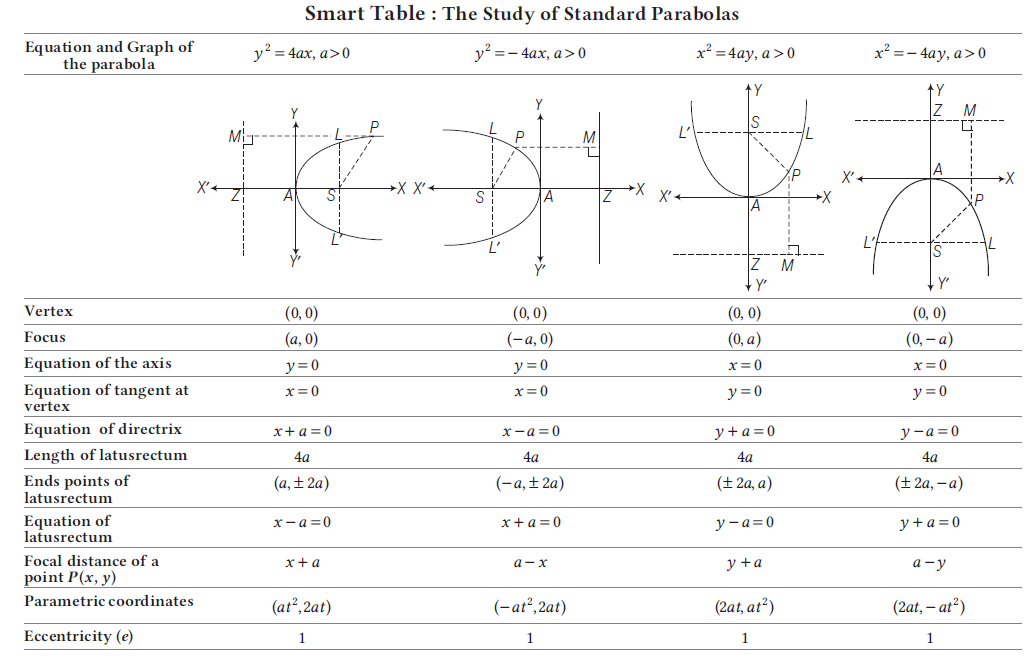
- A parabola is the set of all points in a plane that are equidistant from a fixed line and a fixed point in the plane.
- The equation of the parabola with focus at \((a, 0) a>0\) and directrix \(x=-a\) is
\(
y^2=4 a x
\) - Latus rectum of a parabola is a line segment perpendicular to the axis of the parabola, through the focus and whose end points lie on the parabola.
- Length of the latus rectum of the parabola \(y^2=4 a x\) is \(4 a\).
- Focal distance of a point: Let the equation of the parabola be \(y^2=4 a x\) and \(P (x, y)\) be a point on it. Then the distance of \(P\) from the focus \((a, 0)\) is called the focal distance of the point, i.e.,
\(
\begin{aligned}
FP & =\sqrt{(x-a)^2+y^2} \\
& =\sqrt{(x-a)^2+4 a x} \\
& =\sqrt{(x+a)^2} \\
& =|x+a|
\end{aligned}
\)
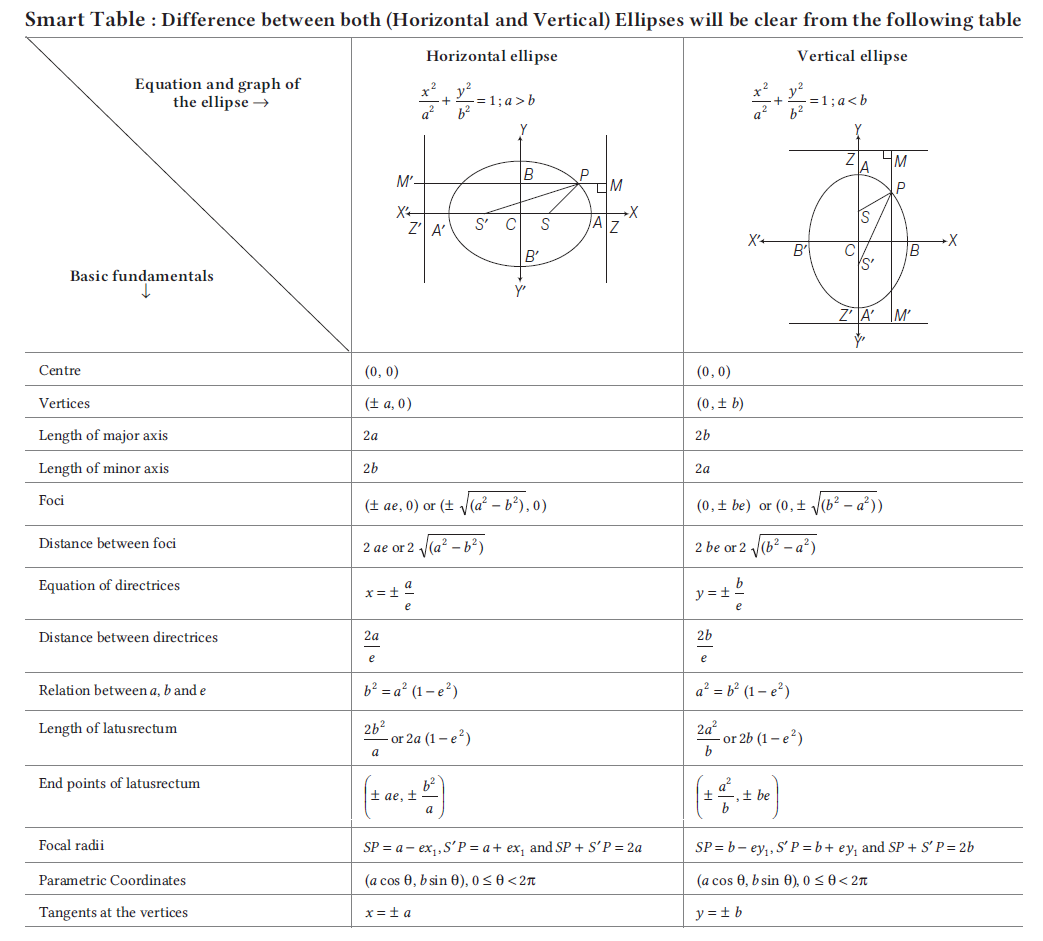
Ellipse
- An ellipse is the set of all points in a plane, the sum of whose distances from two fixed points in the plane is a constant.
- The equation of an ellipse with foci on the \(x\)-axis is \(\frac{x^2}{a^2}+\frac{y^2}{b^2}=1\).
- Latus rectum of an ellipse is a line segment perpendicular to the major axis through any of the foci and whose end points lie on the ellipse.
- Length of the latus rectum of the ellipse \(\frac{x^2}{a^2}+\frac{y^2}{b^2}=1\) is \(\frac{2 b^2}{a}\).
- The eccentricity of an ellipse is the ratio between the distances from the centre of the ellipse to one of the foci and to one of the vertices of the ellipse.
- We have two standard forms of the ellipse, i.e.,
(i) \(\frac{x^2}{a^2}+\frac{y^2}{b^2}=1 \quad\) and
(ii) \(\frac{x^2}{b^2}+\frac{y^2}{a^2}=1\),
In both cases \(a>b\) and \(b^2=a^2\left(1-e^2\right), e<1\). - Focal Distance: The focal distance of a point \((x, y)\) on the ellipse \(\frac{x^2}{a^2}+\frac{y^2}{b^2}=1\) is
\(a-e|x|\) from the nearer focus
\(a+e|x|\) from the farther focus - Sum of the focal distances of any point on an ellipse is constant and equal to the length of the major axis.
Hyperbola
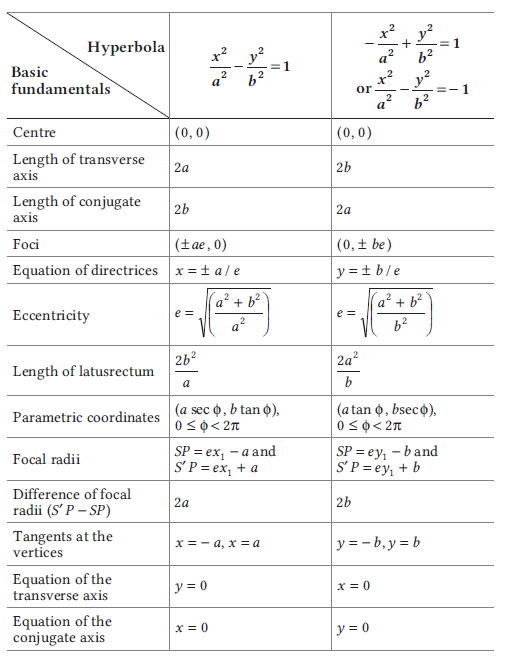
- The equation of a hyperbola with foci on the \(x\)-axis is : \(\frac{x^2}{a^2}-\frac{y^2}{b^2}=1\)
- Latus rectum of hyperbola is a line segment perpendicular to the transverse axis through any of the foci and whose end points lie on the hyperbola.
- Length of the latus rectum of the hyperbola : \(\frac{x^2}{a^2}-\frac{y^2}{b^2}=1\) is: \(\frac{2 b^2}{a}\).
- The eccentricity of a hyperbola is the ratio of the distances from the centre of the hyperbola to one of the foci and to one of the vertices of the hyperbola.
- We have two standard forms of the hyperbola, i.e.,
(i) \(\frac{x^2}{a^2}-\frac{y^2}{b^2}=1\) and
(ii) \(\frac{y^2}{a^2}-\frac{x^2}{b^2}=1\)
Here \(b^2=a^2\left(e^2-1\right), e>1\). - Focal distance: The focal distance of any point \((x, y)\) on the hyperbola \(\frac{x^2}{a^2}-\frac{y^2}{b^2}=1\) is \(e|x|-a\) from the nearer focus
\(e|x|+a\) from the farther focus
Differences of the focal distances of any point on a hyperbola is constant and equal to the length of the transverse axis.
Quiz Summary
0 of 13 Questions completed
Questions:
Information
You have already completed the quiz before. Hence you can not start it again.
Quiz is loading…
You must sign in or sign up to start the quiz.
You must first complete the following:
Results
Results
0 of 13 Questions answered correctly
Your time:
Time has elapsed
You have reached 0 of 0 point(s), (0)
Earned Point(s): 0 of 0, (0)
0 Essay(s) Pending (Possible Point(s): 0)
Categories
- Not categorized 0%
- 1
- 2
- 3
- 4
- 5
- 6
- 7
- 8
- 9
- 10
- 11
- 12
- 13
- Current
- Review
- Answered
- Correct
- Incorrect
- Question 1 of 13
1. Question
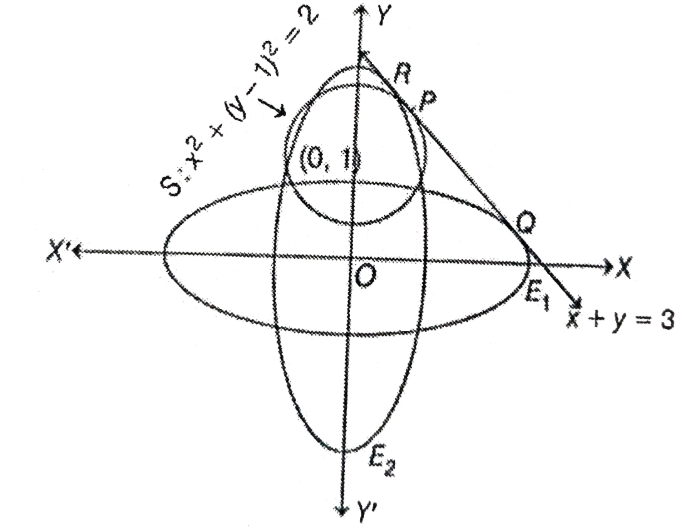
Let \(C\) be the circle \(x^2+(y-1)^2=2, E_1\) and \(E_2\) be two ellipses whose centres lie at the origin and major axes lie on x -axis and y -axis respectively. Let the straight line \(x+y=3\) touch the curves \(C, E_1\) and \(E_2\) at \(P\left(x_1, y_1\right), Q\left(x_2, y_2\right)\) and \(R\left(x_3, y_3\right)\) respectively. Given that \(P\) is the mid point of the line segment \(Q R\) and \(P Q=\frac{2 \sqrt{2}}{3}\), the value of \(9\left(x_1 y_1+x_2 y_2+x_3 y_3\right)\) is equal to _____. [JEE Main 2025 (Online) 4th April Morning Shift]
CorrectIncorrectHint
(d)

To find the value of \(9\left(x_1 y_1+x_2 y_2+x_3 y_3\right)\), we need to determine the coordinates of the points of tangency \(P, Q\), and \(R\) on the line \(L: x+y=3\).
Step 1: Find Point \(P\) (Tangency on Circle \(C\))
The circle \(C\) is given by \(x^2+(y-1)^2=2\). The line is \(y=3-x\). Substituting this into the circle equation:
\(
\begin{gathered}
x^2+(3-x-1)^2=2 \\
x^2+(2-x)^2=2 \Longrightarrow x^2+4-4 x+x^2=2 \\
2 x^2-4 x+2=0 \Longrightarrow(x-1)^2=0
\end{gathered}
\)
Thus, \(x_1=1\). Substituting back into the line equation, \(y_1=3-1=2\). Point \(P=(1,2)\).
Step 2: Find Points \(Q\) and \(R\)
Points \(Q\left(x_2, y_2\right)\) and \(R\left(x_3, y_3\right)\) lie on the line \(x+y=3\). Since \(P\) is the midpoint of \(Q R\), we have:
\(
\begin{aligned}
& \frac{x_2+x_3}{2}=1 \Longrightarrow x_2+x_3=2 \\
& \frac{y_2+y_3}{2}=2 \Longrightarrow y_2+y_3=4
\end{aligned}
\)
We are given the distance \(P Q=\frac{2 \sqrt{2}}{3}\). Since \(Q\) lies on the line \(x+y=3\) (which has a slope of -1, or an angle of \(135^{\circ}\)), we can use the parametric form of a line:
\(
x=x_1 \pm r \cos \theta, \quad y=y_1 \pm r \sin \theta
\)
For \(\theta=135^{\circ}, \cos \theta=-\frac{1}{\sqrt{2}}\) and \(\sin \theta=\frac{1}{\sqrt{2}}\). With \(r=\frac{2 \sqrt{2}}{3}\) :
\(
\begin{gathered}
x=1 \pm \frac{2 \sqrt{2}}{3}\left(-\frac{1}{\sqrt{2}}\right)=1 \mp \frac{2}{3} \\
y=2 \pm \frac{2 \sqrt{2}}{3}\left(\frac{1}{\sqrt{2}}\right)=2 \pm \frac{2}{3}
\end{gathered}
\)
This gives us two points:
\(\left(\frac{1}{3}, \frac{8}{3}\right)\)
\(\left(\frac{5}{3}, \frac{4}{3}\right)\)
Step 3: Assigning \(Q\) and \(R\)
\(E_1\) has its major axis on the \(x\)-axis (equation \(\frac{x^2}{a^2}+\frac{y^2}{b^2}=1\) with \(a>b\) ). \(E_2\) has its major axis on the \(y\)-axis (equation \(\frac{x^2}{A^2}+\frac{y^2}{B^2}=1\) with \(B>A\) ). For a line \(y=m x+c\) to touch \(\frac{x^2}{a^2}+ \frac{y^2}{b^2}=1\), the point of tangency is \(\left(\frac{-a^2 m}{c}, \frac{b^2}{c}\right)\). Here, \(m=-1\) and \(c=3\).
For \(E_1: x_2=\frac{a^2}{3}, y_2=\frac{b^2}{3}\). Since \(a>b\), it follows \(x_2>y_2\). Looking at our points, \(\left(\frac{5}{3}, \frac{4}{3}\right)\) satisfies \(x>y\). So, \(Q=\left(\frac{5}{3}, \frac{4}{3}\right)\).
For \(E_2: x_3=\frac{A^2}{3}, y_3=\frac{B^2}{3}\). Since \(B>A\), it follows \(y_3>x_3\). Looking at our points, \(\left(\frac{1}{3}, \frac{8}{3}\right)\) satisfies \(y>x\). So, \(R=\left(\frac{1}{3}, \frac{8}{3}\right)\).
Step 4: Final Calculation
Now we calculate \(x_1 y_1+x_2 y_2+x_3 y_3\) :
\(x_1 y_1=1 \times 2=2\)
\(x_2 y_2=\frac{5}{3} \times \frac{4}{3}=\frac{20}{9}\)
\(x_3 y_3=\frac{1}{3} \times \frac{8}{3}=\frac{8}{9}\)
Summing them up:
\(
x_1 y_1+x_2 y_2+x_3 y_3=2+\frac{20}{9}+\frac{8}{9}=2+\frac{28}{9}
\)
Multiply by 9:
\(
9\left(2+\frac{28}{9}\right)=18+28=46
\) - Question 2 of 13
2. Question
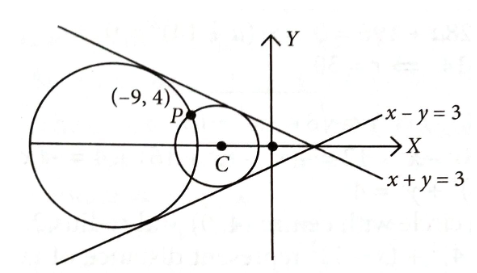
The absolute difference between the squares of the radii of the two circles passing through the point (\(-9,4\)) and touching the lines \(x+y=3\) and \(x-y=3\), is equal to ____. [JEE Main 2025 (Online) 2nd April Morning Shift]
CorrectIncorrectHint
(a)

We have, \(x+y=3\) and \(x-y=3\) are tangents
∴ The centre of both circles will lie on \(x\)-axis
Equation of circle is
\(
\therefore \quad(x-\alpha)^2+y^2=r^2
\)
Hence, centre is \(\mathrm{C}(\alpha, 0)\).
\(
r=P C=\sqrt{(\alpha+9)^2+16} \dots(i)
\)
Also, \(\left|\frac{\alpha-3}{\sqrt{2}}\right|=r \dots(ii)\)
From (i) and (ii), we get
\(
\begin{aligned}
& \sqrt{(\alpha+9)^2+16}=\left|\frac{\alpha-3}{\sqrt{2}}\right| \\
& \Rightarrow \quad \alpha=-5 \text { or }-37 \\
& r=\left|\frac{-5-3}{\sqrt{2}}\right| \text { or }\left|\frac{-37-3}{\sqrt{2}}\right|=4 \sqrt{2} \text { or } 20 \sqrt{2} \\
& \therefore \text { Now, }\left|r_1^2-r_2^2\right|=\left|(4 \sqrt{2})^2-(20 \sqrt{2})^2\right|=768
\end{aligned}
\)Explanation: Step 1: Identify the Bisector Line for the Centers
The two lines \(L_1: x+y-3=0\) and \(L_2: x-y-3=0\) intersect at \((3,0)\). A circle touching both lines must have its center (\(h, k\)) on an angle bisector of these lines. The bisectors are:
\(
\frac{x+y-3}{\sqrt{2}}= \pm \frac{x-y-3}{\sqrt{2}}
\)
This gives two possible lines for the center: \(y=0\) (the \(x\)-axis) or \(x=3\).
Since the point (\(-9,4\)) is far from the line \(x=3\), the circles passing through it must be centered on the x -axis. Thus, the center is \((h, 0)\).
Step 2: Define the Radius in terms of the Center
The radius \(r\) is the perpendicular distance from the center \((h, 0)\) to the line \(x+y-3=0\) :
\(
r=\frac{|h+0-3|}{\sqrt{2}} \Longrightarrow \sqrt{2} r=|h-3|
\)
Since the point \((-9,4)\) lies to the left of the intersection \((3,0)\), we know \(h<3\). Therefore:
\(
h-3=-\sqrt{2} r \Longrightarrow h=3-\sqrt{2} r
\)
Step 3: Set up the Circle Equation using the Point
The distance from the center \((h, 0)\) to the point \((-9,4)\) is the radius \(r\). Using the distance formula:
\(
\begin{gathered}
(h-(-9))^2+(0-4)^2=r^2 \\
(h+9)^2+16=r^2
\end{gathered}
\)
Substitute \(h=3-\sqrt{2} r\) :
\(
\begin{gathered}
(3-\sqrt{2} r+9)^2+16=r^2 \\
(12-\sqrt{2} r)^2+16=r^2
\end{gathered}
\)
Step 4: Solve the Quadratic for \(r\)
Expanding the equation:
\(
\begin{gathered}
144-24 \sqrt{2} r+2 r^2+16=r^2 \\
r^2-24 \sqrt{2} r+160=0
\end{gathered}
\)
Let the radii of the two circles be \(r_1\) and \(r_2\). From the properties of quadratic equations:
Sum of roots \(\left(r_1+r_2\right): 24 \sqrt{2}\)
Product of roots \(\left(r_1 r_2\right): 160\)
Step 5: Calculate the Absolute Difference of Squares
We need to find \(\left|r_1^2-r_2^2\right|\), which factors into \(\left(r_1+r_2\right)\left|r_1-r_2\right|\). First, find \(\left(r_1-r_2\right)^2\) :
\(
\begin{gathered}
\left(r_1-r_2\right)^2=\left(r_1+r_2\right)^2-4 r_1 r_2=(24 \sqrt{2})^2-4(160) \\
\left(r_1-r_2\right)^2=1152-640=512
\end{gathered}
\)
So, \(\left|r_1-r_2\right|=\sqrt{512}=16 \sqrt{2}\).
\(
\left|r_1^2-r_2^2\right|=(24 \sqrt{2})(16 \sqrt{2})=24 \times 16 \times 2=768
\) - Question 3 of 13
3. Question
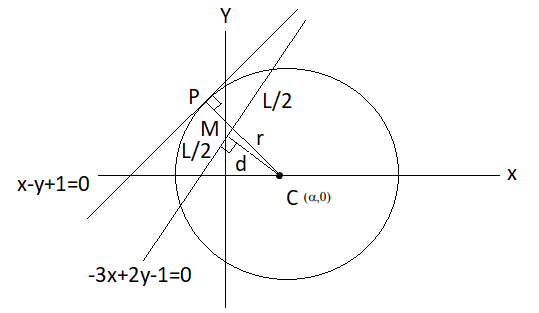
Let the circle \(C\) touch the line \(x-y+1=0\), have the centre on the positive \(x\)-axis, and cut off a chord of length \(\frac{4}{\sqrt{13}}\) along the line \(-3 x+2 y=1\). Let H be the hyperbola \(\frac{x^2}{\alpha^2}-\frac{y^2}{\beta^2}=1\), whose one of the foci is the centre of \(C\) and the length of the transverse axis is the diameter of \(C\). Then \(2 \alpha^2+3 \beta^2\) is equal to _____. [JEE Main 2025 (Online) 23rd January Morning Shift]
CorrectIncorrectHint
(d)

Step 1: Find the Center and Radius of Circle \(C\)
Let the center of circle \(C\) be ( \(\alpha, 0\) ) where \(\alpha>0\) (since it lies on the positive x-axis). Let its radius be \(r\).
Condition 1: The circle touches \(x-y+1=0\). The perpendicular distance from (\(\alpha, 0\)) to this line equals the radius:
\(
r=\frac{|\alpha-0+1|}{\sqrt{1^2+(-1)^2}}=\frac{\alpha+1}{\sqrt{2}}
\)
Squaring gives: \(r^2=\frac{(\alpha+1)^2}{2}\)
Condition 2: The circle cuts a chord of length \(\frac{4}{\sqrt{13}}\) on \(-3 x+2 y-1=0\). Let \(d\) be the perpendicular distance from \((\alpha, 0)\) to the line \(3 x-2 y+1=0\) :
\(
d=\frac{|3 \alpha-0+1|}{\sqrt{3^2+2^2}}=\frac{3 \alpha+1}{\sqrt{13}}
\)
The relationship between radius \(r\), distance \(d\), and chord length \(L\) is:
\(
r^2=d^2+\left(\frac{L}{2}\right)^2 \Longrightarrow r^2=\left(\frac{3 \alpha+1}{\sqrt{13}}\right)^2+\left(\frac{2}{\sqrt{13}}\right)^2
\)
\(
r^2=\frac{9 \alpha^2+6 \alpha+1+4}{13}=\frac{9 \alpha^2+6 \alpha+5}{13}
\)
Step 2: Solve for \(\alpha\) and \(r\)
Equate the two expressions for \(r^2\) :
\(
\begin{gathered}
\frac{(\alpha+1)^2}{2}=\frac{9 \alpha^2+6 \alpha+5}{13} \\
13\left(\alpha^2+2 \alpha+1\right)=2\left(9 \alpha^2+6 \alpha+5\right) \\
13 \alpha^2+26 \alpha+13=18 \alpha^2+12 \alpha+10 \\
5 \alpha^2-14 \alpha-3=0
\end{gathered}
\)
Solving the quadratic: \((5 \alpha+1)(\alpha-3)=0\). Since \(\alpha>0\), we have \(\alpha=3\).
Now, find \(r^2\) and the diameter \(D\) :
\(
r^2=\frac{(3+1)^2}{2}=\frac{16}{2}=8 \Longrightarrow r=2 \sqrt{2}
\)
Diameter \(D=2 r=4 \sqrt{2}\).
Step 3: Determine Hyperbola \(H\) parameters
For the hyperbola \(\frac{x^2}{\alpha^2}-\frac{y^2}{\beta^2}=1\) :
Transverse Axis Length (2 \(\alpha\)): Equal to diameter of \(C\).
\(
2 \alpha=4 \sqrt{2} \Longrightarrow \alpha=2 \sqrt{2} \Longrightarrow \alpha^2=8
\)
Focus (\(a e, 0\)): One focus is the center of \(C\), which is \((3,0)\).
\(
\alpha e=3
\)
Find \(\beta^2\) : Using the identity \(b^2=a^2\left(e^2-1\right)=(a e)^2-a^2\) :
\(
\beta^2=3^2-\alpha^2=9-8=1
\)
Step 4: Final Calculation
Substitute the values of \(\alpha^2\) and \(\beta^2\) :
\(
2 \alpha^2+3 \beta^2=2(8)+3(1)=19
\) - Question 4 of 13
4. Question
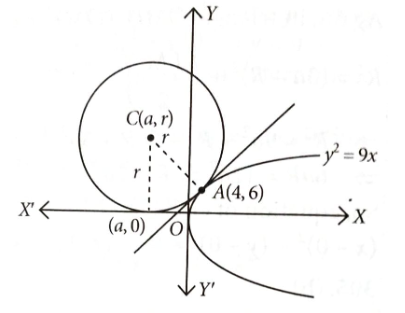
Let \(r\) be the radius of the circle, which touches \(x\) – axis at point \((a, 0), a<0\) and the parabola \(\mathrm{y}^2=9 x\) at the point \((4,6)\). Then \(r\) is equal to ____. [JEE Main 2025 (Online) 8th April Evening Shift]
CorrectIncorrectHint
(b)

Step 1: Establish the Circle’s Properties
Since the circle touches the \(x\)-axis at (\(a, 0\)), its center must lie on the vertical line \(x=a\). The radius \(r\) is the vertical distance from the center to the \(x\)-axis. Given the point of contact on the parabola is \((4,6)\) (in the first quadrant), the center is \((a, r)\)
Step 2: Find the Normal to the Parabola
The circle touches the parabola \(y^2=9 x\) at \(P(4,6)\). The normal to the parabola at this point must pass through the center of the circle \((a, r)\).
Differentiating the parabola:
\(
2 y \frac{d y}{d x}=9 \Longrightarrow \frac{d y}{d x}=\frac{9}{2 y}
\)
At \((4,6)\), the slope of the tangent is \(m_t=\frac{9}{12}=\frac{3}{4}\). The slope of the normal is \(m_n=-\frac{4}{3}\).
The equation of the normal line is:
\(
y-6=-\frac{4}{3}(x-4) \Longrightarrow 4 x+3 y=34
\)
Step 3: Relate the Center Coordinates
Substitute the center (\(a, r\)) into the normal equation:
\(
4 a+3 r=34 \Longrightarrow a=\frac{34-3 r}{4}
\)
Step 4: Use the Radius Condition
The distance from the center \((a, r)\) to the point of contact \((4,6)\) is equal to \(r\) :
\(
(a-4)^2+(r-6)^2=r^2
\)
\(
\begin{gathered}
a^2-8 a+16+r^2-12 r+36=r^2 \\
a^2-8 a-12 r+52=0
\end{gathered}
\)
Substitute \(a=\frac{34-3 r}{4}\) :
\(
\begin{gathered}
\left(\frac{34-3 r}{4}\right)^2-8\left(\frac{34-3 r}{4}\right)-12 r+52=0 \\
\frac{1156-204 r+9 r^2}{16}-68+6 r-12 r+52=0 \\
1156-204 r+9 r^2+16(-6 r-16)=0 \\
9 r^2-300 r+900=0 \Longrightarrow 3 r^2-100 r+300=0
\end{gathered}
\)
Step 5: Solve for \(\boldsymbol{r}\)
Using the quadratic formula:
\(
r=\frac{100 \pm \sqrt{10000-3600}}{6}=\frac{100 \pm 80}{6}
\)
This gives \(r=30\) or \(r=\frac{10}{3}\).
If \(r=\frac{10}{3}\), then \(a=\frac{34-10}{4}=6\) (rejected as \(a<0\)).
If \(r=30\), then \(a=\frac{34-90}{4}=-14\) (accepted).
The radius \(r\) is 30. - Question 5 of 13
5. Question
Let \(y^2=12 x\) be the parabola and \(S\) be its focus. Let \(P Q\) be a focal chord of the parabola such that \((S P)(S Q)=\frac{147}{4}\). Let \(C\) be the circle described taking \(P Q\) as a diameter. If the equation of a circle \(C\) is \(64 x^2+64 y^2-\alpha x-64 \sqrt{3} y=\beta\), then \(\beta-\alpha\) is equal to ___. [JEE Main 2025 (Online) 29th January Evening Shift]
CorrectIncorrectHint
(c) Step 1: Analyze the Parabola and Focal Chord
The parabola is \(y^2=12 x\). Here, \(4 a=12\), so \(a=3\). The focus \(S\) is \((3,0)\). Let the coordinates of \(P\) be (\(a t_1^2, 2 a t_1\)) and \(Q\) be (\(a t_2^2, 2 a t_2\)). Since \(P Q\) is a focal chord, we have the property:
\(
t_1 t_2=-1
\)
Step 2: Use the Focal Chord Length Property
The focal distances for a parabola are \(S P=a\left(1+t_1^2\right)\) and \(S Q=a\left(1+t_2^2\right)\). Given \((S P)(S Q)=\frac{147}{4}:\)
\(
\begin{aligned}
& a\left(1+t_1^2\right) \cdot a\left(1+t_2^2\right)=\frac{147}{4} \\
& 9\left(1+t_1^2+t_2^2+t_1^2 t_2^2\right)=\frac{147}{4}
\end{aligned}
\)
Since \(t_1^2 t_2^2=(-1)^2=1\) :
\(
\begin{gathered}
9\left(2+t_1^2+t_2^2\right)=\frac{147}{4} \\
2+t_1^2+t_2^2=\frac{147}{36}=\frac{49}{12} \\
t_1^2+t_2^2=\frac{49}{12}-2=\frac{25}{12}
\end{gathered}
\)
Step 3: Determine the Center and Diameter of Circle \(C\)
The circle is drawn with \(P Q\) as the diameter.
Center \((h, k): h=\frac{a\left(t_1^2+t_2^2\right)}{2}=\frac{3(25 / 12)}{2}=\frac{25}{8} k=\frac{2 a\left(t_1+t_2\right)}{2}=3\left(t_1+t_2\right)\)
Diameter \(L\) : The length of the focal chord \(P Q=S P+S Q=a\left(2+t_1^2+t_2^2\right)=\frac{49}{4}\). The radius \(R=\frac{49}{8}\).
Step 4: Find \(k\) and the Circle Equation
We need \(\left(t_1+t_2\right)\). We know \(\left(t_1+t_2\right)^2=t_1^2+t_2^2+2 t_1 t_2=\frac{25}{12}-2=\frac{1}{12}\). Thus, \(t_1+t_2= \pm \frac{1}{\sqrt{12}}= \pm \frac{1}{2 \sqrt{3}}\). From the given circle equation, the \(y\)-coefficient is \(-64 \sqrt{3}\). In standard form \((x-h)^2+(y-k)^2=R^2\), the \(y\)-term is \(-2 k y\). Matching coefficients: \(k=\frac{64 \sqrt{3}}{2 \times 64}=\frac{\sqrt{3}}{2}\). Our calculated \(k=3\left(t_1+t_2\right)\). Let’s check: \(3\left(\frac{1}{2 \sqrt{3}}\right)=\frac{\sqrt{3}}{2}\). This matches perfectly.
The equation of the circle is:
\(
\begin{gathered}
\left(x-\frac{25}{8}\right)^2+\left(y-\frac{\sqrt{3}}{2}\right)^2=\left(\frac{49}{8}\right)^2 \\
x^2-\frac{25}{4} x+\frac{625}{64}+y^2-\sqrt{3} y+\frac{3}{4}=\frac{2401}{64}
\end{gathered}
\)
Multiply by 64 to match the format \(64 x^2+64 y^2-\alpha x-64 \sqrt{3} y=\beta\) :
\(
\begin{gathered}
64 x^2-16(25) x+625+64 y^2-64 \sqrt{3} y+48=2401 \\
64 x^2+64 y^2-400 x-64 \sqrt{3} y=2401-625-48 \\
64 x^2+64 y^2-400 x-64 \sqrt{3} y=1728
\end{gathered}
\)
Step 5: Final Calculation
Comparing the equation to \(64 x^2+64 y^2-\alpha x-64 \sqrt{3} y=\beta\) :
\(\alpha=400\)
\(\beta=1728\)
Therefore:
\(
\beta-\alpha=1728-400=1328
\) - Question 6 of 13
6. Question
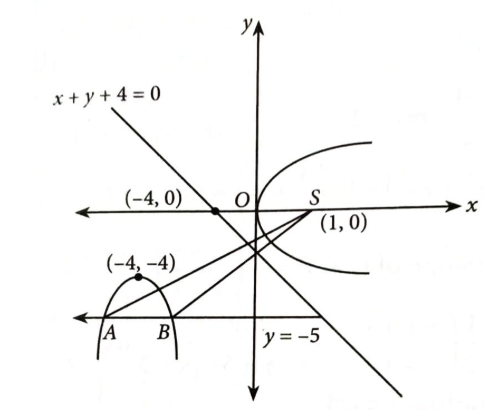
Let \(A\) and \(B\) be the two points of intersection of the line \(y+5=0\) and the mirror image of the parabola \(y^2=4 x\) with respect to the line \(x+y+4=0\). If \(d\) denotes the distance between \(A\) and \(B\), and a denotes the area of \(\triangle S A B\), where \(S\) is the focus of the parabola \(y^2=4 x\), then the value of \((a+d)\) is ____. [JEE Main 2025 (Online) 28th January Evening Shift]
CorrectIncorrectHint
(b)

To find the value of \(a+d\), we first need to find the equation of the mirrored parabola and determine its intersection with the line \(y=-5\).
Step 1: Find the Mirror Image of the Parabola
The original parabola is \(y^2=4 x\). We need its reflection about the line \(L: x+y+4=0\). The reflection of a point (\(x_1, y_1\)) about the line \(a x+b y+c=0\) is given by:
\(
\frac{x-x_1}{a}=\frac{y-y_1}{b}=-2 \frac{a x_1+b y_1+c}{a^2+b^2}
\)
For the line \(x+y+4=0(a=1, b=1, c=4)\) :
\(
\frac{x-x_1}{1}=\frac{y-y_1}{1}=-2 \frac{x_1+y_1+4}{1^2+1^2}=-\left(x_1+y_1+4\right)
\)
This gives us:
\(x=x_1-x_1-y_1-4 \Longrightarrow x=-y_1-4 \Longrightarrow y_1=-(x+4)\)
\(y=y_1-x_1-y_1-4 \Longrightarrow y=-x_1-4 \Longrightarrow x_1=-(y+4)\)
Substitute \(x_1\) and \(y_1\) into the original parabola equation \(y_1^2=4 x_1\) :
\(
\begin{gathered}
(-(x+4))^2=4(-(y+4)) \\
(x+4)^2=-4(y+4)
\end{gathered}
\)
Step 2: Intersection Points \(A\) and \(B\)
The line is \(y+5=0\), so \(y=-5\). Substitute this into the mirrored parabola:
\(
\begin{gathered}
(x+4)^2=-4(-5+4) \\
(x+4)^2=-4(-1)=4 \\
x+4= \pm 2
\end{gathered}
\)
If \(x+4=2\), then \(x=-2\). Point \(A=(-2,-5)\).
If \(x+4=-2\), then \(x=-6\). Point \(B=(-6,-5)\).
Distance \(d\) : The distance between \(A(-2,-5)\) and \(B(-6,-5)\) is:
\(
d=|-2-(-6)|=4
\)
Step 3: Area a of \(\triangle S A B\)
The focus \(S\) of the original parabola \(y^2=4 x\) is at \((1,0)\). The coordinates of the triangle vertices are \(S(1,0), A(-2,-5)\), and \(B(-6,-5)\).
The area \(a\) is given by:
\(
\begin{gathered}
a=\frac{1}{2}\left|x_S\left(y_A-y_B\right)+x_A\left(y_B-y_S\right)+x_B\left(y_S-y_A\right)\right| \\
a=\frac{1}{2}|1(-5-(-5))+(-2)(-5-0)+(-6)(0-(-5))| \\
a=\frac{1}{2}|0+10-30| \\
a=\frac{1}{2}|-20|=10
\end{gathered}
\)
Step 4: Final Value
\(
a+d=10+4=14
\) - Question 7 of 13
7. Question
The focus of the parabola \(y^2=4 x+16\) is the centre of the circle \(C\) of radius 5. If the values of \(\lambda\), for which C passes through the point of intersection of the lines \(3 x-y=0\) and \(x+\lambda y=4\), are \(\lambda_1\) and \(\lambda_2, \lambda_1<\lambda_2\), then \(12 \lambda_1+29 \lambda_2\) is equal to ____. [JEE Main 2025 (Online) 23rd January Evening Shift]
CorrectIncorrectHint
(c) To solve this, we need to find the center of the circle from the parabola’s focus and then use the intersection point of the lines to determine \(\lambda\).
Step 1: Find the Focus of the Parabola
The given parabola is \(y^2=4 x+16\). Let’s rewrite it in standard form:
\(
y^2=4(x+4)
\)
Comparing this to \(Y^2=4 a X\) :
\(a=1\)
\(Y=y, X=x+4\)
The focus of \(Y^2=4 a X\) is \((a, 0)\). Thus, for our parabola:
\(X=1 \Longrightarrow x+4=1 \Longrightarrow x=-3\)
\(Y=0 \Longrightarrow y=0\)
The center of the circle \(C\) is \(S(-3,0)\).
Step 2: Determine the Points of Intersection
The radius of circle \(C\) is 5. The equation of the circle is:
\(
(x+3)^2+(y-0)^2=5^2 \Longrightarrow(x+3)^2+y^2=25
\)
The circle passes through the intersection of:
\(3 x-y=0 \Longrightarrow y=3 x\)
\(x+\lambda y=4\)
Substitute \(y=3 x\) into the circle equation to find the \(x\)-coordinates of the intersection points:
\(
\begin{gathered}
(x+3)^2+(3 x)^2=25 \\
x^2+6 x+9+9 x^2=25 \\
10 x^2+6 x-16=0 \Longrightarrow 5 x^2+3 x-8=0
\end{gathered}
\)
Factoring the quadratic:
\(
(5 x+8)(x-1)=0
\)
The intersection points on the circle are:
Case 1: \(x=1\). Then \(y=3(1)=3\). Point is \((1,3)\).
Case 2: \(x=-8 / 5\). Then \(y=3(-8 / 5)=-24 / 5\). Point is \((-8 / 5,-24 / 5)\).
Step 3: Solve for \(\lambda\)
Now, substitute these points into the second line equation \(x+\lambda y=4\) :
For (1, 3):
\(
1+\lambda(3)=4 \Longrightarrow 3 \lambda=3 \Longrightarrow \lambda=1
\)
For (-8/5, -24/5):
\(
-\frac{8}{5}+\lambda\left(-\frac{24}{5}\right)=4
\)
Multiply by 5:
\(
-8-24 \lambda=20 \Longrightarrow-24 \lambda=28 \Longrightarrow \lambda=-\frac{28}{24}=-\frac{7}{6}
\)
Step 4: Calculate \(12 \lambda_1+29 \lambda_2\)
Given \(\lambda_1<\lambda_2\) :
\(\lambda_1=-\frac{7}{6}\)
\(\lambda_2=1\)
Now, compute the final value:
\(
12\left(-\frac{7}{6}\right)+29(1)=15
\) - Question 8 of 13
8. Question
Let \(\mathrm{E}_1: \frac{x^2}{9}+\frac{y^2}{4}=1\) be an ellipse. Ellipses \(\mathrm{E}_{\mathrm{i}}\) ‘s are constructed such that their centres and eccentricities are same as that of \(\mathrm{E}_1\), and the length of minor axis of \(\mathrm{E}_{\mathrm{i}}\) is the length of major axis of \(E_{i+1}(i \geq 1)\). If \(A_i\) is the area of the ellipse \(E_i\), then \(\frac{5}{\pi}\left(\sum_{i=1}^{\infty} A_i\right)\), is equal to ____. [JEE Main 2025 (Online) 28th January Morning Shift]
CorrectIncorrectHint
(c) Step 1: Analyze the initial ellipse \(\boldsymbol{E}_1\)
The equation of \(E_1\) is \(\frac{x^2}{9}+\frac{y^2}{4}=1\). Comparing this with the standard form \(\frac{x^2}{a^2}+\frac{y^2}{b^2}=1\), we have:
Semi-major axis \(a_1=3\)
Semi-minor axis \(b_1=2\)
Area \(A_1=\pi a_1 b_1=\pi(3)(2)=6 \pi\)
Eccentricity e: \(b_1^2=a_1^2\left(1-e^2\right) \Rightarrow 4=9\left(1-e^2\right) \Rightarrow 1-e^2=\frac{4}{9}\)
Step 2: Establish the relationship between subsequent ellipses
For any ellipse \(E_i\), let the semi-major axis be \(a_i\) and the semi-minor axis be \(b_i\). Since all ellipses have the same eccentricity, the ratio of the axes remains constant:
\(
\frac{b_i}{a_i}=\sqrt{1-e^2}=\sqrt{\frac{4}{9}}=\frac{2}{3} \Longrightarrow b_i=\frac{2}{3} a_i
\)
According to the problem, the length of the minor axis of \(E_i\) is the length of the major axis of \(E_{i+1}\) :
\(
2 b_i=2 a_{i+1} \Longrightarrow a_{i+1}=b_i
\)
Substituting \(b_i=\frac{2}{3} a_i\), we get \(a_{i+1}=\frac{2}{3} a_i\). Consequently, \(b_{i+1}=\frac{2}{3} a_{i+1}=\frac{2}{3} b_i\).
Step 3: Determine the common ratio of the area series
The area of the \(i\)-th ellipse is \(A_i=\pi a_i b_i\). The ratio of successive areas is:
\(
r=\frac{A_{i+1}}{A_i}=\frac{\pi a_{i+1} b_{i+1}}{\pi a_i b_i}=\frac{a_{i+1}}{a_i} \cdot \frac{b_{i+1}}{b_i}=\frac{2}{3} \cdot \frac{2}{3}=\frac{4}{9}
\)
Since \(r=\frac{4}{9}<1\), the sum of areas \(\sum_{i=1}^{\infty} A_i\) forms an infinite geometric series.
Step 4: Calculate the sum and final expression
The sum of the infinite geometric series is:
\(
\sum_{i=1}^{\infty} A_i=\frac{A_1}{1-r}=\frac{6 \pi}{1-\frac{4}{9}}=\frac{6 \pi}{\frac{5}{9}}=\frac{54 \pi}{5}
\)
Now, we find the required value:
\(
\frac{5}{\pi}\left(\sum_{i=1}^{\infty} A_i\right)=\frac{5}{\pi}\left(\frac{54 \pi}{5}\right)=54
\) - Question 9 of 13
9. Question
Let the lengths of the transverse and conjugate axes of a hyperbola in standard form be \(2 a\) and \(2 b\), respectively, and one focus and the corresponding directrix of this hyperbola be \((-5,0)\) and \(5 x+9=0\), respectively. If the product of the focal distances of a point \((\alpha, 2 \sqrt{5})\) on the hyperbola is \(p\), then \(4 p\) is equal to _____. [JEE Main 2025 (Online) 7th April Evening Shift]
CorrectIncorrectHint
(a) Step 1: Determine the parameters \(\boldsymbol{a}\) and \(\boldsymbol{e}\)
A hyperbola in standard form \(\frac{x^2}{a^2}-\frac{y^2}{b^2}=1\) has a focus at \((-a e, 0)\) and a corresponding directrix \(x=-\frac{a}{e}\). From the given data:
Focus: \(-a e=-5 \Rightarrow a e=5\)
Directrix: \(x=-\frac{9}{5} \Rightarrow \frac{a}{e}=\frac{9}{5}\)
Multiplying the two equations:
\(
(a e) \cdot\left(\frac{a}{e}\right)=5 \cdot \frac{9}{5} \Rightarrow a^2=9 \Rightarrow a=3
\)
Dividing the two equations:
\(
\frac{a e}{a / e}=\frac{5}{9 / 5} \Rightarrow e^2=\frac{25}{9} \Rightarrow e=\frac{5}{3}
\)
Step 2: Determine \(b^2\) and the hyperbola equation
Using the relation \(b^2=a^2\left(e^2-1\right)\) :
\(
b^2=9\left(\frac{25}{9}-1\right)=9\left(\frac{16}{9}\right)=16
\)
The equation of the hyperbola is:
\(
\frac{x^2}{9}-\frac{y^2}{16}=1
\)
Step 3: Find the coordinates of point \(\boldsymbol{P}\)
The point \(P(\alpha, 2 \sqrt{5})\) lies on the hyperbola. Substituting \(y=2 \sqrt{5}\) :
\(
\begin{gathered}
\frac{\alpha^2}{9}-\frac{(2 \sqrt{5})^2}{16}=1 \Rightarrow \frac{\alpha^2}{9}-\frac{20}{16}=1 \\
\frac{\alpha^2}{9}=1+\frac{5}{4}=\frac{9}{4} \Rightarrow \alpha^2=\frac{81}{4}
\end{gathered}
\)
Step 4: Calculate the product of focal distances \(p\)
For any point (\(x, y\)) on a hyperbola, the focal distances are \(r_1=|e x+a|\) and \(r_2=|e x-a|\). The product \(p\) is:
\(
p=\left|e^2 x^2-a^2\right|
\)
Substituting \(e^2=\frac{25}{9}, x^2=\alpha^2=\frac{81}{4}\), and \(a^2=9\) :
\(
\begin{gathered}
p=\left|\left(\frac{25}{9}\right)\left(\frac{81}{4}\right)-9\right|=\left|\frac{25 \cdot 9}{4}-9\right| \\
p=\left|\frac{225}{4}-\frac{36}{4}\right|=\frac{189}{4}
\end{gathered}
\)
The value of \(4 p\) is:
\(
4 p=4 \times \frac{189}{4}=189
\) - Question 10 of 13
10. Question
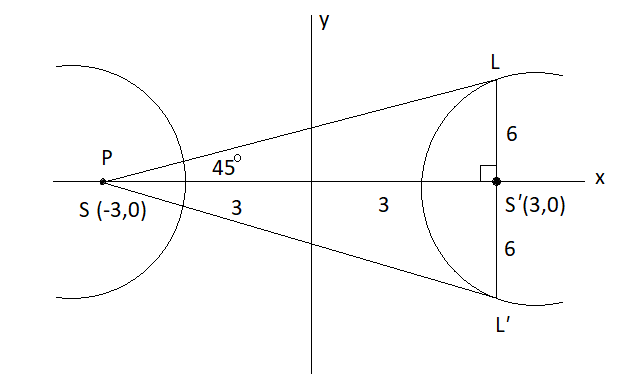
Consider the hyperbola \(\frac{x^2}{a^2}-\frac{y^2}{b^2}=1\) having one of its focus at \(\mathrm{P}(-3,0)\). If the latus ractum through its other focus subtends a right angle at P and \(a^2 b^2=\alpha \sqrt{2}-\beta, \alpha, \beta \in \mathbb{N}\), then \(\alpha+\beta\) is ____. [JEE Main 2025 (Online) 7th April Morning Shift]
CorrectIncorrectHint
(c)

To solve this, we will use the properties of the hyperbola’s focus, latus rectum, and the geometry of right-angled triangles.
Step 1: Identify Hyperbola Parameters
For the standard hyperbola \(\frac{x^2}{a^2}-\frac{y^2}{b^2}=1\) :
Foci: \(S(-a e, 0)\) and \(S^{\prime}(a e, 0)\).
We are given one focus at \(P(-3,0)\), so \(a e=3\).
Step 2: Geometry of the Latus Rectum
The other focus is \(S^{\prime}(3,0)\). The latus rectum through \(S^{\prime}\) consists of two points, \(L\) and \(L^{\prime}\), with coordinates:
\(L=\left(a e, \frac{b^2}{a}\right)=\left(3, \frac{b^2}{a}\right)\)
\(L^{\prime}=\left(a e,-\frac{b^2}{a}\right)=\left(3,-\frac{b^2}{a}\right)\)
The problem states that the latus rectum \(L L^{\prime}\) subtends a right angle at \(P(-3,0)\). Due to symmetry about the x -axis, the line segment \(P L\) must make an angle of \(45^{\circ}\) with the x -axis (the transverse axis).
This means the slope of \(P L\) is 1 :
\(
\begin{gathered}
m_{P L}=\frac{\frac{b^2}{a}-0}{3-(-3)}=\frac{b^2 / a}{6}=1 \\
\frac{b^2}{a}=6 \Longrightarrow b^2=6 a
\end{gathered}
\)
Step 3: Solve for \(a^2\) and \(b^2\)
We have two primary equations:
\(a e=3 \Longrightarrow a^2 e^2=9\)
\(b^2=a^2\left(e^2-1\right) \Longrightarrow a^2 e^2-a^2=b^2\)
Substitute \(a^2 e^2=9\) into the second equation:
\(
9-a^2=b^2
\)
Now substitute \(b^2=6 a\) :
\(
9-a^2=6 a \Longrightarrow a^2+6 a-9=0
\)
Using the quadratic formula for \(a(a>0)\) :
\(
a=\frac{-6+\sqrt{36-4(1)(-9)}}{2}=\frac{-6+\sqrt{72}}{2}=\frac{-6+6 \sqrt{2}}{2}=3 \sqrt{2}-3
\)
Now, calculate \(a^2\) and \(b^2\) :
\(a^2=(3 \sqrt{2}-3)^2=18+9-18 \sqrt{2}=27-18 \sqrt{2}\)
\(b^2=6 a=6(3 \sqrt{2}-3)=18 \sqrt{2}-18\)
Step 4: Find \(a^2 b^2\)
\(
a^2 b^2=(27-18 \sqrt{2})(18 \sqrt{2}-18)
\)
Factoring out 9 from the first term and 18 from the second:
\(
\begin{gathered}
a^2 b^2=9(3-2 \sqrt{2}) \cdot 18(\sqrt{2}-1)=162(3-2 \sqrt{2})(\sqrt{2}-1) \\
a^2 b^2=162(3 \sqrt{2}-3-4+2 \sqrt{2}) \\
a^2 b^2=162(5 \sqrt{2}-7)=810 \sqrt{2}-1134
\end{gathered}
\)
Step 5: Compare and Calculate \(\alpha+\beta\)
Given \(a^2 b^2=\alpha \sqrt{2}-\beta\) :
\(\alpha=810\)
\(\beta=1134\)
Summing them up:
\(
\alpha+\beta=810+1134=1944
\) - Question 11 of 13
11. Question
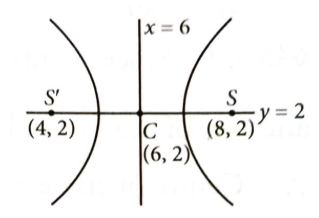
If the equation of the hyperbola with foci \((4,2)\) and \((8,2)\) is \(3 x^2-y^2-\alpha x+\beta y+\gamma=0\), then \(\alpha+\beta+\gamma\) is equal to ____. [JEE Main 2025 (Online) 3rd April Evening Shift]
CorrectIncorrectHint
(c)

To find the value of \(\alpha+\beta+\gamma\), we first need to determine the standard equation of the hyperbola and then expand it into the general form.
Identify the Center and Direction
The foci are \(S^{\prime}(4,2)\) and \(S(8,2)\).
Since the \(y\)-coordinates are the same, the transverse axis is horizontal (parallel to the \(x\) -axis).
Center \((h, k)\) : The midpoint of the foci.
\(
(h, k)=\left(\frac{4+8}{2}, \frac{2+2}{2}\right)=(6,2)
\)
Equation of hyperbola is \(\frac{(x-6)^2}{a^2}-\frac{(y-2)^2}{4-a^2}=1\)
\(
\begin{aligned}
& \Rightarrow \quad\left(4-a^2\right)(x-6)^2-a^2(y-2)^2=a^2\left(4-a^2\right) \\
& \Rightarrow \quad\left(4-a^2\right) x^2-a^2 y^2+\left(12 a^2-48\right) x+4 a^2 y+144-44 a^2+a^4=0
\end{aligned}
\)
On comparing with \(3 x^2-y^2-\alpha x+\beta y+\gamma=0\), we get \(a^2=1\) and \(\alpha=36, \beta=4\) and \(\gamma=101 \therefore \quad \alpha+\beta+\gamma=141\) - Question 12 of 13
12. Question
Let the product of the focal distances of the point \(\mathbf{P}(4,2 \sqrt{3})\) on the hyperbola \(\mathrm{H}: \frac{x^2}{a^2}-\frac{y^2}{b^2}=1\) be 32. Let the length of the conjugate axis of \(H\) be \(p\) and the length of its latus rectum be \(q\). Then \(p^2+q^2\) is equal to ____. [JEE Main 2025 (Online) 3rd April Morning Shift]
CorrectIncorrectHint
(a) Step 1: Establish the Equations for the Hyperbola
The given hyperbola \(H\) is \(\frac{x^2}{a^2}-\frac{y^2}{b^2}=1\). The point \(P(4,2 \sqrt{3})\) lies on \(H\), so it satisfies the equation:
\(
\frac{4^2}{a^2}-\frac{(2 \sqrt{3})^2}{b^2}=1 \Longrightarrow \frac{16}{a^2}-\frac{12}{b^2}=1
\)
For a hyperbola, the focal distances of a point \(\boldsymbol{P ( x , y ) \text { are } | e x – a | \text { and } | e x + a | \text { , where }} e\) is the eccentricity. The product of these distances is:
\(
(e x-a)(e x+a)=e^2 x^2-a^2=32
\)
Substituting \(x=4\) into the product equation:
\(
16 e^2-a^2=32
\)
Step 2: Solve for Hyperbola Parameters
We know that \(b^2=a^2\left(e^2-1\right)\), which implies \(a^2 e^2=a^2+b^2\). Substituting this into the product equation:
\(
16 e^2-a^2=32 \Longrightarrow 16\left(\frac{a^2+b^2}{a^2}\right)-a^2=32
\)
\(
16+\frac{16 b^2}{a^2}-a^2=32 \Longrightarrow \frac{16 b^2}{a^2}-a^2=16 \Longrightarrow \frac{16 b^2-a^4}{a^2}=16
\)
From the point \(P\) equation, we have \(\frac{16 b^2-12 a^2}{a^2 b^2}=1 \Longrightarrow 16 b^2-12 a^2=a^2 b^2\).
Solving these simultaneous equations for \(a^2\) and \(b^2\) :
\(a^2=8\)
\(b^2=12\)
Step 3: Calculate \(p^2+q^2\)
The length of the conjugate axis \(p\) is \(2 b\).
\(
p=2 \sqrt{12} \Longrightarrow p^2=4(12)=48
\)
The length of the latus rectum \(q\) is \(\frac{2 b^2}{a}\).
\(
\begin{gathered}
q=\frac{2(12)}{\sqrt{8}}=\frac{24}{2 \sqrt{2}}=\frac{12}{\sqrt{2}}=6 \sqrt{2} \\
q^2=36(2)=72
\end{gathered}
\)
Summing these values:
\(
p^2+q^2=48+72=120
\) - Question 13 of 13
13. Question
Let \(\mathrm{H}_1: \frac{x^2}{\mathrm{a}^2}-\frac{y^2}{\mathrm{~b}^2}=1\) and \(\mathrm{H}_2:-\frac{x^2}{\mathrm{~A}^2}+\frac{y^2}{\mathrm{~B}^2}=1\) be two hyperbolas having length of latus rectums \(15 \sqrt{2}\) and \(12 \sqrt{5}\) respectively. Let their ecentricities be \(e_1=\sqrt{\frac{5}{2}}\) and \(e_2\) respectively. If the product of the lengths of their transverse axes is \(100 \sqrt{10}\), then \(25 \mathrm{e}_2^2\) is equal to ____. [JEE Main 2025 (Online) 24th January Evening Shift]
CorrectIncorrectHint
(d) Step 1: Analyze the first hyperbola \(\boldsymbol{H}_{\mathbf{1}}\)
The hyperbola \(H_1\) is given by \(\frac{x^2}{a^2}-\frac{y^2}{b^2}=1\).
Eccentricity: \(e_1=\sqrt{1+\frac{b^2}{a^2}}=\sqrt{\frac{5}{2}} \Longrightarrow \frac{b^2}{a^2}=\frac{5}{2}-1=\frac{3}{2}\).
Latus Rectum \(\left(L R_1\right): L R_1=\frac{2 b^2}{a}=15 \sqrt{2}\).
Substituting \(b^2=\frac{3}{2} a^2\) :
\(
\frac{2\left(\frac{3}{2} a^2\right)}{a}=3 a=15 \sqrt{2} \Longrightarrow a=5 \sqrt{2}
\)
Step 2: Determine dimensions of the second hyperbola \(\mathrm{H}_2\)
The hyperbola \(H_2\) is given by \(-\frac{x^2}{A^2}+\frac{y^2}{B^2}=1\). This is a vertical hyperbola.
Transverse Axis Length: The length is 2B.
Product of Transverse Axes: \((2 a)(2 B)=100 \sqrt{10}\).
Substituting \(a=5 \sqrt{2}\) :
\(
4(5 \sqrt{2}) B=100 \sqrt{10} \Longrightarrow 20 \sqrt{2} B=100 \sqrt{10} \Longrightarrow B=\frac{5 \sqrt{10}}{\sqrt{2}}=5 \sqrt{5} \text {. }
\)
Step 3: Calculate \(e_2\) and the final expression
Latus Rectum \(\left(L R_2\right): L R_2=\frac{2 A^2}{B}=12 \sqrt{5}\).
Substituting \(B=5 \sqrt{5}\) :
\(
\frac{2 A^2}{5 \sqrt{5}}=12 \sqrt{5} \Longrightarrow 2 A^2=12 \times 25 \Longrightarrow A^2=150.
\)
Eccentricity (\(e_2\)): For a vertical hyperbola, \(e_2^2=1+\frac{\boldsymbol{A}^2}{\boldsymbol{B}^2}\).
\(
e_2^2=1+\frac{150}{(5 \sqrt{5})^2}=1+\frac{150}{125}=1+\frac{6}{5}=\frac{11}{5}
\)
Final Value: \(25 e_2^2=25 \times \frac{11}{5}=5 \times 11=55\).