Latest JEE PYQs (2025 onwards)
Circle
- A circle is the set of all points in a plane that are equidistant from a fixed point in the plane.
The equation of a circle with centre \((h, k)\) and the radius \(r\) is
\(
(x-h)^2+(y-k)^2=r^2 .
\) - The general equation of the circle is given by \(x^2+y^2+2 g x+2 f y+c=0\), where \(g, f\) and \(c\) are constants.
(a) The centre of this circle is \((-g,-f)\)
(b) The radius of the circle is \(\sqrt{g^2+f^2-c}\) - The general equation of the circle passing through the origin is given by \(x^2+y^2+2 g x+2 f y=0\).
- General equation of second degree i.e., \(a x^2+2 h x y+b y^2+2 g x+2 f y+c=0\) represent a circle if (i) the coefficient of \(x^2\) equals the coefficient of \(y^2\), i.e., \(a=b \neq 0\) and (ii) the coefficient of \(x y\) is zero, i.e., \(h=0\).
- The parametric equations of the circle \(x^2+y^2=r^2\) are given by \(x=r \cos \theta, y=r \sin \theta\) where \(\theta\) is the parameter and the parametric equations of the circle \((x-h)^2+(y-k)^2=r^2\) are given by
\(
\begin{aligned}
x-h & =r \cos \theta, y-k=r \sin \theta \\
x & =h+r \cos \theta, y=k+r \sin \theta .
\end{aligned}
\)
Parabola
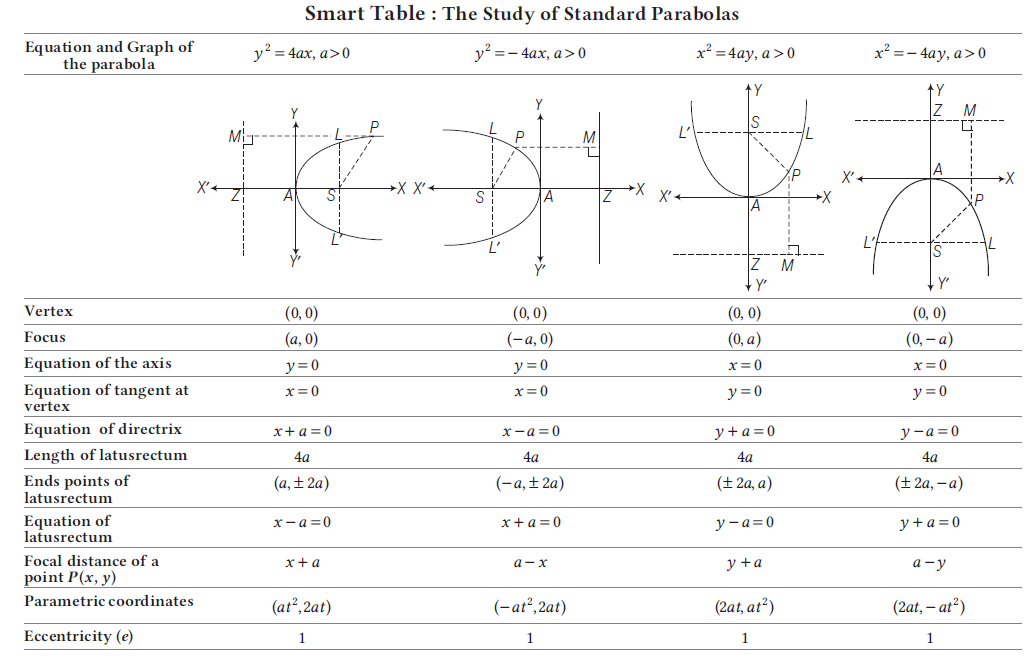
- A parabola is the set of all points in a plane that are equidistant from a fixed line and a fixed point in the plane.
- The equation of the parabola with focus at \((a, 0) a>0\) and directrix \(x=-a\) is
\(
y^2=4 a x
\) - Latus rectum of a parabola is a line segment perpendicular to the axis of the parabola, through the focus and whose end points lie on the parabola.
- Length of the latus rectum of the parabola \(y^2=4 a x\) is \(4 a\).
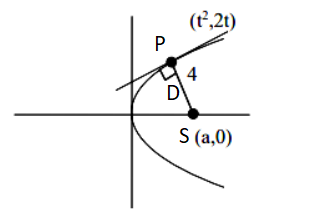
- Focal distance of a point: Let the equation of the parabola be \(y^2=4 a x\) and \(P (x, y)\) be a point on it. Then the distance of \(P\) from the focus \((a, 0)\) is called the focal distance of the point, i.e.,
\(
\begin{aligned}
FP & =\sqrt{(x-a)^2+y^2} \\
& =\sqrt{(x-a)^2+4 a x} \\
& =\sqrt{(x+a)^2} \\
& =|x+a|
\end{aligned}
\)
Ellipse
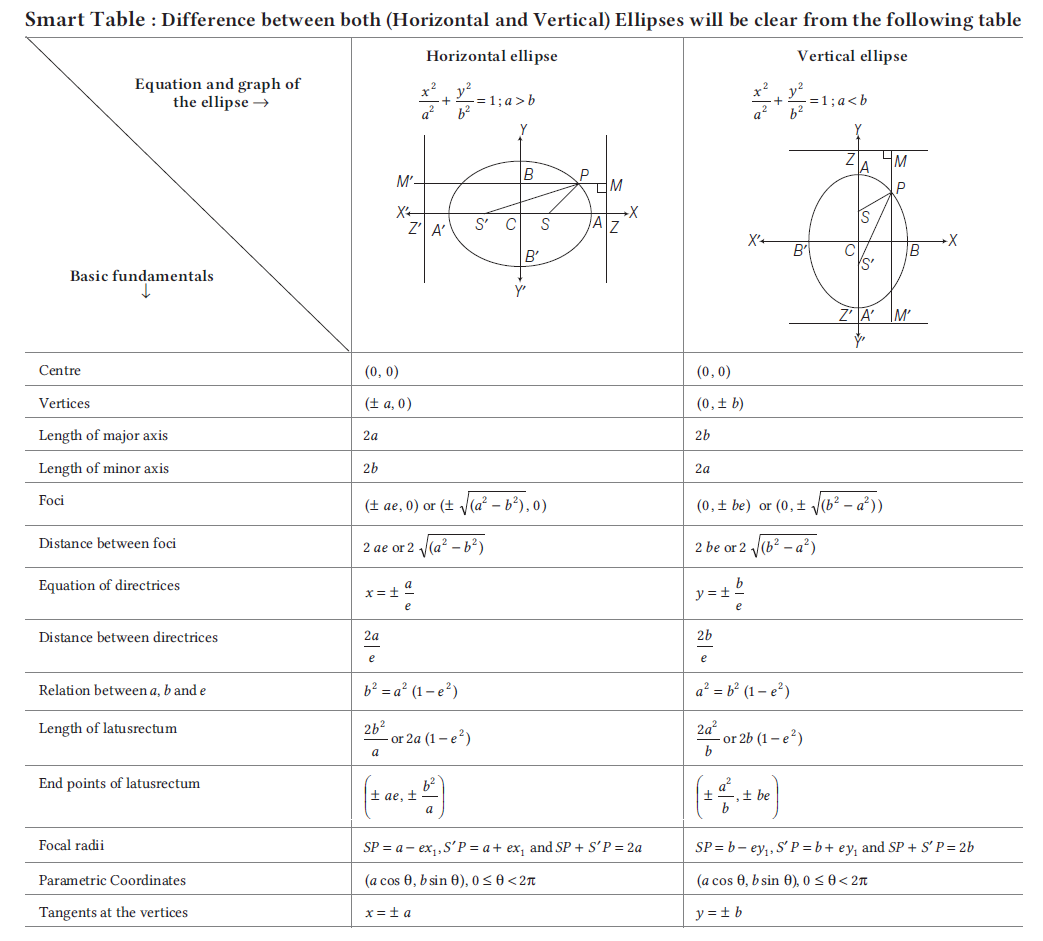
- An ellipse is the set of all points in a plane, the sum of whose distances from two fixed points in the plane is a constant.
- The equation of an ellipse with foci on the \(x\)-axis is \(\frac{x^2}{a^2}+\frac{y^2}{b^2}=1\).
- Latus rectum of an ellipse is a line segment perpendicular to the major axis through any of the foci and whose end points lie on the ellipse.
- Length of the latus rectum of the ellipse \(\frac{x^2}{a^2}+\frac{y^2}{b^2}=1\) is \(\frac{2 b^2}{a}\).
- The eccentricity of an ellipse is the ratio between the distances from the centre of the ellipse to one of the foci and to one of the vertices of the ellipse.
- We have two standard forms of the ellipse, i.e.,
(i) \(\frac{x^2}{a^2}+\frac{y^2}{b^2}=1 \quad\) and
(ii) \(\frac{x^2}{b^2}+\frac{y^2}{a^2}=1\),
In both cases \(a>b\) and \(b^2=a^2\left(1-e^2\right), e<1\). - Focal Distance: The focal distance of a point \((x, y)\) on the ellipse \(\frac{x^2}{a^2}+\frac{y^2}{b^2}=1\) is
\(a-e|x|\) from the nearer focus
\(a+e|x|\) from the farther focus - Sum of the focal distances of any point on an ellipse is constant and equal to the length of the major axis.
Hyperbola
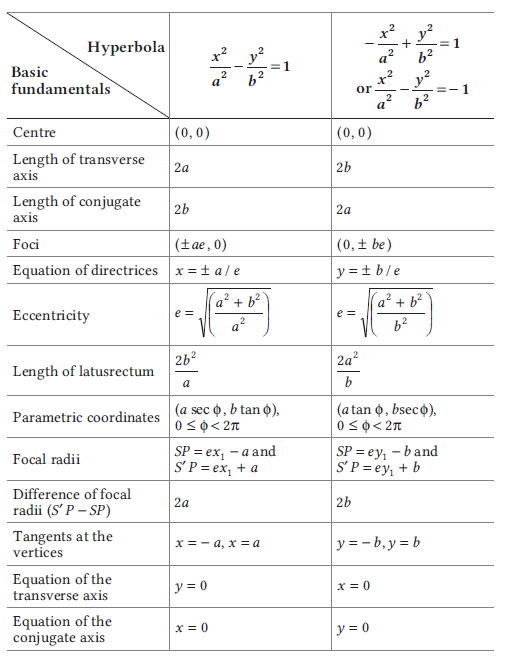
- The equation of a hyperbola with foci on the \(x\)-axis is : \(\frac{x^2}{a^2}-\frac{y^2}{b^2}=1\)
- Latus rectum of hyperbola is a line segment perpendicular to the transverse axis through any of the foci and whose end points lie on the hyperbola.
- Length of the latus rectum of the hyperbola : \(\frac{x^2}{a^2}-\frac{y^2}{b^2}=1\) is: \(\frac{2 b^2}{a}\).
- The eccentricity of a hyperbola is the ratio of the distances from the centre of the hyperbola to one of the foci and to one of the vertices of the hyperbola.
- We have two standard forms of the hyperbola, i.e.,
(i) \(\frac{x^2}{a^2}-\frac{y^2}{b^2}=1\) and
(ii) \(\frac{y^2}{a^2}-\frac{x^2}{b^2}=1\)
Here \(b^2=a^2\left(e^2-1\right), e>1\). - Focal distance: The focal distance of any point \((x, y)\) on the hyperbola \(\frac{x^2}{a^2}-\frac{y^2}{b^2}=1\) is \(e|x|-a\) from the nearer focus
\(e|x|+a\) from the farther focus
Differences of the focal distances of any point on a hyperbola is constant and equal to the length of the transverse axis.
Quiz Summary
0 of 20 Questions completed
Questions:
Information
You have already completed the quiz before. Hence you can not start it again.
Quiz is loading…
You must sign in or sign up to start the quiz.
You must first complete the following:
Results
Results
0 of 20 Questions answered correctly
Your time:
Time has elapsed
You have reached 0 of 0 point(s), (0)
Earned Point(s): 0 of 0, (0)
0 Essay(s) Pending (Possible Point(s): 0)
Categories
- Not categorized 0%
- 1
- 2
- 3
- 4
- 5
- 6
- 7
- 8
- 9
- 10
- 11
- 12
- 13
- 14
- 15
- 16
- 17
- 18
- 19
- 20
- Current
- Review
- Answered
- Correct
- Incorrect
- Question 1 of 20
1. Question
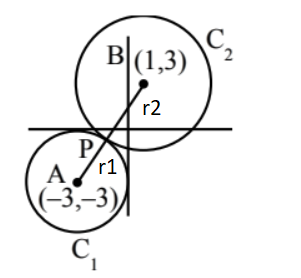
Let \(C_1\) be the circle in the third quadrant of radius 3 , that touches both coordinate axes. Let \(C_2\) be the circle with centre \((1,3)\) that touches \(\mathrm{C}_1\) externally at the point \((\alpha, \beta)\). If \((\beta-\alpha)^2=\frac{m}{n}, \operatorname{gcd}(m, n)=1\), then \(m+n\) is equal to [JEE Main 2025 (Online) 7th April Morning Shift]
CorrectIncorrectHint
(a)

Step 1: Identify the Properties of Circle \(C_1\)
Since the circle \(C_1\) lies in the third quadrant and touches both coordinate axes with a radius of 3, its center \(\boldsymbol{A}\) must be equidistant from both axes in the negative direction.
Center A: (-3,-3)
Radius \(r_1: 3\)
Equation: \((x+3)^2+(y+3)^2=3^2\)
Step 2: Identify the Properties of Circle \(C_2\)
We are given the center of the second circle, and the fact that it touches \(C_1\) externally.
Center \(B:(1,3)\)
External Touch: This implies the distance between the two centers (\(d\)) is exactly equal to the sum of their radii \(\left(r_1+r_2\right)\).
Step 3: Calculate the Distance \(A B\) and Radius \(r_2\)
To find the radius of the second circle, we calculate the distance between \(A(-3,-3)\) and \(B(1,3)\) using the distance formula:
\(
\begin{gathered}
A B=\sqrt{(1-(-3))^2+(3-(-3))^2} \\
A B=\sqrt{4^2+6^2}=\sqrt{16+36}=\sqrt{52}=2 \sqrt{13}
\end{gathered}
\)
Since \(A B=r_1+r_2\), we find \(r_2\) :
\(
2 \sqrt{13}=3+r_2 \Longrightarrow r_2=2 \sqrt{13}-3
\)
Step 4: Find the Point of Contact \(P(\alpha, \beta)\) (Identify the Point of Tangency (\(\alpha, \beta\)))
The point of contact \(P\) divides the line segment joining centers \(A\) and \(B\) internally in the ratio of their radii, \(r_1: r_2\). Using the section formula \(P=\left(\frac{r_1 x_2+r_2 x_1}{r_1+r_2}, \frac{r_1 y_2+r_2 y_1}{r_1+r_2}\right)\) :
\(\alpha\) calculation:
\(
\alpha=\frac{3(1)+(2 \sqrt{13}-3)(-3)}{2 \sqrt{13}}=\frac{3-6 \sqrt{13}+9}{2 \sqrt{13}}=\frac{12-6 \sqrt{13}}{2 \sqrt{13}}=\frac{6}{\sqrt{13}}-3
\)
\(\beta\) calculation:
\(
\beta=\frac{3(3)+(2 \sqrt{13}-3)(-3)}{2 \sqrt{13}}=\frac{9-6 \sqrt{13}+9}{2 \sqrt{13}}=\frac{18-6 \sqrt{13}}{2 \sqrt{13}}=\frac{9}{\sqrt{13}}-3
\)
Step 5: Final Calculation
Now, we find the value of \((\beta-\alpha)^2\) :
\(
\begin{gathered}
\beta-\alpha=\left(\frac{9}{\sqrt{13}}-3\right)-\left(\frac{6}{\sqrt{13}}-3\right)=\frac{3}{\sqrt{13}} \\
(\beta-\alpha)^2=\left(\frac{3}{\sqrt{13}}\right)^2=\frac{9}{13}
\end{gathered}
\)
Given \((\beta-\alpha)^2=\frac{m}{n}\) where \(\operatorname{gcd}(m, n)=1\) :
\(m=9, n=13\)
\(m+n=9+13=22\) - Question 2 of 20
2. Question
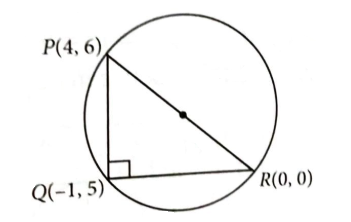
If the four distinct points \((4,6),(-1,5),(0,0)\) and \((k, 3 k)\) lie on a circle of radius \(r\), then \(10 k+r^2\) is equal to [JEE Main 2025 (Online) 3rd April Evening Shift]
CorrectIncorrectHint
(c)

Let \(P \equiv(4,6), \quad Q \equiv(-1,5), \quad R \equiv(0,0)\) and \(S \equiv(k, 3 k)\).
Slope of line through point \(P\) and \(Q\) is
\(
m_1=\frac{1}{5} \dots(i)
\)
Slope of line through point \(Q\) and \(R\) is
\(
m_2=-5 \dots(ii)
\)
From (i) and (ii), we get
\(
m_1 m_2=-1
\)
So, line passes by \(P\) and \(Q\) is perpendicular to line passes by \(Q\) and \(R\).
So, \(P\) and \(R\) will represent end point of diameter of circle so we have
\(
\begin{aligned}
& (x-4)(x-0)+(y-6)(y-0)=0 \\
\Rightarrow & x^2+y^2-4 x-6 y=0
\end{aligned}
\)
Since \((k, 3 k)\) lies on it
\(
\begin{aligned}
& \therefore \quad k^2+9 k^2-4 k-18 k=0 \\
& \Rightarrow \quad 10 k^2-22 k=0 \\
& \Rightarrow k=0, \frac{11}{5}
\end{aligned}
\)
Since, \(k=0\) is not possible, so \(k=\frac{11}{5}\)
Also, \(r=\frac{\sqrt{4^2+6^2}}{2}=\frac{\sqrt{52}}{2}=\sqrt{13}\)
\(
\therefore \quad 10 k+r^2=10 \times \frac{11}{5}+(\sqrt{13})^2=35 .
\) - Question 3 of 20
3. Question
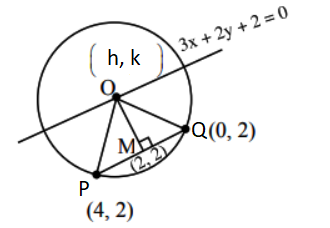
Let a circle \(C\) pass through the points \((4,2)\) and \((0,2)\), and its centre lie on \(3 x+2 y+2=0\). Then the length of the chord, of the circle \(C\), whose mid-point is (1 , 2), is: [JEE Main 2025 (Online) 29th January Evening Shift]
CorrectIncorrectHint
(c)

Step 1: Find the Center of the Circle
The circle passes through \(P(4,2)\) and \(Q(0,2)\). The perpendicular bisector of the chord \(P Q\) passes through the center \((h, k)\). The midpoint of \(P Q\) is \(\left(\frac{4+0}{2}, \frac{2+2}{2}\right)=(2,2)\). Since \(P Q\) is a horizontal line (\(y=2\)), its perpendicular bisector is the vertical line \(x=2\). Thus, the \(x\)-coordinate of the center is \(h=2\).
The center lies on the line \(3 x+2 y+2=0\). Substituting \(x=2\) :
\(
3(2)+2 k+2=0 \Longrightarrow 2 k=-8 \Longrightarrow k=-4
\)
The center of the circle is \(O(2,-4)\).
Step 2: Calculate the Radius
The radius \(r\) is the distance from the center \(O(2,-4)\) to the point \(Q(0,2)\) :
\(
r^2=(2-0)^2+(-4-2)^2=4+36=40
\)
Step 3: Find the Length of the Chord
Let the chord have midpoint \(M(1,2)\). The distance \(d\) from the center \(O(2,-4)\) to \(M\) is:
\(
d^2=(2-1)^2+(-4-2)^2=1^2+(-6)^2=37
\)
Using the Pythagorean theorem, the half-length of the chord \(a\) is:
\(
a=\sqrt{r^2-d^2}=\sqrt{40-37}=\sqrt{3}
\)
The total length of the chord is \(2 a=2 \sqrt{3}\). - Question 4 of 20
4. Question
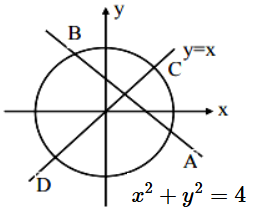
Let the line \(\mathrm{x}+\mathrm{y}=1\) meet the circle \(x^2+y^2=4\) at the points A and B. If the line perpendicular to AB and passing through the mid-point of the chord AB intersects the circle at \(C\) and \(D\), then the area of the quadrilateral \(A B C D\) is equal to : [JEE Main 2025 (Online) 29th January Morning Shift]
CorrectIncorrectHint
(c)

Step 1: Analyze the geometric setup
The given circle is \(x^2+y^2=4\), which has a center \(O(0,0)\) and radius \(R=2\). The line \(x+y=1\) intersects this circle at points \(A\) and \(B\). A line perpendicular to \(A B\) passing through the midpoint of chord \(A B\) is the perpendicular bisector of \(A B\). In any circle, the perpendicular bisector of a chord must pass through the center of the circle. Therefore, the line \(C D\) is a diameter of the circle, and its length is \(2 R=4\).
Step 2: Calculate the length of chord AB
The length of a chord is given by the formula \(2 \sqrt{R^2-d^2}\), where \(d\) is the perpendicular distance from the center to the line.
The distance \(d\) from \((0,0)\) to \(x+y-1=0\) is:
\(
d=\frac{|0+0-1|}{\sqrt{1^2+1^2}}=\frac{1}{\sqrt{2}}
\)
The length of \(A B\) is:
\(
A B=2 \sqrt{2^2-\left(\frac{1}{\sqrt{2}}\right)^2}=2 \sqrt{4-\frac{1}{2}}=2 \sqrt{\frac{7}{2}}=\sqrt{14}
\)
Step 3: Calculate the area of quadrilateral ABCD
In the quadrilateral \(A B C D\), the diagonals \(A B\) and \(C D\) are perpendicular to each other because \(C D\) is the perpendicular bisector of \(A B\). The area of a quadrilateral with perpendicular diagonals is given by:
\(
\text { Area }=\frac{1}{2} \times d_1 \times d_2
\)
Substitute the lengths of the diagonals \(\left(d_1=A B=\sqrt{14}\right.\) and \(\left.d_2=C D=4\right)\) :
\(
\text { Area }=\frac{1}{2} \times \sqrt{14} \times 4=2 \sqrt{14}
\) - Question 5 of 20
5. Question
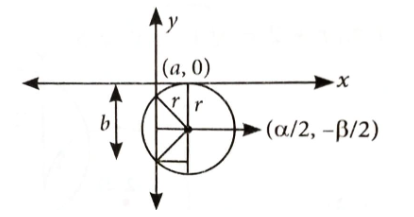
Let the equation of the circle, which touches \(x\)-axis at the point \((a, 0), a>0\) and cuts off an intercept of length \(b\) on \(y-a x i s\) be \(x^2+y^2-\alpha x+\beta y+\gamma=0\). If the circle lies below \(x-a x i s\), then the ordered pair \(\left(2 a, b^2\right)\) is equal to [JEE Main 2025 (Online) 28th January Morning Shift]
CorrectIncorrectHint
(b)

Let, \(r\) be the radius of the circle,
\(
\begin{aligned}
& r=\sqrt{\frac{\alpha^2}{4}+\frac{\beta^2}{4}-\gamma}=\frac{\beta}{2} \\
& \Rightarrow \quad \frac{\alpha^2}{4}-\gamma=0 \\
& \Rightarrow \quad \alpha^2=4 \gamma ; \quad \frac{\alpha}{2}=a \quad \Rightarrow \quad \alpha=2 a
\end{aligned}
\)
Now, length of intercept on \(y\)-axis \(=b=2 \sqrt{\frac{\beta^2}{4}-\gamma}\)
\(
\begin{aligned}
& \Rightarrow \frac{\beta^2}{4}-\gamma=\frac{b^2}{4} \Rightarrow b^2=\beta^2-4 \gamma \\
& \therefore \text { Points }\left(2 a, b^2\right)=\left(\alpha, \beta^2-4 \gamma\right)
\end{aligned}
\)Explanation: To find the ordered pair \(\left(2 a, b^2\right)\) in terms of the coefficients \(\alpha, \beta\), and \(\gamma\), we will analyze the properties of the given circle equation:
\(
x^2+y^2-\alpha x+\beta y+\gamma=0
\)
Step 1: Identify Circle Parameters
The general form of a circle is \(x^2+y^2+2 g x+2 f y+c=0\). Comparing this to our equation:
\(2 g=-\alpha \Longrightarrow g=-\frac{\alpha}{2}\)
\(2 f=\beta \Longrightarrow f=\frac{\beta}{2}\)
\(c=\gamma\)
The center of the circle is \((-g,-f)=\left(\frac{\alpha}{2},-\frac{\beta}{2}\right)\) and the radius is \(R=\sqrt{g^2+f^2-c}= \sqrt{\frac{\alpha^2}{4}+\frac{\beta^2}{4}-\gamma}\).
Step 2: Condition: Touching the \(x\)-axis at \((a, 0)\)
When a circle touches the \(x\)-axis at (\(a, 0\)):
The \(x\)-coordinate of the center must be \(a\). Thus, \(\frac{\alpha}{2}=a \Longrightarrow \alpha=2 a\).
The radius \(R\) must be equal to the absolute value of the \(y\)-coordinate of the center. Since the circle lies below the x -axis, the \(y\)-coordinate \(-\frac{\beta}{2}\) must be negative, meaning \(\beta\) is positive.
\(R=\left|-\frac{\beta}{2}\right|=\frac{\beta}{2}\)
For a circle touching the \(x\)-axis, \(g^2=c\).
\(\left(-\frac{\alpha}{2}\right)^2=\gamma \Longrightarrow \frac{\alpha^2}{4}=\gamma\).
Substituting \(\alpha=2 a\), we get \(\gamma=a^2\).
Step 3: Condition: Intercept on the \(\mathbf{y}\)-axis
The length of the intercept made by the circle on the \(y\)-axis is given by the formula \(2 \sqrt{f^2-c}\). We are told this length is \(b\) :
\(
\begin{gathered}
b=2 \sqrt{\left(\frac{\beta}{2}\right)^2-\gamma} \\
b=2 \sqrt{\frac{\beta^2}{4}-\gamma}
\end{gathered}
\)
Square both sides:
\(
b^2=4\left(\frac{\beta^2}{4}-\gamma\right)=\beta^2-4 \gamma
\)
Step 4: Solve for the Ordered Pair \(\left(2 a, b^2\right)\)
We already found:
\(2 a=\alpha\)
\(b^2=\beta^2-4 \gamma\)
\(
\left(2 a, b^2\right)=\left(\alpha, \beta^2-4 \gamma\right)
\) - Question 6 of 20
6. Question
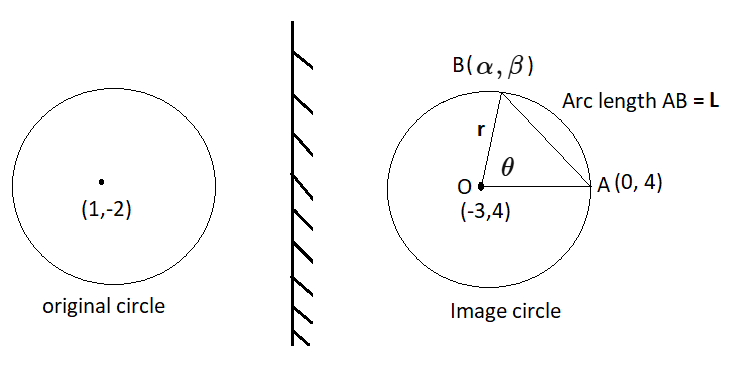
Let circle \(C\) be the image of \(x^2+y^2-2 x+4 y-4=0\) in the line \(2 x-3 y+5=0\) and \(A\) be the point on \(C\) such that \(O A\) is parallel to \(x\)-axis and \(A\) lies on the right hand side of the centre \(O\) of \(C\). If \(B(\alpha, \beta)\), with \(\beta<4\), lies on \(C\) such that the length of the \(\operatorname{arc} A B\) is \((1 / 6)^{\text {th }}\) of the perimeter of \(C\), then \(\beta-\sqrt{3} \alpha\) is equal to [JEE Main 2025 (Online) 24th January Morning Shift]
CorrectIncorrectHint
(c)

To solve this, we will find the properties of the original circle, determine its image (circle \(C\)), and then use the geometric conditions given for points \(A\) and \(B\).
Step 1: Identify the Original Circle
The given equation is \(x^2+y^2-2 x+4 y-4=0\).
Center \(\left(C_0\right):(1,-2)\)
Radius \((r): \sqrt{1^2+(-2)^2-(-4)}=\sqrt{1+4+4}=3\)
Step 2: Find the Image Circle \(C\)
The circle \(C\) is the image of the original circle in the line \(2 x-3 y+5=0\). Since reflection preserves size, the radius of \(C\) remains \(r=3\). We only need to find the image of the center \(C_0(1,-2)\). Using the image formula for a point \(\left(x_1, y_1\right)\) in a line \(a x+b y+c=0\) :
\(
\frac{x-x_1}{a}=\frac{y-y_1}{b}=-2 \frac{a x_1+b y_1+c}{a^2+b^2}
\)
\(
\frac{x-1}{2}=\frac{y+2}{-3}=-2 \frac{2(1)-3(-2)+5}{2^2+(-3)^2}=-2 \frac{2+6+5}{13}=-2(1)=-2
\)
\(x-1=-4 \Longrightarrow x=-3\)
\(y+2=6 \Longrightarrow y=4\)
The center \(O\) of circle \(C\) is \((-3,4)\) and the radius is 3.
Step 4: Locate Point \(B(\alpha, \beta)\)
We are told the arc length \(A B\) is \(1 / 6\) of the perimeter.
Arc length \(=\frac{1}{6} \times(2 \pi r)=r \theta \Longrightarrow \theta=\frac{2 \pi}{6}=\frac{\pi}{3}=60^{\circ}\) The point \(B\) is obtained by rotating \(A\) about the center \(O\) by \(60^{\circ}\).
Since \(A\) is at an angle of \(0^{\circ}\) relative to the center \(O\), the coordinates of \(B\) in parametric form \((x=h+r \cos \theta, y=k+r \sin \theta)\) are:
\(
\alpha=-3+3 \cos \theta, \quad \beta=4+3 \sin \theta
\)
There are two possibilities: \(\theta=60^{\circ}\) or \(\theta=-60^{\circ}\).
If \(\theta=60^{\circ}: \beta=4+3 \sin \left(60^{\circ}\right)=4+\frac{3 \sqrt{3}}{2}>4\).
If \(\theta=-60^{\circ}: \beta=4+3 \sin \left(-60^{\circ}\right)=4-\frac{3 \sqrt{3}}{2}<4\).
Since the problem states \(\beta<4\), we must use \(\theta=-60^{\circ}\).
Step 5: Calculate \(\alpha\) and \(\beta\)
\(
\begin{gathered}
\alpha=-3+3 \cos \left(-60^{\circ}\right)=-3+3\left(\frac{1}{2}\right)=-3+1.5=-1.5 \\
\beta=4+3 \sin \left(-60^{\circ}\right)=4-\frac{3 \sqrt{3}}{2}
\end{gathered}
\)
Step 6: Final Calculation
We need to find \(\beta-\sqrt{3} \alpha\) :
\(
\begin{gathered}
\beta-\sqrt{3} \alpha=\left(4-\frac{3 \sqrt{3}}{2}\right)-\sqrt{3}\left(-3+\frac{3}{2}\right) \\
\beta-\sqrt{3} \alpha=4-\frac{3 \sqrt{3}}{2}-\sqrt{3}\left(-\frac{3}{2}\right) \\
\beta-\sqrt{3} \alpha=4-\frac{3 \sqrt{3}}{2}+\frac{3 \sqrt{3}}{2} \\
\beta-\sqrt{3} \alpha=4
\end{gathered}
\) - Question 7 of 20
7. Question
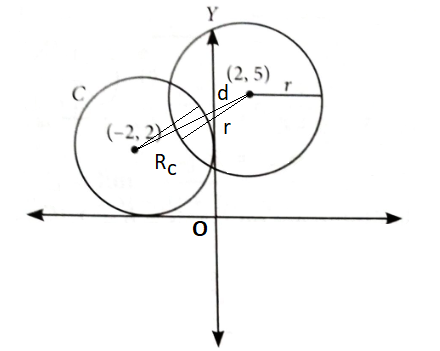
A circle \(C\) of radius 2 lies in the second quadrant and touches both the coordinate axes. Let \(r\) be the radius of a circle that has centre at the point \((2,5)\) and intersects the circle \(C\) at exactly two points. If the set of all possible values of r is the interval \((\alpha, \beta)\), then \(3 \beta-2 \alpha\) is equal to : [JEE Main 2025 (Online) 22nd January Morning Shift]
CorrectIncorrectHint
(d)

To solve this problem, we need to determine the range of the radius \(r\) for a circle centered at \((2,5)\) such that it intersects circle \(C\) at exactly two points.
Step 1: Identify Circle C
Quadrant: Second quadrant ( \(x\) is negative, \(y\) is positive).
Radius \(\left(R_C\right): 2\).
Touching both axes: Since it touches both axes in the second quadrant, its center \(C_1\) must be \((-2,2)\).
Equation: \((x+2)^2+(y-2)^2=2^2\).
Step 2: Analyze the Intersection Condition
Let the second circle be \(C_2\) with center \(O(2,5)\) and radius \(r\). Two circles intersect at exactly two points if the distance between their centers (\(d\)) satisfies:
\(
\left|r-R_C\right|<d<r+R_C
\)
First, let’s calculate the distance \(d\) between \(C_1(-2,2)\) and \(O(2,5)\) :
\(
d=\sqrt{(2-(-2))^2+(5-2)^2}=\sqrt{4^2+3^2}=\sqrt{16+9}=5
\)
Step 3: Solve the Inequalities for \(r\)
Substitute \(d=5\) and \(R_C=2\) into the intersection condition:
Upper Bound ( \(d<r+R_C\) ):
\(
5<r+2 \Longrightarrow r>3
\)
This is the condition for the circles to touch externally (\(r=3\)) or intersect.
Lower Bound \(\left(\left|r-R_C\right|<d\right)\) :
\(
\begin{gathered}
|r-2|<5 \\
-5<r-2<5 \\
-3<r<7
\end{gathered}
\)
Since \(r\) must be positive, we focus on \(r<7\). This is the condition for the circles to touch internally (\(r=7\)) or intersect.
Combining these, the range for \(r\) is \((3,7)\). Thus, \(\alpha=3\) and \(\beta=7\).
We need to find \(3 \beta-2 \alpha\) :
\(
3(7)-2(3)=21-6=15
\) - Question 8 of 20
8. Question
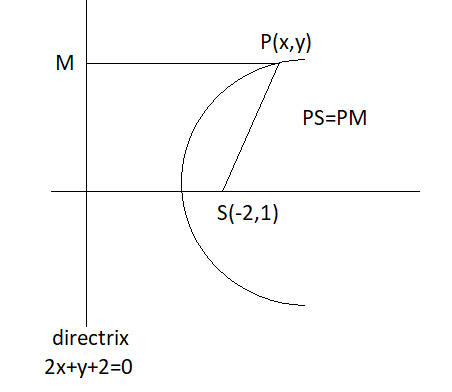
Let P be the parabola, whose focus is \((-2,1)\) and directrix is \(2 x+y+2=0\). Then the sum of the ordinates of the points on P, whose abscissa is -2, is [JEE Main 2025 (Online) 7th April Morning Shift]
CorrectIncorrectHint
(b)

To find the sum of the ordinates ( \(y\)-values) of the points on the parabola \(P\) where the abscissa ( \(x\)-value) is -2, we use the fundamental definition of a parabola: the distance from any point (\(x, y\)) on the parabola to the focus is equal to its perpendicular distance to the directrix.
Step 1: Set up the Parabola Equation
Focus (S): \((-2,1)\)
Directrix (\(L\)): \(2 x+y+2=0\)
Point on Parabola \((P):(x, y)\)
The condition \(P S^2=P M^2\) gives us:
\(
\begin{gathered}
(x-(-2))^2+(y-1)^2=\left(\frac{|2 x+y+2|}{\sqrt{2^2+1^2}}\right)^2 \\
(x+2)^2+(y-1)^2=\frac{(2 x+y+2)^2}{5}
\end{gathered}
\)
Step 2: Substitute the given Abscissa
We are looking for points where the abscissa \(x=-2\). Substitute \(x=-2\) into the equation:
\(
\begin{aligned}
(-2+2)^2+(y-1)^2 & =\frac{(2(-2)+y+2)^2}{5} \\
0^2+(y-1)^2 & =\frac{(-4+y+2)^2}{5} \\
(y-1)^2 & =\frac{(y-2)^2}{5}
\end{aligned}
\)
Step 3: Solve for the Ordinates ( \(y\) )
Expand both sides to form a quadratic equation in terms of \(y\) :
\(
\begin{gathered}
5\left(y^2-2 y+1\right)=y^2-4 y+4 \\
5 y^2-10 y+5=y^2-4 y+4 \\
4 y^2-6 y+1=0
\end{gathered}
\)
This quadratic equation represents the two possible \(y\)-coordinates (\(y_1\) and \(y_2\)) for the points on the parabola where \(x=-2\).
Step 4: Calculate the Sum of Ordinates
For a quadratic equation of the form \(A y^2+B y+C=0\), the sum of the roots is given by \(-\frac{B}{A}\).
\(A=4\)
\(B=-6\)
\(
\text { Sum }=y_1+y_2=-\frac{-6}{4}=\frac{6}{4}=\frac{3}{2}
\) - Question 9 of 20
9. Question
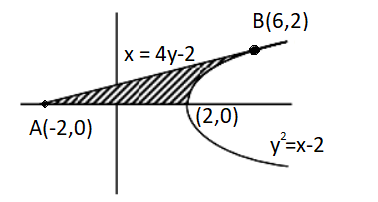
A line passing through the point \(\mathrm{A}(-2,0)\), touches the parabola \(\mathrm{P}: y^2=x-2\) at the point \(B\) in the first quadrant. The area, of the region bounded by the line \(A B\), parabola \(P\) and the \(x\)-axis, is : [JEE Main 2025 (Online) 4th April Evening Shift]
CorrectIncorrectHint
(c)

To find the area of the region bounded by the line \(A B\), the parabola \(P\), and the \(x\)-axis, we first need to determine the equation of the tangent line and the coordinates of point \(B\).
Step 1: Find the Point of Tangency \(B\)
The parabola is \(y^2=x-2\). Let the point of tangency be \(B\left(x_1, y_1\right)\). The equation of the tangent to \(y^2=4 a(x-h)\) at \(\left(x_1, y_1\right)\) is given by \(y y_1=\frac{1}{2}\left(x+x_1\right)-2\). Substituting our specific parabola equation:
\(
y y_1=\frac{1}{2}\left(x+x_1\right)-2
\)
Since this line passes through \(A(-2,0)\), we substitute \(x=-2\) and \(y=0\) :
\(
\begin{gathered}
0 \cdot y_1=\frac{1}{2}\left(-2+x_1\right)-2 \\
0=\frac{-2+x_1-4}{2} \Longrightarrow x_1=6
\end{gathered}
\)
Now, find \(y_1\) using the parabola equation \(y^2=x-2\) :
\(
y_1^2=6-2=4 \Longrightarrow y_1=2 \text { (since } B \text { is in the first quadrant) }
\)
So, the point of tangency is \(B(6,2)\).
Step 2: Equation of the Line \(A B\)
The line passes through \(A(-2,0)\) and \(B(6,2)\). The slope \(m\) is:
\(
m=\frac{2-0}{6-(-2)}=\frac{2}{8}=\frac{1}{4}
\)
Equation of line \(A B: y-0=\frac{1}{4}(x+2) \Longrightarrow x=4 y-2\).
Step 3: Calculate the Area
It is much easier to integrate with respect to \(y\) (from \(y=0\) to \(y=2\) ), as the region is bounded on the right by the parabola and on the left by the line.
Parabola: \(x_P=y^2+2\)
Line: \(x_L=4 y-2\)
The area Area is:
\(
\text { Area }=\int_0^2\left(x_P-x_L\right) d y
\)
\(
\begin{aligned}
&\begin{gathered}
\text { Area }=\int_0^2\left(y^2-4 y+4\right) d y \\
\text { Area }=\int_0^2(y-2)^2 d y
\end{gathered}\\
&\text { Evaluating the integral: }\\
&\begin{gathered}
\text { Area }=\left[\frac{(y-2)^3}{3}\right]_0^2 \\
\text { Area }=\left(\frac{(2-2)^3}{3}\right)-\left(\frac{(0-2)^3}{3}\right) \\
\text { Area }=0-\left(\frac{-8}{3}\right)=\frac{8}{3}
\end{gathered}
\end{aligned}
\) - Question 10 of 20
10. Question
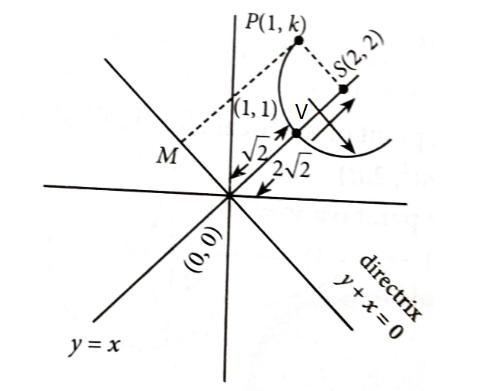
The axis of a parabola is the line \(y=x\) and its vertex and focus are in the first quadrant at distances \(\sqrt{2}\) and \(2 \sqrt{2}\) units from the origin, respectively. If the point \((1, k)\) lies on the parabola, then a possible value of \(k\) is : [JEE Main 2025 (Online) 4th April Evening Shift]
CorrectIncorrectHint
(c)

For the parabola, axis is \(y=x\)
⇒ Directrix is \(x+y=0\)
Also, vertex and focus are of \(\sqrt{2}\) and \(2 \sqrt{2}\) from origin
⇒ Vertex is \((1,1)\) and focus \(=(2,2)\)
The point \(P(1, k)\) lies on parabola.
Using definition of parabola
\(
\begin{aligned}
& P S=P M \\
\Rightarrow & \sqrt{(1-2)^2+(k-2)^2}=\frac{1+k}{\sqrt{2}} \\
\Rightarrow & k^2-10 k+9=0 \\
\Rightarrow & (k-9)(k-1)=0 \\
\therefore & k=9 \text { and } k=1
\end{aligned}
\)Explanation: Step 1: Find the Coordinates of the Vertex and Focus
The axis of the parabola is the line \(y=x\). The vertex \(V\) and focus \(S\) lie on this line in the first quadrant at distances \(\sqrt{2}\) and \(2 \sqrt{2}\) from the origin, respectively.
For any point (\(a, a\)) on \(y=x\), the distance from the origin is \(\sqrt{a^2+a^2}=a \sqrt{2}\).
Since \(V\) is at distance \(\sqrt{2}\), we have \(a \sqrt{2}=\sqrt{2} \Longrightarrow a=1\). Thus, \(V=(1,1)\).
Since \(S\) is at distance \(2 \sqrt{2}\), we have \(a \sqrt{2}=2 \sqrt{2} \Longrightarrow a=2\). Thus, \(S=(2,2)\).
The axis \(y=x\) and directrix \(x+y=0\) are perpendicular. The distance from the focus \(S(2,2)\) to the directrix \(x+y=0\) is:
\(
d=\frac{|2+2|}{\sqrt{1^2+1^2}}=\frac{4}{\sqrt{2}}=2 \sqrt{2}
\)
The vertex \((1,1)\) lies exactly at the midpoint between the focus and the directrix along the axis, confirming the setup is consistent with the definition of a parabola where the eccentricity \(e=1\).
Step 2: Apply the Parabolic Definition
For any point \(P(x, y)\) on the parabola, the distance to the focus \(S(2,2)\) must equal the perpendicular distance to the directrix \(x+y=0\). For \(P(1, k)\) :
Distance to Focus (PS): \(\sqrt{(1-2)^2+(k-2)^2}=\sqrt{1+(k-2)^2}\)
Distance to Directrix (PM): \(\frac{|1+k|}{\sqrt{1^2+1^2}}=\frac{|1+k|}{\sqrt{2}}\)
Step 3: Solve for \(k\)
Equating \(P S^2=P M^2\) to remove radicals:
\(
\begin{gathered}
1+(k-2)^2=\frac{(1+k)^2}{2} \\
2\left(1+k^2-4 k+4\right)=1+2 k+k^2 \\
2 k^2-8 k+10=k^2+2 k+1 \\
k^2-10 k+9=0
\end{gathered}
\)
Factoring the quadratic gives \((k-9)(k-1)=0\), yielding \(k=9\) and \(k=1\). - Question 11 of 20
11. Question
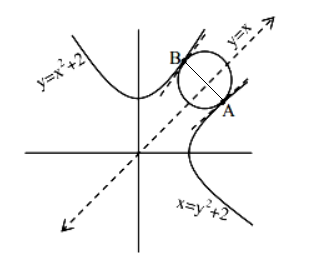
The radius of the smallest circle which touches the parabolas \(y=x^2+2\) and \(x=y^2+2\) is [JEE Main 2025 (Online) 3rd April Morning Shift]
CorrectIncorrectHint
(b)

Tangents at A & B must be parallel to \(\mathrm{y}=\mathrm{x}\) line, so slope of the tangents \(=1\)
\(
\left(\frac{d y}{d x}\right)_{\min A}=1=\left(\frac{d y}{d x}\right)_{\min B}
\)
For point \(\mathrm{B}, \mathrm{y}=\mathrm{x}^2+2\)
\(
\begin{aligned}
& \frac{d y}{d x}=2 x=1 \\
& x=\frac{1}{2} \Rightarrow y=\frac{9}{4}
\end{aligned}
\)
\(
\begin{aligned}
& \therefore \text { Point } \mathrm{B}=\left(\frac{1}{2}, \frac{9}{4}\right) \Rightarrow \text { Point } \mathrm{A}=\left(\frac{9}{4}, \frac{1}{2}\right) \\
& \mathrm{AB}=\sqrt{\left(\frac{1}{2}-\frac{9}{4}\right)^2+\left(\frac{9}{4}-\frac{1}{2}\right)^2} \\
& =\sqrt{\frac{98}{16}}=\frac{7 \sqrt{2}}{4} \\
& \text { Radius }=AB/2=\frac{7 \sqrt{2}}{8}
\end{aligned}
\) - Question 12 of 20
12. Question
Let the point P of the focal chord PQ of the parabola \(y^2=16 x\) be \((1,-4)\). If the focus of the parabola divides the chord \(P Q\) in the ratio \(m: n, \operatorname{gcd}(m, n)=1\), then \(m^2+n^2\) is equal to : [JEE Main 2025 (Online) 2nd April Evening Shift]
CorrectIncorrectHint
(a) To solve for \(m^2+n^2\), we need to find the coordinates of the point \(Q\) and then calculate the ratio in which the focus \(S\) divides the segment \(P Q\).
Step 1: Identify Parabola Parameters
For the parabola \(y^2=16 x\), we compare it to the standard form \(y^2=4 a x\) :
\(4 a=16 \Longrightarrow a=4\)
Focus (\(S\)): Located at (\(a, 0\)), so \(S=(4,0)\)
Point \(P\) : Given as \((1,-4)\)
Step 2: Find the Point \(Q\)
For any parabola \(y^2=4 a x\), if \(P\left(a t_1^2, 2 a t_1\right)\) and \(Q\left(a t_2^2, 2 a t_2\right)\) are endpoints of a focal chord, they satisfy the property \(t_1 t_2=-1\).
Find \(t_1\) for \(P\) : Using the \(y\)-coordinate: \(2 a t_1=-4 \Longrightarrow 2(4) t_1=-4 \Longrightarrow t_1=-\frac{1}{2}\)
Find \(t_2\) for \(Q: t_2=-\frac{1}{t_1}=-\frac{1}{-1 / 2}=2\)
Calculate coordinates of \(Q\) :
\(x_Q=a t_2^2=4(2)^2=16\)
\(y_Q=2 a t_2=2(4)(2)=16\)
\(Q=(16,16)\)
Step 3: Determine the Ratio \(m: n\)
The focus \(S(4,0)\) divides the chord \(P Q\) where \(P(1,-4)\) and \(Q(16,16)\). We use the section formula for the \(x\)-coordinate:
\(
\begin{aligned}
x_S & =\frac{m \cdot x_Q+n \cdot x_P}{m+n} \\
4 & =\frac{m(16)+n(1)}{m+n}
\end{aligned}
\)
Multiply both sides by \((m+n)\) :
\(
\begin{gathered}
4 m+4 n=16 m+n \\
3 n=12 m \Longrightarrow \frac{m}{n}=\frac{3}{12}=\frac{1}{4}
\end{gathered}
\)
Since \(\operatorname{gcd}(1,4)=1\), we have \(m=1\) and \(n=4\).
Step 4: Final Calculation
Now, we find the value of \(m^2+n^2\) :
\(
m^2+n^2=1^2+4^2=1+16=17
\) - Question 13 of 20
13. Question
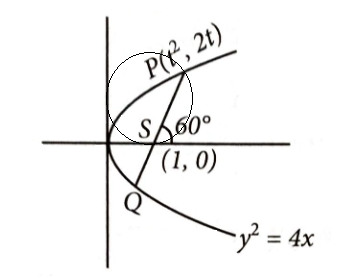
Let the focal chord PQ of the parabola \(y^2=4 x\) make an angle of \(60^{\circ}\) with the positive \(x\) axis, where P lies in the first quadrant. If the circle, whose one diameter is \(\mathrm{PS}, \mathrm{S}\) being the focus of the parabola, touches the \(y\)-axis at the point \((0, \alpha)\), then \(5 \alpha^2\) is equal to: [JEE Main 2025 (Online) 2nd April Morning Shift]
CorrectIncorrectHint
(a)

To solve for \(5 \alpha^2\), we will find the coordinates of point \(P\), identify the circle’s properties, and use the condition that it touches the \(y\)-axis.
Step 1: Identify Parabola and Focus
For the parabola \(y^2=4 x\) :
\(4 a=4 \Longrightarrow a=1\).
\(\operatorname{Focus}(S):(a, 0)=(1,0)\).
Step 2: Find the Coordinates of Point \(P\)
The focal chord \(P Q\) makes an angle \(\theta=60^{\circ}\) with the positive \(x\)-axis and passes through the focus \(S(1,0)\). The equation of the line \(P Q\) is:
\(
y-0=\tan \left(60^{\circ}\right)(x-1) \Longrightarrow y=\sqrt{3}(x-1)
\)
To find point \(P\), we substitute this into the parabola equation \(y^2=4 x\) :
\(
\begin{gathered}
(\sqrt{3}(x-1))^2=4 x \\
3\left(x^2-2 x+1\right)=4 x \\
3 x^2-10 x+3=0
\end{gathered}
\)
Solving the quadratic using the factor method:
\(
(3 x-1)(x-3)=0 \Longrightarrow x=3 \text { or } x=\frac{1}{3}
\)
Since \(P\) is in the first quadrant and part of a focal chord where \(P\) is further from the directrix (implied by the geometry of \(60^{\circ}\) focal chords), we take \(x=3\).
For \(x=3, y=\sqrt{3}(3-1)=2 \sqrt{3}\).
Point \(P:(3,2 \sqrt{3})\).
Step 3: Properties of the Circle with Diameter PS
The circle has \(P(3,2 \sqrt{3})\) and \(S(1,0)\) as endpoints of its diameter.
Center (\(C\)): Midpoint of \(P S=\left(\frac{3+1}{2}, \frac{2 \sqrt{3}+0}{2}\right)=(2, \sqrt{3})\).
Radius (\(R\)): Half the distance \(P S\).
\(
\begin{gathered}
P S=\sqrt{(3-1)^2+(2 \sqrt{3}-0)^2}=\sqrt{4+12}=\sqrt{16}=4 \\
R=\frac{4}{2}=2
\end{gathered}
\)
Step 4: Circle Touching the \(y\)-axis
The equation of the circle is:
\(
(x-2)^2+(y-\sqrt{3})^2=2^2
\)
To find where it touches the \(y\)-axis, set \(x=0\) :
\(
\begin{gathered}
(0-2)^2+(y-\sqrt{3})^2=4 \\
4+(y-\sqrt{3})^2=4 \Longrightarrow(y-\sqrt{3})^2=0 \\
y=\sqrt{3}
\end{gathered}
\)
Thus, the point of tangency is \((0, \sqrt{3})\), which means \(\alpha=\sqrt{3}\).
Step 5: Final Calculation
\(
5 \alpha^2=5(\sqrt{3})^2=5(3)=15
\) - Question 14 of 20
14. Question
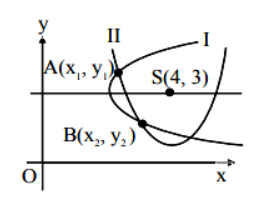
Two parabolas have the same focus \((4,3)\) and their directrices are the \(x\)-axis and the \(y\)-axis, respectively. If these parabolas intersect at the points \(A\) and \(B\), then \((A B)^2\) is equal to : [JEE Main 2025 (Online) 29th January Morning Shift]
CorrectIncorrectHint
(d)

Step 1: Identify the Parabolas
The definition of a parabola is the locus of a point \((x, y)\) such that its distance from the focus \((h, k)\) is equal to its perpendicular distance from the directrix.
Focus \((S):(4,3)\)
Parabola \(1\left(I\right)\) : Directrix is the \(x\)-axis \((y=0)\).
Parabola \(2\left(II\right)\) : Directrix is the \(y\)-axis \((x=0)\).
Let intersection points of these two parabolas are \(\mathrm{A}\left(\mathrm{x}_1, \mathrm{y}_1\right) \& \mathrm{~B}\left(\mathrm{x}_2, \mathrm{y}_2\right)\)
∵ equation of parabola I and II are given below:
\(
\begin{aligned}
& \therefore(\mathrm{x}-4)^2+(\mathrm{y}-3)^2=\mathrm{x}^2 \dots(1) \\
& \&(\mathrm{x}-4)^2+(\mathrm{y}-3)^2=\mathrm{y}^2 \dots(2)
\end{aligned}
\)
Here \(A\left(x_1, y_1\right) \& B\left(x_2, y_2\right)\) will satisfy the equation
Also from equations (1) & (2), we get \(x=y \dots(3)\)
Put \(x=y\) in equation (1)
We get \(x^2-14 x+25=0\)
\(
\begin{aligned}
& x_1+x_2=14 \\
& x_1 x_2=25 \\
& \therefore A B^2=\left(x_1-x_2\right)^2+\left(y_1-y_2\right)^2 \\
& =2\left(x_1-x_2\right)^2 \\
& =2\left[\left(x_1+x_2\right)^2-4 x_1 x_2\right] \\
& =192
\end{aligned}
\) - Question 15 of 20
15. Question
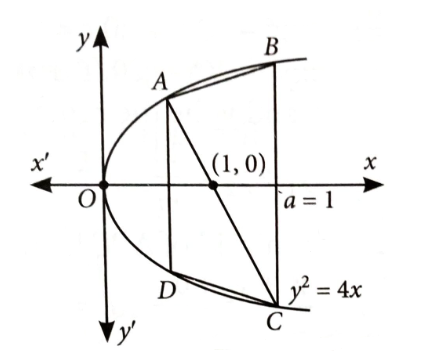
Let \(A B C D\) be a trapezium whose vertices lie on the parabola \(y^2=4 x\). Let the sides \(A D\) and \(B C\) of the trapezium be parallel to \(y\)-axis. If the diagonal \(A C\) is of length \(\frac{25}{4}\) and it passes through the point \((1,0)\), then the area of \(A B C D\) is [JEE Main 2025 (Online) 28th January Morning Shift]
CorrectIncorrectHint
(d)

Let \(A\left(a t_1^2, 2 a t_1\right)\) and \(C\left(\frac{a}{t_1^2}, \frac{-2 a}{t_1}\right)\) be the points lies on parabola \(y^2=4 x\).
∴ Length of \(A C=a\left(t_1+\frac{1}{t_1}\right)^2=\frac{25}{4}\) (Given)
\(
\Rightarrow \quad t_1+\frac{1}{t_1}= \pm \frac{5}{2}
\)
So, \(A\left(\frac{1}{4}, 1\right), \quad B(4,4), \quad C(4,-4)\) and \(D\left(\frac{1}{4},-1\right)\)
∴ The area of trapezium \(A B C D=\frac{1}{2}(8+2)\left(4-\frac{1}{4}\right)=\frac{75}{4}\).Explanation: To solve for the area of the trapezium \(A B C D\), we will utilize the properties of the parabola and the specific geometric constraints given.
Step 1: Coordinate Geometry of the Vertices
The vertices \(A, B, C\), and \(D\) lie on \(y^2=4 x\). Let the coordinates of the points be:
\(A=\left(t_1^2, 2 t_1\right)\)
\(C=\left(t_2^2, 2 t_2\right)\)
Since \(A D\) and \(B C\) are parallel to the \(y\)-axis, the \(x\)-coordinates of \(A\) and \(D\) must be the same, and the \(x\)-coordinates of \(B\) and \(C\) must be the same.
\(D=\left(t_1^2,-2 t_1\right)\)
\(B=\left(t_2^2,-2 t_2\right)\)
Step 2: Use the Condition that \(A C\) passes through \((1,0)\)
The point (1,0) is the focus \(S\) of the parabola \(y^2=4 x\) (where \(a=1\)). If a chord \(A C\) passes through the focus, it is a focal chord. For a focal chord with parameters \(t_1\) and \(t_2\), we have the property:
\(
t_1 t_2=-1
\)
Step 3: Length of the Focal Chord \(A C\)
The length of a focal chord for \(y^2=4 a x\) is given by \(a\left(t+\frac{1}{t}\right)^2\), or simply \(x_A+x_C+2 a\). Given \(A C=\frac{25}{4}\) and \(a=1\) :
\(
\begin{gathered}
\frac{25}{4}=t_1^2+t_2^2+2 \\
t_1^2+t_2^2=\frac{25}{4}-2=\frac{17}{4}
\end{gathered}
\)
We also know \(t_2=-\frac{1}{t_1}\), so:
\(
t_1^2+\frac{1}{t_1^2}=\frac{17}{4}
\)
By observation or solving the quadratic \(\left(t_1^2\right)^2-\frac{17}{4} t_1^2+1=0\), we find:
\(
t_1^2=4 \quad \text { and } \quad t_2^2=\frac{1}{4}
\)
This gives \(t_1=2\) and \(t_2=-\frac{1}{2}\) (or vice versa).
Step 4: Determine the Coordinates
Using \(t_1^2=4\) and \(t_2^2=\frac{1}{4}\) :
\(x_A=4, y_A=2(2)=4 \Longrightarrow A(4,4), D(4,-4)\)
\(x_C=\frac{1}{4}, \quad y_C=2\left(-\frac{1}{2}\right)=-1 \Longrightarrow C\left(\frac{1}{4},-1\right), B\left(\frac{1}{4}, 1\right)\)
Step 5: Calculate the Area of Trapezium \(A B C D\)
The parallel sides are \(A D\) and \(B C\) (both vertical).
Length of \(A D=|4-(-4)|=8\)
Length of \(B C=|1-(-1)|=2\)
Height \((h)=\) Distance between \(x=4\) and \(x=\frac{1}{4}: h=4-\frac{1}{4}=\frac{15}{4}\)
\(
\begin{gathered}
\text { Area }=\frac{1}{2} \times(\text { sum of parallel sides }) \times h \\
\text { Area }=\frac{1}{2} \times(8+2) \times \frac{15}{4} \\
\text { Area }=\frac{1}{2} \times 10 \times \frac{15}{4}=5 \times \frac{15}{4}=\frac{75}{4}
\end{gathered}
\) - Question 16 of 20
16. Question
If the equation of the parabola with vertex \(\mathrm{V}\left(\frac{3}{2}, 3\right)\) and the directrix \(x+2 y=0\) is \(\alpha x^2+\beta y^2-\gamma x y-30 x-60 y+225=0\), then \(\alpha+\beta+\gamma\) is equal to: [JEE Main 2025 (Online) 24th January Evening Shift]
CorrectIncorrectHint
(d) To find the value of \(\alpha+\beta+\gamma\), we first need to derive the equation of the parabola using its fundamental definition: the distance of any point \(P(x, y)\) on the parabola from the focus is equal to its perpendicular distance from the directrix.
Step 1: Find the Focus \(S\)
The vertex \(V\) is the midpoint between the focus \(S\) and the point \(M\) where the axis of the parabola intersects the directrix.
Axis Equation: The axis is perpendicular to the directrix \(x+2 y=0\) (slope \(m_d=-1 / 2\)) and passes through the vertex \(V(3 / 2,3)\).
Slope of axis \(m_a=2\).
Equation: \(y-3=2(x-3 / 2) \Longrightarrow y-3=2 x-3 \Longrightarrow y=2 x\).
Intersection Point \(M\) : Solve \(x+2 y=0\) and \(y=2 x\).
\(x+2(2 x)=0 \Longrightarrow 5 x=0 \Longrightarrow x=0, y=0\). So, \(M=(0,0)\).
Focus \(S(h, k)\) : Since \(V\) is the midpoint of \(S M\) :
\(\frac{h+0}{2}=\frac{3}{2} \Longrightarrow h=3\)
\(\frac{k+0}{2}=3 \Longrightarrow k=6\)
Focus \(S=(3,6)\).
Step 2: Apply the Parabola Definition
A point \(P(x, y)\) on the parabola satisfies \(P S^2=P M^2\), where \(P M\) is the distance to \(x+ 2 y=0\).
\(
\begin{gathered}
(x-3)^2+(y-6)^2=\left(\frac{|x+2 y|}{\sqrt{1^2+2^2}}\right)^2 \\
\left(x^2-6 x+9\right)+\left(y^2-12 y+36\right)=\frac{(x+2 y)^2}{5}
\end{gathered}
\)
Step 3: Expand and Simplify
Multiply the entire equation by 5 :
\(
\begin{gathered}
5\left(x^2+y^2-6 x-12 y+45\right)=x^2+4 y^2+4 x y \\
5 x^2+5 y^2-30 x-60 y+225=x^2+4 y^2+4 x y
\end{gathered}
\)
Rearrange to match the given form \(\alpha x^2+\beta y^2-\gamma x y-30 x-60 y+225=0\) :
\(
\begin{gathered}
(5-1) x^2+(5-4) y^2-4 x y-30 x-60 y+225=0 \\
4 x^2+1 y^2-4 x y-30 x-60 y+225=0
\end{gathered}
\)
Step 4: Identify Coefficients and Calculate Sum
Comparing this to the given equation:
\(\alpha=4\)
\(\beta=1\)
\(\gamma=4\) (since the term is \(-\gamma x y\), and we have \(-4 x y\) )
\(
\alpha+\beta+\gamma=4+1+4=9
\) - Question 17 of 20
17. Question
Let the shortest distance from \((a, 0), a>0\), to the parabola \(y^2=4 x\) be 4. Then the equation of the circle passing through the point \((a, 0)\) and the focus of the parabola, and having its centre on the axis of the parabola is : [JEE Main 2025 (Online) 23rd January Evening Shift]
CorrectIncorrectHint
(b) To solve this, we need to find the value of \(a\) using the shortest distance property, then determine the equation of the circle based on the given geometric constraints.

Step 1: Find the shortest distance from \((a, 0)\) to \(y^2=4 x\)
For the parabola \(y^2=4 x\), we have \(a_{\text {parabola }}=1\) and focus \(S(1,0)\). The shortest distance from a point on the axis to the parabola occurs along the normal to the parabola.
Let a point on the parabola be \(P\left(t^2, 2 t\right)\). The square of the distance \(D\) from \((a, 0)\) to \(P\) is:
\(
D^2=\left(t^2-a\right)^2+(2 t-0)^2=t^4-2 a t^2+a^2+4 t^2=t^4+(4-2 a) t^2+a^2
\)
To find the minimum, we differentiate with respect to \(t^2\) :
\(
\frac{d\left(D^2\right)}{d\left(t^2\right)}=2\left(t^2\right)+(4-2 a)
\)
Setting this to zero gives \(t^2=a-2\).
Case 1: If \(a \leq 2, t^2\) cannot be negative, so the minimum distance is at \(t=0\) (the vertex). The distance would be \(a\). If \(a=4\), this is a valid distance, but we must check Case 2 .
Case 2: If \(a>2\), the minimum occurs at \(t^2=a-2\). Substituting \(t^2=a-2\) into the \(D^2\) equation:
\(
\begin{gathered}
D^2=(a-2)^2+(4-2 a)(a-2)+a^2 \\
D^2=(a-2)^2-2(a-2)^2+a^2=a^2-(a-2)^2=a^2-\left(a^2-4 a+4\right)=4 a-4
\end{gathered}
\)
Given the shortest distance is 4 , so \(D^2=16\) :
\(
4 a-4=16 \Longrightarrow 4 a=20 \Longrightarrow a=5
\)
Since \(5>2\), this value is consistent with our assumption.
Step 2: Identify Circle Properties
We now need the equation of a circle that:
Passes through \((a, 0)=(5,0)\).
Passes through the focus \(S(1,0)\).
Has its center on the axis of the parabola (the \(x\)-axis, \(y=0\)).
Since the two points \((5,0)\) and \((1,0)\) both lie on the \(x\)-axis, and the center also lies on the \(x\) axis, the segment connecting these two points must be a diameter of the circle (or a chord whose perpendicular bisector is the axis, but since both points are on the axis itself, the center must be the midpoint to satisfy the “passing through” condition).
Center: Midpoint of \((1,0)\) and \((5,0)=\left(\frac{1+5}{2}, 0\right)=(3,0)\).
Radius: Distance from \((3,0)\) to \((5,0)=2\).
Step 2: Identify Circle Properties
We now need the equation of a circle that:
Passes through \((a, 0)=(5,0)\).
Passes through the focus \(S(1,0)\).
Has its center on the axis of the parabola (the \(x\)-axis, \(y=0\)).
Since the two points \((5,0)\) and \((1,0)\) both lie on the \(x\)-axis, and the center also lies on the \(x\) axis, the segment connecting these two points must be a diameter of the circle (or a chord whose perpendicular bisector is the axis, but since both points are on the axis itself, the center must be the midpoint to satisfy the “passing through” condition).
Center: Midpoint of \((1,0)\) and \((5,0)=\left(\frac{1+5}{2}, 0\right)=(3,0)\).
Radius: Distance from \((3,0)\) to \((5,0)=2\).
Step 3: Derive the Circle Equation
Using the center \((3,0)\) and radius \(r=2\) :
\(
\begin{gathered}
(x-3)^2+(y-0)^2=2^2 \\
x^2-6 x+9+y^2=4 \\
x^2+y^2-6 x+5=0
\end{gathered}
\) - Question 18 of 20
18. Question
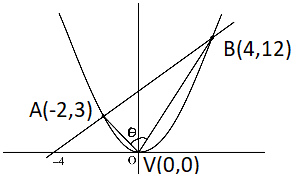
If the line \(3 x-2 y+12=0\) intersects the parabola \(4 y=3 x^2\) at the points \(A\) and \(B\), then at the vertex of the parabola, the line segment AB subtends an angle equal to [JEE Main 2025 (Online) 23rd January Morning Shift]
CorrectIncorrectHint
(b)

To find the angle subtended by the chord \(A B\) at the vertex of the parabola, we will first determine the coordinates of \(A\) and \(B\) and then use the slopes of the lines connecting them to the vertex.
Step 1: Find the Intersection Points \(A\) and \(B\)
The given equations are:
Line: \(3 x-2 y+12=0 \Longrightarrow 2 y=3 x+12\)
Parabola: \(4 y=3 x^2\)
We can substitute \(2 y\) from the line equation into the parabola equation. Multiplying the line equation by 2 gives \(4 y=6 x+24\). Now, equate it to the parabola:
\(
\begin{gathered}
3 x^2=6 x+24 \\
3 x^2-6 x-24=0
\end{gathered}
\)
Dividing by 3:
\(
\begin{gathered}
x^2-2 x-8=0 \\
(x-4)(x+2)=0
\end{gathered}
\)
This gives the \(x\)-coordinates \(x_1=4\) and \(x_2=-2\). Now find the corresponding \(y\)-coordinates using \(4 y=3 x^2\) :
For \(x_1=4\) : \(4 y=3(16) \Longrightarrow y=12\). So, \(A=(4,12)\).
For \(x_2=-2: 4 y=3(4) \Longrightarrow y=3\). So, \(B=(-2,3)\).
Step 2: Identify the Vertex and Slopes
The parabola \(4 y=3 x^2\) is in the form \(x^2=\frac{4}{3} y\), so its vertex \(V\) is at ( 0,0 ).
Now, calculate the slopes of the lines \(V A\) and \(V B\) :
Slope of VA (\(m_1\)):
\(
m_1=\frac{y_A-y_V}{x_A-x_V}=\frac{12-0}{4-0}=3
\)
Slope of VB (\(m_2\)):
\(
m_2=\frac{y_B-y_V}{x_B-x_V}=\frac{3-0}{-2-0}=-\frac{3}{2}
\)
Step 3: Calculate the Angle \(\theta\)
The angle \(\theta\) subtended at the vertex is the angle between lines \(V A\) and \(V B\). We use the formula:
\(
\tan \theta=\left|\frac{m_1-m_2}{1+m_1 m_2}\right|
\)
Substitute the values:
\(
\begin{gathered}
\tan \theta=\left|\frac{3-(-3 / 2)}{1+(3)(-3 / 2)}\right| \\
\tan \theta=\left|\frac{3+1.5}{1-4.5}\right|=\left|\frac{4.5}{-3.5}\right|=\left|\frac{9 / 2}{-7 / 2}\right|=\frac{9}{7}
\end{gathered}
\)
Therefore:
\(
\theta=\tan ^{-1}\left(\frac{9}{7}\right)
\)
The line segment \(A B\) subtends an angle of \(\tan ^{-1}\left(\frac{9}{7}\right)\) at the vertex. - Question 19 of 20
19. Question
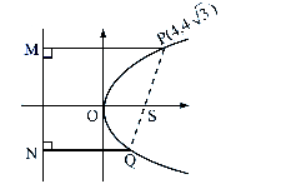
Let \(\mathrm{P}(4,4 \sqrt{3})\) be a point on the parabola \(y^2=4 \mathrm{a} x\) and PQ be a focal chord of the parabola. If M and N are the foot of perpendiculars drawn from P and Q respectively on the directrix of the parabola, then the area of the quadrilateral \(P Q M N\) is equal to : [JEE Main 2025 (Online) 22nd January Evening Shift]
CorrectIncorrectHint
(b)

To solve for the area of the quadrilateral \(P Q M N\), we need to find the coordinates of the points \(P, Q, M\), and \(N\) and recognize the geometric shape they form.
Step 1: Find the Parabola Parameter \(a\)
The point \(P(4,4 \sqrt{3})\) lies on the parabola \(y^2=4 a x\). Substituting these coordinates:
\(
\begin{aligned}
(4 \sqrt{3})^2 & =4 a(4) \\
16 \times 3 & =16 a \\
a & =3
\end{aligned}
\)
Thus, the parabola is \(y^2=12 x\) and the directrix is \(x=-3\).
Step 2: Determine Coordinates of \(Q\)
Let \(P=\left(a t_1^2, 2 a t_1\right)\) and \(Q=\left(a t_2^2, 2 a t_2\right)\). For a focal chord, \(t_1 t_2=-1\).
From \(P(4,4 \sqrt{3})\), we have \(2 a t_1=4 \sqrt{3} \Longrightarrow 6 t_1=4 \sqrt{3} \Longrightarrow t_1=\frac{2 \sqrt{3}}{3}=\frac{2}{\sqrt{3}}\).
Then, \(t_2=-\frac{1}{t_1}=-\frac{\sqrt{3}}{2}\).
The coordinates of \(Q\) are:
\(
\begin{gathered}
x_Q=3\left(-\frac{\sqrt{3}}{2}\right)^2=\frac{9}{4} \\
y_Q=2(3)\left(-\frac{\sqrt{3}}{2}\right)=-3 \sqrt{3}
\end{gathered}
\)
Step 3: Calculate the Area of Quadrilateral PQMN
\(P Q M N\) is a trapezoid where \(P M\) and \(Q N\) are perpendicular to the directrix \(x=-3\), making them parallel.
Length \(P M: x_P-(-a)=4+3=7\)
Length \(Q N: x_Q-(-a)=\frac{9}{4}+3=\frac{21}{4}\)
Height \(h:\left|y_P-y_Q\right|=|4 \sqrt{3}-(-3 \sqrt{3})|=7 \sqrt{3}\)
The area \(A\) is given by:
\(
\begin{gathered}
A=\frac{1}{2}(P M+Q N) \times h \\
A=\frac{1}{2}\left(7+\frac{21}{4}\right) \times 7 \sqrt{3} \\
A=\frac{1}{2}\left(\frac{28+21}{4}\right) \times 7 \sqrt{3}=\frac{1}{2} \times \frac{49}{4} \times 7 \sqrt{3} \\
A=\frac{343 \sqrt{3}}{8}
\end{gathered}
\)
The area of the quadrilateral \(P Q M N\) is \(\frac{343 \sqrt{3}}{8}\). - Question 20 of 20
20. Question
Let the parabola \(y=x^2+\mathrm{p} x-3\), meet the coordinate axes at the points \(\mathrm{P}, \mathrm{Q}\) and \(R\). If the circle C with centre at \((-1,-1)\) passes through the points \(P, Q\) and \(R\), then the area of \(\triangle P Q R\) is : [JEE Main 2025 (Online) 22nd January Morning Shift]
CorrectIncorrectHint
(b) To solve for the area of \(\triangle P Q R\), we need to find the value of \(p\) using the property that the three points of intersection lie on a circle with a given center.
Step 1: Identify the Points P, Q, and R
The parabola is given by \(y=x^2+p x-3\).
Intersection with the \(\mathbf{y}\)-axis (Point \(\mathbf{R}\)): Set \(x=0 \Longrightarrow y=-3\). Thus, \(R=(0,-3)\).
Intersection with the \(\mathbf{x}\)-axis (Points \(\mathbf{P}\) and \(\mathbf{Q}\)): Set \(y=0 \Longrightarrow x^2+p x-3=0\). Let the roots of this quadratic be \(x_1\) and \(x_2\). Then \(P=\left(x_1, 0\right)\) and \(Q=\left(x_2, 0\right)\). From the properties of quadratic equations:
\(x_1+x_2=-p\)
\(x_1 x_2=-3\)
Step 2: Use the Circle Property
The circle \(C\) has its center at \(O^{\prime}(-1,-1)\) and passes through \(P, Q\), and \(R\). Therefore, the distance from the center to each point (the radius) must be equal (\(O^{\prime} P=O^{\prime} Q=O^{\prime} R\)).
First, calculate the square of the radius using point \(R(0,-3)\) :
\(
r^2=(0-(-1))^2+(-3-(-1))^2=1^2+(-2)^2=5
\)
Now, apply this to point \(P\left(x_1, 0\right)\) :
\(
\left(x_1-(-1)\right)^2+(0-(-1))^2=5
\)
\(
\begin{gathered}
\left(x_1+1\right)^2+1=5 \Longrightarrow\left(x_1+1\right)^2=4 \\
x_1+1= \pm 2 \\
x_1=1 \text { or } x_1=-3
\end{gathered}
\)
These two values are the roots of the quadratic equation \(x^2+p x-3=0\). Thus, \(x_1=1\) and \(x_2=-3\) (or vice versa). We can verify this: \(x_1 x_2=(1)(-3)=-3\), which matches the constant term in our parabola equation. The sum of roots is \(x_1+x_2=1-3=-2\). Since \(x_1+x_2=-p\), we find \(p=2\).
Step 3: Calculate the Area of \(\triangle P Q R\)
The vertices of the triangle are \(P(1,0), Q(-3,0)\), and \(R(0,-3)\). This is a triangle where the base \(P Q\) lies on the \(x\)-axis.
Length of base \(P Q\) : \(\left|x_1-x_2\right|=|1-(-3)|=4\)
Height (h): The absolute value of the \(y\)-coordinate of point \(R\) : \(|-3|=3\)
\(
\begin{gathered}
\text { Area }=\frac{1}{2} \times \text { base × height } \\
\text { Area }=\frac{1}{2} \times 4 \times 3=6
\end{gathered}
\)
The area of \(\triangle P Q R\) is 6 square units.