JEE Practice Questions:Trigonometric Equations (Single Choice Type)
Quiz Summary
0 of 85 Questions completed
Questions:
Information
You have already completed the quiz before. Hence you can not start it again.
Quiz is loading…
You must sign in or sign up to start the quiz.
You must first complete the following:
Results
Results
0 of 85 Questions answered correctly
Your time:
Time has elapsed
You have reached 0 of 0 point(s), (0)
Earned Point(s): 0 of 0, (0)
0 Essay(s) Pending (Possible Point(s): 0)
Categories
- Not categorized 0%
- 1
- 2
- 3
- 4
- 5
- 6
- 7
- 8
- 9
- 10
- 11
- 12
- 13
- 14
- 15
- 16
- 17
- 18
- 19
- 20
- 21
- 22
- 23
- 24
- 25
- 26
- 27
- 28
- 29
- 30
- 31
- 32
- 33
- 34
- 35
- 36
- 37
- 38
- 39
- 40
- 41
- 42
- 43
- 44
- 45
- 46
- 47
- 48
- 49
- 50
- 51
- 52
- 53
- 54
- 55
- 56
- 57
- 58
- 59
- 60
- 61
- 62
- 63
- 64
- 65
- 66
- 67
- 68
- 69
- 70
- 71
- 72
- 73
- 74
- 75
- 76
- 77
- 78
- 79
- 80
- 81
- 82
- 83
- 84
- 85
- Current
- Review
- Answered
- Correct
- Incorrect
-
Question 1 of 85
1. Question
If \(\sin \theta=\frac{1}{2}\) and \(\cos \theta=-\frac{\sqrt{3}}{2}\), then the general value of \(\theta\) is \((n \in Z)\)
Hint
(a) \(\sin \theta=1 / 2\) and \(\cos \theta=-\sqrt{3} / 2\)
\(\Rightarrow \theta\) lies in the second quadrant.
\(\Rightarrow \sin \theta=\sin 5 \pi / 6 ; \cos \theta=\cos 5 \pi / 6\);
\(\therefore \theta=2 n \pi+(5 \pi / 6)\) -
Question 2 of 85
2. Question
The most general value for which \(\tan \theta=-1, \cos \theta=\frac{1}{\sqrt{2}}\) is \((n \in Z)\)
Hint
(c) Since \(\tan \theta<0\) and \(\cos \theta>0, \theta\) lies in the fourth quadrant. Then \(\theta=7 \pi / 4\).
Hence, the general value of \(\theta\) is \(2 n \pi+7 \pi / 4, n \in Z\). -
Question 3 of 85
3. Question
If \(\cos p \theta+\cos q \theta=0\), then the different values of \(\theta\) are in A.P. where the common difference is
Hint
(c)
\(
\begin{aligned}
&\begin{aligned}
& \cos p \theta=-\cos q \theta=\cos (\pi-q \theta) \\
& \Rightarrow p \theta=2 n \pi \pm(\pi-q \theta) \\
& \Rightarrow \quad(p \mp q) \theta=(2 n \pm 1) \pi \\
& \Rightarrow \quad \theta=\frac{(2 n \pm 1) \pi}{(p \mp q)}, n \in Z \\
& \Rightarrow \quad \theta=\frac{r \pi}{p \pm q}, \text { where } r=-3,-1,1,3, \ldots \\
& \Rightarrow \quad \theta=\cdots, \frac{-3 \pi}{p \pm q}, \frac{-\pi}{p \pm q}, \frac{\pi}{p \pm q}, \frac{3 \pi}{p \pm q}, \cdots
\end{aligned}\\
&\text { Shown above is an A.P. of common difference } \frac{2 \pi}{p \pm q} \text {. }
\end{aligned}
\) -
Question 4 of 85
4. Question
If \(\cos \theta+\cos 7 \theta+\cos 3 \theta+\cos 5 \theta=0\), then \(\theta\) is equal to \((n \in Z)\)
Hint
(d)
\(
\begin{aligned}
&\text { A. }\\
&\begin{aligned}
& (\cos \theta+\cos 7 \theta)+(\cos 3 \theta+\cos 5 \theta)=0 \\
& \Rightarrow 2 \cos 4 \theta(\cos 3 \theta+\cos \theta)=0 \\
& \Rightarrow 4 \cos 4 \theta \cos 2 \theta \cos \theta=0 \\
& \Rightarrow 4 \times \frac{1}{2^3 \sin \theta}\left(\sin 2^3 \theta\right)=0 \\
& \Rightarrow \sin 8 \theta=0 \text { or } \theta=n \pi / 8, n \in Z
\end{aligned}
\end{aligned}
\) -
Question 5 of 85
5. Question
If \(3 \tan ^2 \theta-2 \sin \theta=0\), then \(\theta\) is equal to \((n \in Z)\)
Hint
(b)
\(
\begin{aligned}
& 3 \frac{\sin ^2 \theta}{\cos ^2 \theta}-2 \sin \theta=0, \cos \theta \neq 0 \\
& \Rightarrow 3 \sin ^2 \theta-2 \sin \theta\left(1-\sin ^2 \theta\right)=0 \\
& \Rightarrow \sin \theta\left(2 \sin ^2 \theta+3 \sin \theta-2\right)=0 \\
& \Rightarrow \sin \theta(2 \sin \theta-1)(\sin \theta+2)=0 \\
& \Rightarrow \sin \theta=0,1 \\
& \Rightarrow \theta=n \pi, n \pi+(-1)^n(\pi / 6), n \in Z
\end{aligned}
\) -
Question 6 of 85
6. Question
If \(\sin \theta, 1, \cos 2 \theta\) are in G.P., then \(\theta\) is equal to \((n \in Z)\)
Hint
(b)
\(
\begin{aligned}
&\text { We have } 1^2=\sin \theta \cos 2 \theta\\
&\begin{aligned}
& \Rightarrow \quad 1-\sin \theta\left(1-2 \sin ^2 \theta\right)=0 \\
& \Rightarrow \quad 2 \sin ^3 \theta-\sin \theta+1=0 \\
& \Rightarrow \quad(\sin \theta+1)\left(2 \sin ^2 \theta-2 \sin \theta+1\right)=0 \\
& \Rightarrow \quad \sin \theta=-1
\end{aligned}
\end{aligned}
\)
\(
\begin{aligned}
&\text { The other factor gives imaginary roots. }\\
&\Rightarrow \quad \theta=n \pi+(-1)^n\left(-\frac{\pi}{2}\right)=n \pi-(-1)^n \frac{\pi}{2}=n \pi+(-1)^{n-1} \frac{\pi}{2}, n \in Z .
\end{aligned}
\) -
Question 7 of 85
7. Question
The sum of all the solutions of the equation \(\cos \theta \cos \left(\frac{\pi}{3}+\theta\right) \cos \left(\frac{\pi}{3}-\theta\right)=\frac{1}{4}, \theta \in[0,6 \pi]\)
Hint
(b)
\(
\begin{aligned}
& 2 \cos \theta\left[\cos 120^{\circ}+\cos 2 \theta\right]=1 \\
& \Rightarrow 2 \cos \theta\left(-\frac{1}{2}+2 \cos ^2 \theta-1\right)=1 \\
& \Rightarrow 4 \cos ^3 \theta-3 \cos \theta-1=0 \\
& \Rightarrow \cos 3 \theta=1=\cos 0 \\
& \Rightarrow 3 \theta=2 n \pi \text { or } \theta=\frac{2 n \pi}{3}, n \in Z
\end{aligned}
\)
Given the values so that \(2 n\) does not exceed 18 .
\(
\therefore \quad n=0,1,2,3, \ldots, 9
\)
Hence, the sum \(=\frac{2 \pi}{3} \sum_1^9 n=\frac{2 \pi}{3} \times \frac{9(9+1)}{2}=30 \pi\). -
Question 8 of 85
8. Question
If \(\sec \theta-1=(\sqrt{2}-1) \tan \theta\), then \(\theta\) is equal to \((n \in Z)\)
Hint
(b)
\(
\begin{aligned}
& \sec \theta-1=(\sqrt{2}-1) \tan \theta \Rightarrow \frac{1-\cos \theta}{\cos \theta}=\frac{(\sqrt{2}-1) \sin \theta}{\cos \theta} \\
& \Rightarrow 2 \sin ^2(\theta / 2)=(-\sqrt{2}-1) 2 \sin (\theta / 2) \cos (\theta / 2) \\
& \Rightarrow \sin (\theta / 2)=0 \text { or } \tan (\theta / 2)=(\sqrt{2}-1)=\tan (\pi / 8) \\
& \Rightarrow \theta / 2=n \pi \text { or } \theta / 2=n \pi+(\pi / 8), n \in Z \\
& \Rightarrow \theta=2 n \pi \text { or } \theta=2 n \pi+(\pi / 4), n \in Z
\end{aligned}
\) -
Question 9 of 85
9. Question
The total number of solution of \(\sin ^4 x+\cos ^4 x=\sin x \cos x\) in \([0,2 \pi]\) is equal to
Hint
(a)
\(
\begin{aligned}
& \sin ^4 x+\cos ^4 x=\sin x \cos x \\
& \Rightarrow\left(\sin ^2 x+\cos ^2 x\right)^2-2 \sin ^2 x \cos ^2 x=\sin x \cos x \\
& \Rightarrow 1-\frac{\sin ^2 2 x}{2}=\frac{\sin 2 x}{2} \\
& \Rightarrow \sin ^2 2 x+\sin 2 x-2=0 \\
& \Rightarrow(\sin 2 x+2)(\sin 2 x-1)=0 \\
& \Rightarrow \sin 2 x=1
\end{aligned}
\)
\(
\begin{aligned}
&\begin{aligned}
\Rightarrow \quad 2 x & =(4 n+1) \frac{\pi}{2}, n \in Z \\
\Rightarrow \quad x & =(4 n+1) \frac{\pi}{4}, n \in Z \\
& =\frac{\pi}{4}, \frac{5 \pi}{4}(\because x \in[0,2 \pi])
\end{aligned}\\
&\text { Thus, there are two solutions. }
\end{aligned}
\) -
Question 10 of 85
10. Question
Number of solutions of \(\sin 5 x+\sin 3 x+\sin x=0\) for \(0 \leq x \leq \pi\) is
Hint
(c)
\(
\begin{aligned}
&\begin{aligned}
& \sin 3 x+(\sin 5 x+\sin x)=0 \\
& \Rightarrow \sin 3 x+(2 \sin 3 x \cos 2 x)=0 \\
& \Rightarrow \sin 3 x=0 \text { or } \cos 2 x=-\frac{1}{2}=\cos \frac{2 \pi}{3} \\
& \Rightarrow x=n \pi / 3 \text { or } x=n \pi \pm \pi / 3, n \in Z
\end{aligned}\\
&\text { Then } x=0, \pi / 3 \text {, and } 2 \pi / 3 \text {, Hence, there are three solutions. }
\end{aligned}
\) -
Question 11 of 85
11. Question
The sum of all the solution of \(\cot \theta=\sin 2 \theta,(\theta \neq n \pi, n\) integer \(), 0 \leq \theta \leq \pi\) is
Hint
(a) From the given relation
\(
\begin{aligned}
& \cos \theta=(2 \sin \theta \cos \theta) \sin \theta, \sin \theta \neq 0 \\
& \Rightarrow \sin \theta= \pm \frac{1}{\sqrt{2}} \text { or } \cos \theta=0 \\
& \Rightarrow \quad \theta=\frac{\pi}{4}, \frac{3 \pi}{4}, \frac{\pi}{2}(\because \theta \in[0, \pi])
\end{aligned}
\)
Then the sum of roots is \(\frac{3 \pi}{2}\). -
Question 12 of 85
12. Question
The number of solutions of \(12 \cos ^3 x-7 \cos ^2 x+4 \cos x=9\) is
Hint
(c) The given equation is \((\cos x-1)\left(12 \cos ^2 x+5 \cos x+9\right)=0\) \(\Rightarrow \cos x=1\) only as the other factor gives imaginary roots
\(
=1 \Rightarrow x=2 n \pi, n \in Z
\)
Hence, it has infinite solutions as \(n \in Z\). -
Question 13 of 85
13. Question
Which of the following is not the general solution of \(2^{\cos 2 x}+1=3.2^{-\sin ^2 x}\)?
Hint
(d)
\(
\begin{aligned}
& \cos 2 x=1-2 \sin ^2 x \text { and put } 2^{-\sin ^2 x}=t \\
& \Rightarrow 2^{\cos 2 x}=2^{1-2 \sin ^2 x}=2\left(2^{-\sin ^2 x}\right)^2=2 t^2 \\
& \Rightarrow 2 t^2-3 t+1=0 \\
& \Rightarrow t=1,1 / 2 \\
& \Rightarrow 2^{-\sin ^2 x}=1=2^0 \\
& \Rightarrow \sin ^2 x=0 \text { or } x=n \pi, n \in Z \\
& \text { From } 2^{-\sin ^2 x}=\frac{1}{2}=2^{-1}, \text { we get } \\
& \sin ^2 x=1 \text { or } x=n \pi \pm \frac{\pi}{2}, n \in Z
\end{aligned}
\) -
Question 14 of 85
14. Question
The general solution of \(\cos x \cos 6 x=-1\) is
Hint
(a)
\(
\begin{aligned}
& \cos x \cos 6 x=-1 \\
& \Rightarrow 2 \cos x \cos 6 x=-2 \quad \Rightarrow \cos 7 x+\cos 5 x=-2 \quad \Rightarrow \cos 7 x=-1 \text { and } \cos 5 x=-1
\end{aligned}
\)
The value of \(x\) satisfying these two equations simultaneously and lying between 0 and \(2 \pi\) is \(\pi\). Therefore, the general solution is \(x=2 n \pi+\pi, n \in Z\).
\(
\Rightarrow \quad x=(2 n+1) \pi, n \in Z
\) -
Question 15 of 85
15. Question
The equation \(\cos x+\sin x=2\) has
Hint
(c) This is possible only when \(\sin x=\cos x=1\), which does not hold simultaneously. Hence, there is no solution.
-
Question 16 of 85
16. Question
If \(0 \leq x \leq 2 \pi\), then the number of solutions of \(3(\sin x+\cos x)-2\left(\sin ^3 x+\cos ^3 x\right)=8\) is
Hint
(a) The given equation is \(3(\sin x+\cos x)-2(\sin x+\cos x)(1-\sin x \cos x)=8\)
\(
\begin{aligned}
& \Rightarrow \quad(\sin x+\cos x)[3-2+2 \sin x \cos x]=8 \\
& \Rightarrow \quad(\sin x+\cos x)\left[\sin ^2 x+\cos ^2 x+2 \sin x \cos x\right]=8 \\
& \Rightarrow \quad(\sin x+\cos x)^3=8 \\
& \Rightarrow \quad \sin x+\cos x=2
\end{aligned}
\)
Above solution is not possible. Hence, the given equation has no solution. -
Question 17 of 85
17. Question
If \(\frac{1}{6} \sin \theta, \cos \theta, \tan \theta\) are in G.P., then \(\theta\) is equal to \((n \in Z)\)
Hint
(a)
\(
\begin{aligned}
& \cos ^2 \theta=\frac{1}{6} \sin \theta \tan \theta \\
& \Rightarrow 6 \cos ^3 \theta=1-\cos ^2 \theta \\
& \Rightarrow 6 \cos ^3 \theta+\cos ^2 \theta-1=0 \\
& \Rightarrow(2 \cos \theta-1)\left(3 \cos ^2 \theta+2 \cos \theta+1\right)=0
\end{aligned}
\)
\(
\begin{aligned}
&\Rightarrow \cos \theta=\frac{1}{2} \Rightarrow \theta=2 n \pi \pm \frac{\pi}{3}, n \in Z\\
&\text { The other factor gives imaginary roots. }
\end{aligned}
\) -
Question 18 of 85
18. Question
The number of solutions of \(2 \sin ^2 x+\sin ^2 2 x=2, x \in[0,2 \pi]\) is
Hint
(c)
\(
\begin{aligned}
&\begin{aligned}
& (1-\cos 2 x)+\left(1-\cos ^2 2 x\right)=2 \\
& \Rightarrow \cos 2 x(\cos 2 x+1)=0 \\
& \Rightarrow \cos 2 x=0 \text { or } \cos 2 x=-1 \\
& \Rightarrow 2 x=(2 n+1) \pi / 2 \text { or } 2 x=(2 n \pm 1) \pi, n \in Z \\
& \Rightarrow x=(2 n+1) \pi / 4 \text { or } x=(2 n \pm 1) \pi / 2, n \in Z
\end{aligned}\\
&\text { Hence, the solutions are } \pi / 4,3 \pi / 4,5 \pi / 4,7 \pi / 4, \pi / 2,3 \pi / 2 \text {. }
\end{aligned}
\) -
Question 19 of 85
19. Question
General solution of \(\sin ^2 x-5 \sin x \cos x-6 \cos ^2 x=0\) is
Hint
(c) Dividing the given equation by \(\cos ^2 x\), as \(\cos x=0\) does not satisfy the equation, we have
\(
\begin{aligned}
& \tan ^2 x-5 \tan x-6=0 \\
& \Rightarrow(\tan x+1)(\tan x-6)=0 \\
& \Rightarrow \tan x=-1 \text { or } \tan x=6
\end{aligned}
\)
If \(\tan x=-1=\tan (-\pi / 4)\), then \(x=n \pi-\pi / 4, \forall n \in Z\)
and, if \(\tan x=6=\tan \alpha\) (say)
\(
\Rightarrow \quad \alpha=\tan ^{-1} 6, \text { then } x=n \pi+\alpha=n \pi+\tan ^{-1} 6, \forall n \in Z
\)
Hence, \(x=n \pi-(\pi / 4), n \pi+\tan ^{-1} 6, n \in Z\). -
Question 20 of 85
20. Question
General solution of \(\tan \theta+\tan 4 \theta+\tan 7 \theta=\tan \theta \tan 4 \theta \tan 7 \theta\) is
Hint
(d)
\(
\begin{aligned}
&\text { From the given equation, we have } \frac{\tan \theta+\tan 4 \theta}{1-\tan \theta \tan 4 \theta}=-\tan 7 \theta\\
&\begin{aligned}
& \Rightarrow \tan (\theta+4 \theta)=-\tan 7 \theta \\
& \Rightarrow \tan 5 \theta=\tan (-7 \theta) \\
& \Rightarrow 5 \theta=n \pi-7 \theta \\
& \Rightarrow \theta=n \pi / 12, \text { where } n \in Z, \text { but } n \neq 6,18,30, \ldots
\end{aligned}
\end{aligned}
\) -
Question 21 of 85
21. Question
The number of solutions of \(\sec ^2 \theta+\operatorname{cosec}^2 \theta+2 \operatorname{cosec}^2 \theta=8,0 \leq \theta \leq \pi / 2\) is
Hint
(d) We have \(\frac{1}{\sin ^2 \theta \cos ^2 \theta}+\frac{2}{\sin ^2 \theta}=8, \sin \theta \neq 0, \cos \theta \neq 0\)
\(
\begin{aligned}
& \Rightarrow 1+2 \cos ^2 \theta=8 \sin ^2 \theta \cos ^2 \theta=8 \cos ^2 \theta\left(1-\cos ^2 \theta\right) \\
& \Rightarrow 8 \cos ^4 \theta-6 \cos ^2 \theta+1=0 \\
& \Rightarrow\left(4 \cos ^2 \theta-1\right)\left(2 \cos ^2 \theta-1\right)=0 \\
& \Rightarrow \cos ^2 \theta=1 / 4=\cos ^2(\pi / 3) \text { or } \cos ^2 \theta=1 / 2=\cos ^2(\pi / 4) \\
& \Rightarrow \theta=n \pi \pm(\pi / 3) \text { or } \theta=n \pi \pm(\pi / 4), n \in Z
\end{aligned}
\)
Hence, for \(0 \leq \theta \leq \pi / 2, \theta=\pi / 3, \theta=\pi / 4\) -
Question 22 of 85
22. Question
The total number of solutions of \(\tan x+\cot x=2 \operatorname{cosec} x\) in \([-2 \pi, 2 \pi]\) is
Hint
(b)
\(
\begin{aligned}
& \tan x+\cot x=2 \operatorname{cosec} x \\
& \Rightarrow \frac{\sin x}{\cos x}+\frac{\cos x}{\sin x}=\frac{2}{\sin x} \\
& \Rightarrow \frac{1}{\sin x \cos x}=\frac{2}{\sin x} \\
& \Rightarrow \cos x=\frac{1}{2}
\end{aligned}
\)
\(
\begin{aligned}
&\Rightarrow \quad x= \pm \frac{\pi}{3}, \pm \frac{5 \pi}{3}\\
&\text { Thus, there are four solutions. }
\end{aligned}
\) -
Question 23 of 85
23. Question
Which of the following is true for \(z=(3+2 i \sin \theta) /(1-2\) i \(\sin \theta)\), where \(i=\sqrt{-1}\)
Hint
(c)
\(
\text { Let } Z=\frac{3+2 i \sin \theta}{1-2 i \sin \theta}=\frac{(3+2 i \sin \theta)(1+2 i \sin \theta)}{(1-2 i \sin \theta)(1+2 i \sin \theta)}=\frac{\left(3-4 \sin ^2 \theta\right)+8 i \sin \theta}{1+4 \sin ^2 \theta}
\)
Therefore, the real part of \(Z=\frac{3-4 \sin ^2 \theta}{1+4 \sin ^2 \theta}\) and the imaginary part of \(Z=\frac{8 \sin \theta}{1+4 \sin ^2 \theta}\).
\(Z\) is real, if imaginary part \(=\frac{8 \sin \theta}{1+4 \sin ^2 \theta}=0\) or \(\sin \theta=0\) or \(\theta=n \pi, \forall n \in I\)
\(Z\) is purely imaginary, if real part \(\left(3-4 \sin ^2 \theta\right) /\left(1+4 \sin ^2 \theta\right)=0\)
or \(\sin ^2 \theta=3 / 4=\sin ^2(\pi / 3)\) or \(\theta=n \pi \pm \pi / 3, \forall n \in I\) -
Question 24 of 85
24. Question
Number of roots of \(\cos ^2 x+\frac{\sqrt{3}+1}{2} \sin x-\frac{\sqrt{3}}{4}-1=0\) which liẹ in the interval \([-\pi, \pi]\) is
Hint
(b)
\(
\begin{aligned}
&\begin{aligned}
& 1-\sin ^2 x+\frac{\sqrt{3}+1}{2} \sin x-\frac{\sqrt{3}}{4}-1=0 \\
& \Rightarrow \sin ^2 x-\frac{\sqrt{3}+1}{2} \cdot \sin x+\frac{\sqrt{3}}{4}=0 \\
& \Rightarrow 4 \sin ^2 x-2 \sqrt{3} \sin x-2 \sin x+\sqrt{3}=0
\end{aligned}\\
&\text { On solving, we get } \sin x=1 / 2, \sqrt{3} / 2 \text {. }\\
&\Rightarrow x=\pi / 6,5 \pi / 6 ; \pi / 3,2 \pi / 3
\end{aligned}
\) -
Question 25 of 85
25. Question
The complete solution of \(7 \cos ^2 x+\sin x \cos x-3=0\) is given by
Hint
(d) Since, \(7 \cos ^2 x+\sin x \cos x-3=0\), Dividing the equation by \(\cos ^2 x\), we get
\(
\begin{aligned}
& 7+\tan x-3 \sec ^2 x=0 \\
& \Rightarrow \quad 7+\tan x-3\left(1+\tan ^2 x\right)=0 \\
& \Rightarrow \quad 3 \tan ^2 x-\tan x-4=0 \\
& \Rightarrow \quad(\tan x+1)(3 \tan x-4)=0 \\
& \Rightarrow \quad \tan x=-1 \text { or } \tan x=\frac{4}{3} \\
& \Rightarrow \quad x=n \pi+\frac{3 \pi}{4} \text { or } x=k \pi+\tan ^{-1}\left(\frac{4}{3}\right), \text { where }(k, n \in Z)
\end{aligned}
\) -
Question 26 of 85
26. Question
Let \(\theta \in[0,4 \pi]\) satisfy the equation \((\sin \theta+2)(\sin \theta+3)(\sin \theta+4)=6\). If the sum of all the values of \(\theta\) is of the form \(k \pi\), then the value of \(k\) is
Hint
(b)
\(
\begin{aligned}
& (\sin \theta+2)(\sin \theta+3)(\sin \theta+4)=6 \\
& \text { L.H.S. }>6 \text { and R.H.S. } 6
\end{aligned}
\)
Therefore, equality only holds if \(\sin \theta=-1 \Rightarrow \theta=3 \pi / 2,7 \pi / 2\)
Therefore, sum \(=5 \pi \Rightarrow k=5\) -
Question 27 of 85
27. Question
If the inequality \(\sin ^2 x+a \cos x+a^2>1+\cos x\) holds for any \(x \in R\), then the largest negative integral value of \(a\) is
Hint
(b)
\(
\begin{aligned}
& \sin ^2 x+a \cos x+a^2>1+\cos x \\
& \text { Putting } x=0, \text { we get } \\
& \Rightarrow a+a^2>2 \\
& \Rightarrow a^2+a-2>0 \\
& \Rightarrow(a+2)(a-1)>0 \\
& \Rightarrow a<-2 \text { or } a>1
\end{aligned}
\)
Therefore, we have the largest negative integral value of \(a=-3\). -
Question 28 of 85
28. Question
The number of solution of \(\sin ^4 x-\cos ^2 x \sin x+2 \sin ^2 x+\sin x=0\) in \(0 \leq x \leq 3 \pi\) is
Hint
(b)
\(
\begin{aligned}
&\begin{aligned}
& \sin ^4 x-\cos ^2 x \sin x+2 \sin ^2 x+\sin x=0 \\
& \Rightarrow \sin x\left[\sin ^3 x-\cos ^2 x+2 \sin x+1\right]=0 \\
& \Rightarrow \sin x\left[\sin ^3 x-1+\sin ^2 x+2 \sin x+1\right]=0 \\
& \Rightarrow \sin x\left[\sin ^3 x+\sin ^2 x+2 \sin x\right]=0 \\
& \Rightarrow \sin ^2 x=0 \text { or } \sin ^2 x+\sin x+2=0 \text { (not possible for real } x \text { ) } \\
& \Rightarrow \sin x=0
\end{aligned}\\
&\text { Hence, the solutions are } x=0, \pi, 2 \pi, 3 \pi \text {. }
\end{aligned}
\) -
Question 29 of 85
29. Question
If \(x, y \in[0,2 \pi]\) and \(\sin x+\sin y=2\), then the value of \(x+y\) is
Hint
(a) Since, \(x \in[0,2 \pi]\) and \(y \in[0,2 \pi]\), and \(\sin x+\sin y=2\)
This is possible only, when \(\sin x=1\) and \(\sin y=1\) \(\Rightarrow x=\pi / 2\) and \(y=\pi / 2\)
Hence, \(x+y=\pi\). -
Question 30 of 85
30. Question
For \(n \in Z\), the general solution of \((\sqrt{3}-1) \sin \theta+(\sqrt{3}+1) \cos \theta=2\) is \((n \in Z)\)
Hint
(a)
\(
\begin{aligned}
& (\sqrt{3}-1) \sin \theta+(\sqrt{3}+1) \cos \theta=2 \\
& \Rightarrow \frac{(\sqrt{3}-1)}{2 \sqrt{2}} \sin \theta+\left(\frac{\sqrt{3}+1}{2 \sqrt{2}}\right) \cos \theta=\frac{1}{\sqrt{2}} \\
& \Rightarrow \sin \frac{\pi}{12} \sin \theta+\cos \frac{\pi}{12} \cos \theta=\cos \frac{\pi}{4} \\
& \Rightarrow \cos \left(\theta-\frac{\pi}{12}\right)=\cos \frac{\pi}{4} \\
& \Rightarrow \theta-\frac{\pi}{12}=2 n \pi \pm \frac{\pi}{4}, n \in Z \\
& =2 n \pi \pm \frac{\pi}{4}+\frac{\pi}{12}
\end{aligned}
\) -
Question 31 of 85
31. Question
If \(\sin 6 \theta+\sin 4 \theta+\sin 2 \theta=0\), then \(\theta\) is equal to ( \(n \in Z\) )
Hint
(a)
\(
\begin{aligned}
& \sin 6 \theta+\sin 4 \theta+\sin 2 \theta=0 \\
& \Rightarrow(\sin 6 \theta+\sin 2 \theta)+\sin 4 \theta=0 \\
& \Rightarrow 2 \sin 4 \theta \cos 2 \theta+\sin 4 \theta=0 \\
& \Rightarrow \sin 4 \theta(2 \cos 2 \theta+1)=0 \\
& \Rightarrow \sin 4 \theta=0 \text { or } \cos 2 \theta=-\frac{1}{2}=\cos \frac{2 \pi}{3} \\
& \Rightarrow 4 \theta=n \pi \text { or } 2 \theta=2 n \pi \pm \frac{2 \pi}{3}, n \in Z \\
& \Rightarrow \theta=\frac{n \pi}{4} \text { or } \theta=n \pi \pm \frac{\pi}{3}
\end{aligned}
\) -
Question 32 of 85
32. Question
The value of \(\cos y \cos \left(\frac{\pi}{2}-x\right)-\cos \left(\frac{\pi}{2}-y\right) \cos x+\sin y \cos \left(\frac{\pi}{2}-x\right)+\cos x \sin \left(\frac{\pi}{2}-y\right)\) is zero if
Hint
(d)
\(
\begin{aligned}
&\text { The given expression } \cos y \sin x-\sin y \cos x+\sin y \sin x+\cos x \cos y \text { is }\\
&\begin{aligned}
& \sin (x-y)+\cos (x-y) \\
& \therefore \sin (x-y)+\cos (x-y)=0 \\
& \Rightarrow \sqrt{2}\left(\frac{1}{\sqrt{2}} \sin (x-y)+\frac{1}{\sqrt{2}} \cos (x-y)\right)=0 \\
& \Rightarrow \sin \left(x-y+\frac{\pi}{4}\right)=0
\end{aligned}
\end{aligned}
\)
\(
\begin{aligned}
& \Rightarrow \quad \frac{\pi}{4}+x-y=n \pi, n \in Z \\
& \Rightarrow \quad x-y=n \pi-\frac{\pi}{4}, n \in Z \\
& \Rightarrow \quad x=n \pi-\frac{\pi}{4}+y \text { where } n \in Z
\end{aligned}
\) -
Question 33 of 85
33. Question
The number of solution of the equation \(\tan x \tan 4 x=1\) for \(0<x<\pi\) is.
Hint
(c)
\(
\begin{aligned}
&\begin{aligned}
& \tan x \tan 4 x=1 \\
& \Rightarrow \cos 4 x \cos x-\sin 4 x \sin x=0 \\
& \Rightarrow \cos 5 x=0 \\
& \Rightarrow 5 x=\left(n+\frac{1}{2}\right) \pi, n \in Z \\
& \Rightarrow x=\frac{(2 n+1)}{10} \pi ; 0<x<\pi \\
& \quad=\frac{\pi}{10}, \frac{3 \pi}{10}, \frac{5 \pi}{10}, \frac{7 \pi}{10}, \frac{9 \pi}{10}
\end{aligned}\\
&\text { Thus, there are only five solutions. }
\end{aligned}
\) -
Question 34 of 85
34. Question
One root of the equation \(\cos x-x+\frac{1}{2}=0\) lies in the interval
Hint
(a)
\(
\begin{aligned}
&\begin{aligned}
& \text { Let } f(x)=\cos x-x+\frac{1}{2} \\
& \qquad f(0)=1+\frac{1}{2}>0 \\
& f\left(\frac{\pi}{2}\right)=0-\frac{\pi}{2}+\frac{1}{2}=\frac{1-\pi}{2}<0
\end{aligned}\\
&\text { Therefore, one root lies in the interval }\left(0, \frac{\pi}{2}\right) \text {. }
\end{aligned}
\) -
Question 35 of 85
35. Question
\(\tan \left(\frac{p \pi}{4}\right)=\cot \left(\frac{q \pi}{4}\right) \text { if }(n \in Z)\)
Hint
(d)
\(
\begin{aligned}
& \tan \left(\frac{p \pi}{4}\right)=\cot \left(\frac{q \pi}{4}\right)=\tan \left(\frac{\pi}{2}-\frac{q \pi}{4}\right) \\
& \Rightarrow \frac{p \pi}{4}=n \pi+\frac{\pi}{2}-\frac{q \pi}{4} \\
& \Rightarrow \frac{p}{4}=n+\frac{1}{2}-\frac{q}{4} \\
& \Rightarrow \frac{p+q}{4}=\frac{2 n+1}{2} \\
& \Rightarrow p+q=2(2 n+1)
\end{aligned}
\) -
Question 36 of 85
36. Question
The range of \(y\) such that the equation in \(x, y+\cos x=\sin x\) has a real solution is
Hint
(b)
\(
\begin{aligned}
y & =\sin x-\cos x=\sqrt{2}\left[\frac{1}{\sqrt{2}} \sin -\frac{1}{\sqrt{2}} \cos x\right] \\
& =\sqrt{2} \sin \left(x-\frac{\pi}{4}\right) \quad \Rightarrow-\sqrt{2} \leq y \leq \sqrt{2} \quad \Rightarrow \text { Range of } y \text { is }[-\sqrt{2}, \sqrt{2}] .
\end{aligned}
\) -
Question 37 of 85
37. Question
One of the general solutions of \(4 \sin ^4 x+\cos ^4 x=1\) is
Hint
(a)
\(
\begin{aligned}
& 4 \sin ^4 x+\cos ^4 x=1 \\
& \Rightarrow \quad\left(2 \sin ^2 x\right)^2+\frac{1}{4}\left(2 \cos ^2 x\right)^2=1
\end{aligned}
\)
\(
\begin{aligned}
& (1-\cos 2 x)^2+\frac{1}{4}(1+\cos 2 x)^2=i \\
& 5 \cos ^2 2 x-6 \cos 2 x+1=0 \\
& (\cos 2 x-1)(5 \cos 2 x-1)=0
\end{aligned}
\)
\(
\begin{aligned}
& \Rightarrow \quad \cos 2 x=1 \text { or } \cos 2 x=1 / 5 \\
& \Rightarrow \quad 2 x=2 n \pi \text { or } 2 x=2 n \pi \pm \alpha, \text { where } \alpha=\cos ^{-1}(1 / 5), \forall n \in Z
\end{aligned}
\) -
Question 38 of 85
38. Question
Number of roots of \((1-\tan \theta)(1+\sin 2 \theta)=1+\tan \theta\) for \(\theta \in[0,2 \pi]\) is
Hint
(c)
\(
\begin{aligned}
& (1-\tan \theta)\left[1+2 \tan \theta /\left(1+\tan ^2 \theta\right)\right]=1+\tan \theta \\
& \Rightarrow(1-\tan \theta)(1+\tan \theta)^2=(1+\tan \theta)\left(1+\tan ^2 \theta\right) \\
& \Rightarrow(1+\tan \theta)\left[\left(1-\tan ^2 \theta\right)-\left(1+\tan ^2 \theta\right)\right]=0 \\
& \Rightarrow-2 \tan ^2 \theta=0,(1+\tan \theta)=0 \\
& \Rightarrow \tan \theta=0, \text { or } \tan \theta=-1 \\
& \Rightarrow \theta=n \pi \text { or } n \pi-\pi / 4, \forall n \in Z, \text { for } \theta \in[0,2 \pi] \theta=0, \pi, 2 \pi, 3 \pi / 4,7 \pi / 4
\end{aligned}
\) -
Question 39 of 85
39. Question
The number of solutions of \(\sin x+\sin 2 x+\sin 3 x=\cos x+\cos 2 x+\cos 3 x, 0 \leq x \leq 2 \pi\), is
Hint
(d) We have \((\sin x+\sin 3 x)+\sin 2 x=(\cos x+\cos 3 x)+\cos 2 x\)
\(
\begin{aligned}
& \Rightarrow \quad 2 \sin 2 x \cos x+\sin 2 x=2 \cos 2 x \cos x+\cos 2 x \\
& \Rightarrow \quad \sin 2 x(2 \cos x+1)=\cos 2 x(2 \cos x+1) \\
& \Rightarrow \quad(2 \cos x+1)(\sin 2 x-\cos 2 x)=0 \\
& \Rightarrow \quad \cos x=-1 / 2 \text { or } \sin 2 x-\cos 2 x=0 \\
& \Rightarrow \quad x=2 n \pi \pm(2 \pi / 3) \text { or } \tan 2 x=1=\tan (\pi / 4) \\
& \quad=2 n \pi \pm(2 \pi / 3) \text { or } x=(4 n+1) \pi / 8, n \in Z
\end{aligned}
\)
But here \(0 \leq x \leq 2 \pi\)
Hence, \(x=\pi / 8,5 \pi / 8,2 \pi / 3,9 \pi / 8,4 \pi / 3,13 \pi / 8\). -
Question 40 of 85
40. Question
The number of values of \(\theta\) which satisfy the equation \(\sin 3 \theta-\sin \theta=4 \cos ^2 \theta-2, \forall \theta \in[0,2 \pi]\), is
Hint
(b)
\(
\begin{aligned}
&\begin{aligned}
& 3 \sin \theta-4 \sin ^3 \theta-\sin \theta=2\left(2 \cos ^2 \theta-1\right) \\
& \Rightarrow 2 \sin \theta\left(1-2 \sin ^2 \theta\right)=2 \cos 2 \theta \\
& \Rightarrow 2 \cos 2 \theta(\sin \theta-1)=0 \\
& \Rightarrow \cos 2 \theta=0 \text { or } \sin \theta=1 \\
& \Rightarrow 2 \theta=(2 n+1) \pi / 2 \text { or } \theta=2 n \pi+\pi / 2, \forall n \in Z \\
& \Rightarrow \quad \theta=(2 n+1) \pi / 4, \text { or } \theta=(4 n+1) \pi / 2, \forall n \in Z
\end{aligned}\\
&\text { Hence, } \theta=\pi / 4,3 \pi / 4,5 \pi / 4,7 \pi / 4, \pi / 2 \text {. } (\because \theta \in[0,2 \pi])
\end{aligned}
\) -
Question 41 of 85
41. Question
One of the general solutions of \(4 \sin \theta \sin 2 \theta \sin 4 \theta=\sin 3 \theta\) is
Hint
(c)
\(
\begin{aligned}
&\text { We have } 4 \sin \theta \sin 2 \theta \sin 4 \theta=3 \sin \theta-4 \sin ^3 \theta\\
&\begin{aligned}
& \Rightarrow \sin \theta\left[4 \sin 2 \theta \sin 4 \theta-3+4 \sin ^2 \theta\right]=0 \\
& \Rightarrow \sin \theta[2(\cos 2 \theta-\cos 6 \theta)-3+2(1-\cos 2 \theta)]=0 \\
& \Rightarrow \sin \theta(-2 \cos 6 \theta-1)=0 \\
& \Rightarrow \sin \theta=0 \text { or } \cos 6 \theta=-1 / 2 \\
& \Rightarrow \quad \theta=n \pi \text { or } 6 \theta=2 n \pi \pm 2 \pi / 3, \forall n \in Z \\
& \quad=n \pi \text { or } \theta=(3 n \pm 1) \pi / 9, \forall n \in Z
\end{aligned}
\end{aligned}
\) -
Question 42 of 85
42. Question
The general solution of \(\tan \theta+\tan 2 \theta+\tan 3 \theta=0\) is
Hint
(b)
\(
\begin{aligned}
&\text { From the given equation, we have } \tan \theta+\tan 2 \theta+\tan (\theta+2 \theta)=0\\
&\begin{aligned}
& \Rightarrow(\tan \theta+\tan 2 \theta)+\frac{\tan \theta+\tan 2 \theta}{1-\tan \theta \tan 2 \theta}=0 \\
& \Rightarrow(\tan \theta+\tan 2 \theta)\left[1+\frac{1}{1-\tan \theta \tan 2 \theta}\right]=0
\end{aligned}
\end{aligned}
\)
\(
\begin{aligned}
&\begin{aligned}
& \Rightarrow \quad(\tan \theta+\tan 2 \theta)(2-\tan \theta \tan 2 \theta)=0 \\
& \Rightarrow \quad \tan \theta=\tan (-2 \theta) \text { or } 2-\tan \theta\left[(2 \tan \theta) /\left(1-\tan ^2 \theta\right)\right]=0 \\
& \Rightarrow \quad \theta=n \pi-2 \theta \text { or } 1-2 \tan ^2 \theta=0 \\
& \quad=n \pi / 3 \text { or } \tan ^2 \theta=1 / 2=\tan ^2 \alpha \text { (say) }
\end{aligned}\\
&\text { Therefore, } \theta=n \pi \pm \alpha \text {, where } \tan \alpha=1 / \sqrt{2} \text {; }
\end{aligned}
\) -
Question 43 of 85
43. Question
The general solution of \(\sin 3 \alpha=4 \sin \alpha \sin (x+\alpha) \sin (x-\alpha)\) is
Hint
(b)
\(
\begin{aligned}
&\text { We have } \sin 3 \alpha=4 \sin \alpha\left(\sin ^2 x-\sin ^2 \alpha\right)\\
&\begin{aligned}
& \Rightarrow 3 \sin \alpha-4 \sin ^3 \alpha=4 \sin \alpha \sin ^2 x-4 \sin ^3 \alpha \\
& \Rightarrow 3 \sin \alpha=4 \sin \alpha \sin ^2 x \text { or } \sin \alpha=0
\end{aligned}
\end{aligned}
\)
If \(\sin \alpha \neq 0, \sin ^2 x=3 / 4=(\sqrt{3} / 2)^2=\sin ^2(\pi / 3)\), therefore \(x=n \pi \pm \pi / 3, \forall n \in Z\)
If \(\sin \alpha=0\), i.e., \(\alpha=n \pi\), equation becomes an identity. -
Question 44 of 85
44. Question
One of the general solutions of \(\sqrt{3} \cos \theta-3 \sin \theta=4 \sin 2 \theta \cos 3 \theta\) is
Hint
(c)
\(
\begin{aligned}
&\text { We have } \sqrt{3} \cos \theta-3 \sin \theta=2(\sin 5 \theta-\sin \theta) \text {. }\\
&\begin{aligned}
& \Rightarrow(\sqrt{3} / 2) \cos \theta-(1 / 2) \sin \theta=\sin 5 \theta \\
& \Rightarrow \cos (\theta+\pi / 6)=\sin 5 \theta=\cos (\pi / 2-5 \theta) \\
& \Rightarrow \theta+\pi / 6=2 n \pi \pm(\pi / 2-5 \theta) \\
& \Rightarrow \theta=(n \pi / 3)+(\pi / 18) \text { or } \theta=(-n \pi / 2)+(\pi / 6), \forall n \in Z
\end{aligned}
\end{aligned}
\) -
Question 45 of 85
45. Question
The equation \(\sin ^4 x+\cos ^4 x+\sin 2 x+\alpha=0\) is solvable for
Hint
(c)
\(
\begin{aligned}
& \sin ^4 x+\cos ^4 x+\sin 2 x+\alpha=0 \\
& \Rightarrow\left(\sin ^2 x+\cos ^2 x\right)^2-2 \sin ^2 x \cos ^2 x+\sin 2 x+\alpha=0 \\
& \Rightarrow \sin ^2 2 x-2 \sin 2 x-2-2 \alpha=0
\end{aligned}
\)
Let \(\sin 2 x=y\). Then the given equation becomes \(y^2-2 y-2(1+\alpha)=0\) where \(-1 \leq y \leq 1\),
\(
(\because-1 \leq \sin 2 x \leq 1)
\)
For real, discriminant \(\geq 0\)
\(
\begin{array}{ll}
\Rightarrow 3+2 \alpha \geq 0 & \Rightarrow \alpha \geq-\frac{3}{2} \\
\text { Also- } 1 \leq y \leq 1 & \Rightarrow-1 \leq 1-\sqrt{3+2 \alpha} \leq 1 . \\
\Rightarrow 3+2 \alpha \leq 4 & \Rightarrow \alpha \leq \frac{1}{2} . \text { Thus }-\frac{3}{2} \leq \alpha \leq \frac{1}{2}
\end{array}
\) -
Question 46 of 85
46. Question
Consider the system of lincar equations in \(x, y\) and \(z\) :
\(
\begin{aligned}
& (\sin 3 \theta) x-y+z=0 \\
& (\cos 2 \theta) x+4 y+3 z=0 \\
& 2 x+7 y+7 z=0
\end{aligned}
\)
then which of the following can be the values of \(\theta\) for which the system has a non-trivial solutionHint
(a)
\(
\begin{aligned}
&\text { Since the system has a non-trivial solution, the determinant of coefficients }=0\\
&\begin{aligned}
& \Rightarrow\left|\begin{array}{crr}
\sin 3 \theta & -1 & 1 \\
\cos 2 \theta & 4 & 3 \\
2 & 7 & 7
\end{array}\right|=0 \\
& \Rightarrow \sin 3 \theta(28-21)-\cos 2 \theta(-7-7)+2(-3-4)=0 \\
& \Rightarrow \sin 3 \theta+2 \cos 2 \theta-2=0 \\
& \Rightarrow\left(3 \sin \theta-4 \sin ^3 \theta\right)+2\left(1-2 \sin ^2 \theta\right)-2=0 \\
& \Rightarrow 4 \sin \theta^3 \theta+4 \sin ^2 \theta-3 \sin \theta=0 \\
& \Rightarrow \sin \theta(2 \sin \theta-1)(2 \sin \theta+3)=0 \\
& \Rightarrow \sin \theta=0 \text { or } \theta=n \pi+(-1)^n \pi / 6, \forall n \in Z
\end{aligned}
\end{aligned}
\) -
Question 47 of 85
47. Question
The smallest \(+\mathrm{ve}\) \(x\) satisfying the equation \(\log _{\cos x} \sin x+\log _{\sin x} \cos x=2\) is
Hint
(c)
\(
\begin{aligned}
&\text { Let } \log _{\cos x} \sin x=t \text {, then the given equation is } t+\frac{1}{t}=2\\
&\begin{aligned}
& \Rightarrow(t-1)^2=0 \Rightarrow t=1 \Rightarrow \log _{\cos x} \sin x=1 \text { or } \sin x=\cos x \Rightarrow \tan x=1 \\
& \Rightarrow x=\pi / 4
\end{aligned}
\end{aligned}
\) -
Question 48 of 85
48. Question
Number of ordered pairs which satisfy the equation \(x^2+2 x \sin (x y)+1=0\) are (where \(y \in[0,2 \pi]\) )
Hint
(b) Given \(x^2+2 x \sin (x y)+1=0\)
\(
\begin{aligned}
& \Rightarrow \quad[x+\sin (x y)]^2+\left[1-\sin ^2(x y)\right]=0 \\
& \Rightarrow \quad x+\sin (x y)=0 \text { and } \sin ^2(x y)=1 \\
& \sin ^2(x y)=1 \text { gives } \sin (x y)=1 \text { or }-1
\end{aligned}
\)
If \(\sin (x y)=1 \quad \Rightarrow \quad x=-1 \quad \Rightarrow \sin (-y)=1 \quad \Rightarrow \sin y=-1\), then the ordered pair is \((1,3 \pi / 2)\).
\(
\text { If } \sin (x y)=-1 \quad \Rightarrow \quad x=1 \quad \Rightarrow \quad \sin y=-1 \quad \Rightarrow \quad(-1,3 \pi / 2)
\)
Thus, there are two ordered pairs. -
Question 49 of 85
49. Question
The general solution of the equation \(8 \cos x \cos 2 x \cos 4 x=\sin 6 x / \sin x\) is
Hint
(c) The given equation is \(8 \sin x \cos x \cos 2 x \cos 4 x=\sin 6 x(\sin x \neq 0)\)
\(
\Rightarrow \sin 8 x=\sin 6 x \quad \Rightarrow 2 \cos 7 x \sin x=0
\)
As \(\sin x \neq 0, \cos 7 x=0\) or \(7 x=n \pi+\pi / 2, n \in Z\)
i.e., \(x=n \pi / 7+\pi / 14 ; n \in Z\) -
Question 50 of 85
50. Question
If \(\cos 3 x+\sin \left(2 x-\frac{7 \pi}{6}\right)=-2\), then \(x\) is equal to \((k \in Z)\)
Hint
(d) We have \(\cos 3 x+\sin \left(2 x-\frac{7 \pi}{6}\right)=-2\).
\(\Rightarrow 1+\cos 3 x+1+\sin \left(2 x-\frac{7 \pi}{6}\right)=0\)
\(\Rightarrow(1+\cos 3 x)+1-\cos \left(2 x-\frac{2 \pi}{3}\right)=0\)
\(\Rightarrow \quad 2 \cos ^2 \frac{3 x}{2}+2 \sin ^2\left(x-\frac{\pi}{3}\right)=0\)
\(\Rightarrow \quad \cos \frac{3 x}{2}=0\) and \(\sin \left(x-\frac{\pi}{3}\right)=0\)
\(\Rightarrow \quad \frac{3 x}{2}=\frac{\pi}{2}, \frac{3 \pi}{2}, \ldots\), and \(x-\frac{\pi}{3}=0, \pi, 2 \pi, \ldots \quad \Rightarrow \quad x=\frac{\pi}{3}\)
Therefore, the general solution of \(\cos \frac{3 x}{2}=0\) and \(\sin \left(x-\frac{\pi}{3}\right)=0\) is \(x=2 k \pi+\frac{\pi}{3}=\frac{\pi}{3}(6 k+1)\) where \(k \in Z\). -
Question 51 of 85
51. Question
If \((1-\tan \theta)(1+\tan \theta) \sec ^2 \theta+2^{\tan ^2 \theta}=0\), then the number of values of \(\theta\) in the interval \((-\pi / 2, \pi / 2)\) are
Hint
(b) \((1-\tan \theta)(1+\tan \theta) \sec ^2 \theta+2^{\tan ^2 \theta}=0\)
\(
\begin{aligned}
&\sec ^2 \theta=1+\tan ^2 \theta\\
&(1-\tan \theta)(1+\tan \theta)\left(1+\tan ^2 \theta\right)+2^{\tan ^2 \theta}=0
\end{aligned}
\)
Using the identity \(1-\tan ^2 \theta=\sec ^2 \theta-2 \tan ^2 \theta\), we can rewrite the equation as:
\(
1-\tan ^4 \theta+2^{\tan ^2 \theta}=0
\)
\(
\begin{aligned}
&\text { Let } t=\tan ^2 \theta \text {. The equation now becomes: }\\
&1-t^2+2^t=0
\end{aligned}
\)
\(
2^t=t^2-1
\)
We can test values for \(t\) :
For \(t=1\) :
\(
2^1=1-1 \Rightarrow 2 \neq 0
\)
For \(t=2\) :
\(
2^2=4-1 \Rightarrow 4 \neq 3
\)
For \(t=3\) :
\(2^3=9-1 \Rightarrow 8=8 \quad\) (equal)
After testing several values, we find that \(t=3\) satisfies the equation:
\(
1-9+8=0
\)
Since \(t=\tan ^2 \theta=3\), we have:
\(
\tan \theta= \pm \sqrt{3}
\)
The values of \(\theta\) corresponding to \(\tan \theta=\sqrt{3}\) and \(\tan \theta=-\sqrt{3}\) are:
\(
\theta=\frac{\pi}{3}, \quad \theta=-\frac{\pi}{3}
\)
Thus, the values of \(\theta\) in the interval \(\left(-\frac{\pi}{2}, \frac{\pi}{2}\right)\) are:
\(
\theta=\frac{\pi}{3},-\frac{\pi}{3}
\) -
Question 52 of 85
52. Question
Number of solutions of \(\tan \left(\frac{\pi}{2} \sin \theta\right)=\cot \left(\frac{\pi}{2} \cos \theta\right), \theta \in[0,6 \pi]\), is
Hint
(b)
\(
\begin{aligned}
& \tan \left(\frac{\pi}{2} \sin \theta\right)=\cot \left(\frac{\pi}{2} \cos \theta\right) \\
& \therefore \tan \left(\frac{\pi}{2} \sin \theta\right)=\tan \left(\frac{\pi}{2}-\frac{\pi}{2} \cos \theta\right) \\
& \therefore \frac{\pi}{2} \sin \theta=n \pi+\frac{\pi}{2}-\frac{\pi}{2} \cos \theta \\
& \sin \theta+\cos \theta=2 n+1 \\
& \Rightarrow \sin \theta+\cos \theta=1 \pm 1 \\
& \Rightarrow 1+\sin 2 \theta=1 \\
& \Rightarrow \sin 2 \theta=0 \\
& \Rightarrow \theta=n \pi
\end{aligned}
\)
\(
\theta \in[0,6 \pi] \text { (There are 7 different values possible) }
\) -
Question 53 of 85
53. Question
The total number of solutions of \(\cos x=\sqrt{1-\sin 2 x}\) in \([0,2 \pi]\) is equal to
Hint
(a)
\(
\begin{aligned}
& \cos x=\sqrt{1-\sin 2 x}=|\sin x-\cos x| \\
& \text { (i) } \sin x<\cos x \quad \Rightarrow x \in\left[0, \frac{\pi}{4}\right) \cup\left(\frac{5 \pi}{4}, 2 \pi\right] \dots(i)
\end{aligned}
\)
Then the given equation is \(\cos x=\cos x-\sin x \quad \Rightarrow \sin x=0 \quad \Rightarrow \quad x=\pi, 2 \pi\) \(\Rightarrow \quad x=2 \pi \text { [from Eq.(i)] }\)
\(
\begin{aligned}
&\begin{aligned}
& \text { (ii) } \sin x \geq \cos x \quad \Rightarrow x \in\left(\frac{\pi}{4}, \frac{5 \pi}{4}\right) \\
& \Rightarrow \cos x=\sin x-\cos x \\
& \Rightarrow \tan x=2 \\
& \Rightarrow x=\tan ^{-1} 2 \dots(ii)
\end{aligned}\\
&\text { Hence, there are two solutions. }
\end{aligned}
\) -
Question 54 of 85
54. Question
The number of solutions of \(\sum_{r=1}^5 \cos r x=5\) in the interval \([0,2 \pi]\) is
Hint
(b)
\(
\begin{aligned}
& \sum_{r=1}^5 \cos r x=5 \\
& \Rightarrow \cos x+\cos 2 x+\cos 3 x+\cos 4 x+\cos 5 x=5
\end{aligned}
\)
which is possible only, when \(\cos x=\cos 2 x=\cos 3 x=\cos 4 x=\cos 5 x=1\) and is satisfied by \(x=0\) and \(x=2 \pi\). -
Question 55 of 85
55. Question
The number of values of \(x\) for which \(\sin 2 x+\cos 4 x=2\) is
Hint
(a)
\(
\sin 2 x+\cos 4 x=2
\)
It is possible only, when \(\sin 2 x=1\) and \(\cos 4 x=1\)
\(
\begin{aligned}
& \Rightarrow \quad \sin 2 x=1 \text { and } 1-2 \sin ^2 2 x=1 \\
& \Rightarrow \quad \sin 2 x=1 \text { and } \sin 2 x=0
\end{aligned}
\)
Hence, there is no solution. -
Question 56 of 85
56. Question
Let \(\alpha\) and \(\beta\) be any two positive values of \(x\) for which \(2 \cos x,|\cos x|\) and \(1-3 \cos ^2 x\) are in GP. The minimum value of \(|\alpha-\beta|\) is
Hint
(d)
\(
\begin{aligned}
&\text { For a GP, } b^2=a c \text {. }\\
&\begin{aligned}
& (|\cos x|)^2=(2 \cos x)\left(1-3 \cos ^2 x\right) \\
& \cos ^2 x=2 \cos x-6 \cos ^3 x
\end{aligned}
\end{aligned}
\)
\(
\begin{aligned}
&\begin{aligned}
& 6 \cos ^3 x+\cos ^2 x-2 \cos x=0 \\
& \cos x\left(6 \cos ^2 x+\cos x-2\right)=0 \\
& \cos x(3 \cos x+2)(2 \cos x-1)=0
\end{aligned}\\
&\text { Possible values for } \cos x \text { are } \cos x=0, \cos x=-\frac{2}{3} \text {, or } \cos x=\frac{1}{2} \text {. }
\end{aligned}
\)
\(
\Rightarrow \quad x=\frac{\pi}{2}, \frac{\pi}{3}, \cos ^{-1}\left(-\frac{2}{3}\right) \quad(\because \alpha, \beta \text { are }+\mathrm{ve})
\)\(
\text { If } \alpha=\frac{\pi}{2} ; \beta=\frac{\pi}{3} \text {, then we have }|\alpha-\beta|=\frac{\pi}{6} \text {. }
\) -
Question 57 of 85
57. Question
The general solution of the equation \(\sin ^{100} x-\cos ^{100} x=1\) is
Hint
(b) We have \(\sin ^{100} x-\cos ^{100} x=1\)
\(
\Rightarrow \sin ^{100} x=1+\cos ^{100} x
\)
Since the L.H.S. never exceeds 1, R.H.S. exceeds 1 unless \(\cos x=0\)
Then, \(x=n \pi+\frac{\pi}{2}, n \in I\) -
Question 58 of 85
58. Question
The total number of solutions of \(|\cot x|=\cot x+\frac{1}{\sin x}, x \in[0,3 \pi]\) is equal to
Hint
(b) \(|\cot x|=\cot x+\frac{1}{\sin x}\)
If \(\cot x>0 \Rightarrow \cot x=\cot x+\frac{1}{\sin x}=0\).
\(\Rightarrow \frac{1}{\sin x}=0\), which is not possible.
If \(\cot x \leq 0 \Rightarrow-\cot x=\cot x+\frac{1}{\sin x}\)
\(\Rightarrow-2 \cot x=\frac{1}{\sin x}\)
\(\Rightarrow \cos x=-\frac{1}{2}\)
\(\Rightarrow \quad x=\frac{2 \pi}{3}, \frac{8 \pi}{3}\) -
Question 59 of 85
59. Question
If \(\tan (A-B)=1\) and \(\sec (A+B)=2 / \sqrt{3}\), then the smallest positive values of \(A\) and \(B\), respectively, are
Hint
(a)
\(
\begin{aligned}
&\begin{aligned}
& \tan (A-B)=1 \\
& \Rightarrow A-B=n_1 \pi+\frac{\pi}{4}=\frac{\pi}{4}, \frac{3 \pi}{4},-\frac{3 \pi}{4}, \ldots \\
& \sec (A+B)=\frac{2}{\sqrt{3}} \Rightarrow A+B=2 n_2 \pi \pm \frac{\pi}{6}=\frac{\pi}{6}, \frac{11 \pi}{6}, \ldots
\end{aligned}\\
&\text { For the least positive values of } A \text { and } B \text {, }
\end{aligned}
\)
\(
A+B=\frac{11 \pi}{6}, A-B=\frac{\pi}{4} \quad \Rightarrow \quad B=\frac{19 \pi}{24}, A=\frac{25 \pi}{24}
\) -
Question 60 of 85
60. Question
If \(3 \tan \left(\theta-15^{\circ}\right)=\tan \left(\theta+15^{\circ}\right)\), then \(\theta\) is equal to \((n \in Z)\)
Hint
(a)
\(
\begin{aligned}
& \text { Let } A=\theta+15^{\circ}, B=\theta-15^{\circ} \\
& \Rightarrow A+B=2 \theta \text { and } A-B=30^{\circ} \\
& \text { Now } \frac{\tan A}{\tan B}=\frac{3}{1}
\end{aligned}
\)
\(
\Rightarrow \frac{\tan A+\tan B}{\tan A-\tan B}=\frac{3+1}{3-1} \text { (applying componendo and dividendo rule) }
\)
\(
\begin{aligned}
& \Rightarrow \quad \frac{\sin (A+B)}{\sin (A-B)}=2 \\
& \Rightarrow \quad \sin 2 \theta=2 \sin 30^{\circ}=1 \\
& \Rightarrow \quad 2 \theta=2 n \pi+\frac{\pi}{2} \text { or } \theta=n \pi+\frac{\pi}{4} n \in Z
\end{aligned}
\) -
Question 61 of 85
61. Question
If \(\tan 3 \theta+\tan \theta=2 \tan 2 \theta\), then \(\theta\) is equal to \((n \in Z)\)
Hint
(a)
\(
\begin{aligned}
& \tan 3 \theta+\tan \theta=2 \tan 2 \theta \\
& \Rightarrow \tan 3 \theta-\tan 2 \theta=\tan 2 \theta-\tan \theta \\
& \Rightarrow \frac{\sin (3 \theta-2 \theta)}{\cos 3 \theta \cos 2 \theta}=\frac{\sin (2 \theta-\theta)}{\cos 2 \theta \cos \theta} \\
& \Rightarrow \sin \theta(2 \sin \theta \sin 2 \theta)=0 \\
& \Rightarrow \sin \theta=0 \text { or } \sin 2 \theta=0 \\
& \Rightarrow \theta=n \pi \text { or } 2 \theta=n \pi, n \in Z
\end{aligned}
\)
But \(\theta=n \pi / 2\) is rejected as when \(n\) is odd, \(\tan \theta\) is not defined and when \(n\) is even, i.e., \(2 r\), then \(\theta=r \pi\).
Then \(\theta=n \pi, n \in I\) is the only solution. -
Question 62 of 85
62. Question
The set of all \(x\) in \(\left(\frac{-\pi}{2}, \frac{\pi}{2}\right)\) satisfying \(|4 \sin x-1|<\sqrt{5}\) is given by
Hint
(a)
\(
\begin{aligned}
& \text { We have }|4 \sin x-1|<\sqrt{5} \\
& \Rightarrow-\sqrt{5}<4 \sin x-1<\sqrt{5} \\
& \Rightarrow-\left(\frac{\sqrt{5}-1}{4}\right)<\sin x<\left(\frac{\sqrt{5}+1}{4}\right) \\
& \Rightarrow-\sin \frac{\pi}{10}<\sin x<\cos \frac{\pi}{5} \\
& \Rightarrow \sin \left(-\frac{\pi}{10}\right)<\sin x<\sin \left(\frac{\pi}{2}-\frac{\pi}{5}\right) \\
& \Rightarrow \sin \left(-\frac{\pi}{10}\right)<\sin x<\sin \frac{3 \pi}{10} \\
& \Rightarrow x \in\left(-\frac{\pi}{10}, \frac{3 \pi}{10}\right)
\end{aligned}
\) -
Question 63 of 85
63. Question
\(\sin x+\cos x=y^2-y+a\) has no value of \(x\) for any value of \(y\) if \(a\) belongs to
Hint
(d)
\(
\begin{aligned}
&y^2-y+a=\left(y-\frac{1}{2}\right)^2+a-\frac{1}{4}\\
&\text { Since }-\sqrt{2} \leq \sin x+\cos x \leq \sqrt{2} \text {, the given equation will have no real value } x \text { for any } y \text { if } a-\frac{1}{4}>\sqrt{2}
\end{aligned}
\)
\(
\text { i.e., } a \in\left(\sqrt{2}+\frac{1}{4}, \infty\right) \quad \Rightarrow a \in(\sqrt{3}, \infty) \text { (as } \sqrt{2}+\frac{1}{4}<\sqrt{3} \text { ) }
\) -
Question 64 of 85
64. Question
The solution of \(4 \sin ^2 x+\tan ^2 x+\operatorname{cosec}^2 x+\cot ^2 x-6=0\) is
Hint
(a)
\(
\begin{aligned}
& (2 \sin x-\operatorname{cosec} x)^2+(\tan x-\cot x)^2=0 \\
& \Rightarrow \sin ^2 x=\frac{1}{2} \text { and } \tan ^2 x=1 \\
& \Rightarrow x=n \pi \pm \frac{\pi}{4}, n \in Z
\end{aligned}
\) -
Question 65 of 85
65. Question
The number of solutions of \([\sin x+\cos x]=3+[-\sin x]+[-\cos x]\) (where [.] denotes the greatest integer function), \(x \in[0,2 \pi]\), is
Hint
(a) \([\sin x+\cos x]=3+[-\sin x]+[-\cos x]\)
Maximum value of left-hand side is 1 and minimum of right hand side is also 1
\(
\begin{aligned}
& \Rightarrow \quad[\sin x+\cos x]=3+[-\sin x]+[-\cos x]=1 \Rightarrow x \in \pi \pm \frac{\pi}{4} \\
& \Rightarrow \quad[\sin x+\cos x]=1,[-\sin x]=-1,[-\cos x]=-1
\end{aligned}
\)
which is not possible. -
Question 66 of 85
66. Question
The equation \(\cos ^8 x+b \cos ^4 x+1=0\) will have a solution if \(h\) belongs to
Hint
(c)
\(
\begin{aligned}
& \cos ^8 x+b \cos ^4 x+1=0 \\
& \Rightarrow b=-\left(\cos ^4 x+\frac{1}{\cos ^4 x}\right) \leq-2 \forall x \in R \\
& \Rightarrow b \in(-\infty,-2]
\end{aligned}
\) -
Question 67 of 85
67. Question
The number of values of \(y\) in \([-2 \pi, 2 \pi]\) satisfying the equation \(|\sin 2 x|+|\cos 2 x|=|\sin y|\) is
Hint
(b) Here \(1 \leq|\sin 2 x|+|\cos 2 x| \leq \sqrt{2}\) and \(|\sin y| \leq 1\) so solution is possible only when \(|\sin y|=1\)
\(
\Rightarrow \quad \sin y= \pm 1 \quad \Rightarrow \quad y= \pm \frac{\pi}{2}, \pm \frac{3 \pi}{2}
\)Explanation: Let \(f(x)=|\sin 2 x|+|\cos 2 x|\).
Square both sides: \((|\sin 2 x|+|\cos 2 x|)^2=\sin ^2 2 x+\cos ^2 2 x+2|\sin 2 x \cos 2 x|\).
This simplifies to \(1+|\sin 4 x|\).
The minimum value of \(1+|\sin 4 x|\) is \(1+0=1\).
The maximum value of \(1+|\sin 4 x|\) is \(1+1=2\).
So, \(1 \leq(|\sin 2 x|+|\cos 2 x|)^2 \leq 2\).
Taking the square root, \(1 \leq|\sin 2 x|+|\cos 2 x| \leq \sqrt{2}\).
\(
\text { Since }|\sin y| \leq 1 \text {, the condition } 1 \leq|\sin y| \leq \sqrt{2} \text { simplifies to }|\sin y|=1 \text {. }
\)
This means \(\sin y=1[latex] or [latex]\sin y=-1\).
For \(\sin y=1, y=\frac{\pi}{2}, \frac{\pi}{2}-2 \pi=-\frac{3 \pi}{2}\).
For \(\sin y=-1, y=\frac{3 \pi}{2}, \frac{3 \pi}{2}-2 \pi=-\frac{\pi}{2}\).
The values of \(y\) in \([-2 \pi, 2 \pi]\) are \(-\frac{3 \pi}{2},-\frac{\pi}{2}, \frac{\pi}{2}, \frac{3 \pi}{2}\). -
Question 68 of 85
68. Question
If both the distinct roots of the equation \(|\sin x|^2+|\sin x|+b=0\) in \([0, \pi]\) are real, then the values of \(b\) are
Hint
(b)
\(
\begin{aligned}
& \text { Given that }|\sin x|^2+|\sin x|+b=0 \\
& \Rightarrow|\sin x|=\frac{-1 \pm \sqrt{1-4 b}}{2} \Rightarrow 0 \leq \frac{-1 \pm \sqrt{1-4 b}}{2}<1 \quad \Rightarrow-2<b<0
\end{aligned}
\) -
Question 69 of 85
69. Question
If \(|2 \sin \theta-\operatorname{cosec} \theta| \geq 1\) and \(\theta \neq \frac{n \pi}{2}, n \in I\), then
Hint
(a)
\(
\begin{aligned}
& |2 \sin \theta-\operatorname{cosec} \theta| \geq 1 \\
& \Rightarrow \quad\left|2 \sin ^2 \theta-1\right| \geq \mid \sin \theta \\
& \Rightarrow \quad\left|\cos 2 \theta_1 \geq\right| \sin \theta \\
& \Rightarrow \quad 2 \cos ^2 2 \theta \geq 1-\cos 2 \theta \\
& \Rightarrow \quad 2 \cos ^2 2 \theta+\cos 2 \theta-1 \geq 0 \\
& \Rightarrow \quad(2 \cos 2 \theta-1)(\cos 2 \theta+1) \geq 0 \\
& \Rightarrow \quad \cos 2 \theta \geq \frac{1}{2} [\text { as } \cos \theta \neq 0 \text {, i.e., } \cos 2 \theta \neq-1]
\end{aligned}
\) -
Question 70 of 85
70. Question
The number of solutions of the equation \(\sin ^3 x \cos x+\sin ^2 x \cos ^2 x+\sin x \cos ^3 x=1\), in the interval \([0,2 \pi]\), is
Hint
(d) The given equation can be written as
\(
\begin{aligned}
& \sin x \cos x\left[\sin ^2 x+\sin x \cos x+\cos ^2 x\right]=1 \\
& \Rightarrow \sin x \cos x[1+\sin x \cos x]=1 \\
& \Rightarrow \sin 2 x[2+\sin 2 x]=4 \\
& \Rightarrow \sin 2 x=\frac{-2 \pm \sqrt{4+16}}{2}=-1 \pm \sqrt{5}
\end{aligned}
\)
which is not possible. -
Question 71 of 85
71. Question
\(e^{|\sin x|}+e^{-|\sin x|}+4 a=0\) will have exactly four different solutions in \([0,2 \pi]\) if
Hint
(d)
\(
\begin{aligned}
& e^{|\sin x|}+e^{-|\sin x|}+4 a=0, \text { let } t=e^{|\sin x|} \\
& \Rightarrow t \in[1, e] \\
& \Rightarrow t+\frac{1}{t}+4 a=0
\end{aligned}
\)
\(
\Rightarrow t^2+4 a t+1=0
\)
This quadratic expression should have two distinct roots in \([1, e]\)
\(
\begin{aligned}
& \Rightarrow \quad 16 a^2-4>0, f(1)=1+4 a+1 \geq 0, f(e)=e^2+4 a e+1 \geq 0,1<-2 a<e \\
& \Rightarrow \quad|a|>\frac{1}{2}, a \geq-\frac{1}{2}, a \geq \frac{-1-e^2}{4 e},-\frac{e}{2}<a<-\frac{1}{2}
\end{aligned}
\)
Clearly, there is no value of \(a\) satisfying the above inequalities simultaneously. -
Question 72 of 85
72. Question
The total number of solutions of \(\ln |\sin x|=-x^2+2 x\) in \(\left[-\frac{\pi}{2}, \frac{3 \pi}{2}\right]\) is equal to
Hint
(d) For \(\ln |\sin x|\) to be defined, \(|\sin x|>0\).
This means \(\sin x \neq 0\).
In the interval \(\left[-\frac{\pi}{2}, \frac{3 \pi}{2}\right], x \neq 0, \pi\).
The maximum value of \(|\sin x|\) is 1.
So, the maximum value of \(\ln |\sin x|\) is \(\ln (1)=0\).
Thus, \(\ln |\sin x| \leq 0\).
Let \(f(x)=-x^2+2 x\).
This is a downward-opening parabola with vertex at \(x=-\frac{2}{2(-1)}=1\).
The maximum value of \(f(x)\) is \(f(1)=-(1)^2+2(1)=1\).
For a solution to exist, \(\ln |\sin x|=-x^2+2 x\) must be true.
This implies that both sides must be less than or equal to 0.
Since the maximum of \(\ln |\sin x|\) is 0 and the maximum of \(-x^2+2 x\) is 1, the only possible value for both sides to be equal is 0.
If \(\ln |\sin x|=0\), then \(|\sin x|=e^0=1\).
This means \(\sin x=1\) or \(\sin x=-1\).
In the interval \(\left[-\frac{\pi}{2}, \frac{3 \pi}{2}\right], x=-\frac{\pi}{2}, \frac{\pi}{2}\).
If \(-x^2+2 x=0\), then \(-x(x-2)=0\).
This means \(x=0\) or \(x=2\).
The values of \(x\) that make \(\ln |\sin x|=0\) are \(x=-\frac{\pi}{2}\) and \(x=\frac{\pi}{2}\).
The values of \(x\) that make \(-x^2+2 x=0\) are \(x=0\) and \(x=2\).
There are no common values of \(x\) that satisfy both conditions simultaneously. -
Question 73 of 85
73. Question
The total number of ordcred pairs \((x, y)\) satisfying \(|x|+|y|=4, \sin \left(\frac{\pi x^2}{3}\right)=1\) is equal to
Hint
(c)
\(
\begin{aligned}
& |x|+|y|=4, \sin \left(\frac{\pi x^2}{3}\right)=1 \\
& \Rightarrow \quad|x|,|y| \in[0,4], \frac{\pi x^2}{3}=(4 n+1) \frac{\pi}{2} \\
& \Rightarrow \quad x^2=\frac{(4 n+1) 3}{2}=\frac{3}{2}, \text { as }|x| \leq 4
\end{aligned}
\)
\(
\begin{aligned}
&\Rightarrow|x|=\sqrt{\frac{3}{2}},|y|=4-\sqrt{\frac{3}{2}} .\\
&\text { Thus, there are four ordered pairs. }
\end{aligned}
\) -
Question 74 of 85
74. Question
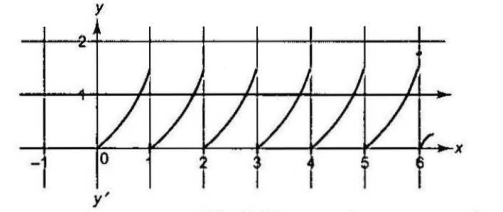
The total number of solutions of \(\sin \{x\}=\cos \{x\}\) \(\text { (where }\{.\} \text { denotes the fractional part) in }[0,2 \pi] \text { is }\)
Hint
(b)
\(
\begin{aligned}
& \sin \{x\}=\cos \{x\} \\
& \tan \{x\}=1 \\
& \tan (\pi / 4)=1<\tan 1
\end{aligned}
\)
\(
\text { Graphs of } y=\tan \{x\} \text { and } y=1 \text { meet exactly six times in }[0,2 \pi] \text {. }
\) -
Question 75 of 85
75. Question
If \(a, b \in[0,2 \pi]\) and the equation \(x^2+4+3 \sin (a x+b)-2 x=0\) has at least one solution, then the value of \((a+b)\) can be
Hint
(a)
\(
\begin{aligned}
& x^2+4-2 x+3 \sin (a x+b)=0 \\
& (x-1)^2+3=-3 \sin (a x+b) \\
& \text { L.H.S. } \geq 3 \text { and R.H.S. } \leq 3 \\
& \Rightarrow \text { L.H.S }=\text { R.H.S }=3 \\
& (x-1)^2+3+3 \sin (a x+b)=0 \\
& \Rightarrow x=1, \sin (a x+b)=-1 \\
& \Rightarrow \sin (a+b)=-1 \\
& \Rightarrow a+b=(4 n-1) \frac{\pi}{2}, n \in I \Rightarrow a+b=\frac{7 \pi}{2}
\end{aligned}
\) -
Question 76 of 85
76. Question
The equation \(\tan ^4 x-2 \sec ^2 x+a=0\) will have at least one solution if
Hint
(c)
\(
\begin{aligned}
& \tan ^4 x-2 \sec ^2 x+a=0 \\
& \Rightarrow \tan ^4 x-2\left(1+\tan ^2 x\right)+a=0 \\
& \Rightarrow \tan ^4 x-2 \tan ^2 x+1=3-a \\
& \Rightarrow\left(\tan ^2 x-1\right)^2=3-a \\
& \Rightarrow 3-a \geq 0 \Rightarrow a \leq 3
\end{aligned}
\) -
Question 77 of 85
77. Question
Complete the set of values of \(x\) in \((0, \pi)\) satisfying the equation \(1+\log _2 \sin x+\log _2 \sin 3 x \geq 0\) is
Hint
(a) \(1+\log _2 \sin x+\log _2 \sin 3 x \geq 0\)
(where \(\sin x, \sin 3 x>0\) )
\(
\begin{aligned}
& \Rightarrow \quad \log _2(2 \sin x \sin 3 x) \geq 0 \\
& \Rightarrow \quad 2 \sin x \sin 3 x \geq 1
\end{aligned}
\)
For \(\sin x>0\)
\(
\begin{aligned}
& \Rightarrow \quad x \in(0, \pi) \dots(i) \\
& \Rightarrow \quad \sin 3 x>0 \\
& \Rightarrow \quad 3 x \in(0, \pi) \cup(2 \pi, 3 \pi) . \\
& \Rightarrow \quad x \in\left(0, \frac{\pi}{3}\right) \cup\left(\frac{2 \pi}{3}, \pi\right) \dots(ii)
\end{aligned}
\)
For \(2 \sin x \sin 3 x \geq 1\)
\(
\begin{aligned}
& \Rightarrow \quad 2 \sin ^2 x\left(3-4 \sin ^2 x\right) \geq 1 \\
& \Rightarrow \quad 8 \sin ^4 x-6 \sin ^2+1 \leq 0 \\
& \Rightarrow \quad\left(2 \sin ^2 x-1\right)\left(4 \sin ^2 x-1\right) \leq 0 \\
& \Rightarrow \quad \frac{1}{2} \leq \sin x \leq \frac{1}{\sqrt{2}} \\
& \Rightarrow \quad x \in\left[\frac{\pi}{3}, \frac{\pi}{4}\right] \cup\left[\frac{2 \pi}{3}, \frac{3 \pi}{4}\right] \dots(ii)
\end{aligned}
\)
Thus, \(x \in\left(\frac{2 \pi}{3}, \frac{3 \pi}{4}\right] \text { [From Eqs. (i), (ii), (iii) ] }\). -
Question 78 of 85
78. Question
The equation \(\sin ^2 \theta-\frac{4}{\sin ^3 \theta-1}=1-\frac{4}{\sin ^3 \theta-1}\) has
Hint
(d)
\(
\sin ^2 \theta-\frac{4}{\sin ^3 \theta-1}=1-\frac{4}{\sin ^3 \theta-1}
\)
\(
\text { This yields } \sin ^2 \theta=1 \text {. }
\)
Take the square root of both sides: \(\sin \theta= \pm \sqrt{1}\). This gives \(\sin \theta=1\) or \(\sin \theta=-1\).
The original equation has a denominator \(\sin ^3 \theta-1\).
This denominator cannot be zero, so \(\sin ^3 \theta-1 \neq 0\).
Therefore, \(\sin ^3 \theta \neq 1\), which implies \(\sin \theta \neq 1\).
We found \(\sin \theta=1\) or \(\sin \theta=-1\).
The restriction states \(\sin \theta \neq 1\).
Thus, the only valid solution is \(\sin \theta=-1\).
The general solution for \(\sin \theta=-1\) is \(\theta=\frac{3 \pi}{2}+2 n \pi\), where \(n\) is an integer.
Since there are infinitely many integer values for \(n\), there are infinitely many roots. -
Question 79 of 85
79. Question
The sum of all roots of \(\sin \left(\pi \log _3\left(\frac{1}{x}\right)\right)=0\) in \((0,2 \pi)\) is
Hint
(c)
\(
\begin{aligned}
&\begin{aligned}
& \pi \log _3\left(\frac{1}{x}\right)=k \pi, k \in I \\
& \log _3\left(\frac{1}{x}\right)=k \Rightarrow x=3^{-k}
\end{aligned}\\
&\text { The possible values of } k \text { are }-1,0,1,2,3, \ldots\\
&S=3+1+\frac{1}{3}+\frac{1}{3^2}+\frac{1}{3^3}+\cdots \infty=\frac{3}{1-\frac{1}{3}}=\frac{9}{2}
\end{aligned}
\) -
Question 80 of 85
80. Question
The number of pairs of integer \((x, y)\) that satisfy the following two equations
\(
\left\{\begin{array}{l}
\cos (x y)=x \\
\tan (x y)=y \text { is }
\end{array}\right.
\)Hint
(a)
\(
\begin{aligned}
&\begin{aligned}
& \frac{\sin (x y)}{\cos (x y)}=y \\
& \Rightarrow \sin (x y)=x y \\
& \Rightarrow x y=0 \\
& \Rightarrow x=0 \text { or } y=0
\end{aligned}\\
&\text { But } x=0 \text { is not possible }\\
&\therefore y=0 \text { and } x=1 \text {, i.e., }(1,0)
\end{aligned}
\) -
Question 81 of 85
81. Question
Sum of all the solutions in \([0,4 \pi]\) of the equation \(\tan x+\cot x+1=\cos \left(x+\frac{\pi}{4}\right)\) is
Hint
(c)
\(
\begin{aligned}
& \tan x+\cot x+1=\cos \left(x+\frac{\pi}{4}\right) \\
& \Rightarrow \tan x+\cot x=\cos \left(x+\frac{\pi}{4}\right)-1
\end{aligned}
\)
Now \(\tan x+\cot x \leq-2\) and \(\cos \left(x+\frac{\pi}{4}\right)-1 \geq-2\).
It implies that equality holds when both are -2.
\(
\begin{aligned}
& \Rightarrow \cos \left(x+\frac{\pi}{4}\right)=-1 \\
& \Rightarrow x+\frac{\pi}{4}=(2 m+1) \pi, m \in Z \\
& \Rightarrow x=\frac{3 \pi}{4} \text { or } \frac{11 \pi}{4}
\end{aligned}
\)
Therefore, the sum of the solutions is \(\frac{3 \pi}{4}+\frac{11 \pi}{4}=\frac{7 \pi}{2}\). -
Question 82 of 85
82. Question
Number of solutions the equation \(\cos (\theta) \cdot \cos (\pi \theta)=1\) has
Hint
(c) \(\cos (\theta) \cos (\pi \theta)=1\)
\(\Rightarrow \cos (\theta)=1\) and \(\cos (\pi \theta)=1 \dots(i)\)
or \(\cos (\theta)=-1\) and \(\cos (\pi \theta)=-1 \dots(ii)\)
If \(\cos (\theta)=1 \Rightarrow \theta=2 m \pi\) and \(\cos (\pi \theta)=1 \Rightarrow \theta=2 \pi\) which is possible only when \(\theta=0\).
Equation (ii) is not possible for any \(\theta\) as for \(\cos (\theta)=-1, \theta\) should be odd multiple of \(\pi \Rightarrow\) irrational and for \(\cos (\pi \theta)=-1 \Rightarrow \theta\) should be odd integer \(\Rightarrow\) rational
Both the conditions cannot be satisfied.
Therefore, \(\theta=0\) is the only solution. -
Question 83 of 85
83. Question
The general value of \(x\) satisfying the equation \(2 \cot ^2 x+2 \sqrt{3} \cot x+4 \operatorname{cosec} x+8=0\) is
Hint
(c)
\(
\begin{aligned}
& (\cot x+\sqrt{3})^2+\cot ^2 x+4 \operatorname{cosec} x+5=0 \\
& \Rightarrow(\cot x+\sqrt{3})^2+\operatorname{cosec}^2 x+4 \operatorname{cosec} x+4=0 \\
& \Rightarrow(\cot x+\sqrt{3})^2+(\operatorname{cosec} x+2)^2=0 \\
& \Rightarrow \cot x=-\sqrt{3} \text { or } \operatorname{cosec} x=-2 \\
& \Rightarrow x=2 n \pi-\frac{\pi}{6}, n \in Z (\because x \in 4 \text { th quadrant })
\end{aligned}
\) -
Question 84 of 85
84. Question
Assume that \(\theta\) is a rational multiple of \(\pi\) such that \(\cos \theta\) is a distinct rational. Number of values of \(\cos \theta\) is
Hint
(c) \(\theta=k \pi, k=\frac{p}{q}, p, q \in I, q \neq 0\)
\(\cos k \pi\) is a rational
Hence, \(k=0,1,1 / 2,1 / 3,2 / 3\)
There are five values of \(\cos \theta\) for which \(\cos \theta\) is rational.Explanation:
\(
\text { Let } \theta=\frac{p}{q} \pi \text {, where } p, q \text { are integers and } q \neq 0 \text {. }
\)
For \(\cos \theta\) to be rational, \(\theta\) must be a specific rational multiple of \(\pi\).
The only rational values of \(\cos \theta\) are \(\pm 1, \pm \frac{1}{2}\), and 0.
\(
\begin{aligned}
&\begin{aligned}
& \cos \theta=1 \Longrightarrow \theta=2 n \pi \\
& \cos \theta=-1 \Longrightarrow \theta=(2 n+1) \pi \\
& \cos \theta=0 \Longrightarrow \theta=\left(n+\frac{1}{2}\right) \pi \\
& \cos \theta=\frac{1}{2} \Longrightarrow \theta=\left(2 n \pm \frac{1}{3}\right) \pi \\
& \cos \theta=-\frac{1}{2} \Longrightarrow \theta=\left(2 n \pm \frac{2}{3}\right) \pi
\end{aligned}\\
&\text { All these } \theta \text { values are rational multiples of } \pi \text {. }
\end{aligned}
\)
The distinct rational values are \(\left\{1,-1,0, \frac{1}{2},-\frac{1}{2}\right\}\).
There are 5 distinct values. -
Question 85 of 85
85. Question
Number of ordered pair(s) \((a, b)\) for each of which the equality \(a(\cos x-1)+b^2=\cos \left(a x+b^2\right)-1\) holds true for all \(x \in R\) are
Hint
(b)
\(
\text { The equation } a(\cos x-1)+b^2=\cos \left(a x+b^2\right)-1 \text { holds for all } x \in \mathbb{R} \text {. }
\)
Substitute \(x=0\) into the equation \(a(\cos x-1)+b^2=\cos \left(a x+b^2\right)-1\) :
\(a(\cos 0-1)+b^2=\cos \left(a \cdot 0+b^2\right)-1\)
\(a(1-1)+b^2=\cos \left(b^2\right)-1\)
\(b^2=\cos \left(b^2\right)-1\)
Rearrange the equation:
\(\cos \left(b^2\right)=1+b^2\)
Since \(\cos \left(b^2\right) \leq 1\) and \(1+b^2 \geq 1\), the only solution is when both sides are equal to 1.
\(\cos \left(b^2\right)=1\) and \(1+b^2=1\)
Therefore, \(b^2=0\), which implies \(b=0\).
Substitute \(b=0\) into the equation \(a(\cos x-1)+b^2=\cos \left(a x+b^2\right)-1\) :
\(a(\cos x-1)+0^2=\cos \left(a x+0^2\right)-1\)
\(a(\cos x-1)=\cos (a x)-1\)
Rewrite the equation using the double angle formula \(\cos (2 \theta)=1-2 \sin ^2(\theta)\) :
\(a(\cos x-1)=\cos (a x)-1\)
\(a\left(-2 \sin ^2\left(\frac{x}{2}\right)\right)=1-2 \sin ^2\left(\frac{a x}{2}\right)-1\)
\(-2 a \sin ^2\left(\frac{x}{2}\right)=-2 \sin ^2\left(\frac{a x}{2}\right)\)
\(a \sin ^2\left(\frac{x}{2}\right)=\sin ^2\left(\frac{a x}{2}\right)\)
For this equation to hold for all \(x\), we must have \(a=0\) or \(a=1\).
If \(a=0\), then \(0=0\), which is true.
If \(a=1\), then \(\sin ^2\left(\frac{x}{2}\right)=\sin ^2\left(\frac{x}{2}\right)\), which is also true.
Therefore, \(a\) can be 0 or 1.
The solutions for \((a, b)\) are \((0,0)\) and \((1,0)\). There are two ordered pairs.