JEE Practice Questions: Trigonometric Ratios and Identities (Single Choice Type)
Quiz Summary
0 of 136 Questions completed
Questions:
Information
You have already completed the quiz before. Hence you can not start it again.
Quiz is loading…
You must sign in or sign up to start the quiz.
You must first complete the following:
Results
Results
0 of 136 Questions answered correctly
Your time:
Time has elapsed
You have reached 0 of 0 point(s), (0)
Earned Point(s): 0 of 0, (0)
0 Essay(s) Pending (Possible Point(s): 0)
Categories
- Not categorized 0%
- 1
- 2
- 3
- 4
- 5
- 6
- 7
- 8
- 9
- 10
- 11
- 12
- 13
- 14
- 15
- 16
- 17
- 18
- 19
- 20
- 21
- 22
- 23
- 24
- 25
- 26
- 27
- 28
- 29
- 30
- 31
- 32
- 33
- 34
- 35
- 36
- 37
- 38
- 39
- 40
- 41
- 42
- 43
- 44
- 45
- 46
- 47
- 48
- 49
- 50
- 51
- 52
- 53
- 54
- 55
- 56
- 57
- 58
- 59
- 60
- 61
- 62
- 63
- 64
- 65
- 66
- 67
- 68
- 69
- 70
- 71
- 72
- 73
- 74
- 75
- 76
- 77
- 78
- 79
- 80
- 81
- 82
- 83
- 84
- 85
- 86
- 87
- 88
- 89
- 90
- 91
- 92
- 93
- 94
- 95
- 96
- 97
- 98
- 99
- 100
- 101
- 102
- 103
- 104
- 105
- 106
- 107
- 108
- 109
- 110
- 111
- 112
- 113
- 114
- 115
- 116
- 117
- 118
- 119
- 120
- 121
- 122
- 123
- 124
- 125
- 126
- 127
- 128
- 129
- 130
- 131
- 132
- 133
- 134
- 135
- 136
- Current
- Review
- Answered
- Correct
- Incorrect
- Question 1 of 136
1. Question
The equation \(\sin ^2 \theta=\frac{x^2+y^2}{2 x y}\) is possible if
Hint
(a)
\(
\text { We have } \frac{x^2+y^2}{2 x y}=\frac{1}{2}\left(\frac{x}{y}+\frac{y}{x}\right)
\)
\(
\begin{aligned}
&\text { Now, } \sin ^2 \theta=\frac{x^2+y^2}{2 x y} \quad \Rightarrow \frac{x^2+y^2}{2 x y} \geq 0\\
&\left[\because \sin ^2 \theta \geq 0\right]
\end{aligned}
\)
Therefore, \(x\) and \(y\) have the same sign.
Now, \(\frac{x^2+y^2}{2 x y}=\frac{1}{2}\left(\frac{x}{y}+\frac{y}{x}\right) \quad \Rightarrow \frac{x^2+y^2}{2 x y} \geq 1(\because[latex] A.M. [latex]\geq[latex] GM. \))\(
But [latex]\sin ^2 \theta \leq 1\). Therefore, \(\frac{x^2+y^2}{2 x y}=1 \Rightarrow x=y\). - Question 2 of 136
2. Question
If \(1+\sin x+\sin ^2 x+\sin ^3 x+\cdots \infty\) is equal to \(4+2 \sqrt{3}, 0<x<\pi\), then \(x\) is equal to
Hint
(d) Since \(0<x<\pi\). Therefore, \(\sin x>0\)
We have \(1+\sin x+\sin ^2 x+\cdots \infty=4+2 \sqrt{3}\)
\(
\begin{aligned}
& \Rightarrow \quad \frac{1}{1-\sin x}=4+2 \sqrt{3} \\
& \Rightarrow \quad \sin x=1-\frac{1}{4+2 \sqrt{3}} \\
& \quad=\frac{3+2 \sqrt{3}}{4+2 \sqrt{3}}=\frac{\sqrt{3}}{2} \\
& \Rightarrow \quad x=\frac{\pi}{3} \text { or } \frac{2 \pi}{3}
\end{aligned}
\) - Question 3 of 136
3. Question
If \(\frac{\sin x}{a}=\frac{\cos x}{b}=\frac{\tan x}{c}=k\), then \(b c+\frac{1}{c k}+\frac{a k}{1+b k}\) is equal to
Hint
(b)
\(
\begin{aligned}
& \frac{\cos x \tan x}{k^2}+\frac{1}{\tan x}+\frac{\sin x}{1+\cos x} \\
& =\frac{\sin x}{k^2}+\frac{\cos x(1+\cos x)+\sin ^2 x}{\sin x(1+\cos x)}=\frac{\cos x(1+\cos x)+\left(1-\cos ^2 x\right)}{\sin x(1+\cos x)}=\frac{a}{k}+\frac{1}{\sin x}=\frac{a}{k}+\frac{1}{a k}
\end{aligned}
\) - Question 4 of 136
4. Question
If \(A, B, C\) are angles of a triangle, then \(2 \sin \frac{A}{2} \operatorname{cosec} \frac{B}{2} \sin \frac{C}{2}-\sin A \cot \frac{B}{2}-\cos A\) is
Hint
(a)
\(
\begin{aligned}
& 2 \sin \frac{A}{2} \operatorname{cosec} \frac{B}{2}\left(\sin \frac{C}{2}-\cos \frac{A}{2} \cos \frac{B}{2}\right)-\cos A \\
& =2 \sin \frac{A}{2} \operatorname{cosec} \frac{B}{2}\left(\cos \frac{A+B}{2}-\cos \frac{A}{2} \cos \frac{B}{2}\right)-\cos A \\
& =2 \sin \frac{A}{2} \operatorname{cosec} \frac{B}{2}\left(-\sin \frac{A}{2} \sin \frac{B}{2}\right)-\cos A=-2 \sin ^2 \frac{A}{2}-\cos A=-1
\end{aligned}
\) - Question 5 of 136
5. Question
The least value of \(6 \tan ^2 \phi+54 \cot ^2 \phi+18\) is
I: 54 when A.M. \(\geq\) G.M. is applicable for \(6 \tan ^2 \phi, 54 \cot ^2 \phi, 18\).
II: 54 when A.M. \(\geq\) G.M is applicable for \(6 \tan ^2 \phi, 54 \cot ^2 \phi\) and 18 added further.
III: 78 when \(\tan ^2 \phi=\cot ^2 \phi\).Hint
(b) Applying A.M. \(\geq\) G.M. in \(6 \tan ^2 \phi, 54 \cot ^2 \phi, 18\), we get
\(
\frac{6 \tan ^2 \phi+54 \cot ^2 \phi+18}{3} \geq(6 \times 54 \times 18)^{1 / 3} \geq 18
\)
This is true if \(6 \tan ^2 \phi=54 \cot ^2 \phi=18\)
\(
\Rightarrow \tan ^2 \phi=3 \text { and } \cot ^2 \phi=1 / 3
\)
Therefore, I and II are correct. - Question 6 of 136
6. Question
If \(5 \tan \theta=4\), then \(\frac{5 \sin \theta-3 \cos \theta}{5 \sin \theta+2 \cos \theta}\) is equal to
Hint
(c)
\(
\begin{aligned}
&5 \tan \theta=4 \Rightarrow \tan \theta=\frac{4}{5}\\
&\text { Now } \frac{5 \sin \theta-3 \cos \theta}{5 \sin \theta+2 \cos \theta}=\frac{5 \frac{\sin \theta}{\cos \theta}-3}{5 \frac{\sin \theta}{\cos \theta}+2}=\frac{5 \tan \theta-3}{5 \tan \theta+2}=\frac{5 \times \frac{4}{5}-3}{5 \times \frac{4}{5}+2}=\frac{1}{6}
\end{aligned}
\) - Question 7 of 136
7. Question
If \(2 \sec 2 \theta=\tan \phi+\cot \phi\), then one of the values of \(\theta+\phi\) is
Hint
(b) \(2 \sec 2 \theta=\tan \phi+\cot \phi\)
\(
\begin{aligned}
& \Rightarrow \frac{2}{\cos 2 \theta}=\frac{\sin ^2 \phi+\cos ^2 \phi}{\sin \phi \cos \phi} \\
& \Rightarrow \frac{2}{\cos 2 \theta}=\frac{1}{\sin \phi \cos \phi} \\
& \Rightarrow \cos 2 \theta=\sin 2 \phi \\
& \Rightarrow 2 \theta=90^{\circ}-2 \phi \\
& \Rightarrow \theta+\phi=\frac{\pi}{4}
\end{aligned}
\) - Question 8 of 136
8. Question
If \(\sin x+\operatorname{cosec} x=2\), then \(\sin ^n x+\operatorname{cosec}^n x\) is equal to
Hint
(a)
\(
\begin{aligned}
& \sin x+\operatorname{cosec} x=2 \\
& \Rightarrow(\sin x-1)^2=0 \\
& \Rightarrow \sin x=1 \\
& \Rightarrow \sin ^n x+\operatorname{cosec}^n x=1+1=2
\end{aligned}
\)Explanation:
\(
\sin x+\frac{1}{\sin x}=2
\)
Multiply by \(\sin x: \sin ^2 x+1=2 \sin x\)
Rearrange: \(\sin ^2 x-2 \sin x+1=0\)
This is a perfect square: \((\sin x-1)^2=0\)
\(
\begin{aligned}
& \sin x-1=0 \\
& \sin x=1
\end{aligned}
\)
\(
\text { Since } \sin x=1, \operatorname{cosec} x=\frac{1}{\sin x}=\frac{1}{1}=1 \text {. }
\)
\(
\begin{aligned}
& \sin ^n x+\operatorname{cosec}^n x=(1)^n+(1)^n \\
& (1)^n+(1)^n=1+1=2
\end{aligned}
\) - Question 9 of 136
9. Question
A quadratic equation whose roots are \(\operatorname{cosec}^2 \theta\) and \(\sec ^2 \theta\) can be
Hint
(c) Sum and Prodeuct of roots are
\(
\begin{aligned}
& \sec ^2 \theta+\operatorname{cosec}^2 \theta=\frac{1}{\cos ^2 \theta}+\frac{1}{\sin ^2 \theta}=\frac{4}{\sin ^2 2 \theta} \geq 4 \\
& \text { Also, } \sec ^2 \theta \operatorname{cosec}^2 \theta=\frac{4}{\sin ^2 2 \theta} \geq 4
\end{aligned}
\)
Both sum of roots and prouct of roots are equal.let it t.
Hence, equation will be \(x^2-t x+t=0\) ( \(t[latex] always greater or equals to 4)
Hence, the only equation which can have roots [latex]\operatorname{cosec}^2 \theta\) and \(\sec ^2 \theta\) is \(x^2-5 x+5=0\). - Question 10 of 136
10. Question
If \(\pi<\alpha<\frac{3 \pi}{2}\), then \(\sqrt{\frac{1-\cos \alpha}{1+\cos \alpha}}+\sqrt{\frac{1+\cos \alpha}{1-\cos \alpha}}\) is equal to
Hint
(b)
\(
\begin{aligned}
\sqrt{\frac{1-\cos \alpha}{1+\cos \alpha}}+\sqrt{\frac{1+\cos \alpha}{1-\cos \alpha}} & =\frac{1-\cos \alpha+1+\cos \alpha}{\sqrt{1-\cos ^2 \alpha}} \\
& =\frac{2}{|\sin \alpha|}=\frac{2}{-\sin \alpha}(\text { since } \pi<\alpha<3 \pi / 2)
\end{aligned}
\) - Question 11 of 136
11. Question
The value of \(\cos \frac{\pi}{7}+\cos \frac{2 \pi}{7}+\cos \frac{3 \pi}{7}+\cos \frac{4 \pi}{7}+\cos \frac{5 \pi}{7}+\cos \frac{6 \pi}{7}+\cos \frac{7 \pi}{7}\) is
Hint
(b)
\(
\begin{aligned}
& \text { We have } \cos \frac{\pi}{7}+\cos \frac{2 \pi}{7}+\cos \frac{3 \pi}{7}+\cos \frac{4 \pi}{7}+\cos \frac{5 \pi}{7}+\cos \frac{6 \pi}{7}+\cos \frac{7 \pi}{7} \\
& =\left(\cos \frac{\pi}{7}+\cos \frac{6 \pi}{7}\right)+\left(\cos \frac{2 \pi}{7}+\cos \frac{5 \pi}{7}\right)+\left(\cos \frac{3 \pi}{7}+\cos \frac{4 \pi}{7}\right)+\cos \pi \\
& =\left(\cos \frac{\pi}{7}-\cos \frac{\pi}{7}\right)+\left(\cos \frac{2 \pi}{7}-\cos \frac{2 \pi}{7}\right)+\left(\cos \frac{3 \pi}{7}-\cos \frac{3 \pi}{7}\right)+\cos \pi \\
& =\cos \pi=-1
\end{aligned}
\) - Question 12 of 136
12. Question
The least value of \(2 \sin ^2 \theta+3 \cos ^2 \theta\) is
Hint
(b)
\(
\begin{aligned}
& 2 \sin ^2 \theta+3 \cos ^2 \theta=2\left(\sin ^2 \theta+\cos ^2 \theta\right)+\cos ^2 \theta=2+\cos ^2 \theta \geq 2 \\
& {\left[\because \cos ^2 \theta>0\right]}
\end{aligned}
\) - Question 13 of 136
13. Question
The greatest value of \(\sin ^4 \theta+\cos ^4 \theta\) is
Hint
(b)
\(
\sin ^4 \theta+\cos ^4 \theta=\left(\sin ^2 \theta+\cos ^2 \theta\right)^2-2 \sin ^2 \theta \cos ^2 \theta=1-2 \sin ^2 \theta \cos ^2 \theta \leq 1
\) - Question 14 of 136
14. Question
If \(f(x)=\cos ^2 \theta+\sec ^2 \theta\), then
Hint
(d)
\(
\begin{aligned}
&\text { We have }\\
&f(x)=\cos ^2 \theta+\sec ^2 \theta=(\cos \theta-\sec \theta)^2+2 \cos \theta \sec \theta=2+(\cos \theta-\sec \theta)^2 \geq 2
\end{aligned}
\) - Question 15 of 136
15. Question
If \(f(x)=\sin ^6 x+\cos ^6 x\), then range of \(f(x)\) is
Hint
(a)
\(
\begin{aligned}
& f(x)=\cos ^6 x+\sin ^6 x \\
&=\left(\cos ^2 x+\sin ^2 x\right)\left(\sin ^4 x+\cos ^4 x-\cos ^2 x \sin ^2 x\right) \\
&=\left(\left(\sin ^2 x+\cos ^2 x\right)^2-3 \sin ^2 x \cos ^2 x\right) \\
&=1-\frac{3}{4} \sin ^2 2 x \\
& \Rightarrow f(x) \in\left[\frac{1}{4}, 1\right]
\end{aligned}
\) - Question 16 of 136
16. Question
If \(a \leq 3 \cos x+5 \sin (x-\pi / 6) \leq b\) for all \(x\), then \((a, b)\) is
Hint
(a)
\(
\begin{aligned}
f(x) & =3 \cos x+5 \sin (x-\pi / 6) \\
& =\frac{1}{2} \cos x+5 \times \frac{\sqrt{3}}{2} \sin x
\end{aligned}
\)
\(
\begin{aligned}
& \text { Then, }-\sqrt{\left(\frac{1}{2}\right)^2+\left(\frac{5 \sqrt{3}}{2}\right)^2} \leq f(x) \leq \sqrt{\left(\frac{1}{2}\right)^2+\left(\frac{5 \sqrt{3}}{2}\right)^2} \\
& \Rightarrow \quad-\sqrt{19} \leq f(x) \leq \sqrt{19}
\end{aligned}
\) - Question 17 of 136
17. Question
The equation \(\sin x(\sin x+\cos x)=k\) has real solutions if and only if \(k\) is a real number such that
Hint
(d)
\(
\begin{aligned}
& 1-\cos 2 x+\sin 2 x=2 k \\
& \Rightarrow \quad \sin 2 x-\cos 2 x=2 k-1 \\
& \Rightarrow \quad \sin (2 x-\alpha)=\frac{2 k-1}{\sqrt{2}} \\
& \Rightarrow \quad-1 \leq \frac{2 k-1}{\sqrt{2}} \leq 1 \\
& \Rightarrow \quad \frac{1-\sqrt{2}}{2} \leq k \leq \frac{1+\sqrt{2}}{2}
\end{aligned}
\) - Question 18 of 136
18. Question
If \(\cot (\alpha+\beta)=0\), then \(\sin (\alpha+2 \beta)\) can be
Hint
(d)
\(
\begin{aligned}
& \cot (\alpha+\beta)=0 \Rightarrow \alpha+\beta=\pi / 2+n \pi, n \in I \\
& \Rightarrow \sin (\alpha+2 \beta)=\sin \left(90^{\circ}+\beta\right)=\cos \beta(\text { for } n=0) .
\end{aligned}
\) - Question 19 of 136
19. Question
If \(\frac{x}{\cos \theta}=\frac{y}{\cos \left(\theta-\frac{2 \pi}{3}\right)}=\frac{z}{\cos \left(\theta+\frac{2 \pi}{3}\right)}\), then \(x+y+z\) is equal to
Hint
(b)
(b)
\(
\begin{aligned}
&\text { We have }\\
&\frac{x}{\cos \theta}=\frac{y}{\cos \left(\theta-\frac{2 \pi}{3}\right)}=\frac{z}{\cos \left(\theta+\frac{2 \pi}{3}\right)}
\end{aligned}
\)
\(
\begin{aligned}
&\text { Therefore, each ratio is equal to }\\
&\begin{aligned}
& \frac{x+y+z}{\cos \theta+\cos \left(\theta-\frac{2 \pi}{3}\right)+\cos \left(\theta+\frac{2 \pi}{3}\right)}=\frac{x+y+z}{0} \\
& \Rightarrow x+y+z=0
\end{aligned}
\end{aligned}
\) - Question 20 of 136
20. Question
\(\sin ^{2 n} x+\cos ^{2 n} x\) lies between
Hint
(b) \(\text { Since } 0 \leq \sin ^{2 n} x \leq \sin ^2 x\)
\(
0 \leq \cos ^{2 n} x \leq \cos ^2 x \text { [as } \sin ^4 x=\sin ^2 x \sin ^2 x \leq \sin ^2 x, \sin ^4 x \leq \sin ^2 x \text { and so on] }
\)
\(
\begin{aligned}
& \Rightarrow \quad 0 \leq \sin ^{2 n} x+\cos ^{2 n} x \leq \sin ^2 x+\cos ^2 x=1 \\
& \Rightarrow \quad 0 \leq \sin ^{2 n} x+\cos ^{2 n} x \leq 1
\end{aligned}
\) - Question 21 of 136
21. Question
The roots of the equation \(4 x^2-2 \sqrt{5} x+1=0\) are.
Hint
(b) \(4 x^2-2 \sqrt{5} x+1=0\)
Let \(\alpha\) and \(\beta\) be the roots, we have
\(
\alpha+\beta=\frac{2 \sqrt{5}}{4}=\frac{\sqrt{5}}{2}, \alpha \beta=\frac{1}{4}
\)
Since \(\sin 18^{\circ}=\frac{\sqrt{5}-1}{4}, \cos 36^{\circ}=\frac{\sqrt{5}+1}{4}\)
\(
\therefore \quad \sin 18^{\circ}+\cos 36^{\circ}=\frac{2 \sqrt{5}}{4}=\frac{\sqrt{5}}{2} \sin 18^{\circ} \cos 36^{\circ}=\frac{5-1}{16}=\frac{4}{16}=\frac{1}{4}
\)
Here the required roots are \(\sin 18^{\circ}, \cos 36^{\circ}\). - Question 22 of 136
22. Question
If \(\frac{3 \pi}{4}<\alpha<\pi\), then \(\sqrt{2 \cot \alpha+\frac{1}{\sin ^2 \alpha}}\) is equal to
Hint
(b)
\(
\begin{aligned}
\sqrt{2 \cot \alpha+\frac{1}{\sin ^2 \alpha}}= & \sqrt{2 \cot \alpha+\operatorname{cosec}^2 \alpha} \\
= & \sqrt{2 \cot \alpha+1+\cot ^2 \alpha}=|1+\cot \alpha|=-1-\cot \alpha \\
& \quad[\text { since } \cot \alpha<-1 \text { when } 3 \pi / 4<\alpha<\pi,|1+\cot \alpha|=-1-\cot \alpha]
\end{aligned}
\) - Question 23 of 136
23. Question
If \(f(\theta)=5 \cos \theta+3 \cos \left(\theta+\frac{\pi}{3}\right)+3\), then range of \(f(\theta)\) is
Hint
(d)
\(
\begin{aligned}
f(\theta) & =5 \cos \theta+3 \cos \left(\theta+\frac{\pi}{3}\right)+3=5 \cos \theta+\frac{3}{2} \cos \theta-\frac{3 \sqrt{3}}{2} \sin \theta+3=\frac{13}{2} \cos \theta-\frac{3 \sqrt{3}}{2} \sin \theta+3 \\
& =\sqrt{\left(\frac{169}{4}+\frac{27}{4}\right)} \sin (\theta-\alpha)+3 . \text { Thus, the range of } f(\theta) \text { is }[-4,10] .
\end{aligned}
\) - Question 24 of 136
24. Question
If \(\alpha, \beta, \gamma, \delta\) are the smallest positive angles in ascending order of magnitude which have their sines equal to the positive quantity \(k\), then the value of \(4 \sin \frac{\alpha}{2}+3 \sin \frac{\beta}{2}+2 \sin \frac{\gamma}{2}+\sin \frac{\delta}{2}\) is cqual to
Hint
(b)
\(
\begin{aligned}
&\text { Since } \alpha<\beta<\gamma<\delta \text { and } \sin \alpha=\sin \beta=\sin \gamma=\sin \delta=K \text {, therefore } \beta=\pi-\alpha, \gamma=2 \pi+\alpha, \delta=3 \pi-\alpha\\
&\begin{aligned}
\Rightarrow 4 \sin \frac{\alpha}{2}+3 \sin \frac{\beta}{2}+2 \sin \frac{\gamma}{2}+\sin \frac{\delta}{2} & =4 \sin \frac{\alpha}{2}+3 \cos \frac{\alpha}{2}-2 \sin \frac{\alpha}{2}-\cos \frac{\alpha}{2} \\
& =2 \sin \frac{\alpha}{2}+2 \cos \frac{\alpha}{2}=2 \sqrt{1+\sin \alpha}=2 \sqrt{1+K}
\end{aligned}
\end{aligned}
\) - Question 25 of 136
25. Question
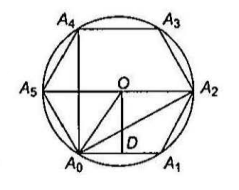
Let \(A_0 A_1 A_2 A_3 A_4 A_5\) be a regular hexagon inscribed in a circle of unit radius. Then the product of the lengths of the line segments \(A_0 A_1, A_0, A_2\) and \(A_0 A_4\) is
Hint
(c) Let \(O\) be the centre of the circle

Since \(\angle A_0 O A_1=\frac{360^{\circ}}{6}=60^{\circ}\)
\(A_0 O A_1\) is an equilateral triangle, we get \(A_0 A_1=1\) [radius of circle \(=1\) ]
Also \(A_0 A_2=A_0 A_4=2 O D=2\left[O A_0\right] \sin 60^{\circ}=2(1) \frac{\sqrt{3}}{2}=\sqrt{3}\) - Question 26 of 136
26. Question
If \(\sin \theta_1+\sin \theta_2+\sin \theta_3=3\), then \(\cos \theta_1+\cos \theta_2+\cos \theta_3\) is equal to
Hint
(d)
\(
\begin{aligned}
&\text { The given relation is satisfied only when } \sin \theta_1=\sin \theta_2=\sin \theta_3=1\\
&\begin{aligned}
& \Rightarrow \quad \cos \theta_1=\cos \theta_2=\cos \theta_3=0 \\
& \Rightarrow \quad \cos \theta_1+\cos \theta_2+\cos \theta_3=0
\end{aligned}
\end{aligned}
\) - Question 27 of 136
27. Question
If \(\sin ^2 \theta=\frac{x^2+y^2+1}{2 x}\), then \(x\) must be
Hint
(c)
\(
\begin{aligned}
&\begin{aligned}
& \sin ^2 \theta \leq 1 \\
& \Rightarrow \quad \frac{x^2+y^2+1}{2 x} \leq 1 \quad \Rightarrow x^2+y^2-2 x+1 \leq 0 [\operatorname{as} x>0]\\
& \Rightarrow \quad(x-1)^2+y^2 \leq 0
\end{aligned}\\
&\text { It is possible, iff } x-1 \text { and } y=0 \text {. }
\end{aligned}
\) - Question 28 of 136
28. Question
If \(\sin (\alpha+\beta)=1, \sin (\alpha-\beta)=\frac{1}{2}\), then \(\tan (\alpha+2 \beta) \tan (2 \alpha+\beta)\) is equal to, \(\alpha, \beta \in(0, \pi / 2)\)
Hint
(a)
\(
\begin{aligned}
&\sin (\alpha+\beta)=1 \Rightarrow \alpha+\beta=\frac{\pi}{2} \sin (\alpha-\beta)=\frac{1}{2} \Rightarrow \alpha-\beta=\frac{\pi}{6}\\
&\text { Solving, we get } \alpha=\pi / 3 \text { and } \beta=\pi / 6\\
&\text { Now } \begin{aligned}
\tan (\alpha+2 \beta) \tan (2 \alpha+\beta)=\tan \left(\frac{\pi}{3}+\frac{\pi}{3}\right) \tan \left(\frac{2 \pi}{3}+\frac{\pi}{6}\right)=\tan \frac{2 \pi}{3} \tan \frac{5 \pi}{6} & =\left(-\cot \frac{\pi}{3}\right)\left(-\cot \frac{\pi}{6}\right) \\
& =\left(-\frac{1}{\sqrt{3}}\right)(-\sqrt{3})=1
\end{aligned}
\end{aligned}
\) - Question 29 of 136
29. Question
Which of the following is not the value of \(\sin 27^{\circ}-\cos 27^{\circ}\)?
Hint
(a)
\(
\begin{aligned}
\sin 27^{\circ}-\sin 63^{\circ} & =-2 \cos 45^{\circ} \sin 18^{\circ} \\
& =-\sqrt{2}\left(\frac{\sqrt{5}-1}{4}\right)=-\frac{\sqrt{5}-1}{2 \sqrt{2}}=-\frac{\sqrt{3-\sqrt{5}}}{2}
\end{aligned}
\) - Question 30 of 136
30. Question
If \(\operatorname{cosec} \theta-\cot \theta=q\), then the value of \(\operatorname{cosec} \theta\) is
Hint
(c)
\(
\begin{aligned}
& \operatorname{cosec} \theta-\cot \theta=\dot{q} \\
& \therefore \operatorname{cosec} \theta+\cot \theta=\frac{1}{q} \\
& \therefore \operatorname{cosec} \theta=\frac{1}{2}[q+(1 / q)] \text { (on addition). }
\end{aligned}
\) - Question 31 of 136
31. Question
If \(\sin \theta+\cos \theta=\frac{1}{5}\) and \(0 \leq \theta<\pi\), then \(\tan \theta\) is
Hint
(a) Squaring both the sides, we get
\(
\begin{aligned}
& 1+\sin 2 \theta=\frac{1}{25} \\
& \Rightarrow \sin 2 \theta=-\frac{24}{25}
\end{aligned}
\)
Let \(t=\tan \theta\), we get \(\frac{2 t}{1+t^2}=-\frac{24}{25}\)
\(
\begin{aligned}
& \Rightarrow 50 t+24+24 t^2=0 \\
& \Rightarrow 12 t^2+25 t+12=0 \\
& \Rightarrow(4 t+3)(3 t+4)=0 \\
& \Rightarrow t=-4 / 3(\text { as for } t=-3 / 4(\text { rejected }) \text { as if } \tan \theta=-3 / 4, \text { then } \theta \in[\pi / 2, \pi) \text { and } \sin \theta+\cos \theta=-1 / 5)
\end{aligned}
\) - Question 32 of 136
32. Question
If \(x=\frac{2 \sin \theta}{1+\cos \theta+\sin \theta}\), then \(\frac{1-\cos \theta+\sin \theta}{1+\sin \theta}\) is equal to.
Hint
(c) Multiplying \(x\) above and below by \(1-\cos \theta+\sin \theta\), we get
\(
x=\frac{2 \sin \theta(1-\cos \theta+\sin \theta)}{(1+\sin \theta)^2-\cos ^2 \theta}=\frac{2 \sin \theta(1-\cos \theta+\sin \theta)}{(1+\sin \theta)^2-\left(1-\sin ^2 \theta\right)}
\)
Putting \(1-\sin ^2 \theta=(1+\sin \theta)(1-\sin \theta)\), we get \(\frac{2 \sin \theta}{2 \sin \theta} \frac{1-\cos \theta+\sin \theta}{1+\sin \theta}=x\). - Question 33 of 136
33. Question
If \(\theta=\pi / 4 n\), then the value of \(\tan \theta \tan 2 \theta \cdots \tan (2 n-2) \theta \tan (2 n-1) \theta\) is
Hint
(b)
\(
\begin{aligned}
&\begin{aligned}
& 2 n \theta=\pi / 2 \\
& \therefore \quad \theta,(2 n-1) \theta=(\pi / 2)-\theta ; 2 \theta,(2 n-2) \theta=(\pi / 2)-2 \theta, \ldots
\end{aligned}\\
&\text { They form complementary angles } A \text { and } B \text { so that } \tan A \tan B=\tan A \cot A=1 \text { for each pair. }
\end{aligned}
\) - Question 34 of 136
34. Question
The value of the expression \(\frac{2\left(\sin 1^{\circ}+\sin 2^{\circ}+\sin 3^{\circ}+\cdots+\sin 89^{\circ}\right)}{2\left(\cos 1^{\circ}+\cos 2^{\circ}+\cdots+\cos 44^{\circ}\right)+1}\) equals
Hint
(a)
\(
\begin{aligned}
& N^r=2\left[\left(\sin 1^{\circ}+\sin 89^{\circ}\right)+\left(\sin 2^{\circ}+\sin 88^{\circ}\right)+\cdots+\left(\sin 44^{\circ}+\sin 46^{\circ}\right)+\sin 45^{\circ}\right] \\
& \begin{aligned}
\Rightarrow \frac{\dot{N}^r}{D^r} & =2\left\{\sin 45^{\circ}\left[2\left(\cos 44^{\circ}+\cos 43^{\circ}+\cdots+\cos 1^{\circ}\right)\right]+1\right\} \\
& =2 \sin 45^{\circ} \\
& =\sqrt{2}
\end{aligned}
\end{aligned}
\) - Question 35 of 136
35. Question
If \(\sec \alpha\) and \(\operatorname{cosec} \alpha\) are the roots of \(x^2-p x+q+0\), then
Hint
(b)
\(
\begin{aligned}
& \sec \alpha+\operatorname{cosec} \alpha=p, \sec \alpha \operatorname{cosec} \alpha=q \\
& \Rightarrow \frac{\sin \alpha+\cos \alpha}{\sin \alpha \cos \alpha}=p \text { and } \frac{1}{\sin \alpha \cos \alpha}=q \\
& \Rightarrow \frac{1+2 \sin \alpha \cos \alpha}{\sin ^2 \alpha \cos ^2 \alpha}=p^2 \\
& \Rightarrow \frac{1+\frac{2}{q}}{\frac{1}{q^2}}=p^2 \\
& \Rightarrow q^2\left(1+\frac{2}{q}\right)=p^2 \Rightarrow q(q+2)=p^2
\end{aligned}
\) - Question 36 of 136
36. Question
If \(\sin x+\sin ^2 x=1\), then the value of \(\cos ^{12} x+3 \cos ^{10} x+3 \cos ^8 x+\cos ^6 x-2\) is equal to
Hint
(c)
\(
\begin{aligned}
&\text { We have } \sin x+\sin ^2 x=1\\
&\begin{aligned}
& \Rightarrow \sin x=1-\sin ^2 x \Rightarrow \sin x=\cos ^2 x \\
& \text { Now } \cos ^{12} x+3 \cos ^{10} x+3 \cos ^8 x+\cos ^6 x-.2=\sin ^6 x+3 \sin ^5 x+3 \sin ^4 x+\sin ^3 x-2 \\
& =\left(\sin ^2 x\right)^3+3\left(\sin ^2 x\right)^2 \sin x+3\left(\sin ^2 x\right)(\sin x)^2+(\sin x)^3-2 \\
& =\left(\sin ^2 x+\sin x\right)^3-2=(1)^3-2=-1
\end{aligned}
\end{aligned}
\) - Question 37 of 136
37. Question
If \(\cos (A-B)=3 / 5\) and \(\tan A \tan B=2\), then
Hint
(a)
\(
\begin{aligned}
& \cos (A-B)=\frac{3}{5} \\
& \Rightarrow 5 \cos A \cos B+5 \sin A \sin B=3
\end{aligned}
\)
From 2nd relation, we have
\(\sin A \sin B=2 \cos A \cos B\)
\(\Rightarrow \quad \cos A \cos B=\frac{1}{5}\) and \(\sin A \sin B=\frac{2}{5}\) - Question 38 of 136
38. Question
If \((1+\tan \alpha)(1+\tan 4 \alpha)=2, \alpha \in(0, \pi / 16)[latex] then [latex]\alpha\) is equal to
Hint
(a)
\(
\begin{aligned}
& (1+\tan A)(1+\tan B)=2 \\
& \Rightarrow \tan A+\tan B=1-\tan A \tan B \\
& \Rightarrow \tan (A+B)=1, \text { i.e., } A+B=\frac{\pi}{4} \\
& \text { or } \alpha+4 \alpha=\frac{\pi}{4}, \text { i.e., } \alpha=\frac{\pi}{20}
\end{aligned}
\) - Question 39 of 136
39. Question
If \(A=\sin 45^{\circ}+\cos 45^{\circ}\) and \(B=\sin 44^{\circ}+\cos 44^{\circ}\), then
Hint
(a)
\(
\begin{aligned}
A & =\frac{1}{\sqrt{2}}+\frac{1}{\sqrt{2}}=\sqrt{2} \sin 90^{\circ} \\
B & =\sqrt{2}\left[\frac{1}{\sqrt{2}} \sin 44^{\circ}+\frac{1}{\sqrt{2}} \cos 44^{\circ}\right]=\sqrt{2} \sin \left(45^{\circ}+44^{\circ}\right) \\
& =\sqrt{2} \sin 89^{\circ}<\sqrt{2} \sin 90^{\circ}=\sqrt{2} \quad \therefore \dot{A}>B
\end{aligned}
\) - Question 40 of 136
40. Question
\(\frac{1}{4}\left[\sqrt{3} \cos 23^{\circ}-\sin 23^{\circ}\right]\) is equal to
Hint
(d)
\(
\frac{1}{4}\left(\sqrt{3} \cos 23^{\circ}-\sin 23^{\circ}\right)=\frac{1}{2}\left(\cos 30^{\circ} \cos 23^{\circ}-\sin 30^{\circ} \sin 23^{\circ}\right)=\frac{1}{2} \cos \left(30^{\circ}+23^{\circ}\right)=\frac{1}{2} \cos 53^{\circ}
\) - Question 41 of 136
41. Question
If \(\cos \theta_1=2 \cos \theta_2\), then \(\tan \frac{\theta_1-\theta_2}{2} \tan \frac{\theta_1+\theta_2}{2}\) is equal to.
Hint
(b)
\(
\begin{aligned}
\tan \left(\frac{\theta_1-\theta_2}{2}\right) \tan \left(\frac{\theta_1+\theta_2}{2}\right) & =\frac{\sin \left(\frac{\theta_1+\theta_2}{2}\right) \sin \left(\frac{\theta_1-\theta_2}{2}\right)}{\cos \left(\frac{\theta_1+\theta_2}{2}\right) \cos \left(\frac{\theta_1-\theta_2}{2}\right)} \\
& =\frac{\cos \theta_2-\cos \theta_1}{\cos \theta_1+\cos \theta_2}=\frac{-1}{3}
\end{aligned}
\) - Question 42 of 136
42. Question
Value of \(\frac{3+\cot 80^{\circ} \cot 20^{\circ}}{\cot 80^{\circ}+\cot 20^{\circ}}\) is equal to
Hint
(b)
\(
\begin{aligned}
\frac{3+\frac{\cos 80^{\circ} \cos 20^{\circ}}{\sin 80^{\circ} \sin 20^{\circ}}}{\frac{\cos 80^{\circ}}{\sin 80^{\circ}}+\frac{\cos 20^{\circ}}{\sin 20^{\circ}}} & =\frac{2 \sin 80^{\circ} \sin 20^{\circ}+\left(\cos 80^{\circ} \cos 20^{\circ}+\sin 80^{\circ} \sin 20^{\circ}\right)}{\sin 20^{\circ} \cos 80^{\circ}+\cos 20^{\circ} \sin 80^{\circ}} \\
& =\frac{-\cos 100^{\circ}+\cos 60^{\circ}+\cos 60^{\circ}}{\sin 100^{\circ}}=\frac{1-\cos 100^{\circ}}{\sin 100}=\tan 50^{\circ}
\end{aligned}
\) - Question 43 of 136
43. Question
If \(\tan \beta=2 \sin \alpha \sin \gamma \operatorname{cosec}(\alpha+\gamma)\), then \(\cot \alpha ; \cot \beta, \cot \gamma\) are in
Hint
(a)
\(
\begin{aligned}
& \tan \beta=2 \sin \alpha \sin \gamma \operatorname{cosec}(\alpha+\gamma)=\frac{2 \sin \alpha \sin \gamma}{\sin (\alpha+\gamma)} \\
& \Rightarrow \cot \beta=\frac{\sin (\alpha+\gamma)}{2 \sin \alpha \sin \gamma}
\end{aligned}
\)
\(
\begin{aligned}
& \Rightarrow 2 \cot \beta=\frac{\sin \alpha \cos \gamma+\cos \alpha \sin \gamma}{\sin \alpha \sin \gamma}=\cot \alpha+\cot \gamma \\
& \Rightarrow \cot \alpha, \cot \beta, \cot \gamma \text { are in A.P. }
\end{aligned}
\) - Question 44 of 136
44. Question
In triangle \(A B C\), if \(\sin A \cos B=\frac{1}{4}\) and \(3 \tan A=\tan B\), then \(\cot ^2 A\) is equal to
Hint
(b)
\(
\begin{aligned}
& 3 \sin A \cos B=\sin B \cos A \\
& \Rightarrow \quad \cos A \sin B=\frac{3}{4} \\
& \Rightarrow \quad \sin (A+B)=1 \\
& \Rightarrow \quad C=\frac{\pi}{2}, B=\frac{\pi}{2}-A \\
& \Rightarrow \quad 3 \tan A=\tan \left(\frac{\pi}{2}-A\right) \\
& \Rightarrow \quad 3=\cot ^2 A
\end{aligned}
\) - Question 45 of 136
45. Question
\(\tan 100^{\circ}+\tan 125^{\circ}+\tan 100^{\circ}\) tan \(125^{\circ}\) is equal to
Hint
(d)
\(
\begin{aligned}
&\begin{aligned}
& \tan \left(100^{\circ}+125^{\circ}\right)=\frac{\tan 100^{\circ}+\tan 125^{\circ}}{1-\tan 100^{\circ} \tan 125^{\circ}} \\
& \therefore \quad \tan 225^{\circ}=\frac{\tan 100^{\circ}+\tan 125^{\circ}}{1-\tan 100^{\circ} \tan 125^{\circ}}, \text { i.e., } 1=\frac{\tan 100^{\circ}+\tan 125^{\circ}}{1-\tan 100^{\circ} \tan 125^{\circ}}
\end{aligned}\\
&\text { i.e., } \tan 100^{\circ}+\tan 125^{\circ}+\tan 100^{\circ} \tan 125^{\circ}=1
\end{aligned}
\) - Question 46 of 136
46. Question
\(\tan 20^{\circ}+\tan 40^{\circ}+\sqrt{3} \tan 20^{\circ} \tan 40^{\circ}\) is equal to
Hint
\(
\begin{aligned}
& \text { We know that } \tan \left(20^{\circ}+40^{\circ}\right)=\frac{\tan 20^{\circ}+\tan 40^{\circ}}{1-\tan 20^{\circ} \tan 40^{\circ}} \\
& \Rightarrow \sqrt{3}=\frac{\tan 20^{\circ}+\tan 40^{\circ}}{1-\tan 20^{\circ} \tan 40^{\circ}} \\
& \Rightarrow \sqrt{3}-\sqrt{3} \tan 20^{\circ} \tan 40^{\circ}=\tan 20^{\circ}+\tan 40^{\circ} \\
& \Rightarrow \tan 20^{\circ}+\tan 40^{\circ}+\sqrt{3} \tan 20^{\circ} \tan 40^{\circ}=\sqrt{3}
\end{aligned}
\) - Question 47 of 136
47. Question
\(\frac{\sqrt{2}-\sin \alpha-\cos \alpha}{\sin \alpha-\cos \alpha}\) is equal to
Hint
(c)
\(
\begin{aligned}
& \frac{\sqrt{2}-\sin \alpha-\cos \alpha}{\sin \alpha-\cos \alpha} \\
& =\frac{\sqrt{2}-\sqrt{2}\left(\frac{1}{\sqrt{2}} \sin \alpha+\frac{1}{\sqrt{2}} \cos \alpha\right)}{\sqrt{2}\left(\frac{1}{\sqrt{2}} \sin \alpha-\frac{1}{\sqrt{2}} \cos \alpha\right)} \\
& =\frac{\sqrt{2}-\sqrt{2} \cos \left(\alpha-\frac{\pi}{4}\right)}{\sqrt{2} \sin \left(\alpha-\frac{\pi}{4}\right)} \\
& =\frac{\sqrt{2}(1-\cos \theta)}{\sqrt{2} \sin \theta}, \text { where } \theta=\alpha-\frac{\pi}{4}=\frac{2 \sin ^2(\theta / 2)}{2 \sin (\theta / 2) \cos (\theta / 2)}=\tan \frac{\theta}{2}=\tan \left(\frac{\alpha}{2}-\frac{\pi}{8}\right)
\end{aligned}
\) - Question 48 of 136
48. Question
If \(\sin \theta_1-\sin \theta_2=a\) and \(\cos \theta_1+\cos \theta_2=b\), then
Hint
(b)
\(
\begin{aligned}
& \sin \theta_1-\sin \theta_2=a, \cos \theta_1+\cos \theta_2=b \\
& \Rightarrow \quad a^2+b^2=2+2 \cos \left(\theta_1+\theta_2\right) \\
& \Rightarrow \quad 0 \leq a^2+b^2 \leq 4
\end{aligned}
\) - Question 49 of 136
49. Question
If \(\frac{1+\sin 2 x}{1-\sin 2 x}=\cot ^2(a+x) \forall x \in R \sim\left(n \pi+\frac{\pi}{4}\right), n \in N\), then \(a\) can be
Hint
(c)
\(
\begin{aligned}
\frac{1+\sin 2 x}{1-\sin 2 x} & =\frac{(\sin x+\cos x)^2}{(\sin x-\cos x)^2}=\left(\frac{1+\tan x}{1-\tan x}\right)^2=\left(\tan \left(\frac{\pi}{4}+x\right)\right)^2=\tan ^2\left(\frac{\pi}{4}+x\right) \\
& =\cot ^2\left(\frac{\pi}{2}+\frac{\pi}{4}+x\right)=\cot ^2\left(\frac{3 \pi}{4}+x\right) \\
\Rightarrow \quad a & =\frac{3 \pi}{4}
\end{aligned}
\) - Question 50 of 136
50. Question
If \(\tan \alpha\) is equal to the integral solution of the inequality \(4 x^2-16 x+15<0\) and \(\cos \beta\) is equal to the slope of the bisector of the first quadrant, then \(\sin (\alpha+\beta) \sin (\alpha-\beta)\) is equal to
Hint
(d) We have \(4 x^2-16 x+15<0 \Rightarrow \frac{3}{2}<x<\frac{5}{2}\)
Therefore, the integral solution of \(4 x^2-16 x+15<0[latex] is [latex]x=2\)
Thus, \(\tan \alpha=2\). It is given that \(\cos \beta=\tan 45^{\circ}=1\).
\(
\therefore \quad \sin (\alpha+\beta) \sin (\alpha-\beta)=\sin ^2 \alpha-\sin ^2 \beta=\frac{1}{1+\cot ^2 \alpha}-\left(1-\cos ^2 \beta\right)=\frac{1}{1+\frac{1}{4}}-0=\frac{4}{5}
\) - Question 51 of 136
51. Question
If \(\frac{\cos (x-y)}{\cos (x+y)}+\frac{\cos (z+t)}{\cos (z-t)}=0\), then the value of \(\tan x \tan y \tan z \tan t\) is equal to
Hint
(b)
\(
\begin{aligned}
& \frac{\cos (x-y)}{\cos (x+y)}+\frac{\cos (z+t)}{\cos (z-t)}=0 \\
& \Rightarrow \frac{1+\tan x \tan y}{1-\tan x \tan y}+\frac{1-\tan z \tan t}{1+\tan z \tan t}=0 \\
& \Rightarrow 1+\tan z \tan t+\tan x \tan y+\tan x \tan y \tan z \tan t+1-\tan z \tan t-\tan x \tan y \\
& \quad+\tan x \tan y \tan z \tan t=0 \\
& \Rightarrow \tan x \tan y \tan z \tan t=-1 .
\end{aligned}
\) - Question 52 of 136
52. Question
Let \(f(n)=2 \cos n x \forall n \in N\), then \(f(1) f(n+1)-f(n)\) is equal to
Hint
(b)
\(
\begin{aligned}
& f(n)=2 \cos n x \\
& \begin{aligned}
\Rightarrow \quad f(1) f(n+1)-f(n) & =4 \cos x \cos (n+1) x-2 \cos n x=2[2 \cos (n+1) x \cos x-\cos n x] \\
& =2[\cos (n+2) x+\cos n x-\cos n x]=2 \cos (n+2) x=f(n+2)
\end{aligned}
\end{aligned}
\) - Question 53 of 136
53. Question
If in triangle \(A B C, \sin A \cos B=1 / 4\) and \(3 \tan A=\tan B\), then the triangle is
Hint
(a)
\(
\begin{aligned}
& \frac{\tan A}{\tan B}=\frac{1}{3} \Rightarrow \frac{\sin A \cos B}{\cos A \sin B}=\frac{1}{3} \\
& \text { Put } \sin A \cos B=\frac{1}{4} \\
& \Rightarrow \cos A \sin B=\frac{3}{4} \\
& \Rightarrow \sin (A+B)=\frac{1}{4}+\frac{3}{4}=1 \\
& \Rightarrow \sin C=1=\sin \pi / 2 \\
& \Rightarrow C=\pi / 2 . \text { Hence, the triangle is right angled. }
\end{aligned}
\) - Question 54 of 136
54. Question
If \(A\) and \(B\) are acute positive angles satisfying the equations \(3 \sin ^2 A+2 \sin ^2 B=1\) and \(3 \sin 2 A-2 \sin 2 B=0\), then \(A+2 B\) is equal to
Hint
(b)
\(
\begin{aligned}
& 3 \sin ^2 A+2 \sin ^2 B=1 \\
& \Rightarrow \quad 3 \sin ^2 A=\cos 2 B \\
& \text { Also } 3 \sin 2 A-2 \sin 2 B=0 \\
& \Rightarrow \quad \sin 2 B=\frac{3}{2} \sin 2 A
\end{aligned}
\)
\(
\begin{aligned}
&\text { Now, } \cos (A+2 B)=\cos A \cos 2 B-\sin A \sin 2 B=\cos A 3 \sin ^2 A-\sin A \frac{3}{2} \sin 2 A\\
&=3 \sin ^2 A \cos A-3 \sin ^2 A \cos A=0\\
&\therefore A+2 B=\pi / 2
\end{aligned}
\) - Question 55 of 136
55. Question
Let \(f(\theta)=\frac{\cot \theta}{1+\cot \theta}\) and \(\alpha+\beta=\frac{5 \pi}{4}\), then the value \(f(\alpha) f(\beta)\) is
Hint
\(
\begin{aligned}
&\text { (a) }\\
&\begin{aligned}
f(\beta)=f\left(\frac{5 \pi}{4}-\alpha\right) & =\frac{\cot \left(\frac{5 \pi}{4}-\alpha\right)}{1+\cot \left(\frac{5 \pi}{4}-\alpha\right)} \\
& =\frac{1}{1+\tan \left(\frac{5 \pi}{4}-\alpha\right)} \\
& =\frac{1}{1+\frac{1-\tan \alpha}{1+\tan \alpha}}=\frac{1+\tan \alpha}{2} \\
\text { As } f(\alpha)=\frac{\cot \alpha}{1+\cot \alpha} & =\frac{1}{1+\tan \alpha}, \text { we have } f(\alpha) f(\beta)=\frac{1}{2}
\end{aligned}
\end{aligned}
\) - Question 56 of 136
56. Question
If \(y=(1+\tan A)(1-\tan B)\) where \(A-B=\frac{\pi}{4}\), then \((y+1)^{y+1}\) is equal to
Hint
(c)
\(
\begin{aligned}
& A-B=\frac{\pi}{4} \Rightarrow \tan (A-B)=\tan \frac{\pi}{4} \\
& \Rightarrow \quad \frac{\tan A-\tan B}{1+\tan A \tan B} \\
& \Rightarrow \quad \tan A-\tan B-\tan A \tan B=1 \\
& \Rightarrow \quad \tan A-\tan B-\tan A \tan B+1=2 \\
& \Rightarrow \quad(1+\tan A)(1-\tan B)=2 \Rightarrow y=2 \\
& \text { Hence, }(y+1)^{y+1}=(2+1)^{2+1}=(3)^3=27
\end{aligned}
\) - Question 57 of 136
57. Question
If \(\sin (y+z-x), \sin (z+x-y), \sin (x+y-z)\) are in A.P., then \(\tan x, \tan y, \tan z\) are in
Hint
(a) Applying \(b-a=c-b\) for A.P., we get \(2 \cos z \sin (x-y)=2 \cos x \sin (y-z)\)
Dividing by \(2 \cos x \cos y \cos z\), etc., we get \(\tan x-\tan y=\tan y-\tan z\). - Question 58 of 136
58. Question
If \(\cos \alpha+\cos \beta=0=\sin \alpha+\sin \beta\), then \(\cos 2 \alpha+\cos 2 \beta\) is equal to
Hint
(b)
\(
\begin{aligned}
(\cos \alpha+\cos \beta)^2-(\sin \alpha+\sin \beta)^2=0 \\
\Rightarrow \quad\left(\cos ^2 \alpha+\cos ^2 \beta+2 \cos \alpha \cos \beta\right)-\left(\sin ^2 \alpha+\sin ^2 \beta+2 \sin \alpha \sin \beta\right)=0 \\
\Rightarrow \quad \cos 2 \alpha+\cos 2 \beta=-2(\cos \alpha \cos \beta-\sin \alpha \sin \beta) \\
=-2 \cos (\alpha+\beta)
\end{aligned}
\) - Question 59 of 136
59. Question
If \(x_1, x_2, x_3, \ldots, x_n\) are in A.P. whose common difference is \(\alpha\), then the value of \(\sin \alpha\left(\sec x_1 \sec x_2\right.\) \(\left.+\sec x_2 \sec x_3+\cdots+\sec x_{n-1} \sec x_n\right)\) is
Hint
(a)
\(
\begin{aligned}
&\text { We have }\\
&\begin{aligned}
& \sin \alpha \sec x_1 \sec x_2+\sin \alpha \sec x_2 \sec x_3+\cdots+\sin \alpha \sec x_{n-1} \sec x_n \\
& =\frac{\sin \left(x_2-x_1\right)}{\cos x_1 \cos x_2}+\frac{\sin \left(x_3-x_2\right)}{\cos x_2 \cos x_3}+\cdots+\frac{\sin \left(x_n-x_{n-1}\right)}{\cos x_{n-1} \cos x_n} \\
& =\left(\tan x_2-\tan x_1\right)+\left(\tan x_3-\tan x_2\right)+\cdots+\left(\tan x_n-\tan x_{n-1}\right) \\
& =\tan x_n-\tan x_1=\frac{\sin \left(x_n-x_1\right)}{\cos x_n \cos x_1}=\frac{\sin (n-1) \alpha}{\cos x_n \cos x_1} \left[\because x_n=x_1+(n-1) \alpha\right]
\end{aligned}
\end{aligned}
\) - Question 60 of 136
60. Question
If \(\tan \frac{\pi}{9}, x\) and \(\tan \frac{5 \pi}{18}\) are in A.P. and \(\tan \frac{\pi}{9}, y\) and \(\tan \frac{7 \pi}{18}\) are also in A.P., then
Hint
(a)
\(
\begin{aligned}
&\text { By the given conditions } \tan \frac{\pi}{9}+\tan \frac{5 \pi}{18}=2 x\\
&\begin{aligned}
\tan \frac{\pi}{9}+ & \tan \frac{7 \pi}{18}=2 y \\
\Rightarrow 2 x & =\tan 20^{\circ}+\tan 50^{\circ} \\
& =\frac{\sin 20^{\circ}}{\cos 20^{\circ}}+\frac{\sin 50^{\circ}}{\cos 50^{\circ}} \\
& =\frac{\sin 20^{\circ} \cos 50^{\circ}+\cos 20^{\circ} \sin 50^{\circ}}{\cos 20^{\circ} \cos 50^{\circ}} \\
& =\frac{\sin 70^{\circ}}{\cos 20^{\circ} \cos 50^{\circ}}
\end{aligned}
\end{aligned}
\)
\(
\begin{aligned}
& =\frac{\cos 20^{\circ}}{\cos 20^{\circ} \cos 50^{\circ}}=\frac{1}{\cos 50^{\circ}}=\frac{1}{\sin 40^{\circ}}=\operatorname{cosec} 40^{\circ} \\
2 y & =\tan 20^{\circ}+\tan 70^{\circ} \\
& =\frac{\sin 20^{\circ}}{\cos 20^{\circ}}+\frac{\sin 70^{\circ}}{\cos 70^{\circ}} \\
& =\frac{\sin 90^{\circ}}{\cos 20^{\circ} \cos 70^{\circ}} \\
& =\frac{1}{\cos 20^{\circ} \cos 70^{\circ}}=\frac{1}{\cos 20^{\circ} \sin 20^{\circ}} \\
& =\frac{2}{2 \sin 20^{\circ} \cos 20^{\circ}}=\frac{2}{\sin 40^{\circ}}=2 \operatorname{cosec} 40^{\circ} \\
\therefore 2 y & =2(2 x) \Rightarrow y=2 x
\end{aligned}
\) - Question 61 of 136
61. Question
Let \(x=\sin 1^{\circ}\), then the value of the expression \(\frac{1}{\cos 0^{\circ} \cdot \cos 1^{\circ}}+\frac{1}{\cos 1^{\circ} \cdot \cos 2^{\circ}}+\frac{1}{\cos 2^{\circ} \cdot \cos 3^{\circ}}+\cdots+\frac{1}{\cos 44^{\circ} \cdot \cos 45^{\circ}}\) is equal to
Hint
(b)
\(
\begin{aligned}
& \frac{1}{\sin 1^{\circ}}\left[\frac{\sin \left(1^{\circ}-0^{\circ}\right)}{\cos 0^{\circ} \cos 1^{\circ}}+\frac{\sin \left(2^{\circ}-1^{\circ}\right)}{\cos 1^{\circ} \cos 2^{\circ}}+\frac{\sin \left(3^{\circ}-2^{\circ}\right)}{\cos 2^{\circ} \cos 3^{\circ}}+\cdots+\frac{\sin \left(45^{\circ}-44^{\circ}\right)}{\cos 44^{\circ} \cos 45^{\circ}}\right] \\
& =\frac{1}{\sin 1^{\circ}}\left[\tan 1^{\circ}+\left(\tan 2^{\circ}-\tan 1^{\circ}\right)+\left(\tan 3^{\circ}-\tan 2^{\circ}\right)+\left(\tan 4^{\circ}-\tan 3^{\circ}\right)+\cdots+\left(\tan 45^{\circ}-\tan 44^{\circ}\right)\right] \\
& =\frac{1}{\sin 1^{\circ}}=\frac{1}{x}
\end{aligned}
\) - Question 62 of 136
62. Question
Let \(\alpha\) and, \(\beta\) be such that \(\pi<\alpha-\dot{\beta}<3 \pi\). If \(\sin \alpha+\sin \beta=-\frac{21}{65}\) and \(\cos \alpha+\cos \beta=-\frac{17}{65}\), then the value of \(\cos \frac{\alpha-\beta}{2}\) is
Hint
(a) We have \(\sin \alpha+\sin \beta=-\frac{21}{65} \dots(i)\)
\(
\cos \alpha+\cos \beta=-\frac{17}{65} \dots(ii)
\)
Squaring Eq. (i), we get \(\sin ^2 \alpha+\sin ^2 \beta+2 \sin \alpha \sin \beta=\left(\frac{21}{65}\right)^2 \dots(iii)\)
Squaring Eq. (ii), we get \(\cos ^2 \alpha+\cos ^2 \beta+2 \cos \alpha \cos \beta=\left(\frac{27}{65}\right)^2 \dots(iv)\).
\(
\begin{aligned}
& \text { Adding Eqs. (iii) and (iv), we get } 2+2 \cos (\alpha-\beta)=\frac{1}{(65)^2}\left[(27)^2+(21)^2\right]=\frac{1}{(65)^2}(729+441) \\
& \Rightarrow 2+2 \cos (\alpha-\beta)=\frac{1}{(65)^2}(1170)=\frac{18}{65} \\
& \Rightarrow 1+\cos (\alpha-\beta)=\frac{9}{65} \\
& \Rightarrow 2 \cos ^2 \frac{\alpha-\beta}{2}=\frac{9}{65}
\end{aligned}
\)
\(
\Rightarrow \cos \frac{\alpha-\beta}{2}=-\frac{3}{\sqrt{130}} \left[\because \pi<\alpha-\beta<3 \pi \Rightarrow \frac{\pi}{2}<\frac{\alpha-\beta}{2}<\frac{3 \pi}{2} \Rightarrow \cos \left(\frac{\alpha-\beta}{2}\right)<0\right]
\) - Question 63 of 136
63. Question
If \(\frac{\sin (x+y)}{\sin (x-y)}=\frac{a+b}{a-b}\), then \(\frac{\tan x}{\tan y}\) is equal to
Hint
(b)
\(
\begin{aligned}
& \frac{\sin (x+y)}{\sin (x-y)}=\frac{a+b}{a-b} \\
& \Rightarrow \frac{\sin (x+y)+\sin (x-y)}{\sin (x+y)-\sin (x-y)}=\frac{(a+b)+(a-b)}{(a+b)-(a-b)} \\
& \Rightarrow \frac{2 \sin x \cos y}{2 \cos x \sin y}=\frac{2 a}{2 b} \\
& \Rightarrow \frac{\tan x}{\tan y}=\frac{a}{b}
\end{aligned}
\) - Question 64 of 136
64. Question
\(\frac{\sin 3 \theta+\sin 5 \theta+\sin 7 \theta+\sin 9 \theta}{\cos 3 \theta+\cos 5 \theta+\cos 7 \theta+\cos 9 \theta}\) is equal to
Hint
(c)
\(
\begin{aligned}
& \frac{\sin 3 \theta+\sin 5 \theta+\sin 7 \theta+\sin 9 \theta}{\cos 3 \theta+\cos 5 \theta+\cos 7 \theta+\cos 9 \theta}=\frac{(\sin 3 \theta+\sin 9 \theta)+(\sin 5 \theta+\sin 7 \theta)}{(\cos 3 \theta+\cos 9 \theta)+(\cos 5 \theta+\cos 7 \theta)} \\
& =\frac{2 \sin 6 \theta \cos 3 \theta+2 \sin 6 \theta \cos \theta}{2 \cos 6 \theta \cos 3 \theta+2 \cos 6 \theta \cos \theta}=\frac{2 \sin 6 \theta(\cos 3 \theta+\cos \theta)}{2 \cos 6 \theta(\cos 3 \theta+\cos \theta)}=\tan 6 \theta
\end{aligned}
\) - Question 65 of 136
65. Question
If \(x, y, z\) are in A.P, then \(\frac{\sin x-\sin z}{\cos z-\cos x}\) is equal to
Hint
(b)
\(
\frac{\sin x-\sin z}{\cos z-\cos x}=\frac{2 \cos \left(\frac{x+z}{2}\right) \sin \left(\frac{x-z}{z}\right)}{2 \sin \left(\frac{x+z}{z}\right) \sin \left(\frac{x-z}{z}\right)}=\cot \left(\frac{x+z}{2}\right)=\cot (y)
\) - Question 66 of 136
66. Question
If \(\cos 25^{\circ}+\sin 25^{\circ}=p\), then \(\cos 50^{\circ}\) is
Hint
(c)
\(
\begin{aligned}
&\begin{aligned}
& \cos 50^{\circ}=\cos ^2 25^{\circ}-\sin ^2 25^{\circ}=\left(\cos 25^{\circ}+\sin 25^{\circ}\right)\left(\cos 25^{\circ}-\sin 25^{\circ}\right)=p\left(\cos 25^{\circ}-\sin 25^{\circ}\right) \dots(i) \\
& \text { Now }\left(\cos 25^{\circ}-\sin 25^{\circ}\right)^2+\left(\cos 25^{\circ}+\sin 25^{\circ}\right)^2=1+1 \\
& \therefore \quad \cos 25^{\circ}-\sin 25^{\circ}=\sqrt{2-p^2} \dots(ii)
\end{aligned}\\
&\text { We have taken }+ \text { ve sign as } \cos 25^{\circ}>\sin 25^{\circ} \text {, therefore } \cos 50^{\circ}=p \sqrt{2-p^2} \text {, by Eqs. (i) and (ii). }
\end{aligned}
\) - Question 67 of 136
67. Question
\(\frac{\sin ^2 A-\sin ^2 B}{\sin A \cos A-\sin B \cos B}\) is equal to
Hint
(b)
\(
\begin{aligned}
\frac{\sin ^2 A-\sin ^2 B}{\sin A \cos A-\sin B \cos B}=\frac{2 \sin (A+B) \sin (A-B)}{\sin 2 A-\sin 2 B} & =\frac{2 \sin (A+B) \sin (A-B)}{2 \sin (A-B) \cos (A+B)} \\
& =\tan (A+B)
\end{aligned}
\) - Question 68 of 136
68. Question
If \(\tan A=\frac{1-\cos B}{\sin B}\), then \(\tan 2 A\) is
Hint
(a)
\(
\tan A=\frac{1-\cos B}{\sin B}=\frac{2 \sin ^2(B / 2)}{2 \sin (B / 2) \cos (B / 2)}=\tan \frac{B}{2} \quad \Rightarrow \tan 2 A=\tan B
\) - Question 69 of 136
69. Question
The value of \(\cos ^2 10^{\circ}-\cos 10^{\circ} \cos 50^{\circ}+\cos ^2 50^{\circ}\) is equal to
Hint
(c)
\(
\begin{aligned}
& \cos ^2 10^{\circ}-\cos 10^{\circ} \cos 50^{\circ}+\cos ^2 50^{\circ} \\
& =\frac{1}{2}\left[1+\cos 20^{\circ}-\left(\cos 60^{\circ}+\cos 40^{\circ}\right)+\left(1+\cos 100^{\circ}\right)\right] \\
& =\frac{1}{2}\left[1+\cos 20^{\circ}-\frac{1}{2}-\cos 40^{\circ}+1-\cos 80^{\circ}\right] \\
& =\frac{1}{2}\left[\frac{3}{2}+\cos 20^{\circ}-\left(2 \cos 60^{\circ} \cos 20^{\circ}\right)\right]=\frac{3}{4} .
\end{aligned}
\) - Question 70 of 136
70. Question
If \(a+b=3-\cos 4 \theta\) and \(a-b=4 \sin 2 \theta\), then \(a b\) is always less than or equal to
Hint
(b) On adding, we get \(a=\frac{3-\cos 4 \theta+4 \sin 2 \theta}{2}=(1+\sin 2 \theta)^2\)
On subtracting, we get \(b=(1-\sin 2 \theta)^2 \Rightarrow a b=\cos ^4 2 \theta \leq 1\) - Question 71 of 136
71. Question
The numerical value of \(\tan 20^{\circ} \tan 80^{\circ} \cot 50^{\circ}\) is equal to
Hint
(a)
\(
\begin{aligned}
\tan 20^{\circ} \tan 80^{\circ} \cot 50^{\circ} & =\tan 20^{\circ} \tan 80^{\circ} \tan 40^{\circ} \\
& =\tan 20^{\circ} \tan \left(60^{\circ}-20^{\circ}\right) \tan \left(60^{\circ}+20^{\circ}\right)=\tan 60^{\circ}=\sqrt{3}
\end{aligned}
\) - Question 72 of 136
72. Question
If \(\tan ^2 \theta=2 \tan ^2 \phi+1\), then \(\cos 2 \theta+\sin ^2 \phi\) equals
Hint
(b)
\(
\begin{gathered}
\tan ^2 \theta=2 \tan ^2 \phi+1 \\
\Rightarrow \quad 1+\tan ^2 \theta=2\left(1+\tan ^2 \phi\right) \\
\Rightarrow \quad \sec ^2 \theta=2 \sec ^2 \phi \\
\Rightarrow \quad \cos ^2 \phi=2 \cos ^2 \theta \\
\quad=1+\cos 2 \theta \\
\Rightarrow \quad \cos 2 \theta=\cos ^2 \phi-1 \\
\quad=-\sin ^2 \phi \\
\Rightarrow \quad \sin ^2 \phi+\cos 2 \theta=0
\end{gathered}
\) - Question 73 of 136
73. Question
The value of \(\cot 70^{\circ}+4 \cos 70^{\circ}\) is
Hint
(b)
\(
\begin{aligned}
\cot 70^{\circ}+4 \cos 70^{\circ} & =\frac{\cos 70^{\circ}+4 \sin 70^{\circ} \cos 70^{\circ}}{\sin 70^{\circ}} \\
& =\frac{\cos 70^{\circ}+2 \sin 140^{\circ}}{\sin 70^{\circ}} \\
& =\frac{\cos 70^{\circ}+2 \sin \left(180^{\circ}-40^{\circ}\right)}{\sin 70^{\circ}} \\
& =\frac{\sin 20^{\circ}+\sin 40^{\circ}+\sin 40^{\circ}}{\sin 70^{\circ}} \\
& =\frac{2 \sin 30^{\circ} \cos 10^{\circ}+\sin 40^{\circ}}{\sin 70^{\circ}} \\
& =\frac{\sin 80^{\circ}+\sin 40^{\circ}}{\sin 70^{\circ}} \\
& =\frac{2 \sin 60^{\circ} \cos 20^{\circ}}{\sin 70^{\circ}}=\sqrt{3}
\end{aligned}
\) - Question 74 of 136
74. Question
If \(x_1\) and \(x_2\) are two distinct roots of the equation \(a \cos x+b \sin x=c\), then \(\tan \frac{x_1+x_2}{2}\) is equal to
Hint
(b)
\(
\begin{aligned}
& a \cos x+b \sin x=c \\
& \Rightarrow \frac{a\left(1-\tan ^2 \frac{x}{2}\right)}{1+\tan ^2 \frac{x}{2}}+\frac{2 b \tan \frac{x}{2}}{1+\tan ^2 \frac{x}{2}}=c
\end{aligned}
\)
\(
\begin{aligned}
& \Rightarrow \quad(c+a) \tan ^2 \frac{x}{2}-2 b \tan \frac{x}{2}+c-a=0 \\
& \Rightarrow \quad \tan \frac{x_1}{2}+\tan \frac{x_2}{2}=\frac{2 b}{c+a} \text { and } \tan \frac{x_1}{2} \tan \frac{x_2}{2}=\frac{c-a}{c+a} \\
& \Rightarrow \quad \tan \left(\frac{x_1+x_2}{2}\right)=\frac{\frac{2 b}{c+a}}{1-\frac{c-a}{c+a}}=\frac{2 b}{2 a}=\frac{b}{a}
\end{aligned}
\) - Question 75 of 136
75. Question
Given that \((1+\sqrt{1+x}) \tan y=1+\sqrt{1-x}\). Then \(\sin 4 y\) is equal to
Hint
(c)
\(
\begin{aligned}
& \tan y=\frac{1+\sqrt{1-x}}{1+\sqrt{1+x}} \\
& \text { If } x=\cos \theta, \text { then } \sqrt{1-x}=\sqrt{2} \sin (\theta / 2), \sqrt{1+x}=\sqrt{2} \cos (\theta / 2) \\
& \Rightarrow \tan y=\frac{\sqrt{2}\left[\frac{1}{\sqrt{2}}+\sin \frac{\theta}{2}\right]}{\sqrt{2}\left[\frac{1}{\sqrt{2}}+\cos \frac{\theta}{2}\right]}=\frac{\sin \frac{\pi}{4}+\sin \frac{\theta}{2}}{\cos \frac{\pi}{4}+\cos \frac{\theta}{2}} \\
& \quad=\frac{2 \sin \left(\frac{\pi}{8}+\frac{\theta}{4}\right) \cos \left(\frac{\pi}{8}-\frac{\theta}{4}\right)}{2 \cos \left(\frac{\pi}{8}+\frac{\theta}{4}\right) \cos \left(\frac{\pi}{8}-\frac{\theta}{4}\right)} \\
& \quad=\tan \left(\frac{\pi}{8}+\frac{\theta}{4}\right) \\
& \Rightarrow 4 y=\frac{\pi}{2}+\theta \\
& \Rightarrow \sin 4 y=\cos \theta=x
\end{aligned}
\) - Question 76 of 136
76. Question
If \(\cos x=\tan y, \cos y=\tan z, \cos z=\tan x\), then the value of \(\sin x\) is
Hint
(d)
\(
\begin{aligned}
&\text { We have } \cos x=\tan y\\
&\begin{aligned}
\Rightarrow \quad \cos ^2 x & =\tan ^2 y \\
& =\sec ^2 y-1 \\
& =\cot ^2 z-1 [\because \cos y=\tan z, \sec y=\cot z]
\end{aligned}
\end{aligned}
\)
\(
\begin{aligned}
\Rightarrow 1+\cos ^2 x & =\cot ^2 z \\
& =\frac{\tan ^2 x}{1-\tan ^2 x} [\because \cos z=\tan x]
\end{aligned}
\)
\(
\begin{aligned}
& =\frac{\sin ^2 x}{\cos ^2 x-\sin ^2 x} \\
\Rightarrow \quad & 2 \sin ^4 x-6 \sin ^2 x+2=0 \\
\Rightarrow \quad & \sin ^2 x=\frac{3-\sqrt{5}}{2} .
\end{aligned}
\)
\(
\begin{aligned}
& \Rightarrow \sin ^2 x=\left(\frac{\sqrt{5}-1}{2}\right)^2 \\
& \Rightarrow \sin x=\frac{\sqrt{5}-1}{2}=2 \sin 18^{\circ}
\end{aligned}
\) - Question 77 of 136
77. Question
If \(\sin 2 \theta=\cos 3 \theta\) and \(\theta\) is an acute angle, then \(\sin \theta\) equals
Hint
(a)
\(
\begin{aligned}
& \sin 2 \theta=\cos 3 \theta \quad \Rightarrow 2 \sin \theta \cos \theta=4 \cos ^3 \theta-3 \cos \theta \\
& \Rightarrow \quad 2 \sin \theta=4\left(1-\sin ^2 \theta\right)-3 \Rightarrow 4 \sin ^2 \theta+2 \sin \theta-1=0 \\
& \Rightarrow \quad \sin \theta=\frac{\sqrt{5}-1}{4}
\end{aligned}
\) - Question 78 of 136
78. Question
If \(\theta_1\) and \(\theta_2\) are two values lying in \([0,2 \pi]\) for which \(\tan \theta=\lambda\), then \(\tan \frac{\theta_1}{2} \tan \frac{\theta_2}{2}\) is equal to
Hint
(b)
\(
\begin{aligned}
& \tan \theta=\lambda, \text { we get } \frac{2 \tan \theta / 2}{1-\tan ^2 \theta / 2}=\lambda \\
& \Rightarrow \lambda \tan ^2 \frac{\theta}{2}+2 \tan \frac{\theta}{2}-\lambda=0 \\
& \Rightarrow \tan \frac{\theta_1}{2} \tan \frac{\theta_2}{2}=-1
\end{aligned}
\) - Question 79 of 136
79. Question
If \(\tan \theta=\sqrt{n}\) where \(n \in \dot{N}, \geq 2\), then \(\sec 2 \theta\) is always
Hint
(a) \(\tan \theta=\sqrt{n} \quad \Rightarrow \cos 2 \theta=\frac{1-\tan ^2 \theta}{1+\tan ^2 \theta}=\frac{1-n}{1+n}=\text { rational. }\)
- Question 80 of 136
80. Question
If \(\sin x+\cos x=\frac{\sqrt{7}}{2}\) where \(x \in A\), then \(\tan \frac{x}{2}\) is equal to
Hint
(b)
\(
\begin{aligned}
& \sin x+\cos x=\frac{\sqrt{7}}{2} \\
& \Rightarrow \quad \frac{2 \tan \frac{x}{2}}{\left(1+\tan ^2 \frac{x}{2}\right)}+\frac{1-\tan ^2 \frac{x}{2}}{1+\tan ^2 \frac{x}{2}}=\frac{\sqrt{7}}{2} \\
& \Rightarrow \quad(\sqrt{7}+2) \tan ^2 \frac{x}{2}-4 \tan \frac{x}{2}+(\sqrt{7}-2)=0 \\
& \Rightarrow \quad \tan \frac{x}{2}=\frac{4 \pm \sqrt{16-4(7-4)}}{2(\sqrt{7}+2)}=\frac{1}{(\sqrt{7}+2)} \text { as } \frac{x}{2}<\frac{\pi}{8} \\
& \quad=\frac{\sqrt{7}-2}{3}
\end{aligned}
\) - Question 81 of 136
81. Question
The value of \(\sin ^2 \frac{\pi}{8}+\sin ^2 \frac{3 \pi}{8}+\sin ^2 \frac{5 \pi}{8}+\sin ^2 \frac{7 \pi}{8}\) is
Hint
(b)
\(
\begin{aligned}
& \sin \frac{7 \pi}{8}=\sin \left(\pi-\frac{\pi}{8}\right)=\sin \frac{\pi}{8} ; \sin \frac{5 \pi}{8}=\sin \left(\pi-\frac{3 \pi}{8}\right)=\sin \frac{3 \pi}{8} \\
& \text { Therefore, the given value }=2\left[\sin ^2 \frac{\pi}{8}+\sin ^2 \frac{3 \pi}{8}\right]=2\left[\sin ^2 \frac{\pi}{8}+\cos ^2 \frac{\pi}{8}\right]
\end{aligned}
\)
\(
=2(1)=2\left[\because \sin \frac{3 \pi}{8}=\sin \left(\frac{\pi}{2}-\frac{\pi}{8}\right)=\cos \frac{\pi}{8}\right]
\) - Question 82 of 136
82. Question
If \(x \in\left(\pi, \frac{3 \pi}{2}\right)\), then \(4 \cos ^2\left(\frac{\pi}{4}-\frac{x}{2}\right)+\sqrt{4 \sin ^4 x+\sin ^2 2 x}\) is always equal to
Hint
(b)
\(
\begin{aligned}
& 4 \cos ^2\left(\frac{\pi}{4}-\frac{x}{2}\right)+\sqrt{4 \sin ^4 x+\sin ^2 2 x}=4 \cos ^2\left(\frac{\pi}{4}-\frac{x}{2}\right)+\sqrt{4 \sin ^2 x\left(\cos ^2 x+\sin ^2 x\right)} \\
& =2\left(1+\cos \left(\frac{\pi}{2}-x\right)\right)+2|\sin x|=2+2 \sin x-2 \sin x \text { as } x \in\left(\pi, \frac{3 \pi}{2}\right)=2 .
\end{aligned}
\) - Question 83 of 136
83. Question
\(\cos ^3 x \sin 2 x=\sum_{x=0}^n a_r \sin (r x) \forall x \in R\), then
Hint
(b)
\(
\begin{aligned}
\cos ^3 x \sin 2 x & =\cos ^2 x \cos x \sin 2 x \\
& =\left(\frac{1-\cos 2 x}{2}\right)\left(\frac{2 \sin 2 x \cos x}{2}\right) \\
& =\frac{1}{4}(1-\cos 2 x)(\sin 3 x+\sin x) \\
& =\frac{1}{4}\left[\sin 3 x+\sin x-\frac{1}{2}(2 \sin 3 x \cdot \cos 2 x)-\frac{1}{2}(2 \cos 2 x \sin x)\right] \\
& =\frac{1}{4}\left[\sin 3 x+\sin x-\frac{1}{2}(\sin 5 x+\sin x)-\frac{1}{2}(\sin 3 x-\sin x)\right] \\
& =\frac{1}{4}\left[\sin x+\frac{1}{2} \sin 3 x-\frac{1}{2} \sin 5 x\right]
\end{aligned}
\)
\(
\Rightarrow \quad \dot{a}_1=1 / 4, a_3=1 / 8, n=5
\) - Question 84 of 136
84. Question
The value of \(\cos 2(\theta+\phi)+4 \cos (\theta+\phi) \sin \theta \sin \phi+2 \sin ^2 \phi\) is
Hint
(b)
\(
\begin{aligned}
&\text { Given expression is } 2 \sin ^2 \phi+4 \cos (\theta+\phi) \sin \theta \sin \phi+\cos 2(\theta+\phi)\\
&\begin{aligned}
& =(1-\cos 2 \phi)+4 \cos (\theta+\phi) \sin \theta \sin \phi+2 \cos ^2(\theta+\phi)-1 \\
& =-\cos 2 \phi+4 \cos (\theta+\phi) \sin \theta \sin \phi+2 \cos ^2(\theta+\phi) \\
& =-\cos 2 \phi+2 \cos (\theta+\phi)[\cos (\theta+\phi)+2 \sin \theta \sin \phi] \\
& =-\cos 2 \phi+2 \cos (\theta+\phi)[\cos \theta \cos \phi+\sin \theta \sin \phi] \\
& =-\cos 2 \phi+2 \cos (\theta+\phi) \cos (\theta-\phi) \\
& =-\cos 2 \phi+\cos 2 \theta+\cos 2 \phi=\cos 2 \theta
\end{aligned}
\end{aligned}
\) - Question 85 of 136
85. Question
If \(\cos 2 B=\frac{\cos (A+C)}{\cos (A-C)}\), then \(\tan A, \tan B, \tan C\) are in
Hint
(b)
\(
\begin{aligned}
&\frac{\cos 2 B}{1}=\frac{\cos (A+C)}{\cos (A-C)}\\
&\text { Applying componendo and dividendo, we get }\\
&\begin{aligned}
& \Rightarrow \frac{1-\cos 2 B}{1+\cos 2 B}=\frac{\cos (A-C)-\cos (A+C)}{\cos (A-C)+\cos (A+C)} \\
& \Rightarrow \frac{2 \sin ^2 B}{2 \cos ^2 B}=\frac{2 \sin A \sin C}{2 \cos A \cos C} \\
& \Rightarrow \tan { }^2 B=\tan A \tan C \\
& \Rightarrow \tan A, \tan B, \tan C \text { are in G.P. }
\end{aligned}
\end{aligned}
\) - Question 86 of 136
86. Question
If \(\cos x=\frac{2 \cos y-1}{2-\cos y}\), where \(x, y \in(0, \pi)\), then \(\tan \frac{x}{2} \cot \frac{y}{2}\); is equal to
Hint
(b)
(b)
\(
\begin{aligned}
&\cos x=\frac{2 \cos y-1}{2-\cos y}\\
&\Rightarrow \frac{1-\tan ^2 \frac{x}{2}}{1+\tan ^2 \frac{x}{2}}=\frac{\frac{2\left(1-\tan ^2 y / 2\right)}{1+\tan ^2 y / 2}-1}{2-\frac{1-\tan ^2 y / 2}{1+\tan ^2 y / 2}}
\end{aligned}
\)
\(
\begin{aligned}
& \Rightarrow 6 \tan ^2 y / 2=2 \tan ^2 \frac{x}{2} \\
& \Rightarrow \tan \frac{x}{2} \cot \frac{y}{2}=\sqrt{3}
\end{aligned}
\) - Question 87 of 136
87. Question
If \(\tan x=b / a\), then \(\sqrt{(a+b) /(a-b)}+\sqrt{(a-b) /(a+b)}\) is equal to
Hint
(b)
\(
\begin{aligned}
&\text { We have }\\
&\begin{aligned}
\sqrt{\left(\frac{a+b}{a-b}\right)}+\sqrt{\left(\frac{a-b}{a+b}\right)} & =\frac{a+b+a-b}{\sqrt{\left(a^2-b^2\right)}} \\
& =\frac{2 a}{\sqrt{\left(a^2-b^2\right)}}=\frac{2}{\sqrt{\left[1-(b / a)^2\right]}} \\
& =\frac{2}{\sqrt{\left(1-\tan ^2 x\right)}}=\frac{2 \cos x}{\sqrt{\left(\cos ^2 x-\sin ^2 x\right)}} \\
& =\frac{2 \cos x}{\sqrt{(\cos 2 x)}}
\end{aligned}
\end{aligned}
\) - Question 88 of 136
88. Question
If \(\alpha\) is a root of \(25 \cos ^2 \theta+5 \cos \theta-12=0, \frac{\pi}{2}<\alpha<\pi\), then \(\sin 2 \alpha\) is equal to
Hint
(b)
\(
\begin{aligned}
&\text { Since } \alpha \text { is a root of } 25 \cos ^2 \theta+5 \cos \theta-12=0\\
&\begin{aligned}
& \therefore \quad 25 \cos ^2 \alpha+5 \cos \alpha-12=0 \quad \Rightarrow \cos \alpha=\frac{-5 \pm \sqrt{25+1200}}{50}=-\frac{4}{5}\left[\because \frac{\pi}{2}<\alpha<\pi\right] \\
& \text { and } \sin \alpha=\sqrt{1-\frac{16}{25}}=\frac{3}{5} \text {; therefore, } \sin 2 \alpha=2 \sin \alpha \cos \alpha=2\left(\frac{3}{5}\right)\left(\frac{-4}{5}\right)=\frac{-24}{25}
\end{aligned}
\end{aligned}
\) - Question 89 of 136
89. Question
The value of \(\tan 9^{\circ}-\tan 27^{\circ}-\tan 63^{\circ}+\tan 81^{\circ}\) is
Hint
(c)
\(
\begin{aligned}
&\text { We have } \tan 9^{\circ}-\tan 27^{\circ}-\tan 63^{\circ}+\tan 81^{\circ}=\left(\tan 9^{\circ}+\tan 81^{\circ}\right)-\left(\tan \cdot 27^{\circ}+\tan 63^{\circ}\right)\\
&\begin{aligned}
& =\frac{1}{\sin 9^{\circ} \cos 9^{\circ}}-\frac{1}{\sin 27^{\circ} \cos 27^{\circ}} \\
& =\frac{2}{\sin 18^{\circ}}-\frac{2}{\sin 54^{\circ}} \\
& =2\left[\frac{\sin 54^{\circ}-\sin 18^{\circ}}{\sin 54^{\circ} \sin 18^{\circ}}\right] \\
& =2\left[\frac{2 \cos 36^{\circ} \sin 18^{\circ}}{\sin 18^{\circ} \cos 36^{\circ}}\right]=4
\end{aligned}
\end{aligned}
\) - Question 90 of 136
90. Question
If \(\sin ^{-1} a+\sin ^{-1} b+\sin ^{-1} c=\pi\), then \(a \sqrt{1-a^2}+b \sqrt{1-b^2}+c \sqrt{1-c^2}\) is equal to
Hint
(c)
\(
\begin{aligned}
&\text { Let } A=\sin ^{-1} a, B=\sin ^{-1} b \text { and } C=\sin ^{-1} c \text {, we have } A+B+C=\pi \text {. }\\
&a \sqrt{1-a^2}+b \sqrt{1-b^2}+c \sqrt{1-c^2}=\frac{1}{2}(\sin 2 A+\sin 2 B+\sin 2 C)=\frac{1}{2}[4 \sin A \sin B \sin C]=2 a b c
\end{aligned}
\) - Question 91 of 136
91. Question
If \(A+B+C=3 \pi / 2\), then \(\cos 2 A+\cos 2 B+\cos 2 C\) is equal to
Hint
(d)
\(
\begin{aligned}
\cos 2 A+\cos 2 B+\cos 2 C & =2 \cos (A+B) \cos (A-B)+\cos 2 C \\
& =2 \cos \left(\frac{3 \pi}{2}-C\right) \cos (A-B)+\cos 2 C \\
& =-2 \sin C \cos (A-B)+1-2 \sin ^2 C \\
& =1-2 \sin C(\cos (A-B)+\sin C) \\
& =1-2 \sin C\{\cos (A-B)+\sin [3 \pi / 2-(A+B)]\} \\
& =1-2 \sin C[\cos (A-B)-\cos (A+B)]
\end{aligned}
\)
\(
=1-4 \sin A \sin B \sin C
\) - Question 92 of 136
92. Question
In triangle \(A B C, \tan \frac{A}{2}, \tan \frac{B}{2}, \tan \frac{C}{2}\) are in H.P., then the value of \(\cot \frac{A}{2} \times \cot \frac{C}{2}\) is equal to
Hint
(c)
\(
\begin{aligned}
& \frac{2}{\tan \frac{B}{2}}=\frac{1}{\tan \frac{A}{2}}+\frac{1}{\tan \frac{C}{2}} \\
& \Rightarrow 2 \tan \frac{A}{2} \tan \frac{C}{2}=\tan \frac{B}{2} \tan \frac{C}{2}+\tan \frac{B}{2} \tan \frac{A}{2}=1-\tan \frac{A}{2} \tan \frac{C}{2} \\
& \Rightarrow \tan \frac{A}{2} \tan \frac{C}{2}=\frac{1}{3} \\
& \Rightarrow \cot \frac{A}{2} \cot \frac{C}{2}=3
\end{aligned}
\) - Question 93 of 136
93. Question
In any triangle \(A B C, \sin ^2 A-\sin ^2 B+\sin ^2 C\) is always equal to
Hint
(b)
\(
\begin{aligned}
\sin ^2 A-\sin ^2 B+\sin ^2 C & =\sin (A+B) \sin (A-B)+\sin ^2 C=\sin C(\sin (A-B)+\sin C) \\
& =\sin C(\sin (A-B)+\sin (A+B))=2 \sin A \cos B \sin C
\end{aligned}
\) - Question 94 of 136
94. Question
If \(\tan ^2 \alpha \tan ^2 \beta+\tan ^2 \beta \tan ^2 \gamma+\tan ^2 \gamma \tan ^2 \alpha+2 \tan ^2 \alpha \tan ^2 \beta \tan ^2 \gamma=1\), then the value of \(\sin ^2 \alpha+\sin ^2 \beta+\sin ^2 \gamma\) is
Hint
(c)
\(
\sin ^2 \alpha+\sin ^2 \beta+\sin ^2 \gamma=\frac{\tan ^2 \alpha}{1+\tan ^2 \alpha}+\frac{\tan ^2 \beta}{1+\tan ^2 \beta}+\frac{\tan ^2 \gamma}{1+\tan ^2 \gamma}
\)
\(
=\frac{x}{1+x}+\frac{y}{1+y}+\frac{z}{1+z} \quad\left[\text { where } x=\tan ^2 \alpha, y=\tan ^2 \beta, z=\tan ^2 \gamma\right]
\)
\(
=\frac{(x+y+z)+(x y+y z+z x+2 x y z)+x y+y z+z x+x y z}{(1+x)(1+y)(1+z)}
\)
\(
=\frac{1+x+y+z+x y+y z+z x+x y z}{(1+x)(1+y)(1+z)}=1 \quad[\because x y+y z+z x+2 x y z=\gamma]
\) - Question 95 of 136
95. Question
In triangle \(A B C, \frac{\sin A+\sin B+\sin C}{\sin A+\sin B-\sin C}\) is equal to
Hint
(c)
\(
\begin{aligned}
&\begin{aligned}
D^{r} & =\sin A+\sin B-\sin C \\
& =2 \sin \frac{A+B}{2} \cos \frac{A-B}{2}-2 \sin \frac{C}{2} \cos \frac{C}{2} \\
& =2 \cos \frac{C}{2}\left[\cos \left(\frac{A-B}{2}\right)-\sin \frac{C}{2}\right] \\
& =2 \cos \frac{C}{2}\left[\cos \frac{A-B}{2}-\cos \frac{A+B}{2}\right] \\
& =2 \cos \frac{C}{2}\left[2 \sin \frac{A}{2} \sin \frac{B}{2}\right] \\
& =4 \sin \frac{A}{2} \sin \frac{B}{2} \cos \frac{C}{2}
\end{aligned}\\
&\text { Also } \sin A+\sin B+\sin C=4 \cos \frac{A}{2} \cos \frac{B}{2} \cos \frac{C}{2}\\
&\Rightarrow \frac{\sin A+\sin B+\sin C}{\sin A+\sin B-\sin C}=\cot \frac{A}{2} \cot \frac{B}{2}
\end{aligned}
\) - Question 96 of 136
96. Question
\(\frac{\sin 2 A+\sin 2 B+\sin 2 C}{\sin A+\sin B+\sin C}\) is equal to
Hint
(a)
\(
\frac{\sin 2 A+\sin 2 B+\sin 2 C}{\sin \widetilde{A}+\sin B+\sin C}=\frac{4 \sin A \sin B \sin C}{4 \cos \frac{A}{2} \cos \frac{B}{2} \cos \frac{C}{2}}=8 \sin \frac{A}{2} \sin \frac{B}{2} \sin \frac{C}{2} \quad\left[\because \sin A=2 \sin \frac{A}{2} \cos \frac{A}{2}\right]
\) - Question 97 of 136
97. Question
If \(\cos ^2 A+\cos ^2 B+\cos ^2 C=1\), then \(\triangle A B C\) is
Hint
(c) We have \(\cos ^2 A+\cos ^2 B-\left(1-\cos ^2 C\right)=0\)
\(
\begin{aligned}
& \Rightarrow \quad \cos ^2 A+\cos ^2 B-\sin ^2 C=0 \\
& \Rightarrow \quad \cos ^2 A+\cos (B+C) \cos (B-C)=0 \\
& \Rightarrow \quad 2 \cos A \cos B \cos C=0
\end{aligned}
\)
Hence, either \(A\) or \(B\) or \(C\) is \(90^{\circ}\). - Question 98 of 136
98. Question
In triangle \(A B C, \tan A+\tan B+\tan C=6\) and \(\tan A \tan B=2\), then the values of \(\tan A, \tan B, \tan C\) are
Hint
(a) In a triangle, \(\tan A+\tan B+\tan C=\tan A \tan B \tan C \dots(i)\)
\(
\begin{aligned}
& \Rightarrow \quad 6=2 \tan C \\
& \Rightarrow \quad \tan C=3
\end{aligned}
\)
Also \(\tan A+\tan B=6-3=3 \dots(ii)\)
\(\Rightarrow \tan A\) and \(\tan B\) are roots \(x^2-3 x+2=0\) by Eqs. (i) and (ii).
\(\Rightarrow \tan A, \tan B=2,1\) or 1,2 and \(\tan C=3\). - Question 99 of 136
99. Question
The value of \(\tan 6^{\circ} \tan 42^{\circ} \tan 66^{\circ} \tan 78^{\circ}\) is
Hint
(a)
\(
\begin{aligned}
&\text { We have } \tan 6^{\circ} \tan 42^{\circ} \tan 66^{\circ} \tan 78^{\circ}\\
&\begin{aligned}
& =\tan 6^{\circ} \tan \left(60^{\circ}-18^{\circ}\right) \tan \left(60^{\circ}+6^{\circ}\right) \tan \left(60^{\circ}+18^{\circ}\right) \\
& =\frac{\tan 6^{\circ} \tan \left(60^{\circ}+6^{\circ}\right) \tan 18^{\circ} \tan \left(60^{\circ}-18^{\circ}\right) \tan \left(60^{\circ}+18^{\circ}\right)}{\tan 18^{\circ}}=\frac{\tan 6^{\circ} \tan \left(60^{\circ}+6^{\circ}\right) \tan \left(3 \times 18^{\circ}\right)}{\tan 18^{\circ}} \\
& =\frac{\tan 6^{\circ} \tan \left(60^{\circ}-6\right) \tan \left(60^{\circ}+6\right)}{\tan 18^{\circ}}=\frac{\tan 18^{\circ}}{\tan 18^{\circ}}=1
\end{aligned}
\end{aligned}
\) - Question 100 of 136
100. Question
If \(0<\alpha<\frac{\pi}{6}\), then \(\alpha(\operatorname{cosec} \alpha)\) is
Hint
(c)
\(
\begin{aligned}
& \text { As } \alpha \rightarrow 0^{+}, \lim _{\alpha \rightarrow 0^{+}} \frac{\alpha}{\sin \alpha}=1 \\
& \text { At } \alpha=\frac{\pi}{6}, \frac{\frac{\pi}{6}}{\sin \left(\frac{\pi}{6}\right)}=\frac{\frac{\pi}{6}}{\frac{1}{2}}=\frac{2 \pi}{6}=\frac{\pi}{3}
\end{aligned}
\)
Since \(\frac{\alpha}{\sin \alpha}\) is increasing and its values are 1 at \(\alpha \rightarrow 0^{+}\)and \(\frac{\pi}{3}\)
at \(\alpha=\frac{\pi}{6}\), the range is \(1<\alpha(\operatorname{cosec} \alpha)<\frac{\pi}{3}\) - Question 101 of 136
101. Question
If \(\theta\) is eliminated from the equations \(x=a \cos (\theta-\alpha)\) and \(y=b \cos (\theta-\beta)\), then \(\frac{x^2}{a^2}+\frac{y^2}{b^2}-\frac{2 x y}{a b} \cos (\alpha-\beta) \quad\) is equal to
Hint
(d)
\(
\begin{aligned}
& (\alpha-\beta)=(\theta-\beta)-(\theta-\alpha) \\
& \Rightarrow \cos (\alpha-\beta)=\cos (\theta-\beta) \cos (\theta-\alpha)+\sin (\theta-\beta) \sin (\theta-\alpha) \\
& \quad=\frac{y}{b} \times \frac{x}{a}+\sqrt{1-\frac{x^2}{a^2}} \sqrt{1-\frac{y^2}{b^2}} \\
& \Rightarrow\left[\frac{x y}{a b}-\cos (\alpha-\beta)\right]^2=\left(1-\frac{x^2}{a^2}\right)\left(1-\frac{y^2}{b^2}\right)
\end{aligned}
\)
\(
\begin{aligned}
& \Rightarrow \frac{x^2 y^2}{a^2 b^2}+\cos ^2(\alpha-\beta)-\frac{2 x y}{a b} \cos (\alpha-\beta)=1-\frac{y^2}{b^2}-\frac{x^2}{a^2}+\frac{x^2 y^2}{a^2 b^2} \\
& \Rightarrow \frac{x^2}{a^2}+\frac{y^2}{b^2}-\frac{2 x y}{a b} \cos (\alpha-\beta)=\sin ^2(\alpha-\beta)
\end{aligned}
\) - Question 102 of 136
102. Question
If \(\left|\cos \theta\left\{\sin \theta+\sqrt{\sin ^2 \theta+\sin ^2 \alpha}\right\}\right| \leq k\), then the value of \(k\) is
Hint
(b)
\(
\begin{aligned}
&\begin{aligned}
& \text { Let } u=\cos \theta\left\{\sin \theta+\sqrt{\sin ^2 \theta+\sin ^2 \alpha}\right\} \\
& \Rightarrow \quad(u-\sin \theta \cos \theta)^2=\cos ^2 \theta\left(\sin ^2 \theta+\sin ^2 \alpha\right) \\
& \Rightarrow \quad u^2 \tan ^2 \theta-2 u \tan \theta+u^2-\sin ^2 \alpha=0
\end{aligned}\\
&\text { Since } \tan \theta \text { is real, } 4 u^2-4 u^2\left(u^2-\sin ^2 \alpha\right) \geq 0 \text {. }\\
&\begin{aligned}
& \Rightarrow \quad u^2 \leq 1+\sin ^2 \alpha \\
& \Rightarrow \quad|u| \leq \sqrt{1+\sin ^2 \alpha}
\end{aligned}
\end{aligned}
\) - Question 103 of 136
103. Question
If \(\sin \theta_1 \sin \theta_2-\cos \theta_1 \cos \theta_2+1=0\), then the value of \(\tan \left(\theta_1 / 2\right) \cot \left(\theta_2 / 2\right)\) is always equal to
Hint
(a)
\(
\begin{aligned}
&\begin{aligned}
& \sin \theta_1 \sin \theta_2-\cos \theta_1 \cos \theta_2=-1 \\
& \Rightarrow \cos \left(\theta_1+\theta_2\right)=1 \\
& \Rightarrow \theta_1+\theta_2=2 n \pi, n \in I \\
& \Rightarrow \frac{\theta_1}{2}+\frac{\theta_2}{2}=n \pi
\end{aligned}\\
&\text { Thus, } \tan \frac{\theta_1}{2} \cot \frac{\theta_2}{2}=\tan \frac{\theta_1}{2} \cot \left(n \pi-\frac{\theta_1}{2}\right)=-\tan \frac{\theta_1}{2} \cot \frac{\theta_1}{2}=-1
\end{aligned}
\) - Question 104 of 136
104. Question
The numerical value of \(\tan \frac{\pi}{3}+2 \tan \frac{2 \pi}{3}+4 \tan \frac{4 \pi}{3}+8 \tan \frac{8 \pi}{3}\) is equal to
Hint
(a)
\(
\begin{aligned}
& \tan \frac{\pi}{3}+2 \tan \frac{2 \pi}{3}+4 \tan \frac{4 \pi}{3}+8 \tan \frac{8 \pi}{3} \\
& =\tan \frac{\pi}{3}+2 \tan \left(\pi-\frac{\pi}{3}\right)+4 \tan \left(\pi+\frac{\pi}{3}\right)+8 \tan \left(3 \pi-\frac{\pi}{3}\right) \\
& =\tan \frac{\pi}{3}-2 \tan \frac{\pi}{3}+4 \tan \frac{\pi}{3}-8 \tan \frac{\pi}{3}=-5 \tan \frac{\pi}{3}=-5 \sqrt{3}
\end{aligned}
\) - Question 105 of 136
105. Question
\(\tan ^6 \frac{\pi}{9}-33 \tan ^4 \frac{\pi}{9}+27 \tan ^2 \frac{\pi}{9}\) is equal to
Hint
(c) Since \(\tan 3 \theta=\frac{3 \tan \theta-\tan ^3 \theta}{1-3 \tan ^2 \theta}\)
Putting \(\theta=\frac{\pi}{9}\), we get \(\tan \frac{\pi}{3}=\frac{3 \tan \frac{\pi}{9}-\tan ^3 \frac{\pi}{9}}{1-3 \tan ^2 \frac{\pi}{9}}\)
\(
\begin{aligned}
& \Rightarrow \quad 3\left(1-3 \tan ^2 \frac{\pi}{9}\right)^2=\left(3 \tan \frac{\pi}{9}-\tan ^3 \frac{\pi}{9}\right)^2 \\
& \Rightarrow \quad \tan ^6 \frac{\pi}{9}-33 \tan ^4 \frac{\pi}{9}+27 \tan ^2 \frac{\pi}{9}=3
\end{aligned}
\) - Question 106 of 136
106. Question
If \(\cos x+\cos y-\cos (x+y)=\frac{3}{2}\), then
Hint
(c)
\(
\begin{aligned}
& \cos x+\cos y-\cos (x+y)=\frac{3}{2} \\
& \Rightarrow 2 \cos \left(\frac{x+y}{2}\right) \cos \left(\frac{x-y}{2}\right)-2 \cos ^2\left(\frac{x+y}{2}\right)+1=\frac{3}{2}
\end{aligned}
\)
\(
\begin{aligned}
&\Rightarrow \quad 2 \cos ^2\left(\frac{x+y}{2}\right)-2 \cos \left(\frac{x+y}{2}\right) \cos \left(\frac{x-y}{2}\right)+\frac{1}{2}=0\\
&\text { Now } \cos \left(\frac{x+y}{2}\right) \text { is always real, then discriminant } \geq 0 \text {. }\\
&\begin{aligned}
& \Rightarrow \quad 4 \cos ^2\left(\frac{x-y}{2}\right)-4 \geq 0 \\
& \Rightarrow \quad \cos ^2\left(\frac{x-y}{2}\right) \geq 1 \\
& \Rightarrow \quad \cos ^2\left(\frac{x-y}{2}\right)=1 \\
& \Rightarrow \quad \frac{x-y}{2}=0 \Rightarrow x=y
\end{aligned}
\end{aligned}
\) - Question 107 of 136
107. Question
If \(a \sin x+b \cos (x+\theta)+b \cos (x-\theta)=d\), then the minimum value of \(|\cos \theta|\) is equal to
Hint
(a)
\(
\begin{aligned}
& a \sin x+b \cos (x+\theta)+b \cos (x-\theta)=d \\
& \Rightarrow \quad a \sin x+2 b \cos x \cos \theta=d \\
& \Rightarrow \quad|d| \leq \sqrt{a^2+4 b^2 \cos ^2 \theta} \\
& \Rightarrow \quad \frac{d^2-a^2}{4 b^2} \leq \cos ^2 \theta \\
& \Rightarrow \quad|\cos \theta| \geq \frac{\sqrt{d^2-a^2}}{2|b|}
\end{aligned}
\) - Question 108 of 136
108. Question
If \(\frac{\sin x}{\sin y}=\frac{1}{2}, \frac{\cos x}{\cos y}=\frac{3}{2}\) where \(x, y \in\left(0, \frac{\pi}{2}\right)\), then the value of \(\tan (x+y)\) is equal to
Hint
(d)
\(
\begin{aligned}
& \frac{\sin x}{\sin y}=\frac{1}{2}, \frac{\cos x}{\cos y}=\frac{3}{2} \Rightarrow \frac{\tan x}{\tan y}=\frac{1}{3} \Rightarrow \tan (x+y)=\frac{\tan x+\tan y}{1-\tan x \tan y}=\frac{4 \tan x}{1-3 \tan ^2 x} \\
& \text { Also } \sin y=2 \sin x, \cos y=\frac{2}{3} \cos x \\
& \Rightarrow \sin ^2 y+\cos ^2 y=4 \sin ^2 x+\frac{4 \cos ^2 x}{9}=1 \\
& \Rightarrow 36 \tan ^2 x+4=9 \sec ^2 x=9\left(1+\tan ^2 x\right) \\
& \Rightarrow 27 \tan ^2 x=5 \\
& \Rightarrow \tan x=\frac{\sqrt{5}}{3 \sqrt{3}} \\
& \Rightarrow \tan (x+y)=\frac{\frac{4 \sqrt{5}}{3 \sqrt{3}}}{1-\frac{15}{27}}=\frac{4 \sqrt{5} \times 27}{12 \times 3 \sqrt{3}}=\sqrt{15}
\end{aligned}
\) - Question 109 of 136
109. Question
If \(x \in(\pi, 2 \pi)\) and \(\frac{\sqrt{1+\cos x}+\sqrt{1-\cos x}}{\sqrt{1+\cos x}-\sqrt{1-\cos x}}=\cot \left(a+\frac{x}{2}\right)\), then \(a\) is equal to
Hint
(a)
\(
\begin{aligned}
& \sqrt{1+\cos x} \doteq \sqrt{2 \cos ^2 \frac{x}{2}}=\sqrt{2}\left|\cos \frac{x}{2}\right| \text { and } \sqrt{1-\cos x}=\sqrt{2 \sin ^2 \frac{x}{2}}=\sqrt{2}\left|\sin \frac{x}{2}\right| \\
& \Rightarrow \frac{\sqrt{1+\cos x}+\sqrt{1-\cos x}}{\sqrt{1+\cos x}-\sqrt{1-\cos x}}=\frac{\left|\cos \frac{x}{2}\right|+\left|\sin \frac{x}{2}\right|}{\left|\cos \frac{x}{2}\right|-\left|\sin \frac{x}{2}\right|}
\end{aligned}
\)
\(
\begin{aligned}
& =\frac{-\cos \frac{x}{2}+\sin \frac{x}{2}}{-\cos \frac{x}{2}-\sin \frac{x}{2}} \quad\left(\because \frac{\pi}{2}<\frac{x}{2}<\pi\right) \\
& =\frac{\cos \frac{x}{2}-\sin \frac{x}{2}}{\cos \frac{x}{2}+\sin \frac{x}{2}} \\
& =\frac{1-\tan \frac{x}{2}}{1+\tan \frac{x}{2}} \\
& =\tan \left(\frac{\pi}{4}-\frac{x}{2}\right)=\cot \left(\frac{\pi}{2}-\left(\frac{\pi}{4}-\frac{x}{2}\right)\right)=\cot \left(\frac{\pi}{4}+\frac{x}{2}\right)
\end{aligned}
\) - Question 110 of 136
110. Question
If \(\tan x=n \tan y, n \in R^{+}\), then the maximum value of \(\sec ^2(x-y)\) is equal to
Hint
(d)
\(
\begin{aligned}
& \tan x=n \tan y, \cos (x-y)=\cos x \cos y+\sin x \sin y \\
& \Rightarrow \quad \cos (x-y)=\cos x \cos y(1+\tan x \cdot \tan y)=\cos x \cos y\left(1+n \tan ^2 y\right)
\end{aligned}
\)
\(
\begin{aligned}
\Rightarrow \sec ^2(x-y) & =\frac{\sec ^2 x \sec ^2 y}{\left(1+n \tan ^2 y\right)^2} \\
& =\frac{\left(1+\tan ^2 x\right)\left(1+\tan ^2 y\right)}{\left(1+n \tan ^2 y\right)^2} \\
& =\frac{\left(1+n^2 \tan ^2 y\right)\left(1+\tan ^2 y\right)}{\left(1+n \tan ^2 y\right)^2} \\
& =1+\frac{(n-1)^2 \tan ^2 y}{\left(1+n \tan ^2 y\right)^2}
\end{aligned}
\)
\(
\text { Now, }\left(\frac{1+n \tan ^2 y}{2}\right)^2 \geq n \tan ^2 y \quad(\because \text { A.M. } \geq \text { G.M. })
\)
\(
\begin{aligned}
& \Rightarrow \quad \frac{\tan ^2 y}{\left(1+n \tan ^2 y\right)^2} \leq \frac{1}{4 n} \\
& \Rightarrow \sec ^2(x-y) \leq 1+\frac{(n-1)^2}{4 n}=\frac{(n+1)^2}{4 n}
\end{aligned}
\) - Question 111 of 136
111. Question
If \(\cot ^2 x=\cot (x-y) \cot (x-z)\), then \(\cot 2 x\) is equal to (where \(\left.x \neq \pm \pi / 4\right)\)
Hint
(b)
\(
\begin{aligned}
& \cot ^2 x=\cot (x-y) \cot (x-z) \\
& \Rightarrow \cot ^2 x=\left(\frac{\cot x \cot y+1}{\cot y-\cot x}\right)\left(\frac{\cot x \cot z+1}{\cot z-\cot x}\right) \\
& \Rightarrow \cot ^2 x \cot y \cot z-\cot ^3 x \cot y-\cot ^3 x \cot z+\cot ^4 x
\end{aligned}
\)
\(
=\cot ^2 x \cot y \cot z+\cot x \cot y+\cot x \cot z+1
\)
\(
\begin{aligned}
& \Rightarrow \cot ^3 x(\cot y+\cot z)+\cot x(\cot y+\cot z)+1-\cot ^4 x=0 \\
& \Rightarrow \cot x(\cot y+\cot z)\left(1+\cot ^2 x\right)+\left(1-\cot ^2 x\right)\left(1+\cot ^2 x\right)=0 \\
& \Rightarrow\left[\cot x(\cot y+\cot z)+\left(1-\cot ^2 x\right)\right]=0 \\
& \Rightarrow \frac{\cot ^2 x-1}{2 \cot x}=\frac{1}{2}(\cot y+\cot z)=\cot 2 x
\end{aligned}
\) - Question 112 of 136
112. Question
If \(A, B, C\) are acute positive angles such that \(A+B+C=\pi\) and \(\cot A \cot B \cot C=k\), then
Hint
(a)
\(
\begin{aligned}
&A+B+C=\pi \quad \Rightarrow \tan A+\tan B+\tan C=\tan A \tan B \tan C\\
&\text { Now, A.M. } \geq \text { G.M. }\\
&\begin{aligned}
& \Rightarrow \quad \frac{\tan A+\tan B+\tan C}{3} \geq(\tan A \tan B \tan C)^{1 / 3} \\
& \Rightarrow \quad \frac{\tan A+\tan B+\tan C}{3} \geq(\tan A \tan B \tan C)^{1 / 3} \\
& \Rightarrow \quad(\tan A \tan B \tan C)^{2 / 3} \geq 3 \\
& \Rightarrow \quad\left(\frac{1}{K}\right)^{2 / 3} \geq 3 \\
& \Rightarrow \quad K \leq \frac{1}{3 \sqrt{3}}
\end{aligned}
\end{aligned}
\) - Question 113 of 136
113. Question
If \(u=\sqrt{a^2 \cos ^2 \theta+b^2 \sin ^2 \theta}+\sqrt{a^2 \sin ^2 \theta+b^2 \cos ^2 \theta}\), then the difference between the maximum and minimum values of \(u^2\) is given by
Hint
(d)
\(
\begin{aligned}
& u^2=\left(a^2 \cos ^2 \theta+b^2 \sin ^2 \theta\right)+\left(a^2 \sin ^2 \theta+b^2 \sin ^2 \theta\right) \\
&=a^2+b^2+2 \sqrt{a^2 \cos ^2 \theta+b^2 \sin ^2 \theta} \sqrt{a^2 \sin ^2 \theta+b^2 \cos ^2 \theta} \\
&=a^2+b^2+2 \sqrt{\sin ^2 \theta \cos ^2 \theta\left(a^4+b^4\right)+a^2 b^2\left(\sin ^4 \theta+\cos ^4 \theta\right)} \\
&=a^2+b^2+2 \sqrt{a^2 b^2\left(1-2 \sin ^2 \theta \cos ^2 \theta\right)+\left(a^4+b^4\right) \sin ^2 \theta \cos ^2 \theta} \\
&=\left(a^2+b^2\right)+2 \sqrt{a^2 b^2+\left(a^2-b^2\right)^2 \sin ^2 \theta \cos ^2 \theta} \\
&=\left(a^2+b^2\right)+2 \sqrt{a^2 b^2+\frac{\left(a^2-b^2\right)^2}{4} \sin ^2 2 \theta} \\
& \text { Max. } u^2=\left(a^2+b^2\right)=2 \sqrt{a^2 b^2+\frac{\left(a^2-b^2\right)^2}{4}} \\
& \text { Min. } u^2=\left(a^2+b^2\right)+2 a b
\end{aligned}
\)
\(
\begin{aligned}
\text { Therefore, the difference } & =2 \sqrt{a^2 b^2+\frac{\left(a^2-b^2\right)^2}{4}}-2 a b=\sqrt{4 a^2 b^2+a^4+b^4-2 a^2 b^2}-2 a b \\
& =\sqrt{\left(a^2+b^2\right)^2}-2 a b=a^2+b^2-2 a b=(a-b)^2
\end{aligned}
\) - Question 114 of 136
114. Question
If \((\sin x+\cos x)^2+k \sin x \cos x=1\) holds \(\forall x \in R\), then the value of \(k\) equals
Hint
(b)
\(
\begin{aligned}
&\begin{aligned}
& (\sin x+\cos x)^2+k \sin x \cos x=1 \\
& \Rightarrow 1+\sin 2 x+\frac{k}{2} \sin 2 x=1 \\
& \Rightarrow \sin 2 x\left[1+\frac{k}{2}\right]=0
\end{aligned}\\
&\text { For this to be an identity, } 1+\frac{k}{2}=0 \Rightarrow k=-2
\end{aligned}
\) - Question 115 of 136
115. Question
The range of \(k\) for which the inequality \(k \cos ^2 x-k \cos x+1 \geq 0 \forall x \in(-\infty, \infty)\), is
Hint
(b)
\(
\begin{aligned}
& k \cos ^2 x-k \cos x+1 \geq 0 \forall x \in(-\infty, \infty) \\
& \Rightarrow k\left(\cos ^2 x-\cos x\right)+1 \geq 0
\end{aligned}
\)
Now \(\cos ^2 x-\cos x=\left(\cos x-\frac{1}{2}\right)^2-\frac{1}{4}\)
\(
\Rightarrow-\frac{1}{4} \leq \cos ^2 x-\cos x \leq 2
\)
We have \(2 k+1 \geq 0\) and \(-\frac{k}{4}+1 \geq 0\)
Hence, \(-\frac{1}{2} \leq k \leq 4\). - Question 116 of 136
116. Question
The minimum vertical distance between the graphs of \(y=2+\sin x\) and \(y=\cos x\) is
Hint
(d)
\(
\min (2+\sin x-\cos x)=\min \left[2+\sqrt{2} \sin \left(x-\frac{\pi}{4}\right)\right]=2-\sqrt{2}
\) - Question 117 of 136
117. Question
If \(\theta=3 \alpha\) and \(\sin \theta=\frac{a}{\sqrt{a^2+b^2}}\) The value of the expression \(a \operatorname{cosec} \alpha-b \sec \alpha\) is
Hint
(b)
\(
\begin{aligned}
& a \operatorname{cosec} \alpha-b \sec \alpha=\frac{a}{\sin \alpha}+\frac{b}{\cos \alpha} \\
& \qquad=\frac{\sqrt{a^2+b^2}}{\sin \alpha \cos \alpha}\left[\frac{a}{\sqrt{a^2+b^2}} \cos \alpha \frac{b}{\sqrt{a^2+b^2}} \sin \alpha\right] \\
& \text { Now } \sin 3 \alpha=\frac{a}{\sqrt{a^2+b^2}} \text { gives } \sqrt{a^2+b^2}\left[\frac{\sin 3 \alpha \cos \alpha-\cos 3 \alpha \sin \alpha}{\sin \alpha \cos \alpha}\right]=2 \sqrt{a^2+b^2}
\end{aligned}
\) - Question 118 of 136
118. Question
If the equation \(\cot ^4 x-2 \operatorname{cosec}^2 x+a^2=0\) has at least one solution, then the sum of all possible integral values of ‘ \(a\) ‘ is equal to
Hint
(d)
\(
\begin{aligned}
& \cot ^4 x-2\left(1+\cot ^2 x\right)+a^2=0 \\
& \Rightarrow \cot ^4 x-2 \cot ^2 x+a^2-2=0 \\
& \Rightarrow\left(\cot ^2 x-1\right)^2=3-a^2
\end{aligned}
\)
To have at least one solution, \(3-a^2 \geq 0\)
\(
\begin{aligned}
& \Rightarrow a^2-3 \leq 0 \\
& a \in[-\sqrt{3}, \sqrt{3}]
\end{aligned}
\)
Integral values are \(-1,0,1\); therefore, the sum is 0. - Question 119 of 136
119. Question
If the inequality \(\sin ^2 x+a \cos x+a^2>1+\cos x\) holds for any \(x \in R\) then the largest negative integral value of ‘ \(a\) ‘ is
Hint
(b)
\(
\sin ^2 x+a \cos x+a^2>1+\cos x
\)
Putting \(x=0\), we have
\(
\begin{aligned}
& a+a^2>2 \\
& \Rightarrow a^2+a-2>0 \\
& \Rightarrow(a+2)(a-1)>0 \\
& \Rightarrow a<-2 \text { or } a>1
\end{aligned}
\)
Therefore, the largest negative integral value of ‘ \(a\) ‘ \(=-3\). - Question 120 of 136
120. Question
In triangle \(A B C\) if angle \(C\) is \(90^{\circ}\) and area of triangle is 30 sq. units, then the minimum possible value of the hypotenuse \(c\) is equal to
Hint
(d)

\(
\begin{aligned}
& \Delta=\frac{1}{2} a b \Rightarrow a b=60 \\
& b=c \cos \theta ; a=c \sin \theta \\
& \Rightarrow \Delta=\frac{1}{2} c^2 \sin \theta \cos \theta=\frac{c^2 \sin 2 \theta}{4}=30 \\
& \Rightarrow c^2=120 \operatorname{cosec} 2 \theta \\
& \Rightarrow c_{\min }^2=120 \\
& \Rightarrow c_{\min }=2 \sqrt{30}
\end{aligned}
\) - Question 121 of 136
121. Question
The distance between the two parallel lines is 1 unit. A point ‘ \(A\) ‘ is chosen to lie between the lines at a distance ‘ \(d\) ‘ from one of them. Triangle \(A B C\) is equilateral with \(B\) on one line and \(C\) on the other parallel line. The length of the side of the equilateral triangle is
Hint
(b) From the figure,

\(
\begin{aligned}
& x \cos \left(\theta+30^{\circ}\right)=\theta \dots(i) \\
& \text { and } x \sin \theta=1-d \dots(ii)
\end{aligned}
\)
Dividing \(\sqrt{3} \cos \theta=\frac{1+d}{1-d}\), squaring Eq. (ii) and putting the value of \(\cot \theta\), we get \(x^2=\frac{1}{3}\left(4 d^2-4 d+4\right)\)
\(
\Rightarrow x=2 \frac{1}{2}
\) - Question 122 of 136
122. Question
Given that \(a, b, c\) are the sides of a triangle \(A B C\) which is right angled at \(C\), then the minimum value of \(\left(\frac{c}{a}+\frac{c}{b}\right)^2\) is
Hint
(d)

\(
\begin{aligned}
& a=c \sin \theta, b=c \cos \theta \\
& \Rightarrow\left(\frac{c}{a}+\frac{c}{b}\right)^2=\left(\frac{1}{\sin \theta}+\frac{1}{\cos \theta}\right)^2=\frac{4(1+\sin 2 \theta)}{\sin ^2 2 \theta} \\
& =4\left(\frac{1}{\sin ^2 2 \theta}+\frac{1}{\sin 2 \theta}\right) \text { where } 0<\theta<\frac{\pi}{2} \\
& \Rightarrow\left(\frac{c}{a}+\frac{c}{b}\right)^2 \text { min. }=8 \text { when } 2 \theta=90^{\circ} . \\
& \Rightarrow \theta=45^{\circ}
\end{aligned}
\) - Question 123 of 136
123. Question
Let \(y=(\sin x+\operatorname{cosec} x)^2+(\cos x+\sec x)^2+(\cos x+\sec x)^2\), then the minimum value of \(y, \forall x \in R\), is
Hint
(c)
\(
y=\left(\sin ^2 x+\cos ^2 x\right)+2(\sin x \operatorname{cosec} x+\cos x \sec x)+\sec ^2 x+\operatorname{cosec}^2 x
\)
\(
\begin{aligned}
& =5+2+\tan ^2 x+\cot ^2 x \\
& =7+(\tan x-\cot x)^2+2 \\
& \therefore y_{\min }=9
\end{aligned}
\) - Question 124 of 136
124. Question
The equation a \(\sin x+b \cos x=c\), where \(|c|>\sqrt{a^2+b^2}\) has
Hint
(c) We know that
\(
\begin{aligned}
& \quad|a \sin x+b \cos x| \leq \sqrt{a^2+b^2} \text { for all } x \in R \\
& \therefore \quad|c| \leq \sqrt{a^2+b^2} \\
& \text { But, }|c|>\sqrt{a^2+b^2} \text { [Given] }
\end{aligned}
\)
Hence, \(a \sin x+b \cos x=c\) does not hold for any \(x \in R\). - Question 125 of 136
125. Question
If \(\sin \theta+\operatorname{cosec} \theta=2\), then the value of \(\sin ^{10} \theta+\operatorname{cosec}^{10} \theta, i s\)
Hint
(a)
\(
\begin{aligned}
&\text { We have, }\\
&\begin{aligned}
& \sin \theta+\operatorname{cosec} \theta=2 \\
\Rightarrow \quad & \sin ^2 \theta-2 \sin \theta+1=0 \\
\Rightarrow \quad & \sin \theta=1 \\
\therefore \quad & \sin ^{10} \theta+\operatorname{cosec}^{10} \theta=1+1=2
\end{aligned}
\end{aligned}
\) - Question 126 of 136
126. Question
The value of \(\tan \alpha+2 \tan 2 \alpha+4 \tan 4 \alpha+\ldots\) \(+2^{n-1} \tan \left(2^{n-1} \alpha\right)+2^n \cot \left(2^n \alpha\right)\) is
Hint
(d) We have,
\(
\begin{aligned}
& \cot \theta-\tan \theta=2 \cot 2 \theta \\
\therefore & \tan \alpha+2 \tan 2 \alpha+4 \tan 4 \alpha+\ldots+2^{n-1} \tan \left(2^{n-1} \alpha\right) \\
& +2^n \cot \left(2^n \alpha\right)
\end{aligned}
\)
\(
\begin{array}{r}
=-\left\{(\cot \alpha-\tan \alpha)-2 \tan 2 \alpha-4 \tan 4 \alpha \ldots-2^{n-1} \tan \left(2^{n-1} \alpha\right)\right. \\
\left.-2^n \cot \left(2^n \alpha\right)\right\}+\cot \alpha
\end{array}
\)
\(
\begin{aligned}
=\{-(2 \cot 2 \alpha-2 \tan 2 \alpha)-4 \tan 4 \alpha \ldots- & 2^{n-1} \tan \left(2^{n-1} \alpha\right) \\
& \left.-2^n \cot \left(2^n \alpha\right)\right\}+\cot \alpha
\end{aligned}
\)
\(
\begin{aligned}
=-\left\{\left(2^2 \cot 2^2 \alpha-2^2 \tan 2^2 \alpha\right)-2^3 \tan 2^3 \alpha\right. & \ldots-2^{n-1} \tan \left(2^{n-1} \alpha\right) \\
& \left.-2^n \cot \left(2^n \alpha\right)\right\}+\cot \alpha
\end{aligned}
\)
\(
\begin{array}{r}
=-\left\{\left(2^3 \cot 2^3 \alpha-2^3 \tan 2^3 \alpha\right)-2^4 \tan 2^4 \alpha \ldots-2^{n-1} \tan \left(2^{n-1} \alpha\right)\right. \\
\left.-2^n \cot \left(2^n \alpha\right)\right\}+\cot \alpha
\end{array}
\)
\(
\begin{aligned}
& =-\left\{2^{n-1} \cot \left(2^{n-1} \alpha\right)-2^{n-1} \tan \left(2^{n-1} \alpha\right)-2^n \cot \left(2^n \alpha\right)\right\}+\cot \alpha \\
& =-\left\{2^n{ }^1 \times 2 \cot \left(2^n \alpha\right)-2^n \cot \left(2^n \alpha\right)\right\}+\cot \alpha=\cot \alpha
\end{aligned}
\) - Question 127 of 136
127. Question
Two parallel chords are drawn on the same side of the centre of a circle of radius 12 units. It is found that they subtend \(72^{\circ}\) and \(144^{\circ}\) angles at the centre of the circle. The perpendicular distance in units between the chords is
Hint
(a)

\(
\begin{aligned}
& \text { We have, } \\
& \quad \text { Required distance }=L M \\
& \quad=O L-O M \\
& \quad=12 \cos 36^{\circ}-12 \cos 72^{\circ} \\
& \quad=12\left(\cos 36^{\circ}-\sin 18^{\circ}\right)=12\left(\frac{\sqrt{5}+1}{4}-\frac{\sqrt{5}-1}{4}\right)=6 \text { units. }
\end{aligned}
\) - Question 128 of 136
128. Question
For \(A=133^{\circ}, 2 \cos \frac{A}{2}\) is equal to
Hint
(c) We have,
\(
\begin{aligned}
& \sqrt{1+\sin A}=\sqrt{\left(\cos \frac{A}{2}+\sin \frac{A}{2}\right)^2} \\
\Rightarrow & \sqrt{1+\sin A}=\left|\cos \frac{A}{2}+\sin \frac{A}{2}\right| \\
\Rightarrow & \sqrt{1+\sin A}=\cos \frac{A}{2}+\sin \frac{A}{2} \quad\left[\because \frac{A}{2} \text { is an acute angle }\right]
\end{aligned}
\)
and
\(
\begin{aligned}
& \sqrt{1-\sin A}=\sqrt{\left(\cos \frac{A}{2}-\sin \frac{A}{2}\right)^2} \\
\Rightarrow & \sqrt{1-\sin A}=\left|\cos \frac{A}{2}-\sin \frac{A}{2}\right| \\
\Rightarrow & \sqrt{1-\sin A}=-\left(\cos \frac{A}{2}-\sin \frac{A}{2}\right) \quad\left[\begin{array}{c}
\because \frac{A}{2}=66 \frac{1^{\circ}}{2} \\
\therefore \cos \frac{A}{2}<\sin \frac{A}{2}
\end{array}\right] \\
\Rightarrow & \sqrt{1-\sin A}=\sin \frac{A}{2}-\cos \frac{A}{2} \\
\therefore & 2 \cos \frac{A}{2}=\sqrt{1+\sin A}-\sqrt{1-\sin A}
\end{aligned}
\) - Question 129 of 136
129. Question
\(A\) and \(B\) are positive acute angles satisfying the equations \(3 \cos ^2 A+2 \cos ^2 B=4\) and \(\frac{3 \sin A}{\sin B}=\frac{2 \cos B}{\cos A}\), then \(A+2 B\) is equal to
Hint
(b) We have,
\(
\frac{3 \sin A}{\sin B}=\frac{2 \cos B}{\cos A}
\)
\(
\begin{aligned}
& \Rightarrow \quad \frac{3 \sin A}{\cos A}=\frac{2 \cos B \sin B}{\cos ^2 A} \\
& \Rightarrow \quad \tan A=\frac{1}{3} \frac{\sin 2 B}{\cos ^2 A} \\
& \Rightarrow \quad \tan A=\frac{1}{3} \tan 2 B \cdot \frac{\cos 2 B}{\cos ^2 A} \\
& \Rightarrow \quad \tan A=\frac{1}{3} \frac{\tan 2 B}{\cos ^2 A}\left(2 \cos ^2 B-1\right)
\end{aligned}
\)
\(
\Rightarrow \quad \tan A=\frac{1}{3} \frac{\tan 2 B}{\cos ^2 A}\left(4-3 \cos ^2 A-1\right) \quad\left[\begin{array}{r}
\because 2 \cos ^2 B \\
=4-3 \cos ^2 A
\end{array}\right]
\)
\(
\begin{aligned}
& \Rightarrow \quad \tan A=\tan 2 B \tan ^2 A \\
& \Rightarrow \quad \tan A \tan 2 B=1 \\
& \Rightarrow \quad \tan A=\cot 2 B \\
& \Rightarrow \quad \tan A=\tan \left(\frac{\pi}{2}-2 B\right) \\
& \Rightarrow \quad A=\frac{\pi}{2}-2 B \Rightarrow A+2 B=\frac{\pi}{2}
\end{aligned}
\) - Question 130 of 136
130. Question
The expression
\(
\frac{\cos 6 x+6 \cos 4 x+15 \cos 2 x+10}{\cos 5 x+5 \cos 3 x+10 \cos x}
\)
is equal toHint
(d)
\(
\begin{aligned}
& \frac{\cos 6 x+6 \cos 4 x+15 \cos 2 x+10}{\cos 5 x+5 \cos 3 x+10 \cos x} \\
& =\frac{(\cos 6 x+\cos 4 x)+5(\cos 4 x+\cos 2 x)+10(\cos 2 x+1)}{\cos 5 x+5 \cos 3 x+10 \cos x} \\
& =\frac{2 \cos 5 x \cos x+10 \cos 3 x \cos x+20 \cos ^2 x}{\cos 5 x+5 \cos 3 x+10 \cos x} \\
& =2 \cos x .
\end{aligned}
\) - Question 131 of 136
131. Question
If \(8 \sin ^3 x \sin 3 x=\sum_{r=0}^n a_r \cos r x\) is an identity in \(x\), then \(n=\)
Hint
(c)
\(
8 \sin ^3 x \sin 3 x=2 \sin 3 x(3 \sin x-\sin 3 x)
\)
\(
\begin{aligned}
& \Rightarrow \quad 8 \sin ^3 x \sin 3 x=6 \sin 3 x \sin x-2 \sin ^2 3 x \\
& \Rightarrow \quad 8 \sin ^3 x \sin 3 x=3(\cos 2 x-\cos 4 x)-(1-\cos 6 x) \\
& \Rightarrow \quad 8 \sin ^3 x \sin 3 x=-1+3 \cos 2 x-3 \cos 4 x+\cos 6 x
\end{aligned}
\)
\(
\therefore \quad 8 \sin ^3 x \sin 3 x=\sum_{r=0}^n a_r \cos r x
\)
\(
\begin{aligned}
\Rightarrow \quad-1+3 \cos 2 x-3 \cos 4 x+\cos 6 x & \\
& =a_0+a_1 \cos x+\ldots+a_n \cos n x
\end{aligned}
\)
\(
\Rightarrow \quad n=6 .
\) - Question 132 of 136
132. Question
If \(A+B+C=270^{\circ}\), then
\(
\cos 2 A+\cos 2 B+\cos 2 C+4 \sin A \sin B \sin C=
\)Hint
(b)
\(
\begin{aligned}
& \cos 2 A+\cos 2 B+\cos 2 C+4 \sin A \sin B \sin C \\
& =2 \cos (A+B) \cos (A-B)+\cos 2 C+4 \sin A \sin B \sin C \\
& =2 \cos \left(\frac{3 \pi}{2}-C\right) \cos (A-B)+\cos 2 C+4 \sin A \sin B \sin C \\
& =-2 \sin C \cos (A-B)+1-2 \sin ^2 C+4 \sin A \sin B \sin C \\
& =-2 \sin C|\cos (A-B)+\sin C|+4 \sin A \sin B \sin C+1
\end{aligned}
\)
\(
\begin{aligned}
= & -2 \sin C|\cos (A-B)-\cos (A+B)| \\
& +4 \sin A \sin B \sin C+1 \\
= & -4 \sin A \sin B \sin C+4 \sin A \sin B \sin C+1=1
\end{aligned}
\) - Question 133 of 136
133. Question
The value of \(16 \sin 144^{\circ} \sin 108^{\circ} \sin 72^{\circ} \sin 36^{\circ}\) is equal to
Hint
(a)
\(
\begin{aligned}
& \text { Use } \sin \left(180^{\circ}-\theta\right)=\sin \theta \\
& \sin 144^{\circ}=\sin \left(180^{\circ}-36^{\circ}\right)=\sin 36^{\circ} \\
& \sin 108^{\circ}=\sin \left(180^{\circ}-72^{\circ}\right)=\sin 72^{\circ}
\end{aligned}
\)
The expression becomes \(16 \sin 36^{\circ} \sin 72^{\circ} \sin 72^{\circ} \sin 36^{\circ}\). This simplifies to \(16 \sin ^2 36^{\circ} \sin ^2 72^{\circ}\).
\(
\begin{aligned}
& \sin 36^{\circ}=\frac{\sqrt{10-2 \sqrt{5}}}{4} . \\
& \sin 72^{\circ}=\frac{\sqrt{10+2 \sqrt{5}}}{4} .
\end{aligned}
\)
\(
\begin{aligned}
& \sin ^2 36^{\circ}=\left(\frac{\sqrt{10-2 \sqrt{5}}}{4}\right)^2=\frac{10-2 \sqrt{5}}{16} . \\
& \sin ^2 72^{\circ}=\left(\frac{\sqrt{10+2 \sqrt{5}}}{4}\right)^2=\frac{10+2 \sqrt{5}}{16} .
\end{aligned}
\)
The expression is \(16 \times \frac{10-2 \sqrt{5}}{16} \times \frac{10+2 \sqrt{5}}{16}\).
This simplifies to \(\frac{(10-2 \sqrt{5})(10+2 \sqrt{5})}{16}\).
Use the identity \((a-b)(a+b)=a^2-b^2\).
\(
(10-2 \sqrt{5})(10+2 \sqrt{5})=10^2-(2 \sqrt{5})^2=100-(4 \times 5)=100-20=80
\)
The final value is \(\frac{80}{16}=5\). - Question 134 of 136
134. Question
The value of \(\sqrt{3} \operatorname{cosec} 20^{\circ}-\sec 20^{\circ}\) is equal to
Hint
(c)
\(
\sqrt{3} \operatorname{cosec} 20^{\circ}-\sec 20^{\circ}=\frac{\sqrt{3}}{\sin 20^{\circ}}-\frac{1}{\cos 20^{\circ}}
\)
\(
\frac{\sqrt{3}}{\sin 20^{\circ}}-\frac{1}{\cos 20^{\circ}}=\frac{\sqrt{3} \cos 20^{\circ}-\sin 20^{\circ}}{\sin 20^{\circ} \cos 20^{\circ}}
\)
\(
\begin{aligned}
& \frac{2\left(\frac{\sqrt{3}}{2} \cos 20^{\circ}-\frac{1}{2} \sin 20^{\circ}\right)}{\sin 20^{\circ} \cos 20^{\circ}} \\
& \text { Recognize } \frac{\sqrt{3}}{2}=\sin 60^{\circ} \text { and } \frac{1}{2}=\cos 60^{\circ} \\
& \frac{2\left(\sin 60^{\circ} \cos 20^{\circ}-\cos 60^{\circ} \sin 20^{\circ}\right)}{\sin 20^{\circ} \cos 20^{\circ}}
\end{aligned}
\)
\(
\begin{aligned}
&\sin 60^{\circ} \cos 20^{\circ}-\cos 60^{\circ} \sin 20^{\circ}=\sin \left(60^{\circ}-20^{\circ}\right)=\sin 40^{\circ}\\
&\text { The expression becomes } \frac{2 \sin 40^{\circ}}{\sin 20^{\circ} \cos 20^{\circ}} \text {. }
\end{aligned}
\)
\(
\begin{aligned}
&\sin 40^{\circ}=\sin \left(2 \times 20^{\circ}\right)=2 \sin 20^{\circ} \cos 20^{\circ}\\
&\text { Substitute this into the expression: } \frac{2\left(2 \sin 20^{\circ} \cos 20^{\circ}\right)}{\sin 20^{\circ} \cos 20^{\circ}} \text {. }
\end{aligned}
\)
Cancel out \(\sin 20^{\circ} \cos 20^{\circ}\) from the numerator and denominator.
The result is \(2 \times 2=4\). - Question 135 of 136
135. Question
If \(y=\sec ^2 \theta+\cos ^2 \theta, \theta \neq 0\), then
Hint
(d)
\(
y=\frac{1}{\cos ^2 \theta}+\cos ^2 \theta
\)
The Arithmetic Mean-Geometric Mean (AM-GM) inequality states that for non-negative numbers, the arithmetic mean is always greater than or equal to the geometric mean. In this case: \(\frac{a+b}{2} \geq \sqrt{a b}\), where \(a=\frac{1}{\cos ^2 \theta}\) and \(b=\cos ^2 \theta\).
\(
\begin{aligned}
&\text { Substituting the values, we get: }\\
&\begin{aligned}
& \frac{\frac{1}{\cos ^2 \theta}+\cos ^2 \theta}{2} \geq \sqrt{\frac{1}{\cos ^2 \theta} \cdot \cos ^2 \theta} \\
& \frac{y}{2} \geq \sqrt{1} \\
& \frac{y}{2} \geq 1 \\
& y \geq 2
\end{aligned}
\end{aligned}
\)
The inequality \(y \geq 2\) means that \(y\) can be any value greater than or equal to 2 , but it cannot be equal to 2 . For example, if \(\cos ^2 \theta=1\) (which occurs when \(\theta=0\), but we know \(\theta \neq 0\) ), then \(y=1+1=2\). However, if \(\cos ^2 \theta\) is any value other than \(1, y\) will be greater than 2. - Question 136 of 136
136. Question
If \(\cos (\theta-\alpha)=a, \quad \cos (\theta-\beta)=b\), then \(\sin ^2(\alpha-\beta)+2 a b \cos (\alpha-\beta)=\)
Hint
(a)
\(
\begin{aligned}
& \cos (\theta-\alpha)=\cos \theta \cos \alpha+\sin \theta \sin \alpha=a \\
& \cos (\theta-\beta)=\cos \theta \cos \beta+\sin \theta \sin \beta=b
\end{aligned}
\)
\(
\begin{aligned}
& \cos (\alpha-\beta)=\cos ((\theta-\beta)-(\theta-\alpha)) \\
& \cos (\alpha-\beta)=\cos (\theta-\beta) \cos (\theta-\alpha)+\sin (\theta-\beta) \sin (\theta-\alpha) \\
& \cos (\alpha-\beta)=a b+\sin (\theta-\beta) \sin (\theta-\alpha)
\end{aligned}
\)
\(
\begin{aligned}
& \sin ^2(\theta-\alpha)=1-\cos ^2(\theta-\alpha)=1-a^2 \\
& \sin (\theta-\alpha)= \pm \sqrt{1-a^2} \\
& \sin ^2(\theta-\beta)=1-\cos ^2(\theta-\beta)=1-b^2 \\
& \sin (\theta-\beta)= \pm \sqrt{1-b^2}
\end{aligned}
\)
\(
\cos (\alpha-\beta)=a b \pm \sqrt{1-a^2} \sqrt{1-b^2}
\)
\(
\sin ^2(\alpha-\beta)+2 a b \cos (\alpha-\beta)=\left(1-\cos ^2(\alpha-\beta)\right)+2 a b \cos (\alpha-\beta)
\)
Let \(X=\cos (\alpha-\beta)\). The expression becomes \(1-X^2+2 a b X\).
Substitute \(X=a b \pm \sqrt{1-a^2} \sqrt{1-b^2}\).
This leads to \(a^2+b^2\).