JEE Practice Questions (NAT)
Quiz Summary
0 of 30 Questions completed
Questions:
Information
You have already completed the quiz before. Hence you can not start it again.
Quiz is loading…
You must sign in or sign up to start the quiz.
You must first complete the following:
Results
Results
0 of 30 Questions answered correctly
Your time:
Time has elapsed
You have reached 0 of 0 point(s), (0)
Earned Point(s): 0 of 0, (0)
0 Essay(s) Pending (Possible Point(s): 0)
Categories
- Not categorized 0%
- 1
- 2
- 3
- 4
- 5
- 6
- 7
- 8
- 9
- 10
- 11
- 12
- 13
- 14
- 15
- 16
- 17
- 18
- 19
- 20
- 21
- 22
- 23
- 24
- 25
- 26
- 27
- 28
- 29
- 30
- Current
- Review
- Answered
- Correct
- Incorrect
- Question 1 of 30
1. Question
Let \(f\) be a real-valued invertible function such that \(f\left(\frac{2 x-3}{x-2}\right)=5 x-2, x \neq 2\). Then the value of \(f^{-1}(13)\) is ____.
Hint
(c) We have \(f\left(\frac{2 x-3}{x-2}\right)=5 x-2 \Rightarrow f^{-1}(5 x-2)=\frac{2 x-3}{x-2}\) Let \(5 x-2=13\), then \(x=3\)
Hence \(f^{-1}(13)=\frac{2(3)-3}{3-2}=3\) - Question 2 of 30
2. Question
Number of values of \(x\) for which \(\left|\left|\left|x^2-x+4\right|-2\right|-3\right| =x^2+x-12\) is ______.
Hint
(a)
\(
\left|\left|\left|x^2-x+4\right|-2\right|-3\right|=x^2+x-12
\)
\(
\begin{aligned}
& \Rightarrow\left|\left|x^2-x+2\right|-3\right|=x^2+x-12 \\
& \Rightarrow\left|x^2-x-1\right|=x^2+x-12 \\
& \Rightarrow 2 x=11 \\
& \Rightarrow x=11 / 2
\end{aligned}
\) - Question 3 of 30
3. Question
Let \(f(x)=3 x^2-7 x+c\), where ‘ \(c\) ‘ is a variable coefficient and \(x>\frac{7}{6}\). Then the value of \([c]\) such that \(f(x)\) touches \(f^{-1}(x)\) is (where [ \(\cdot\) ] represents greatest integer function)
Hint
(b) For \(f(x)\) to touch \(f^{-1}(x)\), there must be exactly one point of intersection, which means the quadratic equation \(3 x^2-8 x+c=0\) must have exactly one solution. This occurs when the discriminant of the quadratic equation is equal to zero.
The discriminant \(\Delta\) of a quadratic equation \(a x^2+b x+c=0\) is given by \(\Delta=b^2-4 a c\). In this case, \(a=3, b=-8\), and the constant term is \(c\).
Setting the discriminant to zero: \((-8)^2-4(3)(c)=0\).
Simplifying the equation: \(64-12 c=0\).
Solving for \(c: 12 c=64\), which gives \(c=\frac{64}{12}=\frac{16}{3}\).
The value of \(c\) is \(\frac{16}{3}\). The greatest integer function \([c]\) is required.
Calculating the value of \([c]:\left[\frac{16}{3}\right]=[5.333 \ldots]=5\). - Question 4 of 30
4. Question
Number of integral values of \(x\) for which
\(
\frac{\left(2^{\frac{\pi}{\tan ^{-1} x}}-4\right)(x-4)(x-10)}{x!-(x-1)!}<0 \text { is } _______.
\)Hint
(d)
\(
\begin{aligned}
& x!-(x-1)!\neq 0 \Rightarrow x \in I^{+}-\{1\} \\
& 2^{\frac{\pi}{\tan ^{-1} x}}>4 \text { as } \tan ^{-1} x<\frac{\pi}{2} \\
& \frac{(x-4)(x-10)}{(x-1)!(x-1)}<0 \\
& x \in\{5,6, \ldots, 9\}
\end{aligned}
\) - Question 5 of 30
5. Question
Let \(f: R^{+} \rightarrow R\) be a function which satisfies \(f(x) \cdot f(y)=f(x y) ++2\left(\frac{1}{x}+\frac{1}{y}+1\right)\) for \(x, y>0\), then possible value of \(f(1 / 2)\) is _____.
Hint
(b)
\(
\begin{aligned}
& \text { Put } x=1 \text { and } y=1 \text {, } \\
& f^2(1)-f(1)-6=0 \\
& f(1)=3 \text { or } f(1)=-2 \\
& \text { Now put } y=1
\end{aligned}
\)
\(
f(x) \cdot f(1)=f(x)+2\left(\frac{1}{x}+2\right)=f(x)+2\left(\frac{2 x+1}{x}\right)
\)
\(
f(x)[f(1)-1]=\frac{2(2 x+1)}{2}
\)
\(
f(x)=\frac{2(2 x+1)}{x[f(1)-1]}
\)
\(
\begin{aligned}
& \text { For } f(1)=3, f(x)=\frac{2 x+1}{x} \\
& \text { and for } x=-2, f(x)=\frac{2(2 x+1)}{-3 x} \\
& f(1 / 2)=4
\end{aligned}
\) - Question 6 of 30
6. Question
A continuous function \(f(x)\) on \(R \rightarrow R\) satisfies the relation \(f(x)+f(2 x+y)+5 x y=f(3 x-y)+2 x^2+1\) for \(\forall x, y \in R\), then the value of \(|f(4)|\) is ____.
Hint
\(
\begin{aligned}
& \text { (c) } \text { Let } 2 x+y=3 x-y \Rightarrow 2 y=x \Rightarrow y=\frac{x}{2} \\
& \therefore \text { Put } y=\frac{x}{2} \\
& \Rightarrow f(x)+f\left(\frac{5 x}{2}\right)+\frac{5 x^2}{2}=f\left(\frac{5 x}{2}\right)+2 x^2+1 \\
& \Rightarrow f(x)=1-\frac{x^2}{2} \\
& \Rightarrow f(4)=-7
\end{aligned}
\)
\(
|f(4)|=7
\) - Question 7 of 30
7. Question
Let \(a>2\) be a constant. If there are just 18 positive integers satisfying the inequality \((x-a)(x-2 a)\left(x-a^2\right)<0\), then the value of \(a\) is _____.
Hint
(a) As \(a>2\), hence
\(
\begin{aligned}
& a^2>2 a>a>2 \\
& \text { now }(x-a)(x-2 a)\left(x-a^2\right)<0
\end{aligned}
\)
the solution set is as shown
between \((0, a)\) there are \((a-1)\) positive integers and between ( \(2 a, a^2\) ) there are \(a^2-2 a-1\) integer
\(
\begin{aligned}
& \therefore a^2-2 a-1+a-1=18 \Rightarrow a^2-a-20=0 \\
& \quad(a-5)(a+4)=0 \\
& \therefore a=5
\end{aligned}
\) - Question 8 of 30
8. Question
Number of integers in the domain of function, satisfying \(f(x)+f\left(x^{-1}\right)=\frac{x^3+1}{x}\), is _____.
Hint
(b)
\(
\begin{aligned}
& f(x)+f\left(\frac{1}{x}\right)=x^2+\frac{1}{x} \\
& \text { replacing } x \rightarrow \frac{1}{x} ; f\left(\frac{1}{x}\right)+f(x)=\frac{1}{x^2}+x \\
\Rightarrow & \frac{1}{x^2}+x=x^2+\frac{1}{x} \\
\Rightarrow & x-\frac{1}{x}=x^2-\frac{1}{x^2} \\
\Rightarrow & \left(x-\frac{1}{x}\right)=\left(x-\frac{1}{x}\right)\left(x+\frac{1}{x}\right) \\
\Rightarrow & \left(x-\frac{1}{x}\right)\left(x+\frac{1}{x}-1\right)=0
\end{aligned}
\)
\(
\begin{aligned}
&x=\frac{1}{x} ; x+\frac{1}{x}=1(\text { rejected })\\
&\text { Hence } x=1 \text { or }-1
\end{aligned}
\) - Question 9 of 30
9. Question
\(
\begin{aligned}
&f: R \rightarrow R f\left(x^2+x+3\right)+2 f\left(x^2-3 x+5\right)=6 x^2-10 x+17 \forall\\
&x \in R \text {, then the value of } f(5) \text { is }
\end{aligned}
\)Hint
(c) Obviously \(f\) is a linear polynomial
\(
\begin{aligned}
& \text { Let } f(x)=a x+b \text { hence } f\left(x^2+x+3\right)+2 f\left(x^2-3 x+5\right) \equiv 6 x^2- \\
& 10 x+17 \\
& \Rightarrow\left[a\left(x^2+x+3\right)+b\right]+2\left[a\left(x^2-3 x+5\right)+b\right] \equiv 6 x^2-10 x+17 \\
& \Rightarrow a+2 a=6 \dots(1) \\
& \Rightarrow a-6 a=-10 \dots(2)
\end{aligned}
\)
(comparing coeff. of \(x^2\) and coeff. of \(x\) on both sides)
\(
\begin{aligned}
& a \Rightarrow 2 \\
& \text { Again, } 3 a+b+10 a+2 b=17 \text { (Comparing constant term) } \\
\Rightarrow & 6+b+20+2 b=17 \\
\therefore & f(x)=2 x-3 \\
\Rightarrow & f(5)=7
\end{aligned}
\) - Question 10 of 30
10. Question
If \(f(x)\) is an odd function and \(f(1)=3\), and \(f(x+2)=f(x) +f(2)\), then the value of \(f(3)\) is _____.
Hint
(a) Given \(f(x+2)=f(x)+f(2)\)
Put \(x=-1\), we have \(f(1)=f(-1)+f(2)\)
\(f(1)=-f(1)+f(2)\) (as \(f(x)\) is an odd function)
\(f(2)=2 f(1)=6\)
Now put \(x=1\),
We have \(f(3)=f(1)+f(2)=3+6=9\) - Question 11 of 30
11. Question
Let \(f: R \rightarrow R\) be a continuous onto function satisfying \(f(x) +f(-x)=0, \forall x \in R\)
If \(f(-3)=2\) and \(f(5)=4\) in \([-5,5]\), then the minimum number of roots of the equation \(f(x)=0\) isHint
(a) \(f(x)+f(-x)=0\)
\(f(x)\) is an odd function.
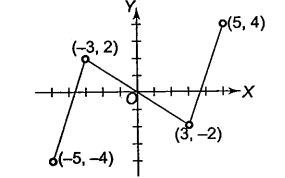
Since points \((-3,2)\) and \((5,4)\) lie on the curve, therefore \((3,-2)\) and \((-5,-4)\) will also lie on the curve. For minimum number of roots, graph of continuous function \(f(x)\) is as follows:
From the above graph of \(f(x)\), it is clear that equation \(f(x) =0\) has at least three real roots.
- Question 12 of 30
12. Question
Number of integral values of \(x\) for which the function
\(\sqrt{\sin x+\cos x}+\sqrt{7 x-x^2-6}\) is defined isHint
(d)
\(
\begin{aligned}
&\begin{aligned}
f(x) & =\sqrt{\sin x+\cos x}+\sqrt{7 x-x^2-6} \\
& =\sqrt{\sqrt{2} \sin \left(x+\frac{\pi}{4}\right)}+\sqrt{(x-6)(1-x)}
\end{aligned}\\
&\text { Now } f(x) \text { is defined if } \sin \left(x+\frac{\pi}{4}\right) \geq 0 \text { and }(x-6)(1-x) \geq 0
\end{aligned}
\)
\(
\begin{aligned}
&\begin{aligned}
& \Rightarrow 0 \leq x+\frac{\pi}{4} \leq \pi \text { or } 2 \pi \leq x+\frac{\pi}{4} \leq 3 \pi \text { and } 1 \leq x \leq 6 \\
& \Rightarrow-\frac{\pi}{4} \leq x \leq \frac{3 \pi}{4} \text { or } \frac{7 \pi}{4} \leq x \leq \frac{11 \pi}{4} \text { and } 1 \leq x \leq 6 \\
& \Rightarrow x \in\left[1, \frac{3 \pi}{4}\right] \cup\left[\frac{7 \pi}{4}, 6\right]
\end{aligned}\\
&\text { Integral values of } x \text { are } x=1,2 \text { and } 6
\end{aligned}
\) - Question 13 of 30
13. Question
Suppose that \(f\) is an even, periodic function with period 2, and that \(f(x)=x\) for all \(x\) in the interval \([0,1]\). The value of [ \(10 f(3.14)\) ] is (where [ \(\cdot\) ] represents the greatest integer function)
Hint
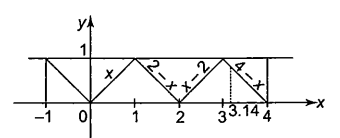
(b) Since \(f\) is periodic with period 2 and \(f(x)=x \quad \forall x \in[0,1]\) also \(f(x)\) is even
symmetry about \(y\)-axis
graph of \(f(x)\) is as shown
\(
f(3.14)=4-3.14=0.86
\) - Question 14 of 30
14. Question
If \(f(x)=\sqrt{4-x^2}+\sqrt{x^2-1}\), then the maximum value of \((f(x))^2\) is ____.
Hint
(a) Let \(x^2=4 \cos ^2 \theta+\sin ^2 \theta\)
then \(\left(4-x^2\right)=3 \sin ^2 \theta\) and \(\left(x^2-1\right)=3 \cos ^2 \theta\)
\(
\begin{aligned}
& f(x)=\sqrt{3}|\sin \theta|+\sqrt{3}|\cos \theta| \\
& y_{\min }=\sqrt{3} \text { and } \\
& y_{\max }=\sqrt{3}\left(\frac{1}{\sqrt{2}}+\frac{1}{\sqrt{2}}\right)=\sqrt{6}
\end{aligned}
\)
Hence range of \(f(x)\) is \([\sqrt{3}, \sqrt{6}]\)
Hence maximum value of \((f(x))^2\) is 6 - Question 15 of 30
15. Question
The function \(f(x)=\frac{x+1}{x^3+1}\) can be written as the sum of an even function \(g(x)\) and an odd function \(h(x)\). Then the value of \(|g(0)|\) is
Hint
(a)
\(
\begin{aligned}
g(x) & =\frac{f(x)+f(-x)}{2} \\
& =\frac{1}{2}\left[\frac{x+1}{x^3+1}+\frac{1-x}{1-x^3}\right] \\
& =\frac{1}{2}\left[\frac{1}{x^2-x+1}+\frac{1}{1+x+x^2}\right] \\
& =\frac{1}{2}\left[\frac{2\left(x^2+1\right)}{\left(x^2+1\right)^2-x^2}\right] \\
& =\frac{x^2+1}{x^4+x^2+1} \\
& =\frac{x^4-1}{x^6+1} \Rightarrow |g(0)|=1
\end{aligned}
\) - Question 16 of 30
16. Question
If \(T\) is the period of the function \(f(x)=[8 x+7]+\mid \tan 2 \pi x+ \cot 2 \pi x \mid-8 x\) (where \([\cdot]\) denotes the greatest integer function), then the value of \(1 / T\) is ____.
Hint
(c)
\(
\begin{aligned}
f(x) & =[8 x+7]+|\tan 2 \pi x+\cot 2 \pi x|-8 x \\
& =[8 x]-8 x-7+|\tan 2 \pi x+\cot 2 \pi x| \\
& =-\{8 x\}+|\tan 2 \pi x+\cot 2 \pi x|+7
\end{aligned}
\)
Period of \(\{8 x\}\) is \(1 / 8\)
Also, \(|\tan 2 \pi x+\cot 2 \pi x|\)
\(
=\left|\frac{\sin 2 \pi x}{\cos 2 \pi x}+\frac{\cos 2 \pi x}{\sin 2 \pi x}\right|=\left|\frac{1}{\sin 2 \pi x \cos 2 \pi x}\right|=|2 \operatorname{cosec} 4 \pi x|
\)
Now period of \(2 \operatorname{cosec} 4 \pi x\) is \(1 / 2\), then period of \(\mid 2 \operatorname{cosec} 4 \pi x\) | is \(1 / 4\)
Period is L.C.M. of \(\frac{1}{8}\) and \(\frac{1}{4}\) which is \(\frac{1}{4}\) - Question 17 of 30
17. Question
If \(a, b\) and \(c\) are non-zero rational numbers, then the sum of all the possible values of \(\frac{|a|}{a}+\frac{|b|}{b}+\frac{|c|}{c}\) is _____.
Hint
(a) Let \(x=\frac{|a|}{a}+\frac{|b|}{b}+\frac{|c|}{c}\)
If exactly one-ve, then \(x=1\)
Exactly two-ve, then \(x=-1\)
All three -ve , then \(x=-3\)
All three +ve , then \(x=3\)
Then the required sum is 0. - Question 18 of 30
18. Question
An even polynomial function \(f(x)\) satisfies a relation \(f(2 x)\left(1-f\left(\frac{1}{2 x}\right)\right)+f\left(16 x^2 y\right)=f(-2)-f(4 x y) \forall x, y \in R -\{0\}\) and \(f(4)=-255, f(0)=1\), then the value of \(|(f(2)+1) / 2|\) is ____.
Hint
(b) We have \(f(2 x)-f(2 x) f\left(\frac{1}{2 x}\right)+f\left(16 x^2 y\right)=f(-2)-f(4 x y)\)
Replacing \(y\) by \(\frac{1}{8 x^2}\), we get
\(
\begin{aligned}
& f(2 x)-f(2 x)\left(\frac{1}{2 x}\right)+f(2)=f(-2)-f\left(\frac{1}{2 x}\right) \\
& f(2 x)+f\left(\frac{1}{2 x}\right)=f(2 x) f\left(\frac{1}{2 x}\right) \quad[\text { As } f(x) \text { is even }] \\
& f(2 x)=1 \pm(2 x)^n \\
& f(x)=1 \pm x^n
\end{aligned}
\)
Now \(f(4)=1 \pm 4^n=-255 \quad\) (Given)
Taking negative sign, we get \(256=4^n \Rightarrow n=4\)
Hence \(f(x)=1-x^4\), which is an even function.
\(
f(2)=-15
\)
\(
|(f(2)+1) / 2|=7
\) - Question 19 of 30
19. Question
If \(f(x)=\sin ^2 x+\sin ^2\left(x+\frac{\pi}{3}\right)+\cos x \cos \left(x+\frac{\pi}{3}\right)\) and \(g\left(\frac{5}{4}\right)=1\) then \((g o f)(x)\) is _____.
Hint
(c)
\(
\begin{aligned}
& f(x)=\sin ^2 x+\sin ^2\left(x+\frac{\pi}{3}\right)+\cos x \cos \left(x+\frac{\pi}{3}\right) \\
& =\sin ^2 x+\frac{1}{4}(\sin x+\sqrt{3} \cos x)^2+\frac{1}{2} \cos x(\cos x-\sqrt{3} \sin x) \\
& =\frac{5}{4}\left(\sin ^2 x+\cos ^2 x\right)=\frac{5}{4} \\
& (g \circ f) x=g[f(x)]=g(5 / 4)=1
\end{aligned}
\) - Question 20 of 30
20. Question
Let \(E=\{1,2,3,4\}\) and \(F=\{1,2\}\). If \(N\) is number of onto functions from \(E\) to \(F\), then the value of \(N / 2\) is _____.
Hint
(a) From \(E\) to \(F\) we can define, in all, \(2 \times 2 \times 2 \times 2=16\) functions ( 2 options for each elements of \(E\) ) out of which 2 are into, when all the elements of \(E\) either map to 1 or to 2 \(\therefore\) Number of onto function \(=16-2=14\)
\(
N / 2=7
\) - Question 21 of 30
21. Question
The function \(f\) is continuous and has the property \(f(f(x)) =1-x\), then the value of \(f\left(\frac{1}{4}\right)+f\left(\frac{3}{4}\right)\) is _____.
Hint
(d)
\(
\begin{aligned}
& \text { Given } f(f(x))=-x+1 \\
& \text { replacing } x \rightarrow f(x) \\
& \qquad \begin{array}{r}
f(f(f(x)))=-f(x)+1 \\
f(1-x)=-f(x)+1 \\
f(x)+f(1-x)=1 \\
f\left(\frac{1}{4}\right)+f\left(\frac{3}{4}\right)=1
\end{array}
\end{aligned}
\) - Question 22 of 30
22. Question
Number of integral values of \(x\) satisfying the inequality
\(
\left(\frac{3}{4}\right)^{6 x+10-x^2}<\frac{27}{64}
\)Hint
\(
\begin{aligned}
& \text { (c) }\left(\frac{3}{4}\right)^{6 x+10-x^2}<\frac{27}{64} \\
& \Rightarrow 6 x+10-x^2>3 \\
& \therefore x^2-6 x-7<0 \\
& \therefore(x+1)(x-7)<0 \\
& \Rightarrow 0,1,2,3,4,5,6
\end{aligned}
\) - Question 23 of 30
23. Question
A function \(f\) from integers to integers is defined as \(f(x)= \left\{\begin{array}{l}\dot{n}+3, n \in \text { odd } \\ n / 2, n \in \text { even }\end{array}\right.\). Suppose \(k \in\) odd and \(f(f(f(k)))=27\), then the sum of digits of \(k\) is ____.
Hint
(a)
\(
\begin{aligned}
\because \quad k & \in \text { odd } \\
f(k) & =k+3 \\
f(f(k)) & =\frac{k+3}{2}
\end{aligned}
\)
If \(\frac{k+3}{2}\) is odd \(\Rightarrow 27=\frac{k+3}{2}+3 \Rightarrow k=45\) not possible \(\frac{k+3}{2}\) is even
\(
\begin{aligned}
& 27=f(f(f(k)))=f\left(\frac{k+3}{2}\right)=\frac{k+3}{4} \\
& k=105
\end{aligned}
\)
\(
\begin{array}{ll}
& \text { verifying } f(f(f(105)))=f(f(108))=f(54)=27 \\
\therefore & k=105
\end{array}
\) - Question 24 of 30
24. Question
If \(\theta\) be the fundamental period of function \(f(x)=\sin ^{99} x+ \sin ^{99}\left(x+\frac{2 \pi}{3}\right)+\sin ^{99}\left(x+\frac{4 \pi}{3}\right)\), then complex number \(z =|z|(\cos \theta+i \sin \theta)\) lies in the quadrant number.
Hint
(c) Clearly fundamental period is \(\frac{4 \pi}{3}\), then \(z\) lies in the third quadrant.
- Question 25 of 30
25. Question
If \(x=\frac{4}{9}\) satisfy the equation \(\log _a\left(x^2-x+2\right)>\log _a\left(-x^2+\right. 2 x+3\) ), then sum of all possible distinct values of \([x]\) is (where \([\cdot]\) represnts greatest integer function)
Hint
(d)
\(
\begin{aligned}
& \log _a\left(x^2-x+2\right)>\log _a\left(-x^2+2 x+3\right) \\
& \text { Put } x=\frac{4}{9}, \log _a\left(\frac{142}{81}\right)>\log _a\left(\frac{299}{81}\right) \\
& \frac{142}{81}<\frac{299}{81} \Rightarrow 0<a<1 \\
& \log _a\left(x^2-x+2\right)>\log _2\left(-x^2+2 x+3\right) \\
& \operatorname{gives}^2 0<x^2-x+2<-x^2+2 x+3 \\
& x^2-x+2>0 \text { and } 2 x^2-3 x-1<0 \\
& \frac{3-\sqrt{17}}{4}<x<\frac{3+\sqrt{17}}{4}
\end{aligned}
\) - Question 26 of 30
26. Question
If \(4^x-2^{x+2}+5+||b-1|-3|=|\sin y|, x, y, b \in R\), then the possible value of \(b\) is ____.
Hint
(c)
\(
\begin{aligned}
&\begin{aligned}
& \left(2^{2 x}-4 \cdot 2^x+4\right)+1+||b-1|-3|=|\sin y| \\
& \left(2^x-2\right)^2+1+||b-1|-3|=|\sin y| \\
& \left(2^x-2\right)^2+1+||b-1|-3|=|\sin y|
\end{aligned}\\
&\text { LHS } \geq 1 \text { and RHS } \leq 1\\
&\begin{aligned}
& 2^x=2,|b-1|-3=0 \\
& (b-1)= \pm 3 \\
& b=4,-2
\end{aligned}
\end{aligned}
\) - Question 27 of 30
27. Question
If \(f: N \rightarrow N\), and \(x_2>x_1 \Rightarrow f\left(x_2\right)>f\left(x_1\right), \forall x_1, x_2 \in N\) and \(f(f(n))=3 n, \forall n \in N\), then \(f(2)=\)
Hint
(d)
\(
\begin{aligned}
& f(3 n)=f(f(f(n)))=3 f(n), \forall n \in N \\
& \text { Put } n=1, f(3)=3 f(1) \\
& \text { If } f(1)=1, \text { then } f(f(1))=f(1)=1, \text { but } f(f(n))=3 n \\
& f(f(1))=3 \text { giving } 1=3 \text { which is absurd. } \\
& f(1) \neq 1 \\
& 3=f(f(1))>f(1)>1 \\
& \text { So } f(1)=2 \\
& f(2)=f(f(1))=3
\end{aligned}
\) - Question 28 of 30
28. Question
Number of integral values of \(a\) for which \(f(x)=\log \left(\log _{1 / 3}\right. \left.\left(\log _7(\sin x+a)\right)\right)\) be defined for every real value of \(x\)
Hint
(b)
\(
\begin{aligned}
& \log _{1 / 3} \log _7(\sin x+a)>0 \\
& 0<\log _7(\sin x+a)<1 \\
& 1<(\sin x+a)<7 \quad \forall x \in R[\text { ‘ } a \text { ‘ should be less than the } \\
& \text { minimum value of } 7-\sin x \text { and ‘ } a \text { ‘ must be greater than } \\
& \text { maximum value of } 1-\sin x] \\
& 1-\sin x<a<7-\sin x \forall x \in R \\
& 2<a<6
\end{aligned}
\) - Question 29 of 30
29. Question
Let \(f(x)=\sin ^{23} x-\cos ^{22} x\) and \(g(x)=1+\frac{1}{2} \tan ^{-1}|x|\), then the number of values of \(x\) in interval \([-10 \pi, 8 \pi]\) satisfying the equation \(f(x)=\operatorname{sgn}(g(x))\) is
Hint
(d)
\(
\begin{aligned}
& g(x)=\frac{1}{2} \tan ^{-1}|x|+1 \Rightarrow-\operatorname{sgn}(g(x))=1 \\
& \sin ^{23} x-\cos ^{22} x=1 \\
& \sin ^{23} x=1+\cos ^{22} x \text { which is possible if } \sin x=1 \text { and } \cos x=0 \\
& \sin x=1, x=2 n \pi+\frac{\pi}{2} \\
& \text { hence }-10 \pi \leq 2 n \pi+\frac{\pi}{2} \leq 8 \pi \Rightarrow-\frac{21}{4} \leq n \leq \frac{15}{4} \\
& -5 \leq n \leq 3 \\
& \text { Hence, number of values of } x=9
\end{aligned}
\) - Question 30 of 30
30. Question
Suppose that \(f(x)\) is a function of the form \(f(x) =\frac{a x^8+b x^6+c x^4+d x^2+15 x+1}{x}(x \neq 0)\). If \(f(5)=2\), then the value of \(|f(-5)| / 4\) is _____.
Hint
(a) \(f(x)=\frac{a x^8+b x^6+c x^4+d x^2+15 x+1}{x}\)
\(
=\underbrace{a x^7+b x^5+c x^3+d x+\frac{1}{x}}_{\text {odd function }}+15
\)
\(
\begin{aligned}
& \text { Now } f(x)+f(-x)=30 \\
\Rightarrow \quad & f(-5)=30-f(5)=28
\end{aligned}
\)
\(
|f(-5)| / 4=7
\)